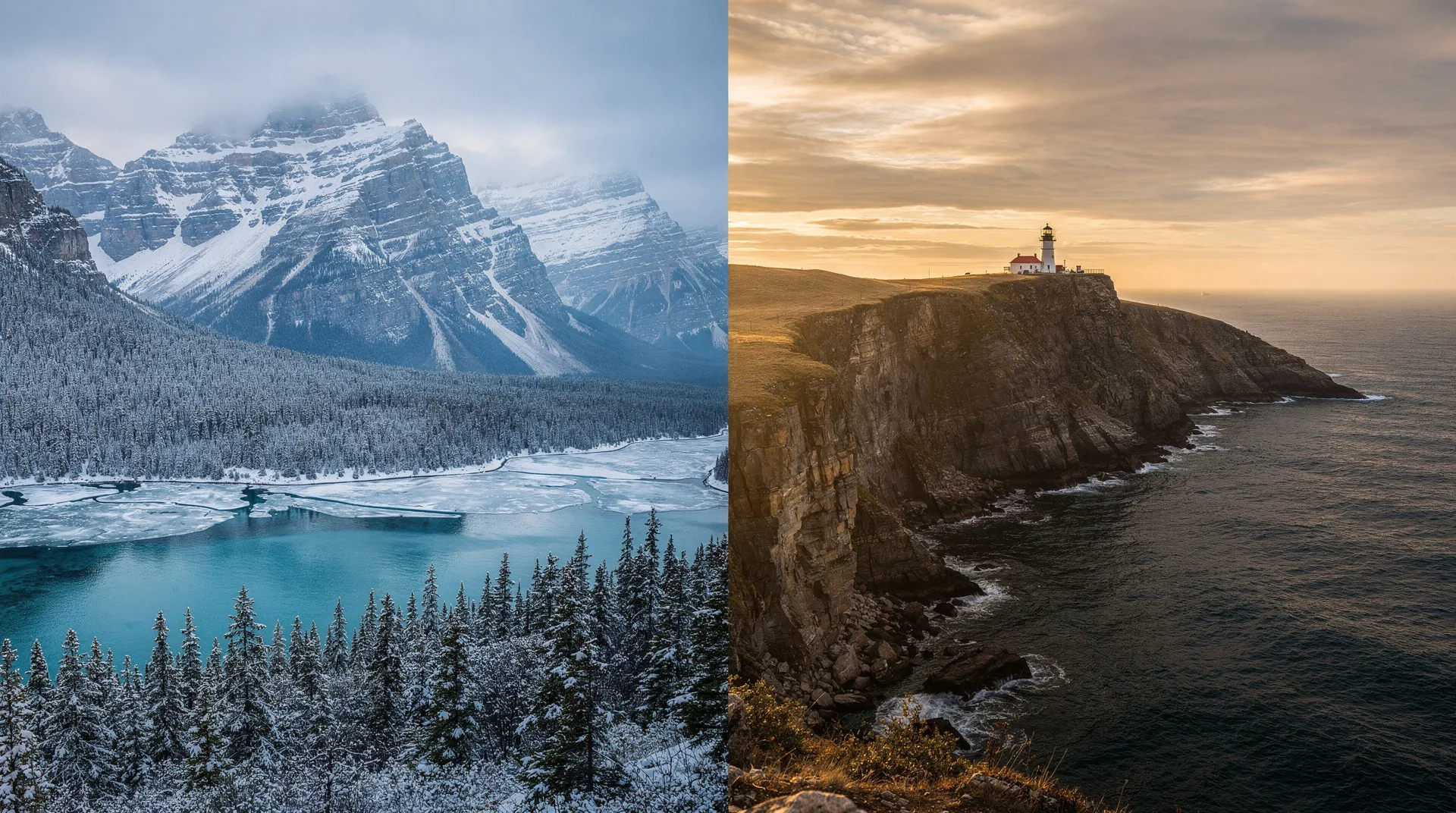
Canada vs USA: which for your first North American trip?
Should I visit Canada or the USA first?
Canada is generally easier, safer, and more welcoming for first-time international visitors — straightforward entry for most nationalities, universal healthcare context, and a culture that is globally approachable. The USA offers more variety and iconic landmarks but more complex logistics. For a first North America trip focused on nature and cities, Canada is the stronger choice.
North America is one destination for most international visitors — a continent, not a country. Yet Canada and the United States are genuinely different countries with different characters, different entry requirements, different costs, and very different travel experiences despite sharing the world’s longest land border.
For visitors planning their first North American trip, choosing between them — or deciding how to combine them — is one of the fundamental planning decisions. This guide addresses it honestly.
| At a glance | |
|---|---|
| Easier entry | Canada (eTA, ~50 visa-exempt countries) |
| Cheaper overall | Canada, modestly, for most categories |
| Bigger variety | USA |
| Best for first-timer with 1-2 weeks | Canada — coherent, focused itinerary |
| Combine both | Yes — Vancouver-Seattle or Toronto-Niagara-New York are easy add-ons |
The fundamental difference
The United States is larger (9.8 million km²), more varied, and home to the most globally recognized tourism icons on earth: New York City, the Grand Canyon, Las Vegas, the national parks of the Southwest, the Florida coast. It is a destination of superlatives that can be overwhelming in its scope.
Canada is the second-largest country on earth (9.98 million km²) but with one-tenth the population — roughly 40 million people across an enormous, mostly wild landscape. It offers world-class cities (Toronto, Vancouver, Montreal), unparalleled national park scenery (the Canadian Rockies), and a travel culture that is generally considered more relaxed and less commercialised than its southern neighbour.
Neither is objectively better. The right choice depends on what you want from the trip.
Visa and entry requirements
This is often the deciding factor before anything else.
Canada
Canada has an Electronic Travel Authorization (eTA) system for visa-exempt countries. Citizens of the EU, UK, Australia, Japan, and dozens of other countries pay CAD $7 for an eTA online, which is approved almost instantly and valid for 5 years. Americans do not need a visa or eTA — a valid passport (or even a passport card) is sufficient.
Canada has a reputation for consistent, professional border entry. The Canada Border Services Agency (CBSA) is considered among the more straightforward major border agencies for legitimate tourists.
United States
The US has a similar ESTA (Electronic System for Travel Authorization) for Visa Waiver Program countries — 42 countries at the time of writing. Citizens of those countries pay USD $21 for an ESTA valid for 2 years. Citizens of countries not on the Visa Waiver list require a US tourist visa (B-2 visa), which involves an application, documents, and in many cases an in-person interview at a US consulate. Processing times can run weeks to months.
The US visa process is more complex, more expensive, and less reliable in timing for nationals of many countries — including large travel markets like India, Brazil, and China. For visitors from those countries, Canada is dramatically easier to enter.
| Canada (eTA) | USA (ESTA) | |
|---|---|---|
| VWP/eTA countries | ~50 | 42 |
| Cost | CAD $7 | USD $21 |
| Validity | 5 years | 2 years |
| Processing | Usually instant | Usually instant |
| Non-VWP countries | Visa required (varies) | Visa required (often slower) |
Safety
Both countries are considered safe destinations for tourists by global standards.
Canada consistently ranks in the top 10–15 safest countries in the world in Global Peace Index rankings. Gun violence is a fraction of US levels (Canada has strict gun control legislation). The universal healthcare system means a tourist who has a medical emergency will be treated without facing immediate financial catastrophe.
The United States is a safe destination in most major tourist areas, but the variability is higher — some urban neighbourhoods and regions have elevated crime statistics, and the gun prevalence creates risks that simply don’t exist in Canada at the same level. The lack of universal healthcare means travel insurance is genuinely non-optional in the US in a way that it is prudent-but-not-critical in Canada.
Travel insurance is recommended in both countries but particularly critical in the US, where medical bills for emergencies can reach USD $100,000+ without coverage.
What each country does best
Canada’s strengths
National parks and wilderness: The Canadian Rockies (Banff, Jasper, Yoho, Kootenay) are among the most spectacular mountain landscapes on earth, and they are accessible, well-managed, and not overcrowded relative to many US national parks. The Pacific coast of British Columbia, Haida Gwaii, the Bay of Fundy, and Cape Breton offer coastal scenery with no US equivalent.
Skiing: Whistler Blackcomb and the Banff ski triangle are world-class ski destinations that compare favourably with the Alps in terrain quality, snow volume, and infrastructure.
Cities with a French dimension: Montreal and Quebec City offer something unique in North America — French-language culture, European urban design, and a food scene shaped by both French and North American traditions. No US city offers this.
Wildlife: Polar bears in Churchill, beluga whales, grizzly bears in the Rockies and BC coast, orca whales off Vancouver Island, and moose encounters in national parks are distinctly Canadian wildlife experiences.
Overall cost: Canada is modestly less expensive than major US destinations for accommodation and dining, and significantly less expensive than New York City or San Francisco equivalents.
USA’s strengths
Variety and scale: No country on earth packs more tourism variety into a single political unit than the United States — tropical beaches in Florida and Hawaii, desert Southwest scenery, Pacific coast, the Appalachian east, the Deep South, and New England. The range is extraordinary.
Iconic landmarks: The Statue of Liberty, the Grand Canyon, Times Square, the Golden Gate Bridge, Yellowstone, Yosemite — these landmarks have a global cultural penetration that Canada’s, while excellent, cannot quite match.
Major cities: New York City, Los Angeles, Chicago, San Francisco — the US has more globally recognizable major cities than any country except possibly the UK or China. For urban culture at the very highest level, the US competes with the world’s best.
Music and culture: New Orleans, Nashville, Memphis, New York — the US has unparalleled live music and popular culture heritage.
National parks of the Southwest: Zion, Bryce Canyon, Arches, Grand Canyon — these desert landscapes have no Canadian equivalent.
Cost comparison
Both countries are broadly comparable in cost for international visitors. Neither is a budget destination by global standards.
| Category | Canada | USA (major cities) |
|---|---|---|
| Mid-range hotel | CAD $180–$350 | USD $200–$400 |
| Casual meal | CAD $18–$28 | USD $18–$30 |
| Inter-city flight (2 hrs) | CAD $150–$350 | USD $150–$350 |
| National park day pass | CAD $12.25 | USD $35 (US parks) |
| Annual parks pass | CAD $83.50 (all Parks Canada) | USD $80 (America the Beautiful) |
The US national park pass (USD $80) covers all US federal recreation lands for 12 months. Canada’s Discovery Pass (CAD $83.50) covers all Parks Canada sites. Both are excellent value for visitors spending multiple days in parks.
Tipping culture is similar in both countries: 18–22% at restaurants, 15–20% for taxis and services. This is a significant add-on to meal and service costs that visitors from tip-less cultures sometimes underestimate.
Healthcare cost difference: Medical treatment costs 10–20x more in the US than in Canada for uninsured visitors. Travel insurance that covers medical evacuation is genuinely essential in the US and strongly recommended in Canada.
Combining both countries
Many first-time North American visitors combine Canada and the US in a single trip — the border crossing is easy (passport required), and crossing between the two countries feels like moving between regions of one large destination.
Common combinations:
- Vancouver (Canada) + Seattle (USA): 3-hour drive or Amtrak train
- Toronto (Canada) + Niagara Falls + Buffalo or New York: Easy extension southward
- Montreal (Canada) + Boston or New York: Day-trip or overnight distance
- Canadian Rockies + US Glacier National Park (Montana): Back-to-back mountain scenery
The Niagara Falls crossing is particularly popular — the falls straddle the border, and seeing both sides is straightforward (see our Niagara Falls Canada vs US side guide).
Choosing a Canadian region if you pick Canada
If Canada wins the decision, the next question is where. First-timers most often start with the Canadian Rockies for scenery, or a city-and-nature combination through Toronto and Niagara Falls. Those interested in French Canadian culture should weigh Montreal against Quebec City as a base. A first trip of 7-10 days rarely covers more than one region well — see how long to spend in Canada before committing to an itinerary, and check Canada in the season you’re travelling since shoulder-season conditions vary sharply by region.
Getting around
Both countries are large and require internal flights for most itineraries covering significant distance.
Canada: Good domestic air network (Air Canada, WestJet) but fewer budget carriers than the US. VIA Rail connects major eastern cities effectively. Western Canada requires a car or organized tours for national park access. Canada tours and guided experiences cover Rockies itineraries well.
USA: The most extensive domestic air network in the world, with multiple budget carriers (Southwest, Spirit, Frontier) keeping prices lower. Driving is the dominant mode for most tourism — the Interstate highway system is excellent. Amtrak rail serves the Northeast corridor effectively but is limited elsewhere.
Best for first-time North America visitors
Choose Canada if you:
- Are from a country that requires a US visa but qualifies for the Canadian eTA
- Want national park scenery as the core of your trip
- Are interested in French Canadian culture
- Value safety and low-stress border entry
- Want a ski resort destination (Whistler or Banff)
- Are interested in wildlife: bears, whales, polar bears
- Have 1–2 weeks and want a focused, coherent itinerary
Choose the USA if you:
- Want maximum variety across a single trip
- Have iconic US landmarks (Grand Canyon, NYC, Yellowstone) as top priorities
- Are a music or pop culture enthusiast
- Have more time (2–3+ weeks) to cover multiple regions
- Are already in an adjacent US city
Consider both if you:
- Have 2–3 weeks and want the complete North America experience
- Are flying into one country and can exit through the other
- Want to combine Canadian Rockies with US Southwest in a multi-week circuit
Our verdict
For most international first-time visitors to North America: Canada.
The reasons are practical and experiential. Canada is easier to enter for more nationalities. The national parks are outstanding and less overcrowded than equivalent US parks. The cities (Toronto, Vancouver, Montreal) are world-class and welcoming. The country is safe, the healthcare system provides a safety net, and the overall travel experience is more relaxed than the high-pressure pace of major US tourist destinations.
None of this means the USA is worse — it simply means that for a first visit, Canada delivers a coherent, high-quality experience with fewer friction points. The USA rewards visitors who already know which regions they want — it is too large and varied for a general “see America” first trip to work well.
See also: East vs West Canada, First time visitors guide, Visa requirements for Canada, Vancouver tours, Toronto tours.
Frequently asked questions about Canada vs USA: which for your first North American trip?
Is Canada cheaper than the USA for tourists?
Broadly comparable, but Canada is modestly cheaper in most categories. Major differences: US national park passes are more expensive per park (USD $35/day vs CAD $12.25 in Canada), and medical costs without insurance are dramatically higher in the US. Big US cities like New York and San Francisco are more expensive than comparable Canadian cities.
Do I need a visa to visit Canada?
Most nationalities from Europe, Australia, Japan, South Korea, and other developed countries qualify for the Canadian eTA (CAD $7, instant approval). US citizens need only a valid passport. A full list of visa-exempt and eTA-eligible countries is available on the Government of Canada website.
Is Canada safe for solo travellers?
Canada is consistently ranked among the safest countries in the world for solo travellers, including solo women. Major cities have low violent crime rates compared to their US equivalents, and the national parks system is well-managed with good infrastructure.
Which country has better national parks?
This is subjective, but Canada’s national parks are arguably less crowded, more affordable to access, and equally spectacular to the best US parks. The Canadian Rockies (Banff, Jasper) are world-class. The US has more variety — desert, tropical (Hawaii), and temperate environments — but many US parks suffer from severe overcrowding in summer that Canada’s parks manage better.
Can I visit both Canada and the USA on one trip?
Yes, and it is very common. The border crossing requires a valid passport (and ESTA or US visa for the US, or eTA for Canada). Popular combinations include Vancouver-Seattle, Toronto-Niagara Falls-New York, and Montreal-New England. Border crossing times vary; land borders are slower than air crossings.
What is the best time to visit Canada for a first trip?
June through September for most destinations — the national parks are accessible, the cities are active, and the weather is cooperative. October for fall foliage (particularly Quebec and Ontario). Winter for skiing (Whistler, Banff) or aurora/polar bear experiences. See our best time to visit Canada guide for a detailed seasonal breakdown.
Do I need travel insurance for a first trip to Canada or the USA?
Yes for both, but it’s more critical in the USA given far higher uninsured medical costs. Canada’s healthcare is also not free for visitors, so insurance is strongly recommended there too. See our Canada travel insurance guide for coverage levels and cost ranges.
Is it easy to combine a Rockies trip with a US national park like Yellowstone?
Reasonably, if you have 2-3 weeks. The Canadian Rockies and US Glacier National Park in Montana sit close together, making a back-to-back mountain-scenery itinerary practical for travellers with enough time and a rental car.