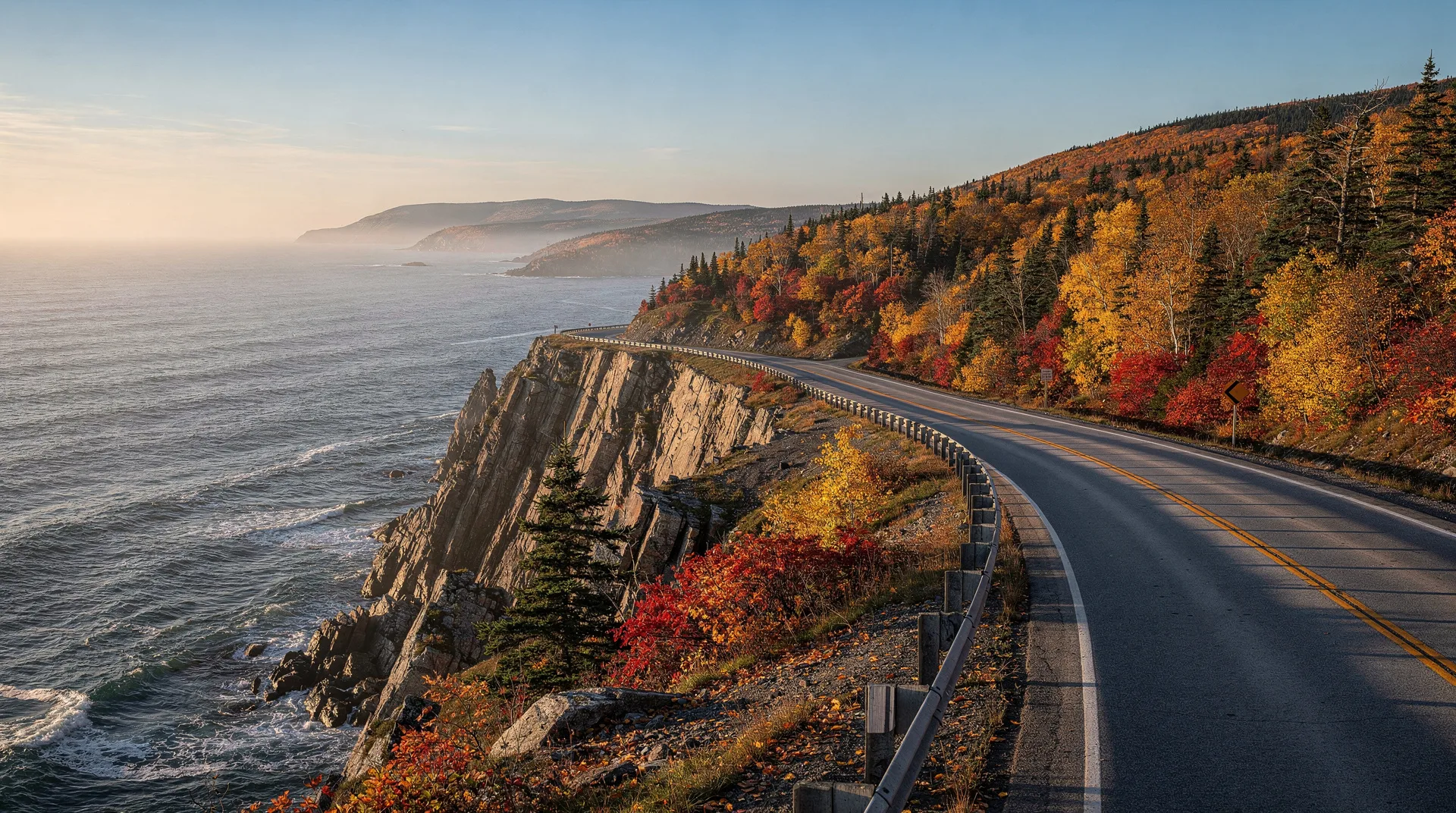
Cabot Trail vs Gaspé Peninsula: which coastal drive to choose?
Is the Cabot Trail or the Gaspé Peninsula better?
The Cabot Trail wins for concentrated highland coastal drama, Acadian culture, and whale watching (pilot whales reliably at Pleasant Bay). The Gaspé wins for length, variety, Percé Rock, and the combination of Quebec culture with dramatic coastline. If you have one week, do the Cabot Trail; if you have two, consider both.
Both are consistently listed among the finest coastal drives in North America. Both combine dramatic cliff scenery with ocean views, wildlife watching, and cultural distinctiveness. Both require a road trip approach. But the Cabot Trail in Cape Breton, Nova Scotia and the Gaspé Peninsula in Quebec are genuinely different experiences, and understanding those differences helps enormously in choosing between them — or in deciding you need to do both.
This guide breaks down the comparison across the dimensions that matter most: scenery, length and logistics, wildlife, culture, food, accommodation, and the type of traveller who will prefer each.
At a glance
| Cabot Trail | Gaspé Peninsula | |
|---|---|---|
| Where | Cape Breton Island, Nova Scotia | Gaspé Peninsula, Quebec |
| Length | 298 km loop | Around 900 km around the peninsula, ~2,000 km round trip from Quebec City |
| Time needed | 3 days minimum, 4-5 comfortable | 6-7 days minimum, 8-10 comfortable |
| Getting there | Fly to Halifax or Sydney | Fly to Quebec City, or drive from Montreal |
| Best time | June to late October, peak July-August | June to September, peak July-August |
Quick comparison table
| Category | Cabot Trail | Gaspé Peninsula |
|---|---|---|
| Cliff-edge scenery | Winner | — |
| Variety and length | — | Winner |
| Autumn colour | Slight edge | Close second |
| Whale variety | — | Winner (belugas, blues near Tadoussac) |
| Reliable pilot whales | Winner | — |
| Seabirds (gannets) | — | Winner |
| Food and drink | — | Winner |
| Accessibility from abroad | Winner | — |
| Accommodation ease | — | Winner |
The routes: what you’re actually driving
The Cabot Trail
The Cabot Trail is a 298-km loop road around the northern tip of Cape Breton Island, Nova Scotia. It is a circuit — you start and finish in the same place (typically Baddeck) and can drive it in either direction. The driving time for the full loop without stops is about 4.5 hours; doing it properly requires 2-3 nights.
The route is almost entirely coastal or highland — the Cape Breton Highlands National Park occupies the centre and northern portion of the loop, with the western coast above the Gulf of St. Lawrence and the eastern coast above the Atlantic. The total elevation gain is significant; the road climbs to over 450 metres on the highland sections and descends dramatically to sea level on both coasts.
Key features: Cape Breton Highlands National Park (950 km²), the Skyline Trail hike, Cheticamp (Acadian village), whale watching at Pleasant Bay, autumn foliage, Acadian and Celtic culture.
The Gaspé Peninsula
The Gaspésie route is not a single loop road but a circuit of the entire Gaspé Peninsula in Quebec — roughly 900 km if driven around the peninsula’s perimeter, longer if inland detours are included. The classic circuit departs Québec City or Rivière-du-Loup, follows the south shore of the St. Lawrence River, rounds the tip of the peninsula at Forillon National Park, and returns via the Bay of Chaleur and inland routes.
The driving time for the full circuit from Québec City and back is a minimum of 6-7 days; most visitors allow 8-10 days.
Key features: Percé Rock and Bonaventure Island (the world’s most accessible northern gannet colony), Forillon National Park, the Parc National de la Gaspésie (with Chic-Choc Mountains reaching 1,300 metres), whale watching in the St. Lawrence (blue whales possible), and Québécois culture throughout.
Scenery: side by side
Drama and concentration
The Cabot Trail wins for concentrated drama — a smaller geography packed with extraordinarily intense scenery. The western cliff section between Cheticamp and Pleasant Bay, where the road cuts along cliff edges above the Gulf of St. Lawrence with the Cape Breton Highlands rising immediately behind, is one of the most visually intense driving experiences in North America. The Skyline Trail headland at 430 metres above the water is unforgettable.
The Gaspé Peninsula offers more varied scenery — the St. Lawrence shore is magnificent but wide and less intimate than the Cabot Trail cliffs. The headland at Cap Gaspé in Forillon National Park and the sections of the Chic-Choc Mountains visible from the road are spectacular, but the overall scenery is more episodic than continuously dramatic.
Winner for pure cliff-edge drama: Cabot Trail.
Variety and length
The Gaspé Peninsula’s longer circuit encompasses more variety: fishing villages of the south St. Lawrence shore, the dramatic headland at Forillon, Percé Rock (one of the most extraordinary rock formations in North America — a 500-metre sea arch accessible on foot at low tide), and the Bonaventure Island gannet colony. The diversity of landscape types is greater.
Winner for variety and length: Gaspé Peninsula.
Autumn foliage
Both are spectacular in autumn. Cape Breton’s hardwood forest on the highlands produces exceptional colour in October — the combination of highland elevation change and coastal backdrop is hard to match. The Gaspésie has the Chic-Choc Mountains and inland hardwood forests that also produce excellent autumn colour.
Winner for autumn colour: Very close; slight edge to Cabot Trail for the coastal-highland combination.
Wildlife
Whale watching
Both offer excellent whale watching, but the species differ significantly.
Cabot Trail (Pleasant Bay): Pilot whales are the signature species — pods of 30-50+ animals are reliably present from June through October. Minkes and occasional humpbacks are also seen. The tours are small-scale and intimate.
Gaspé Peninsula (St. Lawrence): The St. Lawrence estuary is one of the best whale watching areas in the world for species diversity. Belugas (year-round), minkes, fins, humpbacks, and — rarely but regularly — blue whales are all present. Tadoussac, at the mouth of the Saguenay Fjord (accessible from the Gaspé circuit), is the world-class blue whale destination. For species diversity, the St. Lawrence is superior.
Winner for whale variety: Gaspé Peninsula (St. Lawrence).
Winner for reliable pilot whale encounters: Cabot Trail.
Seabirds
The Gaspé Peninsula hosts Bonaventure Island — a gannet colony of approximately 60,000 pairs, accessible by boat from Percé. This is one of the largest and most accessible gannet colonies in the world. The Cabot Trail has good seabirds but nothing comparable to Bonaventure.
Winner for seabirds: Gaspé Peninsula.
Moose
Both have large moose populations. Cape Breton Highlands National Park may have the highest moose density in Nova Scotia, and the Skyline Trail barrens almost always produce sightings. The Gaspésie also has good moose populations, particularly in the park’s interior.
Winner for moose: Roughly equal; slight edge to Cape Breton for accessible viewing.
Browse Cape Breton tours and Cabot Trail experiencesCulture
Acadian and Celtic culture on the Cabot Trail
Cheticamp is one of the finest surviving examples of Acadian culture in Nova Scotia — French-speaking, with its own cuisine, music, and craft traditions (particularly hooked-rug making). The broader Cape Breton island has a living Celtic Scottish heritage: Gaelic is still spoken in some communities, Celtic music permeates the pub scene, and the Cape Breton fiddle tradition is internationally recognised.
The Red Shoe Pub in Mabou (south Cape Breton) for live Celtic music, and the Cheticamp hooked-rug cooperative, are genuinely distinctive cultural experiences.
Quebec culture on the Gaspésie
The Gaspé Peninsula is entirely Québécois — French-speaking, Catholic in heritage, with the fishing village culture of the St. Lawrence shore and the Madeleine Islands visual aesthetic (brightly painted wooden houses, enormous churches, communal village squares). Eating in Gaspésie is eating in Quebec: poutine, tourtière, smoked meat, and a very good regional wine and cheese scene.
Winner for distinctive culture: Both are excellent; the choice depends on whether Celtic-Acadian or Québécois culture interests you more.
Indigenous history
The Mi’kmaq Nation has deep roots in Cape Breton, and several interpretive programs connect the Cabot Trail experience to Mi’kmaq cultural history. The Gaspé Peninsula also has significant Indigenous history — the name “Gaspé” is derived from the Mi’kmaq word “Gespeg” (land’s end), and the initial meeting between Jacques Cartier and the Iroquoian peoples in 1534 occurred here.
Food and drink
Cabot Trail
Seafood is the draw — fresh Atlantic lobster, snow crab, clams, and local mussels are widely available. The Acadian cuisine in Cheticamp (rappie pie, fricot) is distinctive. The Rusty Anchor Restaurant in Pleasant Bay is perennially praised; the Red Shoe Pub in Mabou for atmosphere and local music. The food is reliably good but the restaurant density is lower than Quebec.
Gaspé Peninsula
Quebec’s food culture is generally superior in sophistication and density of excellent options. The Gaspésie adds excellent local seafood (shrimp from the gulf, cod, crab) to the broader Quebec food tradition. The regional cheese scene (particularly around the south St. Lawrence communities) is excellent.
Winner for food: Gaspé Peninsula, by virtue of Quebec’s food culture.
Accessibility and logistics
Getting to the Cabot Trail
Fly to Halifax (major international airport) or Sydney, Cape Breton (regional airport with Halifax and Toronto connections). Drive to Baddeck from Halifax (4 hours) or take a shorter scenic drive from Sydney. The Cabot Trail loop itself is 298 km.
Getting to the Gaspé Peninsula
Fly to Québec City (good connections) or drive from Montreal (6-7 hours to reach the St. Lawrence south shore). The full Gaspé circuit from Québec City and back is approximately 2,000 km total.
Winner for accessibility from Toronto/international: Cabot Trail — Halifax is better connected internationally than Québec City and the drive is far shorter.
Winner if already in Quebec: Gaspé Peninsula — no flights required.
Accommodation
Cabot Trail
Concentrated in Baddeck, Cheticamp, and Ingonish. Limited options in the national park sections. The Keltic Lodge at Ingonish is the most celebrated accommodation on the trail. Book early — particularly the Keltic Lodge and small inns in Ingonish, which fill months ahead for July-October.
Gaspé Peninsula
More accommodation spread across a longer route. Percé (the town opposite Percé Rock) has good options; Forillon and the south shore communities have small inns and gîtes throughout. Somewhat easier to find last-minute accommodation than on the Cabot Trail.
Winner for accommodation ease: Gaspé Peninsula.
Browse Nova Scotia tours and Cape Breton experiencesWho should choose which?
Choose the Cabot Trail if:
- You have 3-5 days and want maximum drama per kilometre
- You prioritise hiking (the Skyline Trail, Franey Trail) over driving variety
- You want pilot whale watching reliably incorporated
- You are flying into Halifax or Sydney
- You want to integrate with a broader Atlantic Canada tour (see our 7-day Atlantic Canada itinerary)
Choose the Gaspé Peninsula if:
- You have at least 8 days available
- You want Percé Rock and the Bonaventure Island gannet colony
- Blue whale watching in the St. Lawrence is a priority
- You are based in or visiting Quebec
- You want the most varied and longest coastal driving circuit in eastern Canada
Do both if: You have 3 weeks, are doing a full eastern Canada road trip, and want to see the finest that two of the country’s most spectacular coastal regions offer.
The 14-day Atlantic Canada road trip covers the Cabot Trail as part of a broader circuit; a Gaspésie extension could be added before or after.
Budgeting and planning ahead
Cost per day is broadly comparable once flights are excluded, but total trip cost differs sharply because of length: a 3-day Cabot Trail loop is a much smaller commitment in both time and money than an 8-10 day Gaspé circuit. If budget is the deciding factor, the Cabot Trail combined with the Cape Breton 5-day itinerary is the more affordable option for most international visitors, while the Gaspésie loop 7-day itinerary makes sense if you’re already in Quebec and don’t need flights.
Whale watching deserves special planning attention on both routes. Cabot Trail pilot-whale tours from Pleasant Bay run reliably June through October with little advance booking needed outside peak weeks. On the Gaspé side, the best blue-whale odds are further along the St. Lawrence near Tadoussac, rather than on the peninsula itself — the Quebec whale watching guide covers timing and species by location in detail. Seabird enthusiasts heading to Bonaventure Island should also budget for the boat crossing from Percé, which can be weather-dependent.
Frequently asked questions about Cabot Trail vs Gaspé Peninsula: which coastal drive to choose?
Can I do both the Cabot Trail and Gaspé on the same trip?
Yes, with 3+ weeks. A logical routing: fly into Halifax, do the Cabot Trail (3-4 days), continue Atlantic Canada (PEI, NB), drive through Amherst to Quebec, and do the Gaspé circuit. Or the reverse.
Which is better for autumn foliage?
Both are spectacular. Cape Breton’s October colour is extraordinary in the Margaree Valley and on the highland plateau. Gaspésie has the Chic-Choc Mountains and the south shore hardwood forests. Peak colour is typically mid-October in both areas.
Which is more suitable for an RV?
The Cabot Trail has some steep switchback sections that require careful driving in larger RVs. The Gaspé circuit’s highways are generally wider and more RV-friendly. Both have good campgrounds. The Cabot Trail’s narrower highland sections should be driven slowly in RVs over 8 metres.
Is either route suitable for cycling?
The Cabot Trail is cycled by a small but enthusiastic community; it is challenging (significant elevation, some narrow sections with traffic) but the scenery rewards the effort. The Gaspé circuit’s longer, flatter south shore sections are more beginner-friendly for cycling.
Which route is better for a shorter trip of 5 days or less?
The Cabot Trail. Five days gives a relaxed pace with time for the Skyline Trail and whale watching, plus a day of buffer for weather or travel. The Gaspé circuit needs at least 6-7 days just for the driving and key stops, so it’s a poor fit for a short trip.
Do I need a car for either route?
Yes, for both. There is no practical public transit that covers either loop; both are self-drive (or organised small-group tour) routes by design.