Bear watching in Canada: grizzlies, black bears, and the Great Bear Rainforest
Where is the best place to see grizzly bears in Canada?
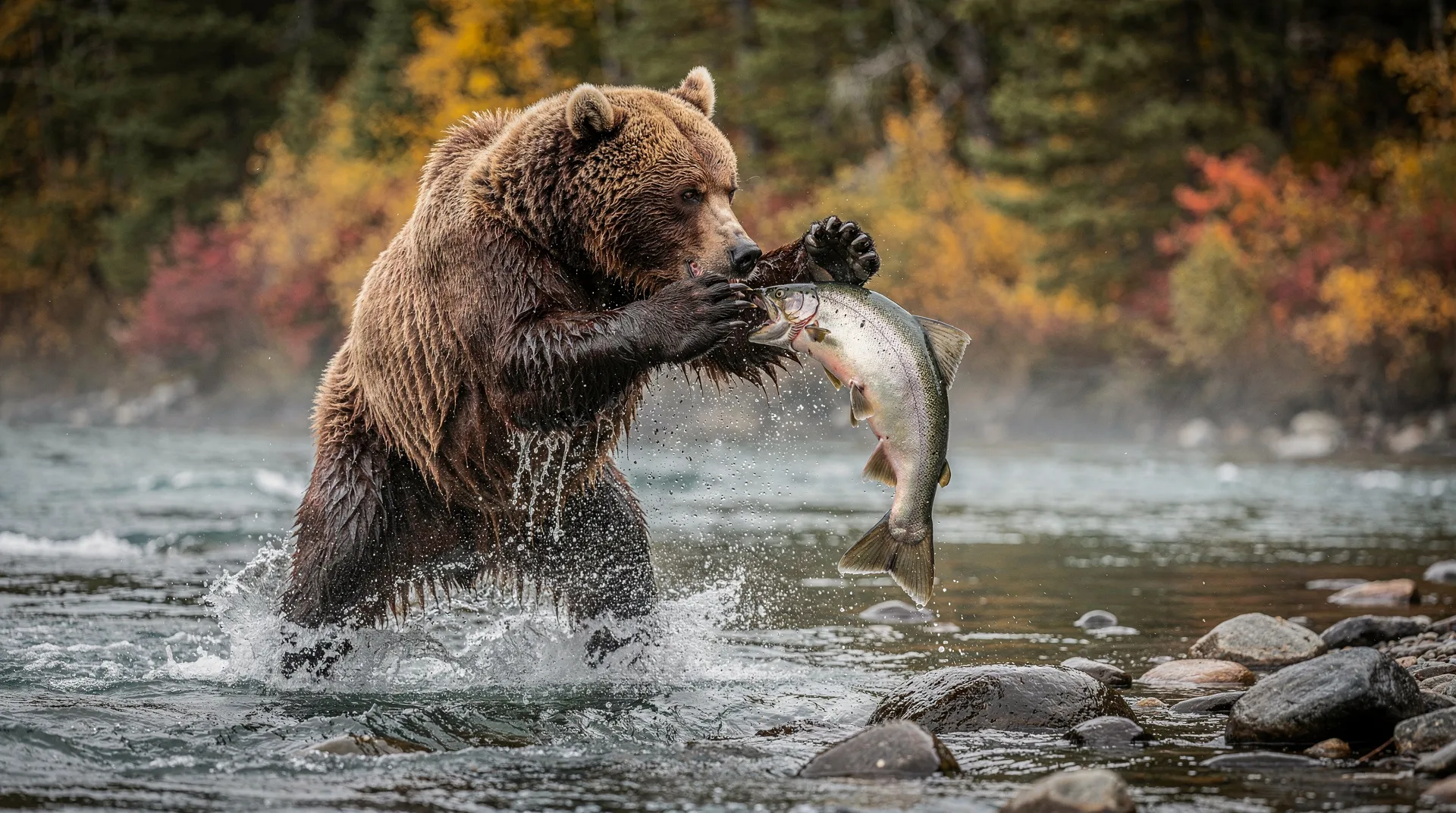
The Great Bear Rainforest on BC's central coast, particularly Knight Inlet and the Khutzeymateen Grizzly Bear Sanctuary near Prince Rupert, offers the most reliable and up-close grizzly bear viewing in the world. The salmon run season (August–October) concentrates bears at spawning streams, making sightings nearly guaranteed on guided trips.
Canada is home to the world’s largest populations of both grizzly bears and black bears. The grizzly bear — larger, slower-reproducing, and requiring vast wilderness ranges — is concentrated in British Columbia, the Yukon, Northwest Territories, and Alberta’s mountain parks. The black bear, smaller and more adaptable, inhabits forests from Newfoundland to Vancouver Island and from the 49th parallel to the edge of the boreal forest. Seeing either species in the wild is one of the most viscerally powerful experiences Canada’s wildlife can provide.
The best bear viewing in the world is not in Yellowstone or Alaska. It is in British Columbia’s coastal river systems during the Pacific salmon run, where grizzly bears congregate at spawning streams in densities that can put dozens of bears in view simultaneously — fishing, sparring, nursing cubs, and occasionally standing within metres of small viewing platforms while completely absorbed in the seasonal abundance around them. Understanding where and when this happens, and how to access it safely, is the foundation of bear-watching in Canada.
| At a glance | Details |
|---|---|
| Where | Great Bear Rainforest (Knight Inlet, Khutzeymateen) for grizzlies; Banff/Jasper roadsides and Hyder/Stewart for black bears |
| Cost | Around CAD 1,800-3,200/person for a multi-night lodge-based grizzly trip; free at the Fish Creek platform near Hyder |
| Time needed | 2-5 nights for a proper coastal lodge experience; a few hours for roadside black bear viewing in the Rockies |
| Getting there | Float plane or boat from Campbell River or Prince Rupert for coastal grizzly lodges; self-drive for Banff/Jasper and Hyder/Stewart |
| Best time | August-October for the salmon run (peak bear activity); May-June for spring bears with cubs |
Grizzly bears: ecology and distribution
Where grizzlies live in Canada
Canada’s grizzly bear population is estimated at 26,000 animals, with approximately 16,000 in British Columbia alone. The remaining population is divided among Alberta (~1,000, primarily in the mountain national parks and adjacent provincial parks), the Yukon (~7,000), and the Northwest Territories and Nunavut. The animals require large, intact wilderness — a single adult male grizzly may range over 1,000 square kilometres.
The coastal grizzlies of BC’s central and north coasts are genetically and behaviourally distinct from interior populations. They have access to an extraordinarily rich diet during the salmon run — a single sockeye salmon contains roughly 5,000 calories, and a bear gorging on salmon during hyperphagia (pre-hibernation eating) can consume 20,000 calories per day. This food abundance produces bears that are notably larger than interior animals; coastal grizzlies regularly reach 500 kg.
Great Bear Rainforest
The Great Bear Rainforest covers 6.4 million hectares of BC’s central and north coast — one of the largest intact temperate rainforest ecosystems on Earth. It extends from roughly the Bute Inlet (north of Powell River) to the Alaska border and encompasses thousands of river systems, inlets, and islands. The name refers to both the physical forest and the formal provincial designation that now protects approximately 85% of the area from industrial logging.
The Great Bear Rainforest is home to the Kermode or “spirit bear” — a white-coated black bear that is not an albino but carries a recessive gene producing cream-coloured fur. Spirit bears are found primarily on Princess Royal Island and Gribbell Island. The white colouration may confer a fishing advantage — spirit bears are observed catching more salmon than black-furred bears in the same streams, possibly because fish can’t see the white fur against the overcast sky. Seeing a spirit bear requires a dedicated expedition to the central coast.
Top bear-watching locations in BC
Knight Inlet
Knight Inlet, a 100-km fjord cutting into BC’s central coast east of Campbell River, is the most accessible major grizzly bear viewing destination on the BC coast. Several lodges operate specifically for bear viewing and are positioned at the river mouths where grizzlies concentrate during the pink and chum salmon runs (August–October).
Grizzly Bear Lodge at the mouth of the Glendale River has been operating bear-watching programs since the early 1990s. Their bear-watching platforms, positioned within a few metres of active fishing bears, are considered among the most reliable close-encounter facilities for grizzlies anywhere in the world. Bears have habituated to the fixed platforms over decades of non-intrusive observation.
Access to Knight Inlet lodges is by float plane or boat from Campbell River. Most visits are structured as 2–5 night stays with bear viewing as the primary daily activity.
Khutzeymateen Grizzly Bear Sanctuary
The Khutzeymateen (“valley of the grizzlies”) is a 44,000-hectare provincial park northeast of Prince Rupert, established in 1994 as Canada’s first grizzly bear sanctuary. It protects approximately 50–70 grizzly bears in a river valley and estuary that is closed to human habitation except for a small number of permitted tour operators.
Access is by boat or float plane from Prince Rupert. Spring viewing (May–June) captures bears emerging from dens and foraging in the estuary grass. Fall viewing (August–October) is focused on the salmon run. The sanctuary’s strict access controls mean viewing is genuinely on the bears’ terms, and the habituated individuals are visible at remarkably close range.
Ocean Light II Adventures and Khutzeymateen Grizzly Bear Tour are among the licensed operators providing guided expeditions to the sanctuary.
Tweedsmuir Provincial Park
Tweedsmuir, BC’s largest provincial park at 989,000 hectares, provides interior grizzly bear viewing in a less coastal context. Bears are present throughout the park but most concentrated along the Atnarko and Bella Coola rivers during the salmon run. The small community of Bella Coola in the park’s southern section is a base for bear-watching trips. Tweedsmuir Park Lodge offers guided float trips and bear viewing programs.
Toba Inlet and Bute Inlet
For visitors based in Vancouver, Toba Inlet and the northern reach of Bute Inlet are the nearest locations for grizzly bear viewing. These fjords are accessible by float plane from Vancouver (approximately 1 hour) or by scheduled float plane from Campbell River. Several operators run day and overnight bear-watching programs in this corridor.
Explore Vancouver-based wildlife tours including grizzly bear trips on GetYourGuide.
If a Vancouver-based trip appeals but you want a wider wildlife picture, the grizzly bear viewing guide goes deeper on the coastal operators, and the Great Bear Rainforest destination page sets the scene for the whole region. Travellers heading further north can pair a bear trip with the Prince Rupert destination page, the usual gateway to the Khutzeymateen.
Black bear watching
Where to see black bears in Canada
Black bears are far more numerous than grizzlies — Canada’s population is estimated at 500,000 animals. They are found in every province and territory except Prince Edward Island. For pure viewing frequency, the national parks of the Rocky Mountains are the most reliable locations: Banff, Jasper, and Kootenay national parks have well-habituated black bear populations that forage in the roadside vegetation, particularly on the Bow Valley Parkway in Banff and along Highway 93 in Jasper.
Black bear viewing in the Rockies is common enough that Parks Canada operates bear jams — traffic stops caused by bears at the roadside — as a routine situation. Viewing from a vehicle at a bear jam is the most common wildlife encounter in Banff and Jasper. Seeing bears at salmon-spawning streams (as in the Great Bear Rainforest context) requires heading to specific river systems where salmon runs occur.
Hyder, Alaska / Stewart, BC
The remote border town of Hyder, Alaska (accessible via Stewart, BC) has gained international fame for the Fish Creek bear-viewing platform, where both black bears and grizzly bears congregate to fish for chum and pink salmon in late July through September. The platform is open to the public at no charge and is managed by the US Forest Service. Seeing grizzlies and black bears fishing simultaneously in the same small stream is routine in peak season.
For visitors willing to make the 5-hour drive north from Prince Rupert, Hyder/Stewart is one of the most accessible concentrations of salmon-fishing bears anywhere. The area also regularly produces black bears on the road between Hyder and the viewing platform.
Vancouver Island and coastal BC
Vancouver Island’s black bear population is estimated at 7,000–8,000 animals. They are frequently encountered on the Island’s logging roads in spring and summer. Viewing from a vehicle is common; guided bear-viewing tours operate from Campbell River, Tofino, and other coastal communities.
Find guided Vancouver Island wildlife and bear-watching tours on GetYourGuide.
Black bears are also part of the wider picture in the Canadian wildlife guide, and the Alberta wildlife watching guide covers what else you may spot from the roadside in the Rockies, including the habits of animals that share bear country.
Best time of year for bear viewing
Spring (May–June): Bears emerge from dens lean and hungry, foraging on early vegetation in meadows and estuary grass. Spring cubs are visible. Coastal spring viewing (Khutzeymateen) is excellent for seeing bears behaving naturally without salmon-run competition.
Late summer (July–August): Salmon begin arriving in BC’s coastal rivers in July (sockeye) and peak in August (pink and chum). Bears concentrate at fishing streams at their most active and well-fed. Knight Inlet and other coastal lodges begin their main season.
Fall (September–October): The peak of bear-watching season. Salmon runs are at maximum volume, bears are in hyperphagia, and the combination of large well-fed bears, salmon in every stream, and autumn light makes this the most visually spectacular bear-watching period. Book 3–6 months ahead for fall slots.
Rockies black bears (April–October): Black bears in the Rocky Mountain national parks are active from snowmelt in April through the onset of denning in October or November. Spring and fall offer more roadside activity as bears forage in lower elevation vegetation.
Guided tours vs. self-guided viewing
Why guided tours are strongly recommended
Bears at Knight Inlet and the Khutzeymateen are habituated to fixed viewing platforms and experienced guides. Attempting to reach these areas independently — even if theoretically possible by private boat — would put you in unfamiliar territory with bears that are unpredictable to anyone who doesn’t know their individual behaviour. The lodge guides know the specific bears by name, understand their hierarchy and current mood, and manage the viewing experience to maximise both safety and quality.
For roadside black bear viewing in Banff and Jasper, self-guided viewing from your vehicle is safe and standard practice. For any situation involving approaching bears on foot or in wilderness settings, a guide is strongly recommended.
What to expect on a guided bear-watching tour
Day 1 typically involves orientation, float plane or boat transfer to the viewing area, and an afternoon bear-watching session. Days 2–4 at lodge-based operations involve morning and evening viewing sessions (bears are most active at dawn and dusk), meals, and interpretation by the resident naturalist. The best lodges provide as much time as the bears offer — sometimes 4–6 hours of viewing per day during peak salmon runs.
Safety and ethical guidelines
The rules below are the essentials. For a broader look at how to behave around large animals anywhere in the country, read the Canada wildlife safety guide. If your plans include hiking in the mountains, the Jasper hikes overview and the Banff National Park guide are good places to check which trails call for extra care in bear country.
Distance rules: In Canadian national parks, the mandatory minimum distance from black bears is 30 metres; from grizzly bears it is 100 metres. In BC provincial parks, similar guidelines apply. These minimums exist because a charging bear covers 100 metres in under 4 seconds.
In bear country (hiking):
- Travel in groups of 3 or more when possible — attacks on groups are extremely rare
- Make noise continuously: talk, clap, call out at blind corners
- Carry and know how to use bear spray — it is effective at ranges of 6–9 metres; firearms are not reliably more effective
- Store food in bear-proof canisters or hang it; never leave food in tents
Vehicle encounters:
- Stay in your vehicle or remain at least 30 metres away on foot
- Do not feed bears — it is illegal in national parks and teaches bears to approach roads
- Report unusual bear behaviour to park wardens
Bear spray: Carried by all serious wilderness travellers in grizzly country. Bear spray is a pressurized capsaicin deterrent that creates a cloud the attacking bear must pass through. It is statistically more effective at stopping charges than a rifle. Available at all outdoor gear shops in Banff, Jasper, Squamish, and other gateway towns.
Costs in Canadian dollars
Knight Inlet 3-night bear-viewing package (lodge): CAD 2,400–3,200 per person, including accommodation, meals, and float plane transfer Khutzeymateen 2-night guided boat expedition: CAD 1,800–2,500 per person Hyder/Stewart Fish Creek (public viewing platform): Free Toba Inlet day trip from Vancouver: CAD 750–1,000 per person Jasper or Banff guided wildlife safari (black bears, 4–6 hours): CAD 95–150 per person Bear spray purchase: CAD 50–75
Where to stay for bear watching
Knight Inlet: The bear-viewing lodges (Grizzly Bear Lodge, Knight Inlet Lodge) are the accommodation — all packages include lodging and meals.
Khutzeymateen/Prince Rupert: Prince Rupert is the gateway city, with hotels ranging from budget motels to comfortable mid-range properties. Eagle Bluff B&B is popular with wildlife visitors.
Stewart/Hyder: The Ripley Creek Inn in Stewart is the standard option; small but clean and well-positioned for early-morning drives to Fish Creek.
Banff/Jasper: See the Banff National Park guide and Banff vs Jasper comparison for comprehensive accommodation options.
For related wildlife experiences, see the whale watching in Canada guide, the birding in Canada guide, and the salmon run BC guide.
Booking a bear-watching trip: practical steps
Planning the rest of the trip matters as much as the lodge itself. The Vancouver destination page and the Campbell River destination page cover the two most common departure points, and the spirit bear tours guide is the place to look if a white Kermode bear is your real goal.
How far ahead to book: Coastal lodges (Knight Inlet, Khutzeymateen) for peak September-October dates typically sell out 6-12 months in advance. Spring viewing (May-June) and Rockies roadside/vehicle tours can usually be booked a few weeks out. If a specific fall week matters, book as early as the lodge’s calendar opens.
Combining with other Canada wildlife: Bear-watching pairs naturally with other coastal or Rockies wildlife experiences. See the whale watching in Canada guide for coastal BC combinations, or the Banff national park guide if roadside bear sightings will be part of a wider Rockies trip.
What a typical multi-day cost includes: Lodge packages at Knight Inlet and the Khutzeymateen almost always bundle float plane or boat transfer, accommodation, and meals into the quoted per-person price — there are rarely major hidden extras beyond gratuities and optional add-on activities.
Frequently asked questions about Bear watching in Canada: grizzlies, black bears, and the Great Bear Rainforest
Are grizzly bear attacks common in Canada?
Grizzly bear attacks are rare given the millions of people who travel in bear country annually. Most incidents involve surprise encounters at close range (surprising a bear on a trail) or a bear protecting cubs or food. Following basic safety protocols — making noise, carrying bear spray, storing food properly — reduces risk dramatically. Statistically, bees and hornets kill far more Canadians than bears.
What is the difference between a grizzly and a black bear?
Grizzly bears are larger (200–450 kg average versus 60–180 kg for black bears), have a pronounced shoulder hump, a dished facial profile, and shorter, rounded ears. Black bears have no shoulder hump, a straight face profile, and taller, more pointed ears. Coat colour is unreliable — both species can be black, brown, or cinnamon. The shoulder hump and face shape are the reliable field identification features.
Do I need bear spray in national parks?
Bear spray is not legally required in national parks but is strongly recommended for anyone hiking in the backcountry or on trails in bear habitat. Most Banff and Jasper hiking guides carry bear spray. Spray canisters are available for purchase at park visitor centres and gear shops; rental is available at some locations if you don’t want to fly with it.
What is the spirit bear and can I see one?
The spirit bear (Kermode bear) is a white-furred black bear found primarily on Princess Royal Island and Gribbell Island in the Great Bear Rainforest. Seeing one requires a dedicated guided expedition by boat or float plane to the central BC coast. Operations like Spirit Bear Lodge on Gribbell Island run dedicated spirit bear programs in October during the salmon run. Sightings are not guaranteed but are common enough that most lodge guests see spirit bears in a multi-day stay.
How close do you get to bears at Knight Inlet?
At the Glendale Estuary viewing platforms, habituated bears routinely fish within 3–10 metres of the platforms. This is not a telephoto-lens experience — the proximity is extraordinary and occasionally disconcerting for first-time visitors. The bears have learned over decades that the platforms pose no threat and largely ignore the observers.
Is bear watching appropriate for children?
Knight Inlet and similar lodge-based experiences are appropriate for children old enough to follow guide instructions and remain quiet when required. Most lodges accept children aged 8 and up; some have younger age limits. The platform-based viewing format is safe and does not involve active wilderness hiking. Roadside black bear viewing in national parks is appropriate for all ages.
What is the best month to see grizzly bears fishing for salmon?
September is generally considered the peak — salmon runs are at their heaviest, bears are in full hyperphagia, and lodge activity at Knight Inlet and the Khutzeymateen is at its most intense. August and early October are also strong, with slightly lower bear density but often better weather and lighter booking pressure.
Can you see bears without a guided tour in BC?
For roadside black bears in Banff, Jasper, and Kootenay, yes — self-guided viewing from a vehicle is standard and safe. For coastal grizzly viewing at Knight Inlet, the Khutzeymateen, or similar habituated sites, no — access is by licensed operator only, both for safety and because the sanctuaries restrict independent entry.