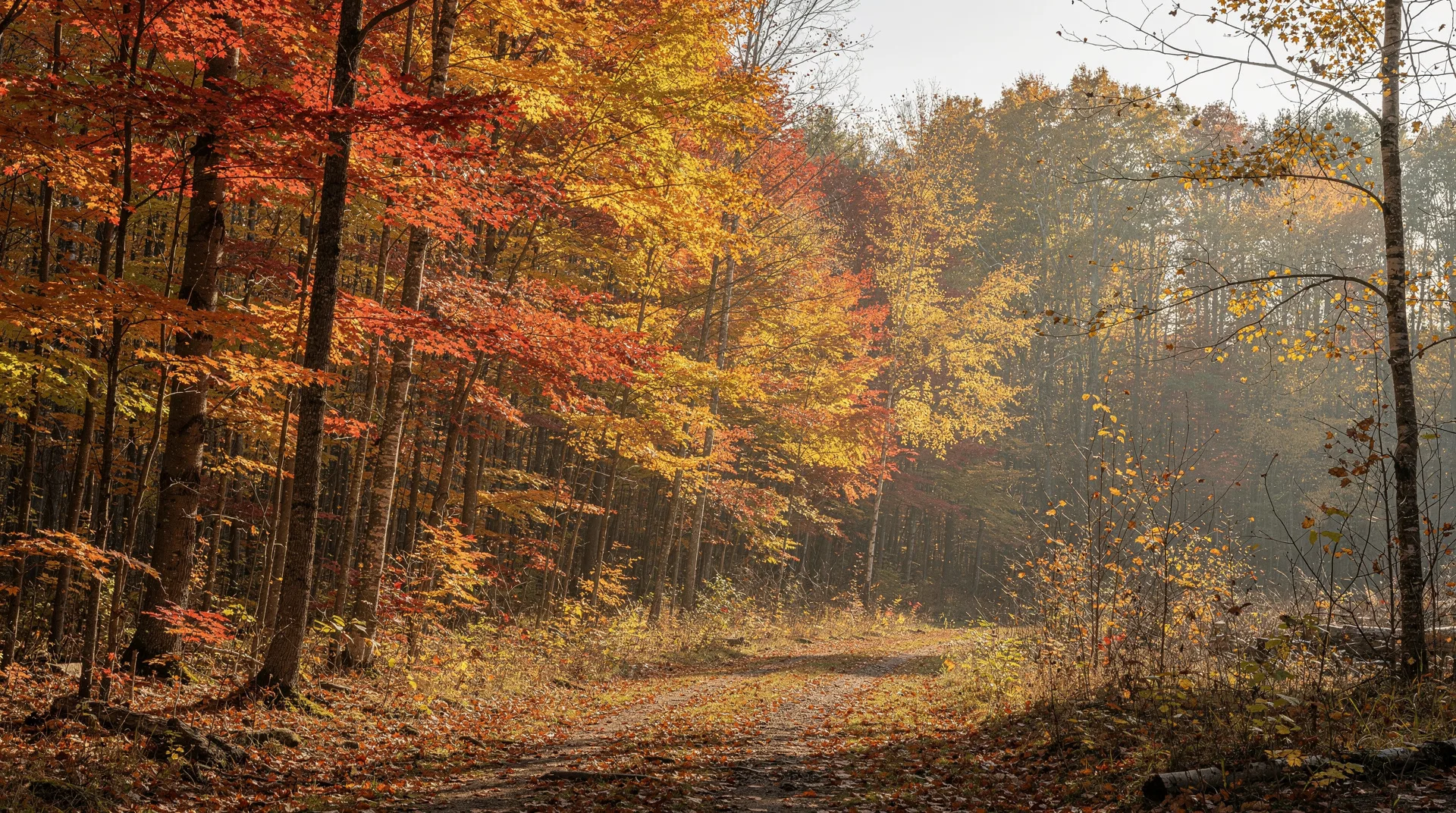
Fall Colours in British Columbia: Best Spots for Autumn Foliage
When are fall colours at peak in British Columbia?
BC fall colours peak from mid-September through mid-October depending on location. The Kootenays and Okanagan peak mid-September to early October for aspens and larches at higher elevations. Vancouver, Victoria and Vancouver Island peak in mid-to-late October for maples and cottonwoods. High-elevation larches in the BC Rockies peak late September.
| At a glance | |
|---|---|
| Where | BC Rockies, Kootenays, Okanagan, Vancouver Island and the Lower Mainland |
| Cost | Free to view in most locations; wine tastings, boat tours and hot springs are extra (around CAD 20-60 depending on activity) |
| Time needed | A single viewpoint is an afternoon; a full colour-chasing loop is around 1-2 weeks |
| Getting there | Self-drive is easiest; base in Vancouver for coastal colour, Kelowna for the Okanagan, or Nelson for the Kootenays |
| Best time | Late September for alpine larches, early-to-mid October for the Interior and Kootenays, mid-to-late October for the coast |
British Columbia does not have the New England-style hardwood maple forests that define Canadian fall foliage mythology. What it has instead is a sequence of three distinct autumn colour shows, each playing out in a different region of the province at a different time: golden larch trees at alpine elevations in late September, aspen and cottonwood yellows across the Interior and Kootenays in early October, and big-leaf maple reds and yellows in the coastal rainforests of Vancouver Island and the Lower Mainland through late October. A well-timed two-week trip can catch all three.
This guide covers where to see fall colour in BC, when it peaks in each region, and how to combine colour with other seasonal pleasures like open vineyards, salmon runs, and empty hiking trails.
When fall colours peak in BC
Autumn progresses from north to south and from high elevation to low. Rough guidance:
- Late September: high-elevation larches in the BC Rockies, including the larch valleys of Yoho and Kootenay National Parks, as well as Vermillion Pass.
- Late September to early October: Kootenay aspens at mid-elevation; Larch Valley-style alpine.
- Early October: Okanagan cottonwoods and vineyard reds; Columbia Valley.
- Mid-October: coastal cottonwoods along the Fraser River Valley, and start of coastal maples.
- Mid-to-late October: Stanley Park, Pacific Spirit Park, Victoria, Cowichan Valley.
- Late October to early November: last colour on sheltered Lower Mainland streets and southern Vancouver Island.
The precise peak date varies year to year by up to two weeks depending on summer heat, moisture, and the arrival of autumn frosts. As a rule, a hot dry summer followed by a cool wet autumn produces the most vivid colours.
Peak colour by region at a glance
| Region | Peak window | What turns | Crowds |
|---|---|---|---|
| BC Rockies (larches) | Sept 20 - Oct 5 | Alpine larch (gold) | Moderate, trail-dependent |
| Kootenays | Late Sept - early Oct | Aspen, larch, maple | Low |
| Okanagan | Early-mid Oct | Cottonwood, vineyard reds | Moderate (harvest season) |
| Vancouver Island | 3rd-4th week Oct | Big-leaf maple | Low-moderate |
| Vancouver / Lower Mainland | Late Oct - early Nov | Maple, cottonwood | Low |
Where to go: region by region
The BC Rockies (for larches)
If you want the signature Canadian Rockies fall experience — golden alpine larch trees set against grey peaks and turquoise lakes — this is the BC side of the same show that happens more famously in Banff. The larches turn only for about two weeks, usually from September 20 to October 5. They grow only at subalpine elevation (roughly 1,800 to 2,400 metres), which means most viewing requires a half-day or full-day hike.
Best viewing:
- Lake O’Hara (Yoho National Park): arguably the finest larch show in Canada. Shuttle-access only, book by March or win the lottery.
- Iceline Trail and Opabin Plateau (Yoho): both accessible from Lake O’Hara.
- Vermillion Pass and Floe Lake area (Kootenay National Park): drivable from Banff; accessible trails lead into the larches.
- Mount Sproatt and Rainbow-Hanging Lake (Whistler backcountry): more accessible larches for Vancouver-based travellers.
See our Larch season guide for the Alberta-side details and direct comparison.
The Kootenays (for aspens and larches)
The Kootenay Rockies — the mountains of southeast BC from Revelstoke to Cranbrook — have the most varied fall colour in the province. Aspens turn gold through late September; larches turn shortly after at elevation; big-leaf maples turn red in sheltered valleys in early October.
Best viewing:
- Kootenay Lake and the West Arm around Nelson: cottonwoods and maples along the lakeshore; hot springs boat tours at Ainsworth.
- Revelstoke and Mount Revelstoke National Park: the Meadows in the Sky Parkway usually closes by early October but fall sections remain accessible.
- Fernie and the Lizard Range: aspens set against sharp dolomite peaks.
- Invermere and the Columbia Wetlands: cottonwoods lining the Columbia River with the Purcell and Rocky Mountains behind.
- Kaslo-New Denver-Nakusp route: arguably the prettiest autumn drive in BC, through aspen and larch groves between heritage Kootenay villages.
Kootenay autumn travel is quieter than summer and the accommodation rates drop. Hot springs (Ainsworth, Halcyon, Nakusp, Radium) stay open year-round and are particularly rewarding in cool autumn weather.
The Okanagan (for cottonwoods and vineyards)
The Okanagan’s fall colour is subtler than the mountain regions but extends over a longer window. Cottonwoods and poplars light up in mid-October in shades of bright yellow; aspens sit above the valley floor; and the vineyards themselves turn red and gold in early to mid-October.
Best viewing:
- Naramata Bench and Penticton area: walking the Kettle Valley Rail Trail in fall is one of the best cycling experiences in the province, with vineyards turning on both sides of the path.
- Kelowna Mission area: cottonwoods along the waterfront.
- Vernon and Coldstream: Kalamalka Lake surrounded by vineyards in autumn.
- Similkameen Valley: west of the Okanagan, drier air, more dramatic valley walls framing fall cottonwoods.
October is harvest season. Most wineries remain open; smaller producers host crush events, and you can compare guided tours in British Columbia if you prefer not to drive between tastings. Our Okanagan harvest season guide details tastings and harvest dinners. See also our dedicated Penticton destination page for a base.
Vancouver Island (for coastal maples)
Vancouver Island’s autumn is later than the rest of BC because the maritime climate slows the transition. Big-leaf maples — the giant hands of coastal rainforest maples — turn yellow through October, with peak colour in the third and fourth weeks of the month.
Best viewing:
- Cowichan Valley: wine country and farmlands frame the mountain slopes. Combine with cider tours.
- Duncan to Port Alberni drive along Highway 4: cathedral groves of maples alongside Douglas fir.
- Gold Mine Trail and Goldstream Provincial Park near Victoria: maple, vine maple, and the start of the salmon run — a combined natural show.
- Pacific Rim National Park trails: understory maples are especially photogenic against old-growth moss.
- Oak Bay and Beacon Hill Park in Victoria: Japanese maples in private gardens are genuinely world-class.
Vancouver and the Lower Mainland
Vancouver’s fall colours are famously concentrated in a handful of specific urban locations — the city’s street trees turn in waves from late October through early November.
Best viewing:
- Stanley Park: maple-lined paths, especially around Lost Lagoon and Second Beach. Peak typically around October 20 to November 5.
- UBC Pacific Spirit Park: Douglas fir plus maple is a distinctive coastal combination.
- VanDusen Botanical Garden: curated fall displays, worth a dedicated visit.
- Queen Elizabeth Park: panoramic views of downtown with autumn trees in the foreground.
- Fraser River Delta cottonwoods: George C. Reifel Migratory Bird Sanctuary adds fall colour with migrating snow geese.
- Lynn Canyon: big-leaf maples against the rainforest; peak mid-to-late October.
- Capilano River Regional Park: spawning salmon plus autumn colour.
Combining fall colour with other seasonal activities
Autumn in BC is the single most rewarding season for a combination trip because multiple activities peak together.
- Fall colours + salmon run viewing: Goldstream (Victoria), Adams River (Kamloops), and lower Fraser rivers all have active runs in late September and October. See our BC salmon runs guide.
- Fall colours + whale watching: Tofino and Victoria both have strong October whale viewing. The weather is often clear even after cooler mornings arrive. You can browse tours and activities across Canada to book a sailing.
- Fall colours + Okanagan wine harvest: vineyards at peak in early October and hosting crush events.
- Fall colours + hot springs: Kootenay hot springs are best enjoyed when the air is cool and leaves are on the trees.
- Fall colours + cycling: Kettle Valley Rail Trail and the Galloping Goose Trail on Vancouver Island are empty in October and cool enough to ride long distances.
Timing a one-week BC fall trip
A seven-day fall colour trip from Vancouver, timed for early October, might look like:
- Day 1: fly into Vancouver. Evening walk at Stanley Park or Lynn Canyon.
- Day 2: drive Sea-to-Sky highway to Whistler; hike to the Rainbow Lake or Russet Lake area for early larches.
- Day 3: continue to the Okanagan via Hope-Princeton. Check into Naramata or Penticton. Vineyard dinner.
- Day 4: KVR cycling day with wine tastings at peak vineyard colour.
- Day 5: drive east to the Kootenays. Overnight Nelson. Evening soak at Ainsworth Hot Springs.
- Day 6: Kootenay Lake scenic drive; ferry crossings; photograph aspens at golden hour.
- Day 7: return drive through the Okanagan to Vancouver (a long day; allow 8 hours).
Practical tips
- Book accommodation ahead in Kootenays and Okanagan; harvest season is busier than many visitors expect.
- Many high-elevation trails close after the first heavy snow (typically mid-to-late October in the Rockies).
- Bring warm layers; alpine elevations can be below freezing at dawn even in September.
- Some provincial park roads close for the season on October 15 or October 31; check before travel.
- Photography: the best light for fall colours is the first and last hour of the day. Overcast days often reveal colour better than bright sun.
- Forest-fire season can linger into September; smoke can obscure distant views. Check air quality advisories before hiking.
British Columbia’s autumn is quieter, cheaper, and more varied than the summer peak. For photographers, cyclists, wine lovers, and anyone who prefers empty trails to crowded ones, it is arguably the province’s best season — with three weeks of rolling colour rewarding any itinerary that moves across BC’s different climatic regions.
Getting around for a fall colour trip
Distances between regions are real — Vancouver to the Kootenays is a full day’s drive. See BC driving distances for realistic timing between regions, and car rental in BC for booking logistics; fall is shoulder season so rates are typically lower than summer. If hiking to alpine larches, check the BC best hikes guide for trail details and the best time to visit BC guide for broader seasonal planning.
Frequently asked questions about Fall Colours in British Columbia
When is the best time to see fall colours in BC? There is no single peak date for the whole province: alpine larches peak late September in the Rockies, Kootenay and Okanagan colour peaks early-to-mid October, and coastal Vancouver Island and Vancouver colour peaks mid-to-late October.
Can I see fall colours and wine harvest in BC at the same time? Yes — early October is the sweet spot, when Okanagan vineyards are at peak colour and harvest events are underway, roughly overlapping with Kootenay aspen and larch season a short drive east.