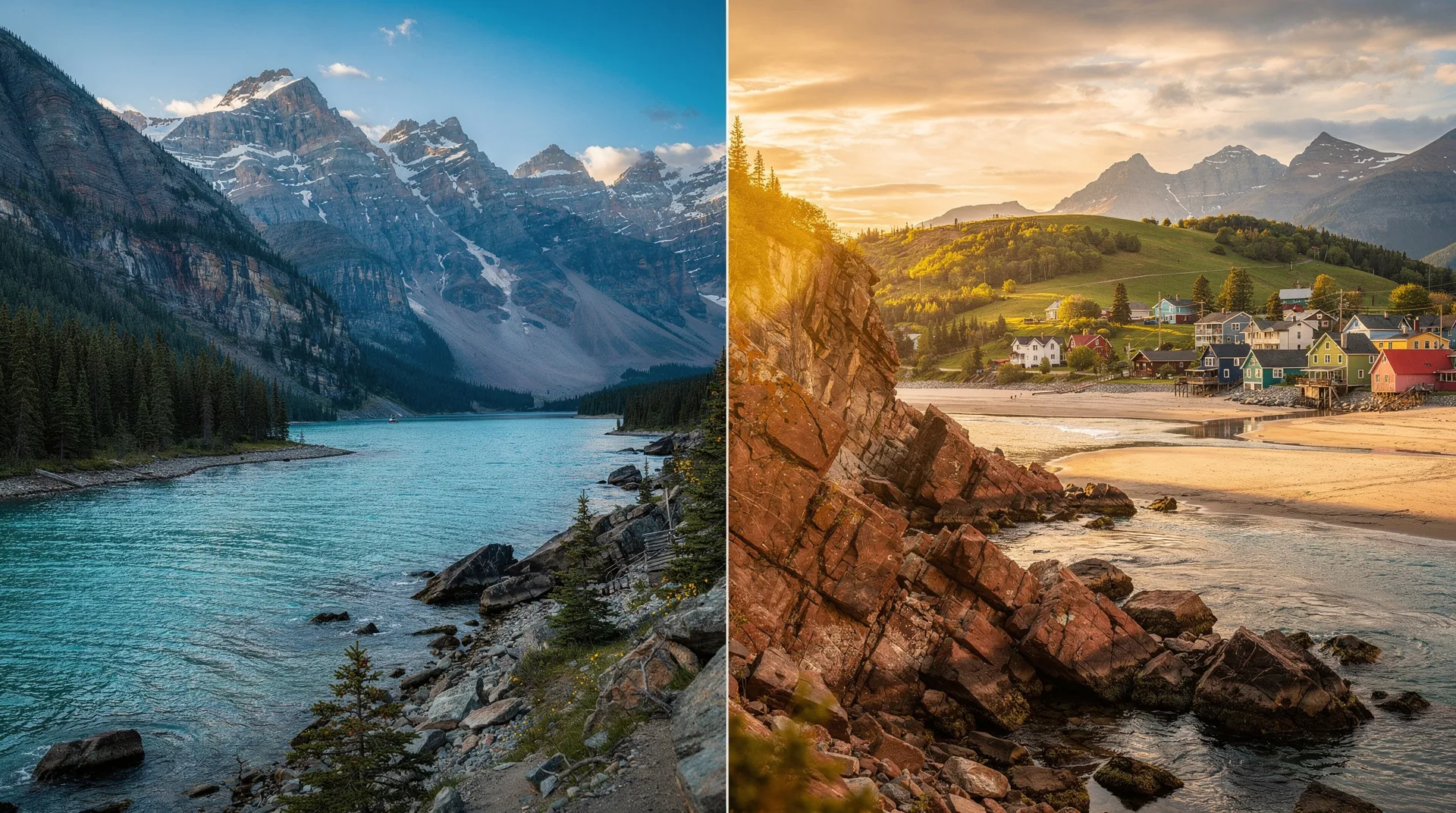
Banff vs Jasper: which to visit?
Should I choose Banff or Jasper?
Choose Banff for infrastructure, dining, and easy access from Calgary. Choose Jasper for fewer crowds, wilder wildlife, and a more remote feel. If you have a week or more, do both — they are connected by the Icefields Parkway, one of the world's great drives.
The Canadian Rockies force a choice on most first-time visitors: Banff or Jasper? Both parks are UNESCO World Heritage sites. Both have turquoise lakes, glacier-capped peaks, hot springs, and wildlife that appears around corners without warning. Yet they attract different types of travellers and deliver distinctly different experiences.
This guide breaks down the differences honestly — crowds, costs, access, accommodation, wildlife, and the specific activities each park does better — so you can make the right call for your trip.
| At a glance | |
|---|---|
| Where | Banff: 90 min from Calgary. Jasper: around 4-4.5 hrs from Calgary or Edmonton |
| Park pass | Required for both — around CAD 12.25/adult/day or a Discovery Pass covering both |
| Time needed | 3-4 days per park minimum; 7+ days to do both with the Icefields Parkway |
| Getting there | Banff by road or shuttle from Calgary; Jasper by road, or seasonal VIA Rail |
| Best time | July-August for full access and warmest weather; late Sept-Oct for fewer crowds and fall colour |
The short answer
Banff is more developed, more accessible, and more convenient. The town of Banff has dozens of hotels, restaurants, and shops within walking distance of the park’s highlights. Jasper is rawer, quieter, and less polished — qualities that many visitors consider advantages rather than drawbacks.
The distance between them is 287 km along the Icefields Parkway, which is itself one of the most spectacular roads on earth. If your itinerary allows it, the right answer to “Banff or Jasper?” is simply “both.”
Location and getting there
Getting to Banff
Banff sits 128 km west of Calgary, about 90 minutes by car on the Trans-Canada Highway. Calgary International Airport (YYC) is one of Canada’s busiest airports with direct connections to major North American and international hubs. The drive from the airport to the park gates takes roughly 75 minutes. Shuttle services and organized tours from Calgary are plentiful and affordable, making Banff one of the easiest Canadian Rockies destinations to reach without a car.
The town of Banff is inside the national park boundaries — you pay the park entry fee (CAD $12.25/adult/day or included in a Discovery Pass at CAD $83.50/adult) simply by entering. The town functions as a full-service tourist hub with grocery stores, pharmacies, medical facilities, and year-round restaurants.
Getting to Jasper
Jasper is 370 km southwest of Edmonton and 362 km north of Calgary. Edmonton International Airport (YEG) offers the most direct approach at roughly 4 hours by car. Via Calgary the drive takes around 4–4.5 hours. Via Rail operates seasonal service to Jasper on the transcontinental Canadian route, making it one of the few national park towns in Canada accessible by train — a genuinely scenic way to arrive.
Jasper town is smaller than Banff town: fewer restaurants, fewer shops, fewer hotel options. That’s part of the appeal for many visitors. It feels like a mountain community that happens to attract tourists, rather than a resort that has grown infrastructure around itself.
The Icefields Parkway connection
The 232 km Icefields Parkway (Highway 93) connects Banff and Jasper directly. Most visitors drive it — the journey takes 3–4 hours without stops, but a full day with stops is more appropriate. The parkway passes 100 glaciers, dozens of viewpoints, and several of the Rockies’ most photographed locations including the Columbia Icefield and Peyto Lake.
| Banff | Jasper | |
|---|---|---|
| Distance from Calgary | 128 km (90 min) | 362 km (4–4.5 hrs) |
| Distance from Edmonton | 400 km (4 hrs) | 370 km (4 hrs) |
| Nearest airport | Calgary (YYC) | Edmonton (YEG) |
| Train access | No direct service | Yes, VIA Rail |
| Town size | Large (8,000 residents) | Small (5,000 residents) |
Main attractions
Banff highlights
Lake Louise is the most-photographed lake in Canada: jade-coloured water backed by the Victoria Glacier and the Fairmont Chateau Lake Louise on its shore. Summer mornings see heavy crowds; arrive before 8am or plan for a shuttle from the overflow parking area.
Moraine Lake rivals Lake Louise for colour and surpasses it for drama. Surrounded by the Valley of the Ten Peaks, it appears on the old Canadian $20 bill. Parks Canada restricts private vehicles on the access road from late May to mid-October — visitors arrive by shuttle or on foot.
Banff Gondola ascends to the summit of Sulphur Mountain (2,281 m) with a boardwalk ridge system and interpretive centre at the top. The Banff Gondola and hot springs combination tour is one of the most popular activities in the park.
Banff Upper Hot Springs offer a soak in natural thermal water at 1,585 m elevation. Operating year-round, they are particularly atmospheric in winter when snow surrounds the pool.
Johnston Canyon is a canyon walk through a narrow limestone gorge to a series of waterfalls. The lower falls are a 1.1 km walk; the upper falls 2.7 km. One of the most accessible hikes in the park.
Bow Valley Parkway (Highway 1A) is a slower alternative to the Trans-Canada between Banff and Lake Louise, lined with meadows, historic sites, and reliable wildlife sightings in the early morning and evening.
Jasper highlights
Maligne Lake is the largest natural lake in the Canadian Rockies at 22 km long. Spirit Island — accessible only by boat cruise — is one of the most reproduced images of Canada. The cruise season runs June to mid-October.
Athabasca Falls is the most powerful waterfall in the Canadian Rockies, reached by a short flat trail. The volume of water compressed through a narrow quartzite gorge creates a roar audible from the parking area.
Columbia Icefield sits at the boundary of Banff and Jasper parks along the Icefields Parkway. The Athabasca Glacier — a lobe of the icefield — is accessible on foot or via the Columbia Icefield Adventure snowcoach tours.
Miette Hot Springs are the hottest hot springs in the Canadian Rockies at 54°C, cooled to a bathing temperature of 40°C. More remote than Banff’s hot springs and consequently less crowded.
Jasper Dark Sky Preserve is the second-largest dark sky preserve in the world. In late September and October, Jasper hosts an annual Dark Sky Festival with telescope viewing, constellation talks, and aurora opportunities.
Wildlife along the Icefields Parkway — the stretch north of the Columbia Icefield into Jasper is particularly productive for bear, elk, moose, bighorn sheep, and mountain goat sightings, often roadside.
| Banff | Jasper | |
|---|---|---|
| Iconic lakes | Lake Louise, Moraine Lake | Maligne Lake, Medicine Lake |
| Hot springs | Banff Upper Hot Springs | Miette Hot Springs (hotter) |
| Glacier access | Crowfoot, Bow Glacier | Athabasca Glacier (Columbia Icefield) |
| Dark sky | Limited | World’s largest dark sky preserve |
| Gondola | Yes (Sulphur Mountain) | Yes (Jasper SkyTram) |
Cost comparison
Park entry
Both parks use the same fee structure — a single fee covers both if you are driving the Icefields Parkway.
- Daily pass: CAD $12.25/adult, CAD $29.40/family
- Discovery Pass (annual): CAD $83.50/adult, CAD $167.50/family — covers all Parks Canada sites for 12 months, excellent value for a trip of 7+ days
Accommodation
Banff commands premium prices due to demand and a limited accommodation supply controlled by Parks Canada. Budget accommodation is scarce.
- Hostel dorm (Banff): CAD $45–$80/night
- Mid-range hotel (Banff): CAD $200–$400/night
- Fairmont Banff Springs: CAD $600–$1,200/night
- Hostel dorm (Jasper): CAD $40–$65/night
- Mid-range hotel (Jasper): CAD $150–$300/night
- Fairmont Jasper Park Lodge: CAD $450–$900/night
Jasper accommodation typically runs 20–35% cheaper than equivalent Banff options, a meaningful difference over a multi-night stay.
Dining
Both towns have a similar range: cafes, casual restaurants, and upscale dining. Banff has more options at every price point. Jasper’s restaurant scene is smaller but maintains quality.
- Casual lunch: CAD $18–$28/person
- Dinner (mid-range restaurant): CAD $40–$65/person
- Groceries for self-catering: Similar to urban Canadian prices
Activities
Most major activities — gondolas, boat tours, hot springs — are priced similarly in both parks. Budget CAD $80–$150/person/day for a mix of paid activities.
Accessibility and crowds
Banff
Banff is the most-visited national park in Canada, receiving approximately 4–5 million visitors per year. July and August are intensely crowded. The shuttle system to Lake Louise and Moraine Lake is mandatory for most of the summer season, and parking infrastructure is under significant strain.
Visiting in the shoulder seasons (May–June, September–October) dramatically improves the experience. October specifically offers fall colours on the larch trees around Larch Valley and Lake Louise — one of the most sought-after seasonal events in the Rockies.
Jasper
Jasper receives roughly 2–2.5 million visitors per year — fewer than half Banff’s total, in a larger park. Trails are quieter, parking lots fill later in the day, and the sense of wilderness is more immediate. The 2024 Jasper wildfire affected part of the townsite and some areas near the park’s western edge; most attractions and trails have since reopened, though some infrastructure remains under repair.
The flip side of fewer visitors is fewer services. If your car breaks down or you need urgent medical care, the distance to full-service facilities matters more in Jasper.
Best for…
Choose Banff if you:
- Are flying into Calgary and want easy access without a long drive
- Want maximum dining and accommodation options
- Are travelling without a car and prefer good shuttle infrastructure
- Need accessible trails and facilities
- Want to combine a park visit with a ski resort (Lake Louise and Sunshine Village are both in Banff)
Choose Jasper if you:
- Prioritize wildlife and prefer backcountry trails
- Want hot springs that are quieter than Banff’s
- Are interested in dark sky astronomy
- Are arriving by train from Vancouver or Toronto
- Want a quieter, less resort-like atmosphere
- Are visiting in late September for the Dark Sky Festival
Choose both if you:
- Have 7+ days and a car
- Want to drive the Icefields Parkway properly
- Are visiting the Canadian Rockies for the first or only time and want the full experience
Can you do both?
Yes, and for most first-time visitors this is the recommended approach. A Banff and Jasper 2-day tour gives a structured introduction to both parks, while a self-drive along the Icefields Parkway lets you set your own pace.
A common itinerary structure: fly into Calgary, spend 3–4 nights in or around Banff, drive the Icefields Parkway to Jasper over a full day with stops, spend 2–3 nights in Jasper, then return to Calgary along Highway 16 (Yellow Head Highway) or fly out of Edmonton.
For those with limited time who must choose one, Banff is the more complete experience for a first visit — not because it is better, but because its infrastructure makes it easier to see the highlights efficiently. Return visitors consistently gravitate toward Jasper.
You can also book a multi-day Calgary, Banff, and Jasper national parks tour that handles transportation and guides both parks in a single trip.
Our verdict
For first-time visitors with 3–4 days: Banff is the better choice. The infrastructure, lake access, and proximity to Calgary make it a more efficient use of limited time.
For visitors with 7+ days: Do both, with the Icefields Parkway as the connecting experience between them.
For repeat visitors or those seeking solitude: Jasper every time.
The parks complement each other rather than competing. Banff delivers polish and convenience; Jasper delivers wildness and quiet. Together they offer the most complete Canadian Rockies experience possible.
Where to base yourself within Banff
If you choose Banff, the next decision is which town to stay in. Our Banff vs Canmore comparison covers whether to stay inside the park or in the cheaper, quieter town 20 minutes east — a decision that matters more for longer stays. Families weighing either park should also see Banff with kids for age-specific hikes and logistics, and hikers who want a lower-key, fee-free alternative to both national parks should look at Banff vs Kananaskis.
Planning the connecting drive
If you’re doing both parks, budget the Icefields Parkway as its own day rather than a transit leg. Stops at Johnston Canyon, Peyto Lake, and the Columbia Icefield turn a 3-hour drive into a full day easily. See our dedicated Icefields Parkway stops guide and the driving Banff to Jasper guide for a mile-by-mile plan, or the Banff-Jasper 7-day itinerary for a full trip structure.
See also: Banff National Park guide, Jasper National Park guide, Lake Louise vs Moraine Lake comparison, Best time to visit Canada.
Frequently asked questions about Banff vs Jasper: which to visit?
Is Banff or Jasper less crowded?
Jasper is significantly less crowded than Banff. Banff receives approximately 4–5 million visitors per year; Jasper receives around 2–2.5 million in a larger park area. Trails, parking, and viewpoints in Jasper are consistently less congested, particularly in July and August.
Which park has better wildlife viewing?
Both parks are excellent for wildlife, but Jasper has a slight edge for sheer quantity and accessibility of encounters. The Icefields Parkway north of the Columbia Icefield — in Jasper — is particularly productive for bear, moose, and elk roadside sightings. Banff has reliable wildlife viewing along the Bow Valley Parkway.
Can I visit Banff and Jasper without a car?
You can visit Banff without a car using the Roam transit system and seasonal park shuttles to Lake Louise and Moraine Lake. Getting to Jasper without a car is harder — shuttle services exist but are more limited. The Icefields Parkway is not served by public transit; touring it independently requires either a car or an organized tour.
What is the best time to visit Banff or Jasper?
July and August offer the best weather and full access to all trails and lakes, but also the heaviest crowds. Late September to mid-October brings fall larch colours and fewer visitors. Winter (December–March) is excellent for skiing in Banff and aurora viewing in Jasper. Avoid the spring mud season (April to mid-May).
How long does it take to drive the Icefields Parkway?
The 232 km route between Lake Louise (Banff) and Jasper takes about 3 hours non-stop. With reasonable stops at Peyto Lake, Bow Summit, the Columbia Icefield, Athabasca Falls, and a few roadside viewpoints, plan a full day — 7–9 hours is realistic if you step out at each major stop.
Do I need a reservation to visit Lake Louise or Moraine Lake?
Parks Canada does not require advance reservations for park entry, but the shuttle from the Lake Louise ski area parking lot to Moraine Lake is mandatory when the access road is restricted (late May to mid-October). These shuttle tickets can be booked through Parks Canada’s reservation system starting in January and often sell out for peak summer dates.
What parks pass do I need?
A single Parks Canada Discovery Pass (CAD $83.50/adult, CAD $167.50/family) covers both Banff and Jasper, plus all other Parks Canada sites across Canada for 12 months from purchase. If you are staying 7+ days across both parks, the Discovery Pass pays for itself over individual daily passes.
Should I stay in Banff town or Canmore if I’m doing the Banff half?
Either works — Canmore is 15-20 minutes further from the park gate but typically 30-50% cheaper for accommodation. See our Banff vs Canmore guide for the full comparison; the calculus changes depending on trip length.