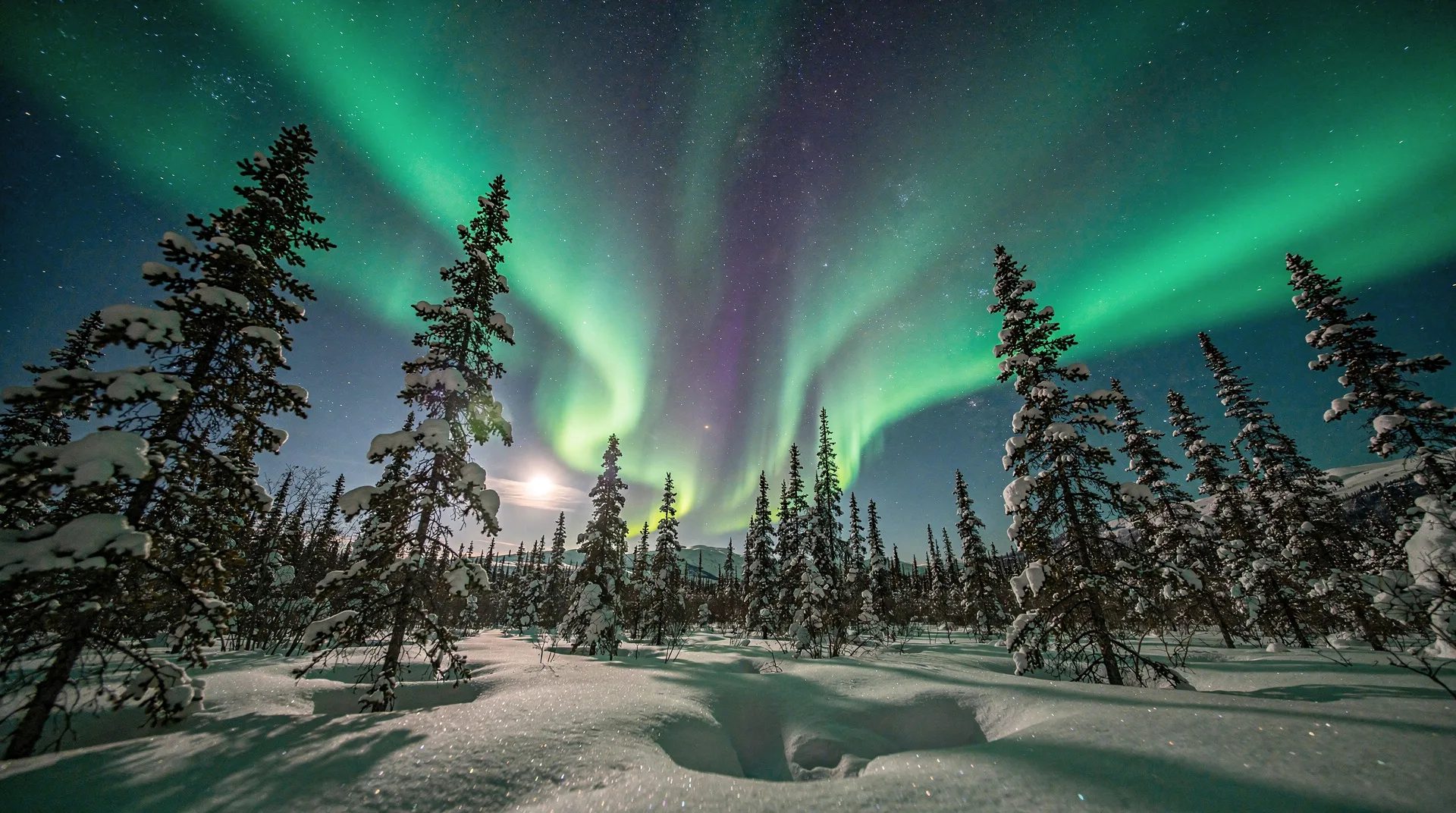
Aurora borealis in Yellowknife: the complete guide
When is the best time to see aurora in Yellowknife?
The aurora season in Yellowknife runs from late August through early April, when nights are dark enough for viewing. The peak window is mid-November through March: long nights, frequent clear skies, and the highest probability of strong geomagnetic activity. Plan at least 3–4 nights to account for cloud cover.
Yellowknife is not just a good aurora destination — it is one of the best places on earth to see the northern lights. The capital of Canada’s Northwest Territories sits at 62° North, directly beneath the auroral oval (the ring of intense geomagnetic activity that circles the magnetic pole), and enjoys more clear-sky nights than virtually any other aurora city in Canada. The combination of position, clear weather, and an exceptional local tourism industry built specifically around aurora viewing makes Yellowknife the first choice for serious northern lights travellers.
At a glance
| Where | Yellowknife, Northwest Territories — reached only by air, typically via Edmonton or Calgary |
| Cost | Around CAD 1,500-2,500 per person for a 5-night trip including flights, hotel, and 3-4 aurora tours |
| Time needed | A minimum of 3-4 nights; 5-7 nights for high confidence of a strong display |
| Getting there | Fly into Yellowknife Airport (YZF); no road or rail access from southern Canada in winter |
| Best time | Mid-November through March for the longest, darkest nights; mid-September for a milder entry point |
The city is small — a population of around 21,000 — and remote, accessible only by air from Edmonton or Calgary. But its infrastructure for aurora visitors is remarkable: heated viewing facilities, professional photography guides, cultural experiences with the Yellowknives Dene First Nation, and operators who spend every winter night monitoring the skies and transporting guests to the best available positions.
Why Yellowknife is Canada’s aurora capital
The science behind Yellowknife’s advantage is specific. The auroral oval is not a fixed ring directly over the North Pole — it sits at roughly 65–70° geomagnetic latitude. Yellowknife, at 62° geographic latitude, sits just inside the equatorward edge of this oval during quiet conditions and directly within it during active geomagnetic storms. This means displays can be visible even on nights with moderate solar activity.
The Northwest Territories’ continental climate is the other key factor. Unlike coastal aurora destinations (Iceland, Norway) which suffer from persistent maritime cloud cover, the NWT sits on the Canadian Shield and experiences a dryer, more stable atmosphere — particularly in the deep winter when Arctic high-pressure systems dominate. Clear nights in Yellowknife in January and February are not a certainty, but they are significantly more frequent than in comparable latitude destinations.
The final advantage is darkness. From late September through mid-March, Yellowknife has enough darkness for viewing (nights exceeding 10 hours). In deep winter (December–January), the sun sets by 3:30pm and rises after 9am — providing a theoretical 17-hour viewing window on every night, though aurora activity can occur at any time throughout.
Aurora season and best timing
The aurora season in Yellowknife runs from approximately late August through early April — any period when the sky is dark enough for the lights to be visible against the night sky. Within this window, the prime months are:
Mid-September to early October: The autumn equinox brings a natural enhancement in geomagnetic activity. Nights are just long enough at around 11 hours. Temperatures are cold but not extreme (-5 to -15°C). A relatively accessible entry point for aurora viewing before the deep winter cold arrives.
November through January: The prime aurora window. Nights are very long, Arctic high-pressure systems produce clear skies with high frequency, and the combination of darkness and cold creates the classic aurora experience. Temperatures can reach -30°C or below — proper cold-weather gear is non-negotiable.
February and March: Still excellent aurora conditions with warming temperatures (average highs reaching -5 to -10°C by March). Daylight hours increase noticeably through March. Slightly milder conditions make this period more comfortable for first-time visitors to the subarctic.
The aurora itself cannot be reliably predicted more than 1–3 days in advance. Plan a minimum of 3–4 nights in Yellowknife to give yourself multiple opportunities; 5–7 nights gives very high probability of witnessing at least one strong display.
Aurora Village — the premier viewing experience
Aurora Village is Yellowknife’s flagship aurora viewing facility, operated approximately 15 km outside the city in a clearing away from urban light pollution. The facility consists of a cluster of heated, insulated teepee-shaped viewing structures (called “Aurora Huts”) arranged in a clearing, with open-sky viewing areas for photography. Guests are transported from downtown hotels, served warm drinks and snacks in the heated huts, and guided outside when aurora activity is detected.
The setup solves the main practical challenge of aurora viewing in extreme cold: you do not have to stand outside in -25°C waiting for something that may or may not appear. You wait in warmth and step out when the guides signal activity. For photography, tripods and composition assistance are available.
Aurora Village operates nightly through the season (weather permitting) with pickup from Yellowknife hotels typically around 9–10pm and return around 1–2am. Advance booking is essential in peak season (November–January).
A Whitehorse alternative for those combining NWT with the Yukon:
Book a Yukon aurora borealis late-night viewing tour from Whitehorse Browse all Yukon and northern Canada northern lights toursDene culture and the aurora
The Yellowknives Dene First Nation have lived in the region around Yellowknife Bay for thousands of years. For the Dene, the aurora borealis is not simply a natural phenomenon but carries deep cultural meaning. Different Dene groups hold varying interpretations — some traditions describe the lights as the spirits of ancestors dancing in the night sky; others connect them to specific animals or seasonal events.
Several Yellowknife tour operators integrate Dene cultural elements into aurora experiences: storytelling from Dene elders about the cultural significance of the lights, traditional food tastings, and explanations of how the aurora was interpreted and responded to in traditional Dene life. These cultural components transform an aurora tour from a science-and-photography experience into something considerably richer.
The Prince of Wales Northern Heritage Centre in Yellowknife, the NWT’s main museum, houses significant collections on Dene material culture and history — worth a daytime visit to understand the full context of the land you are viewing at night.
Best viewing locations around Yellowknife
Aurora Village — The pre-eminent dedicated viewing facility; heated teepees, expert guides, organised transport from hotels.
Prosperous Lake — A large lake southeast of Yellowknife, accessible by road, that provides dark skies and a reflective surface for aurora-over-water photography. No facilities; dress appropriately.
Ingraham Trail (Highway 4) — The road east of Yellowknife along a chain of lakes and rivers. Multiple pullout points with dark skies and north-facing views. Accessible by rental car but the road becomes icy; local guides who use this corridor regularly are the safer option.
Yellowknife Bay — In deep winter when the bay freezes, the ice surface becomes a remarkable aurora viewing and photography platform. The lights reflected in refrozen ice cracks create otherworldly images.
Prelude Lake Territorial Park — A territorial park on the Ingraham Trail with excellent dark sky access and facilities usable in summer and early winter. Gets very cold in January-February.
What to do in Yellowknife by day
Aurora viewing is a night activity; the days in Yellowknife are well spent on complementary experiences:
Dogsledding on the frozen lakes — Yellowknife operators offer dog sled tours on Great Slave Lake from January. A team of huskies pulling a traditional sled across the frozen surface of one of Canada’s largest lakes is an extraordinary way to spend a winter morning. See our dog sledding Canada guide for outfitter options.
Ice road driving — In deep winter (typically January–March), the world-famous Yellowknife ice roads open across Great Slave Lake, connecting island communities and reducing road distances dramatically. A guided ice road tour is a uniquely Yellowknife experience.
Snowshoeing and cross-country skiing — The Yellowknife area has excellent trail networks through boreal forest and around frozen lakes. Many trails are accessible from the city and maintained through winter.
Prince of Wales Northern Heritage Centre — The NWT’s main museum covers the natural and human history of the territory, with strong First Nations collections and exhibits on the subarctic environment.
Old Town Yellowknife — The original settlement on the rocky point above the bay is an eclectic mix of houseboat communities (some now frozen into the bay for winter), heritage buildings, and local restaurants. Walk around in daylight hours to appreciate the setting.
Photography tips for aurora shooting
Aurora photography is achievable with basic camera gear but rewards preparation:
- Camera: Any camera with manual exposure control. Full-frame cameras perform better in low light but APS-C and Micro Four Thirds sensors are entirely capable.
- Lens: Wide-angle (14–24mm equivalent) with a maximum aperture of f/2.8 or wider. The wider the aperture, the better the light-gathering.
- Tripod: Absolutely essential. Exposures typically run 5–25 seconds; any hand movement is catastrophic.
- Settings starting point: ISO 800–3200, f/2.8, 10–20 seconds. Adjust based on aurora brightness — a weak aurora needs longer exposures; a strong, fast-moving display may need 3–5 second exposures at high ISO to avoid motion blur.
- Remote shutter release: Prevents camera shake during exposure. A smartphone cable or wireless remote is adequate.
- Battery: Cold kills batteries rapidly. Carry two batteries and keep the spare warm in an inner pocket. A battery rated to hold 300 shots may deliver 80–100 in -25°C.
- Lens hood: Prevents condensation on the lens when moving between warm and cold environments.
Operate your camera in a dark area before moving back inside — the thermal shock of going from -25°C to a heated space immediately causes condensation on cold equipment. Let it warm up gradually.
Costs and budget
Yellowknife aurora trips have specific cost considerations:
- Flights: Return from Toronto or Vancouver to Yellowknife typically CAD 400–900 depending on season and advance booking; Edmonton is the main hub with connections to Yellowknife
- Accommodation: Yellowknife has a modest hotel range — mid-range hotels CAD 150–250 per night; the Chateau Nova and Explorer Hotel are the main full-service options
- Aurora Village tours: Approximately CAD 100–150 per person per night; packages of 3 or more nights typically offered at discounted rates
- Dog sled tours: Half-day from CAD 180; full-day from CAD 350
- Ice road tour: CAD 100–150 per person
- Meals: Yellowknife restaurants are good value — dinner for two at a mid-range restaurant CAD 60–100
Budget for a 5-night aurora trip: approximately CAD 1,500–2,500 per person all-inclusive (flights, accommodation, 3–4 aurora tours, activities, food), depending on flight origin.
Yellowknife vs other Canadian aurora bases
Yellowknife is not the only northern Canadian city built around the lights. Churchill, Manitoba is better known for polar bears (roughly October-November) and beluga whales in summer, and its aurora season overlaps with the bear season in a way that appeals to wildlife-first travellers — see our Churchill polar bears guide for how that combination works.
Whitehorse in the Yukon offers a milder subarctic climate and easier road access from Alaska or northern British Columbia, and pairs naturally with a wider Yukon road trip on the Dempster Highway. Neither city sits as squarely under the auroral oval as Yellowknife, and neither has an operation as purpose-built as Aurora Village.
Extending the trip beyond Yellowknife
Most visitors fly directly in and out, but the Northwest Territories rewards a few extra days. The Northwest Territories destination page covers the wider territory, including summer options around Great Slave Lake once the aurora season has passed. Travellers connecting through Edmonton or Calgary sometimes combine a Yellowknife aurora trip with a stop in the Alberta Rockies, though the two experiences require very different packing lists — down parkas for the North, layers for the mountains. If your itinerary allows a longer northern loop, the Yukon and Dawson City area offer a second, very different aurora and gold-rush-history base.
Practical tips for Yellowknife
Cold-weather gear is non-negotiable: Dress for -25°C to -35°C with wind chill. The aurora guides can supplement your gear if needed, but proper preparation is your responsibility. See our packing list for a detailed cold-weather kit.
Book aurora tours before you arrive: Aurora Village and other top operators have limited daily capacity. Book online before your trip.
Stay at least 4 nights: The aurora cannot be predicted. Cloud cover on 1–2 nights is common. Four nights gives reasonable odds of at least two clear aurora nights; five to six nights gives high confidence.
Download the My Aurora Forecast app: Available for iOS and Android; shows real-time Kp index (geomagnetic activity level) and local cloud cover forecasts. Your guide will also monitor this, but it is useful for understanding what is happening and what to expect on a given night.
Aurora is unpredictable in intensity: Kp level 2–3 (low activity) can produce a faint green band on the horizon; Kp 5+ (storm level) produces the curtains, rays, and colour shifts that appear in photographs. You cannot guarantee a strong display, but Yellowknife’s position under the auroral oval means even moderate activity is typically visible as a clear display.
Frequently asked questions about Aurora borealis in Yellowknife: the complete guide
How many nights should I spend in Yellowknife for aurora?
The industry recommendation is a minimum of 4 nights, with 5–7 giving high confidence of witnessing at least one strong display. On a 4-night trip you would typically have 3 clear nights available for viewing (one night is statistically likely to be overcast or have only partial clearing). Most aurora packages are sold in 3–5 night configurations.
What is the Kp index and why does it matter?
The Kp index is a global measure of geomagnetic activity on a scale of 0–9. At Yellowknife’s latitude, aurora is typically visible from Kp 2–3 upward — even a relatively quiet geomagnetic night can produce visible aurora. Kp 5 and above (geomagnetic storm conditions) produces the most dramatic displays. Your tour operators will monitor the Kp forecast and make real-time decisions about whether to operate and where to go.
Can I see aurora in Yellowknife in summer?
No — the aurora requires dark skies. In Yellowknife, the sky is too bright for aurora viewing from approximately late May through mid-August. The season runs from late August (when nights become dark enough) through early April (when twilight again becomes too persistent). The darkest, longest nights are in December and January.
Is Yellowknife safe to visit in winter?
Yellowknife is a small Canadian city with a normal crime profile. The main hazard in winter is the cold itself — frostbite can develop quickly in -30°C conditions with wind chill. Stick to guided tours for night activities, ensure someone knows your itinerary if you are going off independently, and dress appropriately. Ice roads are safe when maintained by the territorial government but should not be driven on without local guidance.
How does Yellowknife compare to other aurora destinations?
Yellowknife’s main advantages over Iceland (clear skies are more frequent) and Norway (position under the auroral oval is comparable but weather is more reliable). Compared to Whitehorse in the Yukon, Yellowknife is generally considered to have slightly better viewing probability due to its position inside the auroral oval and typically clearer winter skies. Both cities are excellent. See our northern lights Yukon guide for the Whitehorse alternative.
Do I need a tour or can I view aurora independently?
Independent aurora viewing is possible — rent a car, drive out of the city on the Ingraham Trail to a dark location, and monitor the sky. However, guided tours have significant advantages: they monitor aurora forecasts and cloud cover from multiple weather stations and will move to the best position available; they provide heated refuges; they offer photography guidance; and they provide transport on icy roads. For first-time visitors, guided tours are strongly recommended. Independent viewing is more appropriate for experienced aurora hunters who have visited before and know the terrain.
What is the best camera for aurora photography in Yellowknife?
Any camera with manual exposure control and RAW file capability. A full-frame camera (Sony A7 series, Nikon Z series, Canon R series) with a fast wide-angle lens (24mm f/1.8 or 16–35mm f/2.8) is ideal. But APS-C cameras like a Sony A6400 or Canon R7 with a Sigma 18–35mm f/1.8 or 10–20mm f/2.8 will produce excellent results. Smartphones have improved greatly for aurora photography but cannot match dedicated cameras for sensitivity and creative control in extreme low light.
What else is there to do in the Northwest Territories besides aurora viewing?
Outside the aurora season, Great Slave Lake and the wider Northwest Territories offer canoeing, fishing, and access to remote parks, though most travel infrastructure is aurora-oriented. Many visitors treat Yellowknife purely as an aurora base and combine the trip with time elsewhere in Canada, such as the Rockies or a Yukon road trip through Carcross.
Should I book a private guide or a group aurora tour?
Group tours at facilities like Aurora Village are the standard and most affordable option, with heated shelters and shared transport. Private guides cost more but offer flexibility on location and photography coaching. For a first visit, a group tour is the more practical and cost-effective choice.