Algonquin Fall Colors: Best Time, Viewing Spots & Tips
When is peak fall color in Algonquin Park?
Peak fall colour in Algonquin typically falls in the first two weeks of October — usually between October 1 and 14. The exact week varies by a few days each year depending on summer temperatures and the timing of the first cold nights.
Algonquin Provincial Park in October is one of the great seasonal spectacles of eastern North America. When the park’s vast stands of sugar maple, red maple, yellow birch, and trembling aspen turn in early October, the hillsides become a tapestry of crimson, scarlet, amber, and gold that stretches for hundreds of kilometres in every direction. This is not subtle autumn colour — Algonquin in peak week is genuinely extraordinary, and photographs rarely capture the full effect of standing on a granite ridge with the whole park ablaze below you.
This guide covers the precise timing, the best viewpoints along and off the Highway 60 corridor, how to get there from Toronto, what to do beyond the overlooks, and how to make the most of a fall weekend or extended stay.
| At a glance | |
|---|---|
| Where | Highway 60 corridor, Algonquin Provincial Park, Ontario |
| Cost | Around CAD 22 per vehicle day-use permit |
| Time needed | A full day for the highway corridor; 2 nights for hiking plus wildlife viewing |
| Getting there | Around 3-3.5 hours from Toronto or Ottawa by car; no public transit to the park |
| Best time | First two weeks of October, typically October 1-14 |
When exactly does fall colour peak in Algonquin?
The colour sequence in Algonquin moves in a predictable pattern, triggered by cooling night temperatures and shorter days. It begins in the north of the park and moves south; interior lake areas and higher elevations turn first.
Late September: The park starts to show colour — pops of red and yellow in the birch and early maples, particularly noticeable on north-facing slopes and in interior lake areas. This is an excellent time to canoe the interior; the colours are emerging and the blackflies are long gone.
First week of October: The colour is building to its peak. The hardwood zones along the Highway 60 corridor — the park’s accessible heartland — are typically at 60–80% colour, with the most brilliant reds appearing on the sugar maples.
Second week of October (typically the peak): Full peak colour throughout the park. The hillsides are at maximum saturation. This is the most photographed and most visited week of the park’s year.
Third week of October: The peak passes quickly. Maples begin to drop leaves; the birch and aspen gold lingers longer. Late October has an austere beauty of its own, with bare branches against grey rock and the lakes dark and still.
Ontario Parks publishes a fall colour report on its website each autumn, updated weekly — this is the most reliable real-time guide to current conditions. The park’s visitor centre (open through mid-October) also has staff who can direct you to the best current areas.
Timing your visit: If you are travelling from outside Canada and need to book flights, aim for October 4–12 as the highest-probability window. You may arrive a few days early or late relative to the exact peak, but colour will be impressive anywhere in this range in most years.
Best fall colour viewing spots in Algonquin
Lookout Trail (km 39.7 Highway 60)
The Lookout Trail is the single most rewarding short hike for fall colour in the park. The trail climbs steeply for about 1.9 km (return) to a bare granite ridge with a 180-degree panoramic view over the surrounding hardwood forest. At peak colour, the view from the top is overwhelming — a sea of red, orange, and gold rolling to every horizon, with the glint of lakes visible in the distance.
Start early (arrive before 8:00am on weekends) to get parking. The Lookout Trail car park fills completely by mid-morning during peak colour week.
Hardwood Lookout Trail (km 43.6)
A shorter, easier option — 0.8 km return on a well-maintained gravel path to a south-facing viewpoint over a hardwood bowl. The intimate scale of this viewpoint (you are looking into rather than over the forest) gives a different perspective on the colour. Excellent for families with young children.
Track and Tower Trail (km 25)
A 7.7-km loop following a historic logging railway grade, passing a restored fire tower. The route winds through a mosaic of forest types — mixed hardwood for colour, then open jack pine ridges for contrast. The railway grade is largely flat and easy; the tower loop adds modest elevation. One of the best half-day hikes in the park for fall colour and historic interest.
Opeongo Road corridor
The unpaved Opeongo Road (km 46.8 off Highway 60) runs 8 kilometres north to Opeongo Lake, the park’s largest lake and the main entry point for canoe tripping into the eastern interior. The drive is beautiful in fall — the road passes through old growth mixed forest with beaver ponds on either side. Even without leaving the car, this is an excellent fall colour drive.
Interior lake views by canoe
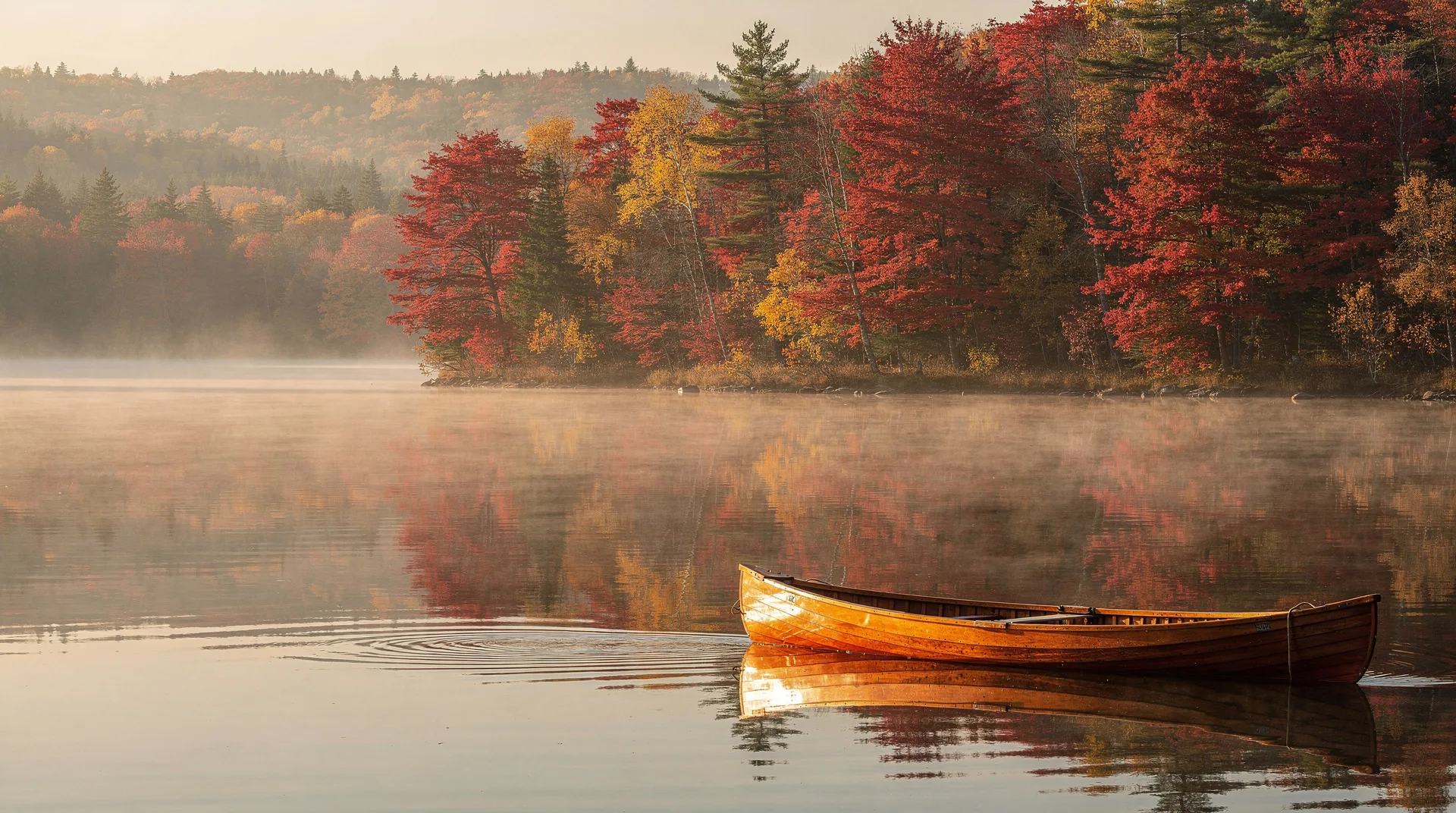
Seeing fall colour from a canoe in the Algonquin interior is categorically different from road viewpoints — the reflection of crimson hillsides in still morning lake water, the silence broken only by loons and the drip of a paddle, the sense of being inside the colour rather than looking at it. Even a one-night interior trip from Canoe Lake or Rain Lake gives this experience.
See our Ontario canoeing routes guide for specific interior entry points and route suggestions suitable for fall paddling.
Mizzy Lake Trail (km 15.4)
This 11-km loop is the best trail in Algonquin for wildlife combined with fall colour — the route passes nine small lakes and ponds, with excellent moose viewing at dawn and dusk. Moose are in rut in October, making them more active and more frequently seen. Arrive at first light to maximise your chances.
Getting to Algonquin for fall colours
From Toronto
The most direct route is Highway 400 north to Barrie, then Highway 11 north to Huntsville, then Highway 60 east into the park. Total distance: approximately 250 kilometres to the West Gate. Allow 3 to 3.5 hours without stops.
The drive up Highway 11 through Huntsville and the Muskoka lakes is itself spectacular in early October — Muskoka’s cottage country peaks slightly earlier than Algonquin (late September), so you will pass through excellent colour on the way north.
Driving vs public transit: Algonquin has no direct public transit access. A rental car is essentially required. See our GO Transit tourist guide for alternatives that stop short of the park.
Day trip vs overnight: Toronto to Algonquin is 250 km each way — a long day trip. Two nights in or near the park allows a day hike, an early-morning wildlife drive, and a proper sunset at one of the viewpoints. The town of Huntsville (45 minutes from the park’s West Gate) has good mid-range hotels; the Arowhon Pines Lodge and Killarney Lodge inside the park are the premium options (both require advance booking weeks ahead during peak colour).
From Ottawa
Ottawa is approximately 250 kilometres from Algonquin’s East Gate via Highway 17 and 60, making it an equally convenient base for fall colour visits. The eastern approach enters the park through the less-visited eastern section, which can be an advantage on peak-colour weekends when the Highway 60 corridor is crowded.
Book a guided fall colours day tour to Algonquin Park from TorontoPhotography tips for Algonquin fall colour
Golden hour: The Lookout Trail viewpoint faces west-southwest — best light is late afternoon on sunny days, with the low October sun warming the reds to their maximum saturation. Arrive 90 minutes before sunset for the walk up.
Overcast days: Do not be discouraged by cloud cover. Diffuse overcast light eliminates harsh shadows and glare, making leaf colour more even and saturated than in direct sun. Many photographers prefer overcast peak-colour days for intimate forest shots.
Reflections: Calm mornings (before any wind develops) on interior lakes give mirror reflections of the surrounding hillsides. Canoe Lake, accessible without an interior permit, has good reflection opportunities.
Composition: Include a lake, a granite rock, or a birch tree trunk as a foreground element to anchor your colour shots. Pure sky-to-forest shots rarely work as well as those with a clear near/far relationship.
Rain: Rain brings out the deep saturation of wet leaves on the forest floor and creates dramatic light as it breaks. Some of the best Algonquin fall colour images are taken in or immediately after rain.
Beyond the viewpoints: what else to do in October
Wolf howl evenings: Ontario Parks runs informal public wolf howl evenings when wolves are actively howling in the park. These events are announced with short notice on the park’s website — check if one is scheduled during your visit. Standing on Highway 60 in total darkness while park staff howl to the wolves, and hearing a pack reply from the dark forest, is one of the most remarkable wildlife experiences available in eastern Canada.
Visitor Centre: The Algonquin Visitor Centre (km 43 on Highway 60) is excellent — interactive natural history exhibits, a bookshop, and a viewing window over a pond frequently visited by moose at dawn and dusk. The resident naturalists can advise on current wildlife sightings. Open through mid-October.
Algonquin Art Centre: Near the East Gate, this gallery showcases art inspired by the park — particularly relevant given the Group of Seven’s historic connection to the area.
Fishing: October is a prime month for brook trout and lake trout fishing in Algonquin’s lakes. The park requires a valid Ontario sport fishing licence; many interior lakes see little fishing pressure and hold abundant trout. The fall evening hatch can produce excellent surface fishing. If you are building a longer autumn trip, browse guided tours across Canada to add other fall experiences.
Fall colour by week: what to expect
| Period | Colour stage | Crowds |
|---|---|---|
| Late September | Emerging, 10-30% colour, strongest on north-facing slopes | Moderate |
| First week of October | Building, roughly 60-80% colour on the corridor | Busy on weekends |
| Second week of October (peak) | Full peak, maximum saturation | Very busy, especially Thanksgiving weekend |
| Third week of October | Fading fast, maples dropping, birch/aspen gold lingers | Quiet |
For a full trip built around the Algonquin Provincial Park guide, pair a fall colour day with a night of canoeing in Algonquin — the interior lakes at dawn in October are, for many visitors, more memorable than the roadside viewpoints. Travellers who want to compare regions before committing to dates should also see how Algonquin as a destination stacks up against nearby Muskoka and the Haliburton Highlands, both of which peak slightly earlier and offer quieter alternatives on the busiest corridor weekends.
Practical information
Entry fees: A provincial park day-use permit is required — approximately CAD 22 per vehicle. Annual Ontario Parks Season Passes pay for themselves in four visits.
Weather: October in Algonquin means cold nights (below 0°C possible after mid-October) and cool days (5–14°C). Pack warm layers, a rain jacket, and waterproof hiking footwear. The park can receive early snowfall in late October — not unusual, though rarely heavy.
Accommodation booking: The Highway 60 campgrounds (Pog Lake, Mew Lake, Tea Lake) have unserviced and electrical sites available in October. Book through Ontario Parks well in advance — October weekends fill up. Mew Lake has heated comfort stations open into November and is the most pleasant October camping option.
Crowds: Peak colour weekends are genuinely busy — the Highway 60 corridor can feel congested on Thanksgiving long weekend (second Monday of October). Arrive before 8:00am for parking at popular trail heads. Weekdays are significantly quieter; if your schedule allows, a mid-week fall visit gives a very different experience.
Related guides
- Ontario provincial parks guide — overview of all of Ontario’s best parks beyond Algonquin
- Ontario canoeing routes — interior canoe routes for fall paddling
- Ontario fall road trip — a driving route through Muskoka, Haliburton, and Algonquin
- Best time to visit Ontario — full seasonal breakdown for trip planning
Frequently asked questions about Algonquin Fall Colors: Best Time, Viewing Spots & Tips
Can I see fall colours in Algonquin on a day trip from Toronto?
Yes, though it is a long day. Leave Toronto by 6:00am to arrive at the park by 9:30am. Hike the Lookout Trail, drive the Highway 60 corridor with stops, and head back by late afternoon. A better option is a Saturday night stay in Huntsville — a one-hour drive from the park gate — which gives you two mornings for wildlife and colour.
Is Algonquin the best fall colour in Ontario?
Algonquin is the most famous, but the broader Muskoka-Haliburton region has equally beautiful colour at a slightly lower elevation — it peaks a few days to a week before Algonquin. Haliburton Highlands in particular is less crowded and has excellent fall colour drives. The Ontario fall road trip guide covers the broader region.
Do I need a permit to visit Algonquin in fall?
A day-use vehicle permit (around CAD 22) is required for all visitors. No reservation is needed for day use — pay at the gate. Camping reservations are required for all campgrounds. Interior canoe permits are available through Ontario Parks and are usually available in October without the January scramble required for summer bookings.
What wildlife can I see in Algonquin in October?
October is one of the best wildlife months in the park. Moose are in rut — bulls are active and visible, cows are accompanied by calves before weaning. Beavers are very active building winter food caches (look for fresh-cut branches piled at the waterline). Migratory birds pass through in large numbers. The first bears are beginning to enter hyperphagia (intensive autumn feeding) before denning. Wolf howling is audible on calm nights.
Is Algonquin busier than Muskoka for fall colour?
Yes, generally. The Highway 60 corridor is Algonquin’s single narrow access route, so traffic and parking pressure concentrate there during peak week. Muskoka spreads visitors across a wider area of lakes and roads and peaks slightly earlier, which can make it a calmer choice if crowds are a concern.
Can I combine Algonquin fall colours with a canoe trip in the same visit?
Yes, and it’s one of the best ways to see the park in October. A short overnight paddle from Canoe Lake or Rain Lake, as outlined in our canoeing in Algonquin guide, adds still-water reflections and a genuine wilderness feel to a trip that would otherwise be limited to roadside viewpoints.