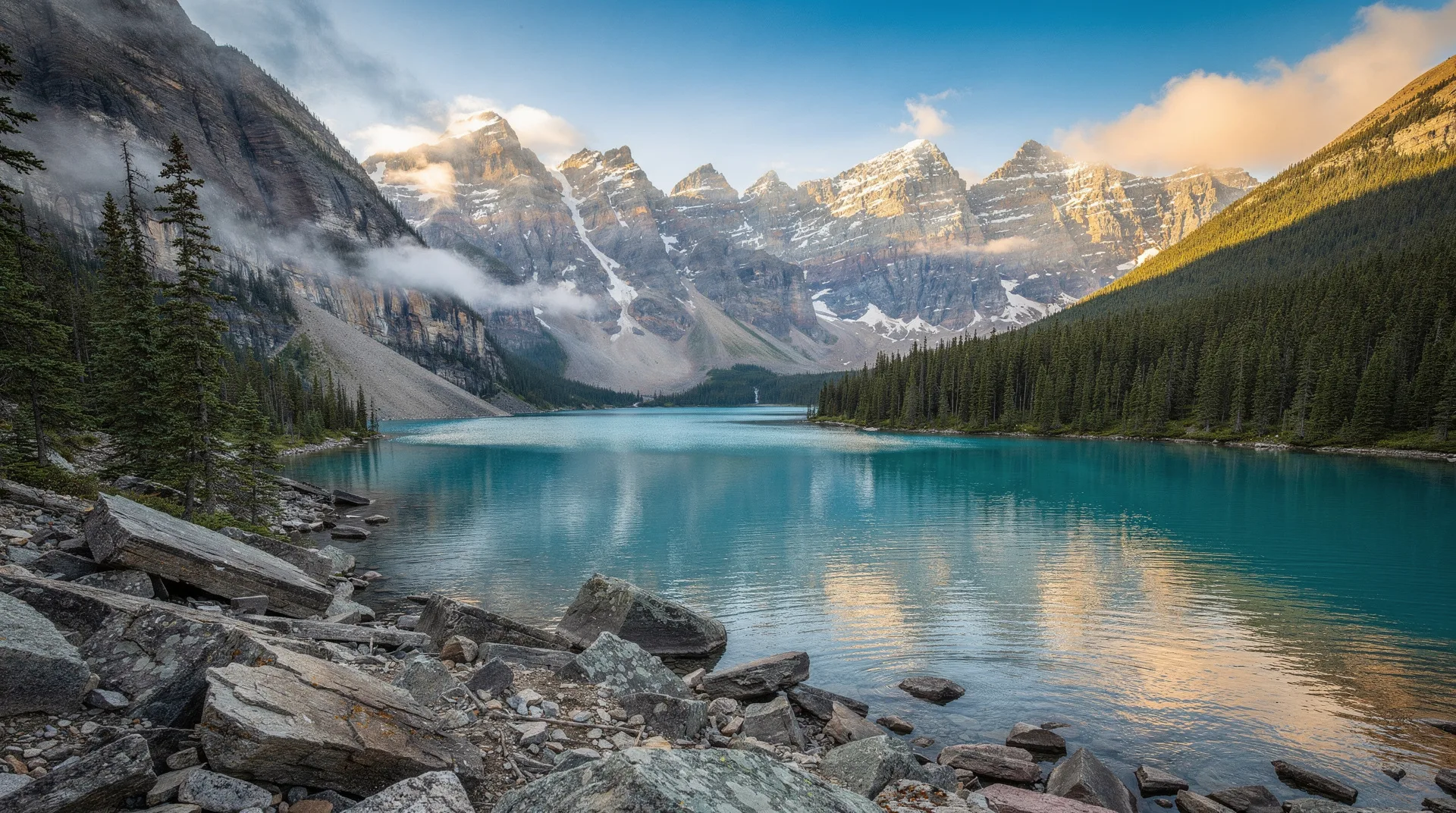
Quick facts
- Located in
- Waterton Lakes National Park, southern Alberta
- Best time
- June to September
- Getting there
- 260 km south of Calgary; 130 km south of Lethbridge
- Days needed
- 2-3 days
Waterton Lakes National Park is the most unusual national park in Alberta. Unlike Banff and Jasper, which are approached through foothills that gradually build to the main mountain ranges, Waterton’s peaks rise directly and abruptly from the flat southern Alberta prairie — a geological collision that produces some of the most dramatic arrival landscapes in Canada. The park is small (525 sq km) but dense with activity: outstanding hiking, exceptional wildlife viewing, a historic townsite, and a boat cruise across an international border.
Combined with Montana’s Glacier National Park to the south, Waterton forms the world’s first International Peace Park and a UNESCO World Heritage Site. The park sees a fraction of Banff’s visitor numbers — a significant advantage for those who find the Banff crowds overwhelming.
| At a glance | |
|---|---|
| Where | Waterton Lakes National Park, southern Alberta, 260 km south of Calgary |
| Cost | Parks Canada Discovery Pass or daily pass required, around CAD 10.50 per vehicle per day |
| Time needed | 2-3 days to see the park properly |
| Getting there | Car required; no public transit to Waterton |
| Best time | June to September; late June-July for wildflowers, September for quieter crowds |
The Waterton townsite
Waterton Townsite is the service hub of the park — a small collection of hotels, restaurants, and shops on the edge of Upper Waterton Lake. The Prince of Wales Hotel, a steeply gabled heritage building on a bluff above the townsite, is one of the most architecturally distinctive buildings in Canada’s national park system and dominates the arrival view into the valley.
The townsite has a visitor centre, a small grocery store, several restaurants, and a handful of accommodation options. The scale is intimate — the entire townsite is walkable in fifteen minutes. In summer, deer wander through the streets, bears are occasionally spotted at the edge of the townsite, and the wind that characterises the area (Waterton is one of the windiest locations in Canada) sweeps up the lake valley at most hours of the day.
The Waterton Lake cruise
The MV International boat cruise is the signature Waterton experience — a 2-hour return trip on Upper Waterton Lake to Goat Haunt, Montana, crossing the Canada-US border by water without a land border crossing. The cruise operates seasonally from Waterton townsite dock (typically mid-May through late September).
The journey south down Upper Waterton Lake delivers remarkable views of the sheer mountain walls on both sides of the lake — including Bear’s Hump directly above the townsite, and the glaciated cirques of the mountains at the lake’s southern end. Goat Haunt, Montana (where the boat turns around or where passengers with appropriate documentation can disembark into Glacier NP) is a remote backcountry outpost accessible only by trail or by the boat.
Note: Disembarking at Goat Haunt requires a valid passport or NEXUS card and US border crossing. Canadian visitors can remain on the boat for the return trip without crossing.
The cruise is the best introduction to the Waterton landscape and the Peace Park concept — the unmarked international border in the middle of the lake is one of the most peaceful border crossings in the world.
Browse guided Alberta national park tours and experiencesRed Rock Canyon
Red Rock Canyon, 15 km northwest of the townsite on Red Rock Parkway, is the most accessible geological spectacle in Waterton — a narrow canyon carved through red and green Precambrian argillite rock, the result of iron oxidation in ancient seafloor sediments deposited over 1.5 billion years ago. The colours are genuine: the deep brick red and sage green stripes are the rock itself, not a trick of light.
A 0.8-km loop trail (flat, paved, wheelchair accessible) circles the canyon. The trail crosses a bridge over the canyon narrows and follows both rims for close-up views of the coloured layers. The canyon is generally walkable in 30-45 minutes.
The Red Rock Parkway itself (the access road from the townsite) is an excellent wildlife corridor — deer, bears, and occasionally wolves are seen along the road, particularly in early morning.
Cameron Lake
Cameron Lake, 16 km southwest of the townsite on Akamina Parkway, sits in a cirque directly on the Continental Divide and international border — the head of the lake is in Montana. The lake’s cold, clear water is a vivid blue-green in good light; the avalanche slopes above the lake on the BC side are prime grizzly bear habitat.
Bear viewing at Cameron Lake is among the most reliable in the Canadian national park system — in June and July, grizzly bears regularly feed on the avalanche slopes above the lake at close enough range to observe with binoculars. The park operates a bear-viewing shuttle from the townsite during peak viewing periods; check with the visitor centre for current programs.
Paddling at Cameron Lake: Canoe and paddleboat rentals are available at the Cameron Lake boathouse. Paddling the lake in the morning, with the cirque walls rising on three sides, is one of the most intimate alpine lake experiences in southern Alberta.
Akamina-Kishinena corridor: The lake is the trailhead for the Akamina-Kishinena backcountry area in BC — some of the most remote terrain in the southern Rockies. Suitable for prepared backcountry travellers only.
Bear’s Hump
Bear’s Hump is the most accessible viewpoint in Waterton — a 2.8-km return hike (240 m elevation gain) from the visitor centre that climbs to the ridge directly above the townsite, delivering a panoramic view over Upper Waterton Lake and the entire southern section of the park. The hike is steep but short; allow 1.5-2 hours return.
From the top, the extraordinary geography of Waterton becomes clear: the mountain ranges dropping directly to the flat prairie visible to the east, the lake stretching south toward Montana, and the Prince of Wales Hotel far below. It is one of the most immediate “mountain gateway” views available from such a short hike in Canada.
Bear’s Hump is exposed and windy — bring a windproof jacket regardless of conditions in the townsite below.
Bison Paddock
The Bison Paddock, on the northeast edge of the park along Highway 6, maintains a small herd of Plains bison on prairie terrain that is representative of the pre-settlement grassland ecosystem. The paddock is viewable from a loop road (driveable or walkable); bison are typically visible year-round.
The paddock represents the ecological connection between Waterton and the broader southern Alberta prairie — Waterton is the only national park in Canada where the prairie, foothills, and mountain ecological zones all meet, giving it an unusual species richness. White-tailed deer, mule deer, pronghorn, and coyotes are frequently seen in the paddock area.
Wildflowers
Waterton has one of the highest concentrations of plant species of any area its size in Canada — over 1,000 species of plants have been recorded in the park, including many species at or near their northern range limits due to the warm Chinook winds that moderate the climate. The wildflower display from late June through July rivals anywhere in the Canadian Rockies.
The wildflower meadows along the Akamina Parkway and on lower trail sections bloom in waves through the summer: glacier lilies emerge as soon as the snow melts in May, followed by Indian paintbrush, wild bergamot, and dozens of species through June and July. The Waterton visitor centre can advise on peak bloom timing during your visit.
Canoeing and kayaking
Upper Waterton Lake is a natural for canoeing and kayaking — the views are exceptional and the lake (when not too windy) is manageable for reasonably experienced paddlers. The wind is the variable: Waterton is regularly very windy (the valley acts as a funnel for winds off the prairie), and paddling in strong winds on a large lake is dangerous. Start early morning when winds are typically calmer.
Cameron Lake (described above) is the calmer, more controlled paddling option with rentals available on site.
Wildlife in Waterton
Waterton’s wildlife list is extensive. The park has one of the highest grizzly bear densities of any national park in Canada. Black bears are also present. Cougars inhabit the mountain terrain. Wolves have recolonised the area. White-tailed deer, mule deer, pronghorn, moose, and bighorn sheep are all commonly seen; pronghorn in particular are frequently visible in the prairie zone near the park entrance.
The Waterton visitor centre (open daily in summer) provides current wildlife sighting reports. Always maintain safe distances: Parks Canada guidelines specify 100 m for bears and wolves, 30 m for other wildlife.
Practical information
Getting there: Waterton is 260 km south of Calgary (2.5-3 hours on Highway 2 South to Highway 5 or 6). From Lethbridge, it is 130 km southwest (1.5 hours). There is no public transit to Waterton — a car is necessary.
Park pass: A Parks Canada Discovery Pass or daily vehicle permit is required. The same Discovery Pass that covers Banff and Jasper is valid here. Daily entry is approximately CAD $10.50 per vehicle.
Accommodation: The Prince of Wales Hotel (historic, premium pricing), Kilmorey Lodge, Waterton Lakes Lodge, and several smaller options are available in the townsite. Crandell Mountain Campground (Parks Canada) provides tent and RV sites. Book accommodation well ahead for summer — the townsite has limited capacity.
Facilities: The townsite has restaurants (the Waterton Lakes Seafood and Steakhouse, Waterton Brew Company, and Zum’s Eatery are visitor favourites), a grocery, bike rentals, and a visitor centre.
Season: The park is open year-round but most services (boat cruise, bear viewing, campgrounds) operate May through October only. Winter visits are possible but facilities are very limited.
Waterton versus Banff and Jasper
Travellers deciding whether to add Waterton to a Rockies itinerary often want a quick comparison against the bigger-name parks.
| Waterton | Banff | |
|---|---|---|
| Size | 525 sq km, compact | Much larger, spread over multiple valleys |
| Crowds | Light even in peak summer | Heavy, especially July-August |
| Signature experience | Cross-border boat cruise, Crypt Lake hike | Lake Louise, Moraine Lake, the Icefields Parkway |
| Getting there | 260 km south of Calgary, car required | Well served by shuttles and tours from Calgary |
| Park pass | Same Parks Canada Discovery Pass as Banff | Same Parks Canada Discovery Pass as Waterton |
For hikers who want the full trail-by-trail breakdown of Waterton, see our best hikes in Waterton Lakes guide. Anyone planning to also visit Banff National Park can review our Banff park pass guide — the same Discovery Pass covers both parks, so it is worth buying once for a combined trip. For wildlife-focused travellers, our bear watching in Canada guide covers etiquette that applies directly to Waterton’s grizzly viewing at Cameron Lake and the Blakiston Valley.
Frequently asked questions
How many days do you need in Waterton Lakes National Park?
Two to three days covers the townsite, the boat cruise, Red Rock Canyon, and Cameron Lake comfortably, with time left for one or two of the major hikes described in our Waterton hiking guide. A single full day is enough to hit the highlights if time is tight.
Is Waterton Lakes less crowded than Banff?
Yes, noticeably. Waterton sees a fraction of Banff’s annual visitors despite similarly dramatic scenery, which is one of its main appeals for travellers who want Rockies views without the peak-season congestion.