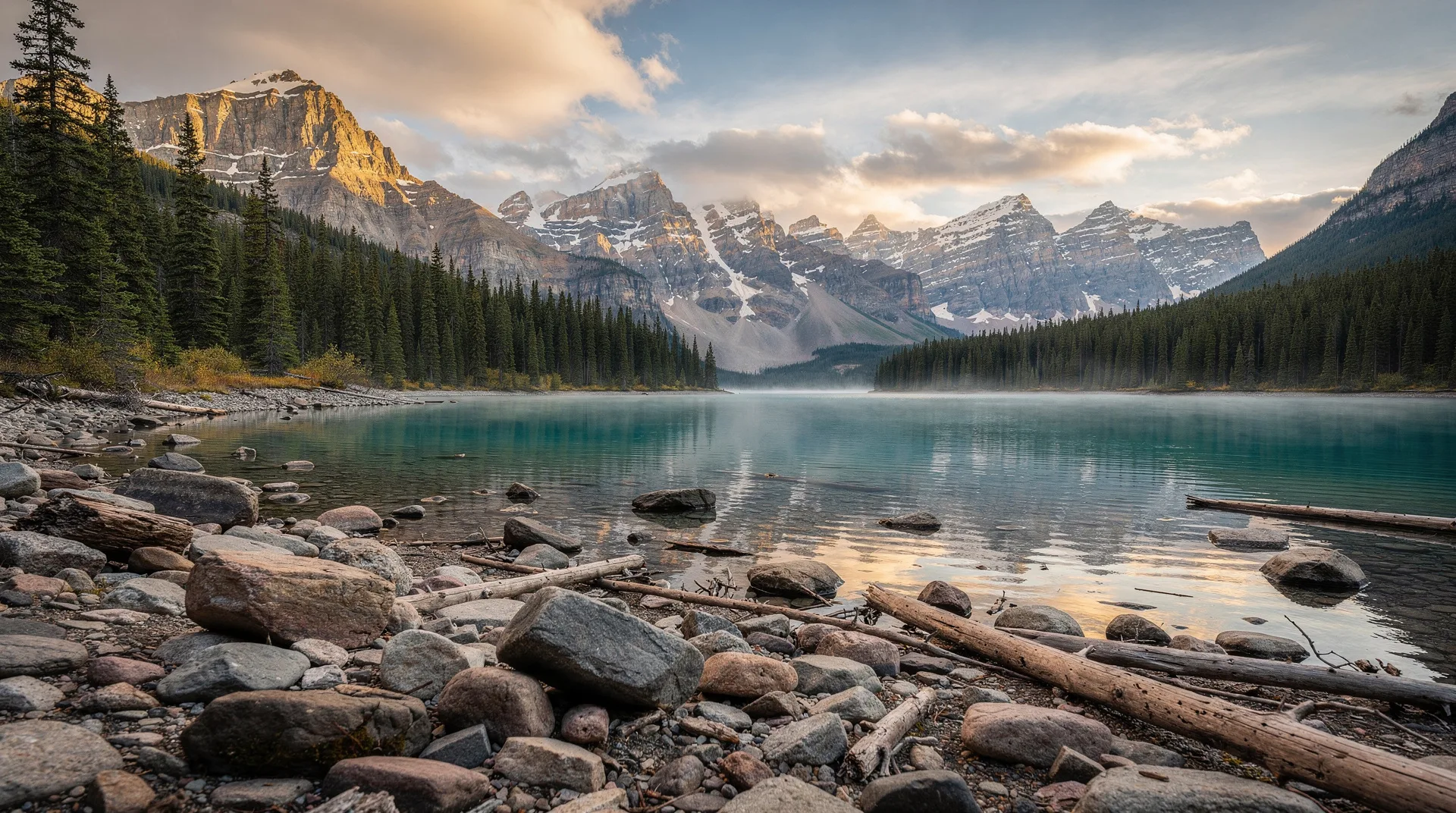
Quick facts
- Located in
- Banff National Park
- From Calgary
- 184 km, approx. 2.5 hours by car
- From Banff town
- 56 km, approx. 45-50 minutes
- Park pass
- Required — daily or annual Discovery Pass
| At a glance | |
|---|---|
| Where | Banff National Park, 184 km from Calgary, 56 km from Banff town |
| Cost | Around CAD $12.25/day park pass, or CAD $83.50 annual Discovery Pass; Moraine Lake shuttle around CAD $8 return |
| Time needed | 2.5 hrs drive from Calgary; 45-50 min from Banff |
| Getting there | Car, Brewster Express shuttle from Calgary, or Roam Transit Route 8X from Banff (seasonal) |
| Best time | Arrive before 7am in summer; shoulder season (May, October) needs no early start |
Getting to Lake Louise is straightforward from Calgary or Banff — the challenge is what happens once you arrive. The Lake Louise parking area is chronically overwhelmed in summer, Moraine Lake Road is closed to private vehicles during peak season, and park pass requirements apply from the moment you enter Banff National Park. Understanding the logistics before you leave makes the difference between a smooth visit and an hour of circling a full parking lot.
This guide covers every transport option to Lake Louise, the summer parking situation in honest detail, and the Moraine Lake access system that trips up many first-time visitors.
From Calgary
Lake Louise village is 184 kilometres west of Calgary International Airport via the Trans-Canada Highway (Highway 1 West). Under normal driving conditions, the journey takes approximately 2.5 hours — longer during summer weekends when the Trans-Canada between Canmore and Banff carries significant traffic.
The route: Trans-Canada Highway (Highway 1) west from Calgary through Cochrane, past Canmore, through the Banff National Park east gate (where you pay park entry fees or show your Discovery Pass), continuing through Banff town and northwest on the Trans-Canada to the Lake Louise interchange. From the interchange, a 5-kilometre access road climbs to the Lake Louise parking area.
Driving tips:
- Fill your tank in Calgary or Cochrane — fuel at Lake Louise is available but more expensive
- Plan to arrive at the lake by 7am or earlier in July and August — the parking lot fills by 7-8am on summer weekends
- The Lake Louise interchange at the Trans-Canada is well-signed; follow signs for “Lake Louise” rather than “Lake Louise Ski Resort”
Shuttle from Calgary: No direct public transit connects Calgary to Lake Louise, but several commercial shuttle services operate the route. Brewster Express (part of Pursuit) runs a scheduled Calgary-Banff-Lake Louise shuttle that picks up at Calgary airport and major downtown hotels. This is the best option for visitors flying into Calgary who don’t want to rent a car.
From Banff town
Lake Louise is 56 kilometres northwest of Banff town — approximately 45-50 minutes on the Trans-Canada. This is the most common way to arrive at Lake Louise, as most visitors use Banff as their primary base.
By car: Straightforward — Highway 1 Northwest from Banff to the Lake Louise interchange.
By Roam Transit: Roam Transit Route 8X operates between Banff and Lake Louise seasonally (late spring through fall). The journey takes approximately 75 minutes and stops at the Lake Louise Park and Ride, which connects to the lake via local shuttles. Roam Transit is an excellent option for car-free travellers or those who want to avoid driving during peak parking pressure. Check current schedules and fares at roamtransit.com.
By Bow Valley Parkway: The scenic alternative to the Trans-Canada is Highway 1A (the Bow Valley Parkway), which runs parallel to the Trans-Canada between Banff and Lake Louise. The parkway is slower (no passing trucks, lower speed limit) but passes through prime wildlife corridor and offers access to Johnston Canyon and Castle Mountain. Allow an additional 30 minutes versus the Trans-Canada. Note: the Bow Valley Parkway may have partial closures in early spring for wildlife corridor management — check Parks Canada for current status.
The parking situation
The Lake Louise parking area is large — and still entirely inadequate for peak summer demand. Understanding the situation prevents frustration:
In summer (June to September): The main parking area fills between 7am and 9am on summer weekends. Arriving after 9am means no parking. Parks Canada operates a Park and Ride system from the Lake Louise village area, with shuttle buses running to the lake when the main lot is full. This shuttle is free but requires a valid park pass.
Strategy for guaranteed parking at the lake:
- Arrive before 7am — the lot is rarely full before this time even on peak weekends
- Alternatively, park at the Lake Louise Park and Ride (at the ski resort base area) and take the shuttle up to the lake
- Consider arriving at 5:30-6am for sunrise photography — the parking lot has available space and the light is exceptional
RV parking: RV parking at the lake is limited and fills even earlier. Overflow RV parking is available at the Park and Ride. The main lake parking area has size restrictions on larger vehicles.
In shoulder season (May, October): Parking is generally available without the summer pressure. Early May and late October may see snow on the access road — check conditions.
In winter (November to April): The ski resort generates significant traffic to the Lake Louise area; the ski resort base parking is separate from the lake. Lake access in winter is generally easier than summer for non-ski visitors.
Book a guided Lake Louise day tour — skip the parking stress entirelyPark passes and entry fees
Banff National Park requires a valid entry pass for all visitors. The park gate on the Trans-Canada Highway east of Banff (the eastern park gate) and the gate on Highway 93 are staffed collection points.
Daily admission: CAD $12.25 per adult, CAD $24.50 per family/group in one vehicle (2025/2026 rates — confirm at Parks Canada website). Valid for one calendar day.
Parks Canada Discovery Pass (annual): CAD $83.50 per adult, with family/group passes available. Valid at all Parks Canada national parks and historic sites across Canada. The Discovery Pass pays for itself in 7 days of park entry at current daily rates — highly recommended for visitors spending a week or more in the Rockies.
Where to buy:
- At the park gates on entry (cash, credit card)
- Online at reservation.pc.gc.ca (best to purchase before arrival, especially if arriving very early)
- Parks Canada visitor centres in Banff and Lake Louise
Important: The park pass covers park entry — it does not include the Moraine Lake shuttle (which has a separate fee).
Getting to Moraine Lake
Moraine Lake is the most logistically complex part of a Lake Louise visit. Access rules change annually, but the core situation as of 2026:
Peak season (typically late May to mid-October): Private vehicles are not permitted on Moraine Lake Road. All visitor access is via Parks Canada shuttle buses departing from the Lake Louise Park and Ride (at the ski resort base). Shuttle tickets cost approximately CAD $8 per person return and must be purchased in advance through the Parks Canada reservation system at reservation.pc.gc.ca.
When to book: Shuttle tickets for July and August go on sale in April and sell out within hours on popular dates. Book the moment tickets become available — 3-4 months ahead minimum for peak dates.
If shuttles are sold out: Commercial guided tours from Banff and Lake Louise have separate vehicle access allocations and are the best backup option. See below for GYG tour links. Alternatively, walking or cycling the 14-kilometre road from the Park and Ride is possible for fit travellers — the road has a significant elevation gain.
Early and late season (before late May, after mid-October): Private vehicles can generally drive directly to Moraine Lake. Early June (when the lake may still be ice-covered) and October (during larch season) are worthwhile times when road restrictions may not apply. Check Parks Canada annually.
Browse Moraine Lake guided tours with guaranteed access when shuttles sell outCycling to Lake Louise
The Bow Valley Parkway (Highway 1A) between Banff and Lake Louise is an excellent cycling route — approximately 56 km, mostly flat, with a few hills, on a road with lower traffic volumes than the Trans-Canada. Roam Transit carries bikes on some services for a one-way cycling option.
Cycling to the lake itself (the 5-kilometre access road from the village) is permitted and provides excellent early morning lake access before the parking lot fills. Bikes can be locked at the lakeshore and do not need a parking space.
The Moraine Lake Road is also open to cyclists in all seasons, including during the summer vehicle restriction period. Cycling to Moraine Lake (14 km from the village, significant elevation gain) is achievable for fit cyclists and guarantees access without requiring shuttle tickets.
By tour from Banff or Calgary
Guided day tours from Banff and Calgary to Lake Louise are an excellent option, particularly for:
- Visitors without a car
- Those who want Moraine Lake access guaranteed (tours have their own vehicle allocations)
- Visitors who want a guide to explain the geology, ecology, and history
Most tour operators combine Lake Louise and Moraine Lake in a single day, often adding the Lake Louise Gondola or Banff stops. See our things to do at Lake Louise guide for activity options.
Key logistics summary
| Journey | Distance | Time | Options |
|---|---|---|---|
| Calgary to Lake Louise | 184 km | 2.5 hrs | Car, Brewster Express shuttle |
| Banff to Lake Louise | 56 km | 45-50 min | Car, Roam Transit Route 8X |
| Lake Louise village to lake | 5 km | 10 min / 45 min walk | Car, shuttle, walk |
| Lake Louise to Moraine Lake | 14 km | 20 min | Shuttle only (summer) |
Choosing a base: Calgary, Banff, or Lake Louise village itself
Where you sleep the night before matters more than the drive itself. Basing in Banff town keeps the drive to 45-50 minutes and gives access to Roam Transit, making an early arrival much less punishing than a 2.5-hour pre-dawn drive from Calgary. Staying in Lake Louise village itself — see where to stay at Lake Louise — removes the drive entirely and is the only way to reliably beat the 7am parking cutoff without an alarm before dawn. Calgary-based day trips are workable but demand the earliest starts and leave the least buffer if traffic or weather slows the Trans-Canada.
Frequently asked questions about Getting to Lake Louise
Can I skip the Moraine Lake shuttle by hiking in instead? Yes — walking or cycling the 14-kilometre road from the Park and Ride is allowed and avoids the ticket system entirely, though it adds significant time and elevation gain compared to the shuttle, and isn’t realistic for most travellers on a tight schedule.
Does the Lake Louise parking situation apply in winter too? Less so. Winter traffic concentrates around the ski resort’s separate base parking, and lake access for non-skiers is generally easier than in summer, though snow and ice add their own driving considerations on the access road.