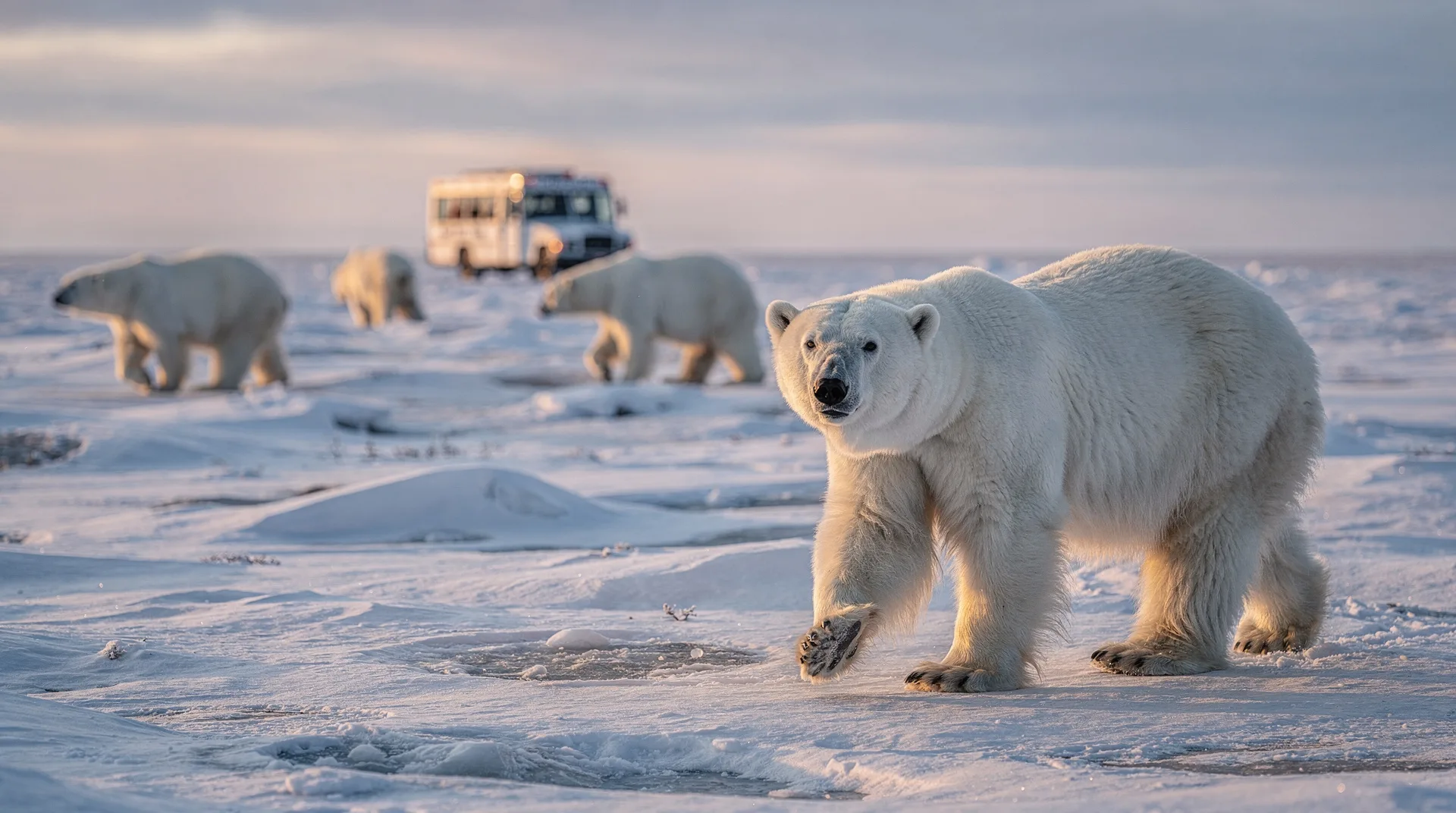
Churchill polar bears: what it's really like
I had been told to expect the cold. Several people, unprompted, mentioned the cold when I said I was going to Churchill in late October. “You can’t really prepare for it,” one person told me, which turned out to be true in the best possible way — not because the cold was worse than I’d imagined, but because the experience it framed was more extraordinary than I’d imagined, and the cold was simply part of that.
Churchill, Manitoba sits at the edge of Hudson Bay in the sub-Arctic, roughly 1,000 km north of Winnipeg. It is accessible only by air or by a two-day train journey on VIA Rail — there is no road. Its winter lasts the better part of eight months. Its permanent population is around 900 people. And every autumn, as the Hudson Bay begins to freeze, it hosts one of the most dramatic and accessible wildlife spectacles on earth: the congregation of polar bears waiting for the sea ice to form so they can return to hunting seals.
This is what it’s actually like.
| At a glance | |
|---|---|
| Where | Churchill, Manitoba, on Hudson Bay, roughly 1,000 km north of Winnipeg |
| Best time | Mid-October to mid-November for peak bear numbers |
| Cost | Around CAD $3,000-5,000 per person for a 4-5 day trip including flights, accommodation and a tundra tour |
| Getting there | Fly from Winnipeg (about 2 hours) or Via Rail (around 45 hours); no road access |
| Book ahead | Months in advance — hotel and tour capacity is limited in bear season |
Getting there and what to expect on arrival
Most visitors fly from Winnipeg on a propeller aircraft that makes the 1,000 km journey in about two hours. The landscape below transitions from boreal forest to sub-Arctic tundra to the vast, horizon-filling grey of Hudson Bay. Landing at Churchill’s small airport in late October involves stepping into cold that is immediately and physically different from anything most temperate-climate travellers have experienced.
The town itself is small and functional rather than picturesque. Main Street has a handful of hotels, restaurants, and outfitter shops. The Polar Bear Alert Program office, run by Manitoba Conservation, is where bears that wander too close to town are live-trapped and held in the “polar bear jail” (officially the polar bear holding facility) until the ice forms. The atmosphere in Churchill during bear season is one of contained excitement — everyone here is here for the same reason, and the collective anticipation makes the experience more social than I’d expected.
Book accommodation months in advance. Churchill’s hotel stock is limited, and October–November bear season books out quickly. Once your rooms are secured, you can compare Churchill tours and activities and reserve the ones that suit your dates.
If you are still deciding between the plane and the rails, the Churchill how-to-get-there guide compares both routes, and the Hudson Bay train guide describes what the long rail journey is like. Before you commit, the Churchill cost guide helps you build a realistic budget.
The tundra vehicle: the centrepiece of the experience
The defining feature of Churchill polar bear viewing is the tundra vehicle — a bus-sized vehicle on enormous tyres, elevated a metre off the ground, designed to travel safely over the tundra and to get close to polar bears without disturbing them. Tour operators take vehicles out onto the tundra east of Churchill, where bears congregate along the Hudson Bay coast, and spend several hours watching bears in their natural environment.
The tundra buggy day trip from Churchill is the most popular format — a full day on the tundra with an expert naturalist guide, getting close to bears as they wait for the ice. Some operators also offer multi-day “tundra lodge” experiences where you sleep in a vehicle parked overnight on the tundra — waking to bears moving around the vehicle in the early morning is apparently a profound experience, though expensive.
For a closer look at the vehicles themselves and how the different operators compare, see the Churchill tundra buggy guide and the roundup of the best tours in Churchill. If this is your first time planning a trip around bears, the Churchill polar bears guide covers the practical side in more depth.
What the tundra vehicle experience actually delivers: you will very likely see polar bears. Churchill’s bear concentration in October and early November makes sightings reliable in a way that wildlife experiences rarely are. The question is not usually whether you’ll see bears but how many and how close.
The first bear I saw was sleeping in the tundra willows about 20 metres from the vehicle. It looked enormous and strangely domestic — a large, pale dog napping in the scrub. Then it woke up, stood on its hind legs to sniff the vehicle, and resolved into something else entirely. Polar bears are the largest land carnivore on earth. At full height, facing you, even from inside a reinforced vehicle on elevated tyres, they reassert their position at the top of the food chain in a way that produces an entirely involuntary physical response.
We saw eight bears that day. Four adults, including two sparring males working out their dominance hierarchy in the slow-motion shoving match that juvenile males use to practice fighting skills during the food-scarce autumn waiting period. Two subadults investigating a piece of kelp on the shore. A mother with a cub at distance, the cub’s white coat blending with the snow patches on the tundra until movement betrayed it.
The cold as a physical experience
Churchill in late October ranges from around -5°C to -20°C, with wind chill pushing the feels-like temperature lower. This is not the deepest cold that Churchill experiences — winter proper brings -30°C and below — but it is genuinely severe for most visitors.
The tundra vehicles are heated inside. The windows open for photography. The challenge is standing on the vehicle’s outdoor observation platform for extended periods, which is where the best photographs happen and where the cold becomes a full-body negotiation. After fifteen minutes on the observation deck in a -15°C wind, even with proper gear, you retreat inside to warm up, then go out again. You develop a rhythm.
Proper clothing is non-negotiable. This means: a base layer of merino wool or synthetic thermal underwear; a mid layer of fleece or down; a wind and waterproof outer shell; heavyweight mittens over liner gloves; a balaclava; goggles or glacier glasses for wind; rubber boots rated to -40°C or heavy-duty insulated winter boots. The outfitters in Churchill hire or sell cold-weather gear — if you’re not confident in your kit, rent locally.
If you are travelling later in the season, the Churchill in November guide explains how the conditions change as the bay begins to freeze, and the packing list is a useful starting point for building your layering system.
The cold is also part of the experience. Churchill in bear season is not a comfortable tourism package with mild inconvenience. It is genuinely sub-Arctic, and the harshness of the environment is part of why the bears are there and part of what makes the experience feel real rather than theatrical.
Churchill through the season
| Period | Bears | Weather | Notes |
|---|---|---|---|
| Early October | Building numbers along the coast | Around -5°C to 0°C | Fewer crowds, still good sightings |
| Mid-late October | Peak concentration | Around -10°C to -20°C | Best balance of bear numbers and daylight |
| Mid-November | Bears moving onto forming ice | Around -20°C and falling | Last reliable window before the ice thickens |
| July-August | Bears absent, belugas present | Mild, around 10-20°C | Beluga snorkelling season instead |
| December-March | Deep winter, bears gone | Below -30°C possible | Not a bear-viewing season |
For the aurora-focused visitor, the aurora best time guide covers viewing windows in more detail, and the Churchill destination guide has logistics for both the polar bear and beluga seasons.
Beyond the bears: what else Churchill offers
The aurora borealis is visible from Churchill on clear nights throughout autumn and winter. Churchill sits at the edge of the auroral oval, and the dark skies away from any significant light pollution make aurora viewing conditions excellent. Several nights during our visit produced strong displays — curtains of green and occasional pink that started around 10 pm and lasted for hours. The combination of polar bears by day and aurora by night makes Churchill one of the most concentrated wildlife and nature experiences available anywhere.
The beluga whales that congregate in the Churchill River estuary in July and August have left by October, but if you’re planning a summer visit, beluga snorkelling — swimming with thousands of curious, friendly belugas in shallow water — is one of the most extraordinary wildlife encounters available in Canada. The beluga kayaking guide for Churchill describes the summer side of the town for anyone who would rather skip the cold.
The town’s history is interesting: Churchill’s strategic position on Hudson Bay made it an important fur trade post for the Hudson’s Bay Company and later a Cold War-era military site. The remains of Fort Prince of Wales, a massive stone fortification built by the HBC in the eighteenth century, sit on a spit of land across the bay from town, accessible by boat in summer.
Is it worth the cost?
Churchill polar bear trips are expensive. The flight from Winnipeg, accommodation, and a tundra vehicle tour together can easily total CAD $3,000–5,000 per person for a four-to-five day visit, and multi-day tundra lodge experiences run significantly higher. It is one of the more expensive wildlife experiences in Canada.
My honest answer is yes, for the right kind of traveller. If wildlife encounters are central to why you travel — if seeing animals in genuinely wild environments rather than in curated reserves is important to you — then Churchill delivers something that has very few equivalents anywhere in the world. The bears are wild, the environment is not staged, and the scale of what you’re witnessing (a large predator waiting for the seasonal shift that will allow it to hunt again) connects you to something genuinely primal.
It is not for everyone. The cold, the expense, and the logistical complexity put it out of reach for casual travellers. Protecting the investment matters too, so read up on travel insurance for Canada before you pay for anything non-refundable, and look at the five-day Churchill itinerary if you want a ready-made shape for the trip. But for those who make the trip, Churchill tends to be not just the highlight of a Canadian trip but one of the highlights of a travelling life.
The Churchill destination guide has more detailed information on logistics, operators, and the best times to visit for different wildlife experiences.
Final thoughts
I took a photograph on my last morning in Churchill — a male bear sitting on the tundra at sunrise, backlit, the Hudson Bay behind him in the early light, the first thin skim of ice forming at the bay’s edge. He was looking toward the ice with an attitude that I am probably projecting human intent onto, but that looked exactly like waiting for something you know is coming.
That image — the bear, the ice forming, the bay — is probably the most accurate representation I have of what Churchill actually is: a place where you witness something ancient and enormous continuing on its own terms, indifferent to the small bus-sized vehicle full of people watching from 15 metres away.
Frequently asked questions about Churchill polar bears: what it’s really like
When is the best time to see polar bears in Churchill?
Mid-October to mid-November is peak season, when the largest number of bears are concentrated along the coast waiting for the ice. The bears begin arriving in early October and progressively move onto the ice as the bay freezes, typically in mid-to-late November. Late October is the sweet spot for both bear numbers and daylight hours.
How do I get to Churchill?
By air from Winnipeg (about 2 hours) or by train on VIA Rail’s Winnipeg–Churchill route (about 45 hours). The train journey is an experience in itself — two days through the boreal forest and tundra — but most visitors fly given the time investment. Calm Air and Perimeter Airlines operate the route.
Do I have to use a tour operator, or can I explore independently?
Independent exploration on the tundra is not safe — polar bears wander freely around Churchill, including into town. Most tundra viewing is done with licensed tour operators in tundra vehicles with experienced guides. Walking around town is fine during the day with awareness, but guided tours are strongly recommended for any tundra excursion.
Can I see polar bears from Churchill town?
Sometimes, yes. Bears occasionally wander into or near town, particularly during the peak season. The Polar Bear Alert Program patrols actively and bears are deterred or trapped when they get too close to residential areas. For reliable viewing at close range, a tundra vehicle tour is necessary.
What should I do about northern lights viewing in Churchill?
The best strategy is to book a late-night aurora viewing tour or simply to be outdoors on clear nights. The aurora is typically strongest between 10 pm and 2 am. Many hotels have aurora alert services that wake guests when activity is strong. Dress for the cold — aurora viewing means standing still in sub-Arctic temperatures.
Is Churchill safe to visit given the polar bear population?
Yes, with normal precautions. The Polar Bear Alert Program actively monitors and deters bears from town, tour operators use enclosed, elevated tundra vehicles, and independent tundra exploration is simply not attempted. Walking around town during the day is fine with basic awareness; guided transport is used after dark in bear season.