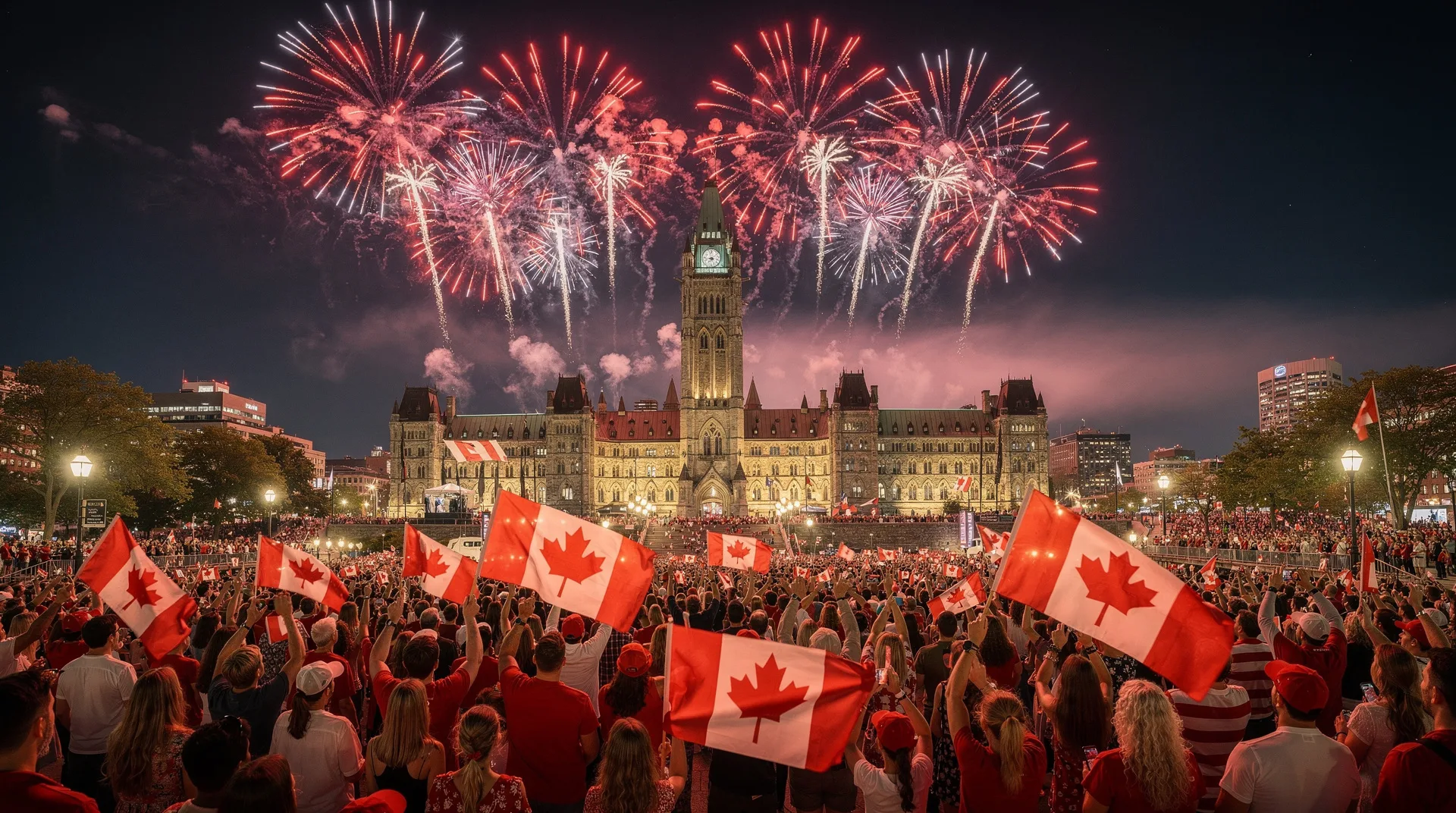
Canada Day celebrations across the country
Canada Day on July 1st is the country’s national holiday — the anniversary of Confederation in 1867, when the British North America Act brought the Province of Canada, Nova Scotia, and New Brunswick together into a single federation. It’s marked differently in different parts of the country, from the enormous formal celebrations on Parliament Hill in Ottawa to beach parties in Vancouver to small-town fireworks over lake water in every province.
For travellers in Canada on July 1st, the day is an opportunity to see Canadian culture expressed in a specifically national register — the particular combination of pride, self-deprecation, and genuine pleasure in summer that characterises Canadian public life at its most relaxed.
| At a glance | |
|---|---|
| When | July 1st every year (Monday observed if it falls on a Sunday) |
| Cost | Most public programming is free; fireworks and street events don’t require tickets |
| Best cities | Ottawa for the official ceremony, Vancouver for the waterfront, small towns for something intimate |
| Book ahead | Accommodation in major cities months in advance for peak pricing and availability |
| Weather | Warm summer conditions nationwide, roughly 18-30°C depending on region |
Ottawa: the national celebration
The official national celebration takes place on Parliament Hill in Ottawa — the seat of federal government and one of Canada’s most architecturally impressive locations. The hill overlooks the Ottawa River, with Quebec visible on the far bank, and the Gothic Revival Parliament buildings provide a backdrop that manages to be both formal and beautiful.
The day’s programming on Parliament Hill includes military ceremonies, speeches from the Prime Minister and Governor General, live music across multiple stages, and a major fireworks display over the Ottawa River at night. Attendance typically reaches hundreds of thousands, and the atmosphere combines genuine civic pride with the cheerful informality of a summer festival.
Practical notes for Ottawa’s Canada Day:
The hill itself is a pedestrian zone on July 1st; arrive on foot or by transit. The OC Transpo bus system runs enhanced service; parking within easy walking distance is limited and expensive. Arrive early for the best positions for the evening fireworks.
The Byward Market neighbourhood east of the hill is excellent for food before or after the main events — restaurants and market stalls operate throughout the day. Major Canadian chains like Tim Hortons typically run Canadiana promotions on July 1st.
Quebec City on the Quebec side of the Ottawa River holds its own celebrations, and the bridge crossing on July 1st is a genuinely bi-cultural experience — Canada Day on one side, Saint-Jean-Baptiste Day (June 24th, Quebec’s own fête nationale) still fresh in memory on the other.
Vancouver: Canada Day on the water
Vancouver celebrates Canada Day primarily around the waterfront and False Creek — the inlet that runs through the heart of the city. Canada Place, on the downtown waterfront, is the focal point for official programming including live music, cultural performances, and a fireworks display over Burrard Inlet.
The real Vancouver Canada Day experience, however, is dispersed. The Granville Island area, Vanier Park, and the beaches along English Bay fill with picnickers, musicians, and informal celebrations. The seawall — the 28 km waterfront path that runs from Coal Harbour to Kitsilano — is particularly animated. Stanley Park’s beaches are full; kayak and paddleboard rentals are popular.
The fireworks in Vancouver on July 1st are coordinated with the city’s waterfront location for maximum effect — the display over Burrard Inlet, with the North Shore mountains as backdrop, is one of the more spectacular municipal fireworks shows in Canada.
Vancouver boat tours and harbour experiences on July 1st offer a water-level view of both the city and the fireworks — worth considering if you want to experience the celebration from a different angle.
Toronto: celebrations across the city
Toronto’s Canada Day programming spreads across multiple sites. Mel Lastman Square in North York and Woodbine Park in the east end are two traditional celebration hubs; Nathan Phillips Square (City Hall) runs programming that reflects the city’s remarkable cultural diversity. Harbourfront Centre on the lake runs a full day of programming with free admission to many performances.
The Toronto Islands are a popular Canada Day destination for residents — ferry access from the mainland is extremely busy on July 1st, with long queues from mid-morning onward. The islands themselves are pleasant in July, with beaches and picnic areas that become very full. If the islands are your destination, take the first available ferry and plan to stay for the day.
The Niagara Falls area, two hours south of Toronto, runs its own Canada Day celebrations and the falls are particularly well illuminated on July 1st. Day tours from Toronto to Niagara Falls on Canada Day include the celebrations and illumination as part of the experience — the combination of the falls and the holiday atmosphere is worth the trip.
Montreal: a celebration with complicated context
July 1st in Montreal — and in Quebec generally — carries some complexity. The province’s own national day (Saint-Jean-Baptiste, June 24th) is more prominently and enthusiastically celebrated in Quebec than Canada Day, which some Québécois see as a more ambivalent occasion. July 1st is also, coincidentally, Moving Day in Quebec — the traditional date on which most residential leases end, producing a citywide annual moving chaos that local media covers with bemused exhaustion every year.
Montreal does celebrate Canada Day, and the Old Port (Vieux-Port) area runs outdoor programming and fireworks. The celebrations are genuine, particularly among Montreal’s large anglophone and immigrant populations. But they sit alongside a distinct Québécois identity that doesn’t always experience July 1st as “its” celebration in the way other provinces do.
This complexity is itself worth understanding. Canada Day in Quebec City, where the linguistic and national identity dynamics are expressed most clearly, is an interesting place to observe Canadian civic culture in its full complexity — the flags, the French language everywhere, and the specific negotiations of identity that have defined Canadian politics for a century and a half.
Small-town Canada Day
Some of the most genuinely Canadian Canada Day experiences happen not in the major cities but in small towns and communities across the country. The format is consistent and reassuring: a parade down the main street with the local fire truck and school band and Lions Club float; a pancake breakfast at the community hall; lawn games at the park; a local band in the evening; fireworks over a lake or a field at 10pm.
Banff townsite in Banff National Park runs a Canada Day celebration that benefits from the town’s mountain setting — the parade down Banff Avenue against the backdrop of Mount Rundle and Cascade Mountain is legitimately photogenic, and the evening’s fireworks over the Bow River are spectacular. The park itself is extremely busy around July 1st; accommodation and shuttle bookings need to be secured well in advance.
Prince Edward Island’s towns celebrate Canada Day with the particular warmth of a small province that is both genuinely proud of its Confederation history (the Charlottetown Conference of 1864 that created Canada took place on the island) and small enough that community events feel genuinely communal.
Victoria, BC — with its British colonial heritage architecture and gardens — celebrates Canada Day on the Inner Harbour with a naval character and formality that reflects the city’s distinct identity. The maritime heritage and the gardens of the Empress Hotel in July make Victoria’s Canada Day one of the most visually attractive in the country.
Canada Day and Indigenous perspectives
Canada Day has a complicated relationship with Indigenous perspectives on Canadian history. For many First Nations, Métis, and Inuit peoples, July 1st marks not a founding to celebrate but a colonial moment that preceded and caused significant harm to Indigenous communities. This is increasingly acknowledged in official programming — Parliament Hill has in recent years included Indigenous ceremonies and programming in the national celebration, and discussions about how to observe Canada Day in a manner that acknowledges the full complexity of Canadian history continue.
Travellers visiting Canada on July 1st in the context of a broader interest in Indigenous tourism may find that some Indigenous communities observe the day differently from the mainstream Canadian celebration. This is worth understanding as part of the full picture of Canadian national identity rather than as a complication to be avoided.
Other cities worth considering
Calgary’s Canada Day celebrations sit in the shadow of the much bigger Calgary Stampede, which starts a few days later in July — but the city still runs solid programming downtown and along the Bow River. Halifax celebrates on the waterfront with a maritime character that fits the city well, and it’s a natural stop if you’re also planning time on the Cabot Trail or elsewhere in Atlantic Canada.
Charlottetown, Prince Edward Island’s capital, leans into its Confederation history harder than almost anywhere else in the country, since the 1864 conference that led to Canada’s founding took place there — worth combining with a PEI itinerary if the island is on your route. Winnipeg’s celebrations at The Forks are underrated: a genuinely central gathering spot with a strong local turnout and less crowding than the biggest cities.
Building Canada Day into a longer trip
If July 1st lands partway through a bigger Canada trip, it’s worth planning around it rather than trying to be in a specific city that day. A Rockies itinerary that has you in or near Banff on July 1st gets a genuinely good small-town celebration for free. An Ontario-Quebec road trip timed to be in Ottawa on the day gets the biggest official show but also the biggest crowds and priciest accommodation of the whole trip.
Practical Canada Day planning
Book early: July 1st in any major Canadian city means accommodation at peak prices and peak occupancy. Book months in advance for the best options.
Transportation: Major celebrations produce transit surges. Use public transit in Ottawa, Toronto, and Vancouver; driving near any celebration site on July 1st involves significant parking difficulty and slow traffic.
Weather: July 1st falls in the heart of Canadian summer. Toronto and Montreal are warm and humid (25–30°C typical); Vancouver is warm and dry (20–25°C); Ottawa varies (18–28°C); Atlantic Canada is pleasant (20–24°C). Mountain locations like Banff can see afternoon thunderstorms. Pack for summer weather; carry a light rain layer in the mountains.
Children: Canada Day is an excellent family travel day. The public celebrations are designed for all ages, admission to most programming is free, and the festive atmosphere is genuinely child-friendly. The fireworks run late (9:30–10:30pm in most cities to align with darkness at Canadian summer latitudes), which may affect younger children.
Final thoughts
Canada Day is a good day to be in Canada. The country is large and self-conscious enough that its national holiday doesn’t tip into aggressive nationalism — the celebrations are cheerful, warm, and somewhat ironic in the Canadian way (there will be Tim Hortons jokes; someone will apologise for something). The fireworks are excellent and they happen late under long summer skies.
If you’re planning a Canada trip and July 1st falls within your dates, lean into it rather than treating it as a logistical complication. The extra crowds are worth the specific experience of a country celebrating itself in summer.
Frequently asked questions about Canada Day celebrations across the country
Where is the biggest Canada Day celebration?
The official national celebration on Parliament Hill in Ottawa is the largest in terms of formal programming and typically draws hundreds of thousands of people. Celebrations in Toronto and Vancouver are also very large. The “biggest” experience depends on what you’re after — Ottawa for the official ceremony; Vancouver for the waterfront setting; small-town Canada for something more intimate.
Is Canada Day a public holiday?
Yes. July 1st is a statutory holiday in Canada. If it falls on a Sunday, the following Monday is observed as the holiday. Most businesses, government offices, and banks are closed; restaurants and tourist attractions typically operate with holiday hours. Parks and outdoor spaces are very busy.
Are the Parliament Hill fireworks visible from around Ottawa?
The fireworks are best viewed from Parliament Hill itself or from the Alexandra Bridge over the Ottawa River. The display is large enough to be partially visible from elevated locations around the city, including from Gatineau on the Quebec side. The hill itself provides the complete experience and the best viewing angle.
Can I wear red and white on Canada Day?
Yes, and it’s encouraged. Red and white are Canada’s national colours, and wearing them on July 1st is completely normal. Canadian flags, maple leaf clothing, and red-and-white face paint are common at celebrations. The dress code is festive and casual — Canada Day is a summer event.
What if I’m in a small town on Canada Day?
Genuinely good. Small-town Canada Day celebrations — the parade, the community breakfast, the local music, the fireworks over the water — capture something about Canadian life that the major city events, for all their scale, don’t quite match. If you happen to be in a small Canadian town on July 1st, go to the events. You’ll be welcome.
Is Canada Day the same as the Calgary Stampede?
No. Canada Day is a single-day national holiday on July 1st, while the Calgary Stampede is a separate ten-day rodeo and festival that usually starts a few days later in July. Calgary marks Canada Day with its own smaller downtown celebration, then shifts into Stampede mode shortly after — don’t plan a trip around one expecting the other.