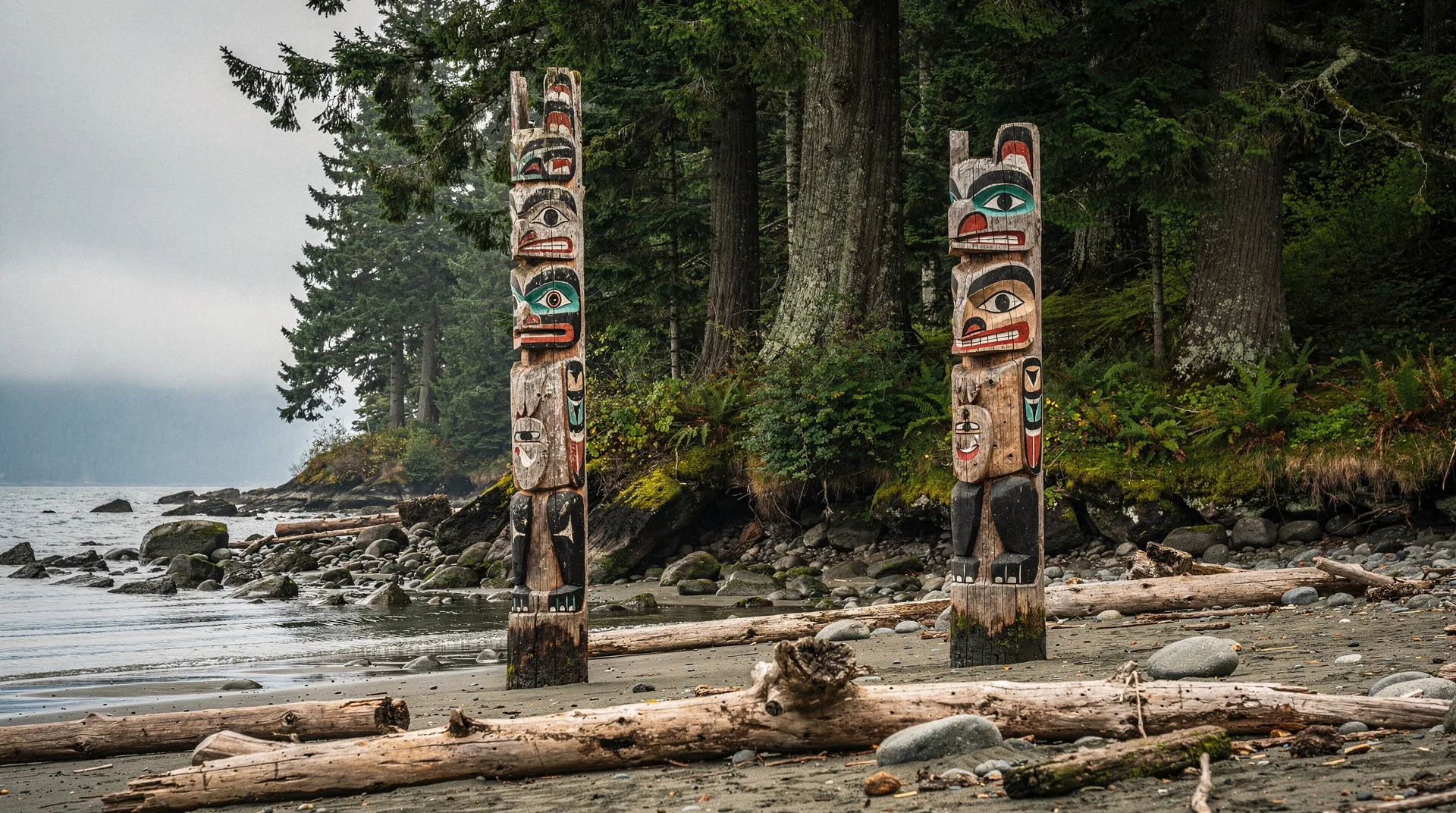
Indigenous tourism experiences across Canada
Canada’s Indigenous peoples — First Nations, Métis, and Inuit — represent over 630 distinct communities, speaking more than 70 languages, with territories that span the country from the Pacific coast to the Arctic, from the Great Lakes to the Atlantic. Tourism experiences led by Indigenous people on their own lands represent some of the most meaningful travel available in Canada — not because they are picturesque (though they often are), but because they offer context and relationship that no museum can fully replicate.
The sector has grown significantly in the past decade, driven partly by reconciliation discussions following the Truth and Reconciliation Commission’s 2015 Calls to Action, which explicitly mentioned tourism as a mechanism for economic development and cultural exchange. The experience today ranges from small community-run programs offering a few hours of cultural engagement to sophisticated multi-day wilderness expeditions that happen to be led by people who have lived on that land for generations.
This guide aims to orient travellers who want to engage genuinely — understanding how to find authentic operators, what to expect, and why these experiences are different in kind from conventional tourism.
| At a glance | |
|---|---|
| Where | Nationwide, with strong clusters in coastal BC, the Prairies, and the Arctic |
| Cost | Urban cultural tours around CAD $50-150/person; multi-day or Arctic fly-in programs from CAD $300/day and up |
| Time needed | A few hours for an urban cultural tour; several days for wilderness or Arctic community programs |
| Getting there | Varies widely — city transit for urban experiences, flights plus local transport for remote community programs |
| Best time | Summer (June-August) for most regions; late September-October in Atlantic Canada; October-November for Churchill polar bear season |
Regional comparison at a glance
| Region | Type of experience | Typical access |
|---|---|---|
| Haida Gwaii, BC | Guided heritage sites, Haida Watchmen | Ferry or small plane, permit required |
| Prairies (Alberta, Saskatchewan) | Métis and Blackfoot cultural sites, historic events | Self-drive from Calgary or Regina |
| Ontario and Quebec | Powwows, cultural centres, hotel-museums | Self-drive or transit from Toronto or Montreal |
| Arctic and subarctic | Sea ice travel, carving, throat singing | Fly-in from Winnipeg or Yellowknife |
| Atlantic Canada | Mi’kmaq heritage parks, canoe journeys | Self-drive from Halifax |
What authentic Indigenous tourism looks like
The most important marker is that the experience is led by Indigenous people, on their own territory, in a way they have designed and control. This seems obvious but is frequently not what gets labelled as “Indigenous tourism.”
Authentic operators will typically identify the specific nation (Haida, Anishinaabe, Cree, Inuit of a specific community, etc.) rather than using generic pan-Indigenous branding. The guide or host will have a personal and familial relationship to the territory and the cultural practices being shared. The experience will have been developed by community members rather than by external tourism operators using Indigenous aesthetics.
The Indigenous Tourism Association of Canada (ITAC) maintains a directory of certified Indigenous-owned and operated tourism businesses. Indigenous Tourism BC (InBC) does the same for the province. These registries are the most reliable starting point for finding genuine operators.
Pacific Northwest: Haida Gwaii and the BC coast
Haida Gwaii — the archipelago off the northern BC coast, formerly called the Queen Charlotte Islands — is one of Canada’s most remote and most compelling destinations. The Haida Nation has managed its territory with exceptional sovereignty and intentionality, and the tourism experience on the islands reflects this. Visitors to Gwaii Haanas National Park Reserve (a collaboration between Parks Canada and the Council of the Haida Nation) must travel with a licensed guide — and the best guides are Haida Watchmen, hereditary knowledge holders whose families have been connected to specific sites for generations.
The totem poles and longhouse remains at sites like Skedans, Tanu, and Ninstints (a UNESCO World Heritage Site) are presented by people who understand them not as historical artefacts but as living presences connected to their own family histories. The difference between this and reading the same information in a museum is significant.
The broader BC coast has excellent Indigenous tourism operators in Vancouver itself — the Bill Reid Gallery of Northwest Coast Art is operated in partnership with Indigenous artists, and several tour operators run experiences on the water and in the urban context that connect the city’s Musqueam, Squamish, and Tsleil-Waututh history with the contemporary landscape.
The prairies: Métis culture and plains history
The Métis — a distinct people descended from the intermarriage of European fur traders and First Nations women, primarily in the prairies and Great Lakes region — have a cultural tradition that is uniquely North American: a mixture of Indigenous and French-Canadian elements that produced a distinct language (Michif), a distinct music tradition (fiddle music and jigging), and a distinct national identity that was suppressed for much of Canadian history.
Métis tourism in Alberta and Saskatchewan has developed steadily in recent years. The Batoche National Historic Site in Saskatchewan — where the 1885 North-West Resistance led by Louis Riel came to its end — is Parks Canada operated but interpreted with substantial Métis community involvement. The annual Back to Batoche celebration each July is the largest Métis cultural gathering in Canada and is open to visitors.
In Alberta, the Métis Crossing Cultural Site near Smoky Lake is a dedicated Métis cultural tourism facility — interpretive programs, traditional food experiences, accommodation in the historic setting, and events throughout the year. It is one of the most intentionally designed Indigenous tourism experiences in western Canada.
The plains First Nations — Blackfoot Confederacy (Siksika, Kainai, Piikani), Cree, Nakoda/Stoney, and others — have their own tourism operations, including the Head-Smashed-In Buffalo Jump World Heritage Site, interpreted by Blackfoot guides who explain the site’s significance from within the tradition rather than from outside it.
Ontario and Quebec: Anishinaabe and Haudenosaunee territories
The Great Lakes region is Anishinaabe (Ojibwe, Odawa, Potawatomi, Algonquin) and Haudenosaunee (Six Nations Iroquois Confederacy) territory, and has a well-developed Indigenous tourism sector that benefits from proximity to Canada’s largest population centres.
Wikwemikong on Manitoulin Island — the world’s largest freshwater island, in Lake Huron — is an unceded First Nations reserve with a well-established cultural tourism program. The Wikwemikong Cultural Festival in August is one of the largest powwows in Ontario and draws visitors from across the continent.
The Six Nations of the Grand River reserve near Brantford, Ontario is the most populous First Nations reserve in Canada and has community-run cultural programs including the Woodland Cultural Centre, which addresses both the rich Haudenosaunee cultural tradition and the painful history of the residential school system — the former Mohawk Institute residential school building is preserved as a historic site with guided interpretation.
In Quebec, the Huron-Wendat Nation operates the Hôtel-Musée Premières Nations near Quebec City — a hotel and cultural centre that offers guided tours, traditional cuisine, and a genuine introduction to Huron-Wendat culture that goes beyond the performance-for-tourists model. Staying at the hotel itself is the most immersive option.
The Arctic and subarctic: Inuit and Cree territories
The most extraordinary Indigenous tourism experiences in Canada are also the most remote. Churchill, Manitoba — accessible by train or fly-in from Winnipeg — is a small subarctic community that sits in the traditional territory of the Cree and is home to the Sayisi Dene community, whose history of forced relocation and subsequent community recovery is documented and interpreted in the town.
Churchill is internationally famous for polar bear viewing (October-November) and beluga whale watching (July), but the cultural dimension of visiting a living northern Indigenous community adds a depth that the wildlife alone doesn’t provide. Churchill Tundra Buggy experiences take you into the polar bear territory in a way that balances wildlife access with safety and environmental care.
The Inuit communities of Nunavut — the territory that covers a fifth of Canada’s land mass — are increasingly accessible through small-group fly-in tourism. Pangnirtung, Pond Inlet (Mittimatalik), and Clyde River (Kangiqtugaapik) all have community-run tourism programs offering sea ice travel, cultural programs, and interactions with carvers, printmakers, and throat singers. These are not easy or inexpensive trips, but they access a way of life and a landscape that has no equivalent.
In the Yukon, Indigenous tourism is well developed: the Tr’ondëk Hwëch’in, Champagne and Aishihik, Kluane, and other First Nations all have tourism programs operating from their territories. The Northern Tutchone Cultural Camp near Haines Junction offers immersive programs in traditional knowledge, wilderness skills, and oral tradition.
Aurora viewing tours in the Yukon increasingly incorporate First Nations knowledge of the northern lights — the Kluane First Nation’s understanding of the lights as spiritual phenomena adds a dimension to the sky-watching experience that meteorological explanation doesn’t provide. Yukon aurora tours can be combined with Indigenous cultural programming for a complete northern experience.
Atlantic Canada: Mi’kmaq territory
The Mi’kmaq Nation’s traditional territory covers all of Nova Scotia, PEI, New Brunswick, Newfoundland, and parts of Quebec and Maine — one of the more geographically expansive First Nations territories in eastern Canada. Mi’kmaq cultural tourism is increasingly available, though less developed than the BC or prairie sectors.
The Membertou Heritage Park in Sydney, Cape Breton, is operated by Membertou First Nation — the first Indigenous community in North America to receive ISO 9001 certification — and offers cultural interpretation, traditional crafts, and guided experiences. The Eskasoni Cultural Journeys program from Eskasoni Mi’kmaq Nation offers canoe journeys, traditional plant knowledge walks, and storytelling programs in Cape Breton Highlands.
Combining Indigenous tourism with a wider itinerary
Most of these experiences work best woven into a broader regional trip rather than treated as a single isolated stop. A Mi’kmaq cultural half-day fits naturally alongside a wider Cape Breton loop that also takes in the Cabot Trail. Métis Crossing pairs well with an Edmonton-based Alberta itinerary, and the Huron-Wendat Hôtel-Musée near Quebec City works as an overnight stop on a Quebec City visit. In the north, Churchill’s cultural and polar bear programs are typically booked as a single multi-day package — see the Churchill polar bears guide for how the logistics usually work.
How to travel responsibly
A few principles for engaging with Indigenous tourism respectfully:
Ask before photographing. In many communities, photography of cultural ceremonies, sacred sites, and individuals is restricted. Ask, and respect the answer.
Understand the history. Canada’s relationship with its Indigenous peoples is complex and marked by significant injustice — residential schools, forced relocation, and cultural suppression. Engaging with Indigenous tourism without any understanding of this history produces a shallow experience. The National Centre for Truth and Reconciliation website provides accessible introductions.
Support Indigenous-operated businesses. The economic argument for booking with Indigenous-owned operators is part of the point — tourism revenue staying within communities rather than flowing to outside operators is a concrete form of economic reconciliation.
Be a learner, not a consumer. The best Indigenous tourism experiences are exchanges, not performances. Coming with curiosity and humility, and leaving with more questions than you arrived with, is the right orientation.
Final thoughts
Indigenous tourism in Canada is not a niche interest — it is access to living cultures that have the longest continuous relationship with this landscape of anyone. The knowledge held in these communities about the land, the animals, the plants, and the patterns of weather and season is irreplaceable.
Travelling with that intention, and with the right operators, produces experiences that reorient how you see Canada. The mountains look different when someone whose ancestors have named every peak in their language explains what the name means. The Arctic sea ice looks different when you’re out on it with a hunter who can read its surface the way you read a road map.
Frequently asked questions about Indigenous tourism experiences across Canada
How do I verify that an Indigenous tourism operator is genuinely Indigenous-owned?
Check the Indigenous Tourism Association of Canada (ITAC) certified operator database, or the regional equivalents (Indigenous Tourism BC, Indigenous Tourism Ontario, etc.). Certified operators have gone through a verification process. You can also simply ask the operator directly — a genuine Indigenous-owned business will be proud to identify the specific community, the founders, and the community relationship.
Are Indigenous cultural tourism experiences appropriate for children?
Most are designed to be multigenerational. Cultural programs, traditional food experiences, and guided nature experiences are typically excellent for families. Specific programs like vigorous wilderness expeditions have age and fitness requirements. Ask operators about what works for the ages in your group.
What should I expect to pay for Indigenous tourism experiences?
Prices vary widely by type and region. Urban cultural tours run CAD $50–150 per person. Wilderness expeditions with cultural components can range from CAD $300–1,000+ per day. Remote fly-in programs in the Arctic or Haida Gwaii involve significant additional travel costs. The pricing often reflects the genuine costs of operating in remote communities with limited infrastructure.
Is it appropriate to participate in ceremonies as a visitor?
Some ceremonies are open to respectful visitors; many are not. The key is to follow the guidance of your Indigenous host or guide. Never assume that being present at a cultural event means you have permission to participate — wait for an explicit invitation. This guidance applies equally to photography during any ceremonial context.
Can I visit Indigenous communities without a formal tour?
In many cases, yes — particularly communities near major tourist destinations. The respectful approach is to seek out community-operated visitor services (cultural centres, campgrounds, craft shops) rather than simply entering a community expecting an informal experience. Wikimapit and similar resources map Indigenous community services across Canada.
Do I need to book Indigenous tourism experiences far in advance?
Urban half-day and full-day tours can often be booked a few days ahead. Remote and fly-in experiences — Haida Gwaii’s Gwaii Haanas permits, Arctic community programs, Torngat Mountains base camp access — need to be arranged weeks to months ahead because of limited capacity, weather-dependent flights, and permit processes.