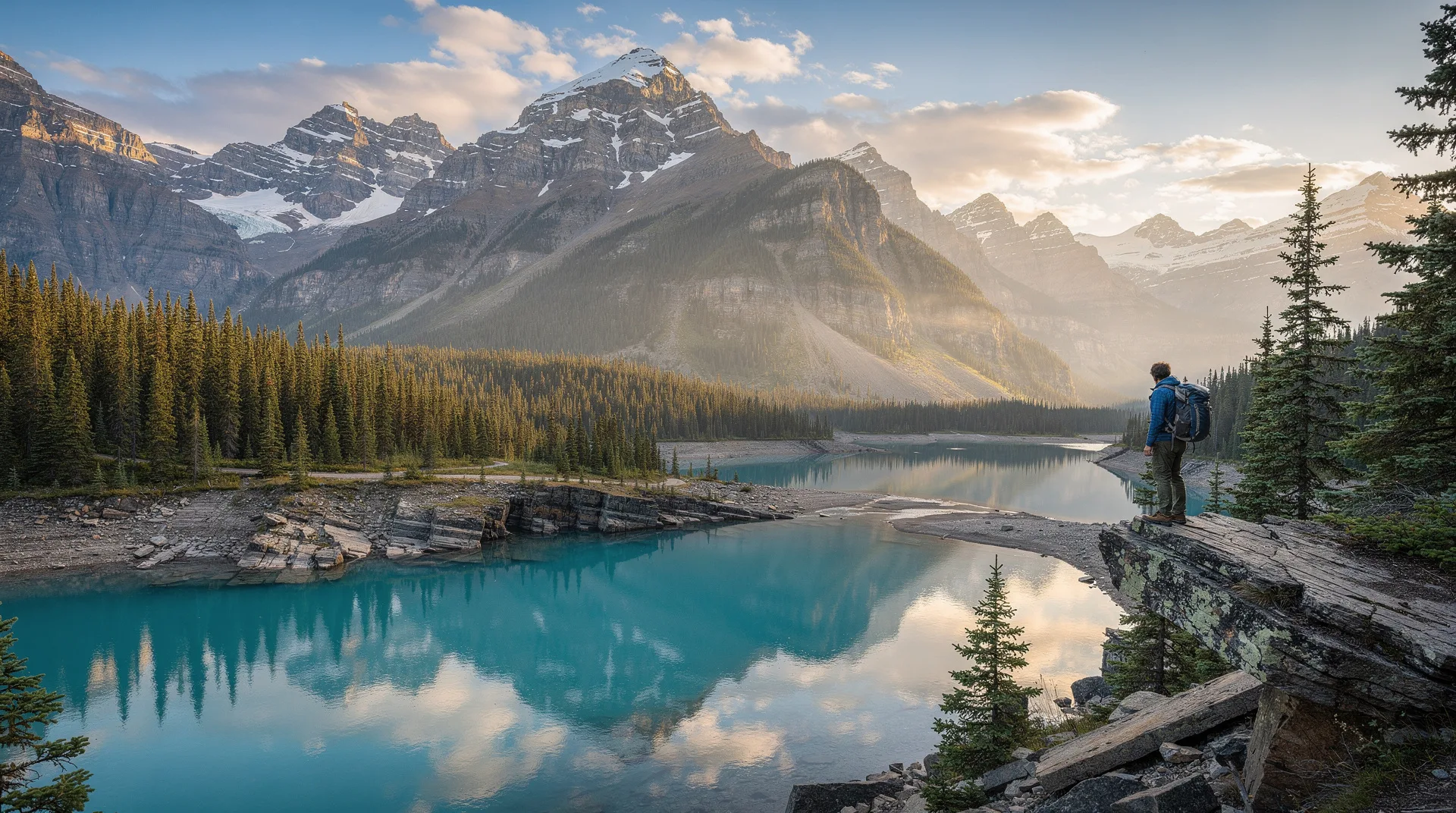
Adventure Canada: 14 days of adrenaline and wild landscapes
This itinerary is built for people who find their best days outdoors, tired, and fully alive. Over 14 days it moves from the heart of the Canadian Rockies — where the hiking is extraordinary, the glaciers are still accessible on foot, and wildlife encounters are common — across to the Pacific coast, where you can spend a morning surfing exposed North Pacific swells at Tofino and an afternoon in a sea kayak among harbour seals. The driving is part of the experience; the Icefields Parkway between Banff and Jasper is one of the great scenic drives in the world, and the highways of British Columbia pass through scenery that demands stops.
The philosophy here is sustained physical engagement: every day involves meaningful movement, whether that is a long ridge hike, a technical climb, a multi-hour paddle, or a sustained mountain bike descent. Rest days are built in not for laziness but for recovery and exploration at a slower pace. The itinerary is structured for active adults with reasonable fitness and some outdoor experience — you do not need to be an elite athlete, but you should be comfortable with long hiking days and open to trying activities you haven’t done before.
At a glance
- Total driving distance: approximately 2,800 km (Calgary to Vancouver, with significant detours)
- Base fitness required: comfortable with 20+ km hiking days and 6+ hours of sustained activity
- Key highlights: Plain of Six Glaciers hike, Icefields Parkway, Athabasca Glacier walk, Tofino surf, Squamish rock climbing intro, Whistler Bike Park, Sea-to-Sky Highway
- Estimated cost: CAD 3,500–5,500 per person (accommodation, car hire, activities, food — excluding international flights)
- Pace: active — 1 to 2 rest/exploration days built in across the two weeks
- Best season: June to September; July and August for peak conditions everywhere
Day-by-day itinerary
Day 1: Calgary arrival and Banff
Fly into Calgary International Airport and collect your rental car — a key piece of this itinerary, so confirm the booking well in advance for summer travel. Drive west on the Trans-Canada Highway (Highway 1) for 90 minutes to Banff. The mountains appear on the western horizon as you leave Calgary and grow rapidly as you approach the park gate.
Afternoon: Check in to accommodation in Banff townsite or Canmore (15 minutes east of the park gate, cheaper, and a good alternative). Drive to Lake Louise — 57 kilometres west of Banff on Highway 1 — for the afternoon. Even a 45-minute lakeside walk sets the scale of the Rockies emphatically.
Evening: Dinner in Banff townsite. The town has a solid range of restaurants for a mountain resort; Saltlik and The Bison are consistently good. Start early tomorrow — the Rockies reward early risers who beat the crowds to the trailheads.
Where to stay: Canmore has better value than Banff townsite. Basecamp Resorts, the Malcolm Hotel, and several independent hostels serve the adventurous visitor well.
Day 2: Banff — Plain of Six Glaciers and Lake Agnes
Today is a full mountain day. Drive to Lake Louise and take the Lakeshore Trail from the Chateau Lake Louise hotel to the Plain of Six Glaciers teahouse — one of the finest hikes in the Rockies, approximately 13 kilometres return with 365 metres of elevation gain. The route follows the upper lake, enters a moraine landscape, and ends at a stone teahouse built by Swiss mountain guides in 1924, with views of the Victoria Glacier’s lower face directly above.
Afternoon option: Add the Lake Agnes Tea House loop on the return (adds 4 km and 300m elevation) for a full-day circuit. Lake Agnes sits in a mountain bowl above Lake Louise with a teahouse built in 1901 — tea and scones at 2,135 metres is one of Canada’s better-value experiences.
Total distance: 13–21 km depending on route chosen. Start no later than 8am to beat the crowds and afternoon thunderstorms.
Evening: Return to Banff or Canmore. Stretch, eat well, hydrate.
Day 3: Banff — Sulphur Mountain, canyon hikes, and hot springs
A slightly less demanding day to vary the intensity. Hike Sulphur Mountain via the trail (5.5 km one way, 655m elevation gain) rather than the gondola — the views from the summit boardwalk over the Bow Valley are earned views, and the descent by gondola saves the knees. Total 3–4 hours.
Afternoon: Johnston Canyon (24 km west of Banff) offers canyon hiking on fixed walkways bolted to the canyon walls, reaching the Lower Falls in 1.1 km and the Upper Falls in 2.7 km. In summer the falls are spectacular; in winter they freeze solid and the canyon fills with ice climbers.
Evening: Banff Upper Hot Springs, directly below the gondola summit, are a legitimate recovery tool rather than a tourist gimmick — the sulphur-mineral pool at 37–40°C on a cool mountain evening is genuinely restorative after two days of hiking.
Day 4: Icefields Parkway — Banff to Jasper
Today is a driving day, but calling the Icefields Parkway (Highway 93) a “driving day” undersells it considerably. The 230-kilometre route between Lake Louise and Jasper is consistently ranked among the great scenic drives on earth, passing continuous mountain scenery, glaciers, turquoise lakes, and wildlife.
Morning: Peyto Lake viewpoint (the most photographed turquoise lake in the Rockies, and justifiably so) is 40 km north of Lake Louise. Arrive before 9am to avoid the crowds. The colour — an almost implausible electric blue — comes from glacial flour suspended in the meltwater.
Midday: The Columbia Icefield Discovery Centre at kilometre 103 (approximately 2.5 hours from Lake Louise) is the jumping-off point for the Athabasca Glacier.
Browse Banff and Icefields Parkway guided experiencesWalk the public moraine path to the glacier toe (free, 1 km, goes to the terminus) or book an ice explorer tour onto the glacier surface. The ice explorer takes modified Snow Coaches onto the glacier itself, where you can walk on 400-metre-deep ice and drink glacial meltwater. The experience is commercially organised but genuinely extraordinary — this is one of the most accessible glaciers in North America and it is visibly receding year by year.
Afternoon: Continue north to Sunwapta Falls (spectacular two-tiered falls on the Sunwapta River) and Athabasca Falls (powerful canyon falls at the junction of Highway 93 and 93A) before arriving in Jasper townsite.
Where to stay in Jasper: The Jasper Inn, Pyramid Lake Resort, or Whistlers Campground (the largest in Canada’s national parks, bookable through Parks Canada).
Day 5: Jasper — Skyline Trail (Day 1)
The Skyline Trail is widely considered the finest multi-day hike in the Canadian Rockies — 44 kilometres above treeline with continuous views of the Rockies, caribou country, and the Columbia Icefield from the ridge. Two days on this trail are the centrepiece of the adventure itinerary.
Day 1: Drive to the Maligne Lake trailhead (48 km east of Jasper) and begin hiking north toward Curator Lake. The first section climbs through forest before breaking above treeline into open alpine terrain. Curator Lake campground (approximately 17 km, 920m gain) is the first overnight stop — a Parks Canada designated campground with bear boxes and outhouses. Permits are required (book through Parks Canada well in advance for July and August).
The alpine scenery from the ridge above Curator Lake is immediate and dramatic. Wildlife on the Skyline is excellent: caribou, grizzly bears, ptarmigan, and hoary marmots are all regularly encountered. Move slowly and enjoy the ridgeline.
Day 6: Jasper — Skyline Trail (Day 2)
The second day of the Skyline traverses the trail’s highest and most exposed section — the aptly named The Notch (2,510m), where the trail crosses a rocky pass with vertiginous views in both directions. The full second day runs approximately 27 km from Curator Lake to the Signal Mountain trailhead, where a car shuttle (pre-arranged) or taxi returns you to Jasper.
Alternative for those not doing overnight: The Bald Hills above Maligne Lake are an excellent day hike (13 km return, 480m gain) with high-quality views over the lake and surrounding peaks. Maligne Lake itself is worth a morning — boat tours to Spirit Island (one of the most photographed lakes in the Rockies) run through the summer.
Evening in Jasper: Recovery dinner and an early night. Two days of sustained mountain hiking earns proper food — Jasper Brewing Company or Nourish Bistro are reliable choices.
Day 7: Jasper rest/adventure day — kayaking or rafting
A day to choose your own adventure from Jasper’s considerable menu of water-based activities.
Option A — Whitewater rafting: The Athabasca and Sunwapta Rivers offer several grades of whitewater within an hour of Jasper. The Upper Athabasca has family-friendly sections; the Sunwapta Canyon run involves Class III-IV rapids and is suitable for those with some whitewater experience or a high tolerance for being cold and wet. Multiple operators run half-day and full-day guided trips departing from Jasper.
Option B — Maligne Canyon icewalk (winter) / canyon hike (summer): Maligne Canyon (8 km east of Jasper) is the deepest canyon in the Canadian Rockies — 50 metres deep in places, with the Maligne River disappearing underground at the canyon bottom. In summer, a series of bridges crosses the canyon at various depths. In winter, it freezes solid and ice walking tours descend into the canyon on the ice.
Option C — Rest day in Jasper: Explore the townsite, visit the Jasper-Yellowhead Museum, or drive the Pyramid Lake Road for reflective mountain lake scenery.
Depart Jasper afternoon: Drive west toward British Columbia, taking Highway 16 toward Prince George and then south. This leg transitions the itinerary from the Rockies to the coast.
Day 8: Kamloops or Kelowna overnight — transition day
The drive from Jasper to the coast takes two to three days unless you fly. Day 8 is a transit day through the BC Interior. Kamloops is the practical midpoint; Kelowna, in the Okanagan wine country, offers better food and lakeside atmosphere.
If time and budget allow, an alternative is to fly from Edmonton or Calgary to Vancouver, eliminating the two-day drive. This compresses the itinerary but sacrifices the BC Interior drive through the Fraser Canyon — which is significant scenery in its own right.
Kelowna alternative: If you are passing through the Okanagan, the wine country along the east side of Okanagan Lake deserves a stop. An evening at a Mission Hill or Quail’s Gate winery, with the lake below and the desert landscape of the valley walls, is a long way from Jasper’s boreal forests.
Day 9: Sea-to-Sky Highway and Squamish
Drive south through the Fraser Canyon (Highway 1) to Vancouver, then north on Highway 99 — the Sea-to-Sky Highway — to Squamish (67 km north of Vancouver). The Sea-to-Sky corridor, particularly the section above Horseshoe Bay where the highway hugs cliff faces above Howe Sound before climbing into the mountains, is one of Canada’s most dramatic highway drives.
Squamish: The climbing capital of British Columbia. The Stawamus Chief — a massive granite monolith rising 652 metres above the town — is one of the top rock climbing destinations in North America, drawing climbers year-round. The Chief’s accessible faces have routes ranging from beginner single-pitch to multi-day big wall routes.
Afternoon activity — intro climbing at Squamish: Book a half-day guided rock climbing introduction through one of Squamish’s several guiding companies. No experience required; guides provide all equipment and instruction. The experience of moving on real granite with an experienced guide in this setting is excellent even for complete beginners.
Shannon Falls Provincial Park, adjacent to the Chief, has a 335-metre waterfall visible from the parking lot and accessible by a 10-minute walk — a worthwhile stop.
Where to stay: Squamish has a surprisingly good accommodation scene for its size. The Executive Suites Hotel and Resort has a pool and hot tub; the Squamish Adventure Inn is the best hostel on the Sea-to-Sky corridor.
Day 10: Whistler — mountain biking, gondola, and village
Drive north from Squamish to Whistler (60 km, 45 minutes). Whistler Blackcomb is the largest ski resort in North America by skiable area, but in summer it transforms into a world-class mountain biking and hiking destination: the lifts run upward, the mountain opens its slopes to downhill riders, and the alpine terrain is accessed on foot through meadows of wildflowers.
Morning — Whistler Mountain Bike Park: If you have any mountain biking experience, book a half-day on the bike park. Rentals (bikes, full-face helmets, body armour) are available at the base. Beginner and intermediate trails are genuinely rideable with reasonable fitness; you progress at your own pace through progressively technical terrain. The experience of riding purpose-built flow trails through the coastal mountain forest is exhilarating.
Afternoon — Peak 2 Peak Gondola and Whistler Peak: Ride the Whistler Gondola to the mountain peak, then take the Peak 2 Peak Gondola across to Blackcomb. The Peak 2 Peak spans 3 kilometres between the two peaks at 436 metres above the valley floor — the longest unsupported gondola span in the world. The views over the Coast Mountain Range on a clear day extend to the Pacific.
Browse Vancouver and Sea-to-Sky guided adventure experiencesEvening in Whistler village: The pedestrian village at the base is car-free, attractive, and lively in summer. The Bearfoot Bistro is the standout fine dining option (worth the splurge mid-trip). Garfinkel’s is the main après-ride bar.
Day 11: Drive to Tofino via ferry and Pacific Rim
Today involves one of the great logistical pleasures of the BC coast: the BC Ferries crossing from Horseshoe Bay (north Vancouver) to Nanaimo on Vancouver Island (1 hour 40 minutes), followed by a 3-hour drive across Vancouver Island to Tofino on the west coast.
Drive south from Whistler to Horseshoe Bay, arriving in time for the mid-morning sailing. Book BC Ferries vehicle reservations well in advance — summer sailings fill weeks ahead. The crossing threads through Howe Sound and the Gulf Islands; stand on deck for the arrival at Nanaimo.
From Nanaimo, Highway 4 crosses Vancouver Island through Cathedral Grove (a magnificent stand of ancient Douglas fir, some over 800 years old and 9 metres in circumference — a 30-minute stop that is genuinely moving) before descending to the coast at Pacific Rim National Park Reserve.
Arrival in Tofino by late afternoon: Drop gear at accommodation and walk down to the beach. The Pacific ocean here — Long Beach, the main surfable stretch — runs for 16 kilometres of exposed west-facing sand with consistent swells and the feel of genuine ocean at the edge of the continent.
Where to stay in Tofino: Wya Point Campground (on the beach, Indigenous-operated by the Ucluelet First Nation, one of the best camping spots in Canada) or Middle Beach Lodge (cedar lodge in the forest above the water, excellent). Book months in advance for July and August.
Day 12: Tofino — surfing, sea kayaking, and bears
A full day on the wild coast of Vancouver Island.
Morning — surf lesson: Tofino is Canada’s surf capital. The Pacific swells arrive consistently from the open ocean and Long Beach and Cox Bay provide beginner-friendly breaks with enough power to be exciting. Several surf schools (Pacific Surf School, Surf Sister are the most reputable) offer 2-hour lessons for beginners. Boards and wetsuits are provided. Water temperature year-round is cold enough to require a 3/2mm or 4/3mm wetsuit.
Afternoon — sea kayaking or whale watching: Two options. A half-day guided sea kayak tour through the Clayoquot Sound estuary provides intimate access to harbour seals, bald eagles, blue herons, and, seasonally, humpback whales in the outer sound. Alternatively, join a whale watching boat tour departing from the Tofino docks — grey whales are present March through October; humpbacks arrive in summer and are now resident through the season.
Wildlife note — black bears: Black bears are commonly seen on Tofino’s beaches in summer, foraging in the kelp and surf grass at low tide. The bear activity is managed by local wildlife monitors, and bears have learned to coexist with beach walkers at a respectful distance. Seeing a black bear 50 metres down the beach while surfing is an entirely normal Tofino experience.
Evening: Dinner at Shelter (the best restaurant in Tofino, consistently) or Wolf in the Fog (James Beard-nominated chef, wild Pacific ingredients).
Day 13: Tofino to Victoria — west coast trail alternative
Drive back across Vancouver Island to Victoria (approximately 4.5 hours). Stop again at Cathedral Grove on the return if you skipped it eastbound.
Afternoon in Victoria: The Inner Harbour, afternoon tea at the Fairmont Empress (a genuine BC institution), and a walk through Beacon Hill Park to the southern tip of the island, where the Strait of Juan de Fuca opens up with views to the Olympic Mountains of Washington State.
For those with extra energy, a short whale watching excursion from the Inner Harbour provides a bookend wildlife experience to Tofino: orca (killer whales, both resident and transient pods), humpbacks, and harbour porpoise are regularly encountered.
Where to stay in Victoria: Inn at Laurel Point (excellent harbour views, striking contemporary architecture) or the Fairmont Empress (iconic, if the budget allows).
Day 14: Victoria to Vancouver and departure
Take the BC Ferries sailing from Swartz Bay (30 km north of Victoria) to Tsawwassen (south of Vancouver). The ferry runs multiple times daily; the 1-hour-35-minute crossing through the Gulf Islands is consistently enjoyable.
Drive to Vancouver International Airport (approximately 45 minutes from the Tsawwassen terminal). If your departure is late afternoon or evening, Vancouver’s Stanley Park is directly en route and deserves a final hour — the seawall loop provides one of the more memorable urban farewell walks available.
Return your rental car at the airport and depart.
Budget breakdown
All costs are per person in Canadian dollars, assuming two people sharing accommodation:
| Category | Budget range (CAD) |
|---|---|
| Car rental (14 days, including insurance) | 900–1,400 |
| Fuel (approximately 3,000 km total) | 300–450 |
| Accommodation (14 nights) | 1,000–1,800 |
| Food and drink | 700–1,000 |
| National park passes (Discovery Pass, annual) | 75 |
| Activities (glacier, climbing, surfing, gondola, kayaking) | 600–900 |
| BC Ferries (2 crossings, vehicle) | 200–280 |
| Skyline Trail permits | 30–50 |
| Total | 3,500–5,500 |
International flights are not included. The Discovery Pass (annual Parks Canada pass, CAD 83.50 per adult) covers entry fees to all national parks including Banff, Jasper, and Pacific Rim — buy it on arrival.
Booking tips and logistics
Car rental: Book as early as possible — summer car rental in Calgary is a genuine constraint. Major chains are at the airport. Confirm the vehicle can be returned in Vancouver if you plan a one-way trip (one-way drop fees apply but are manageable).
National park accommodation: Whistlers Campground (Jasper) and campgrounds in Banff fill weeks ahead in summer. The Parks Canada reservation system opens in spring; set a reminder.
Skyline Trail: Backcountry permits open for reservation in January–February for the following summer. If the Skyline is a priority, this is non-negotiable — permits sell out.
BC Ferries: Vehicle reservations on peak summer sailings (particularly Horseshoe Bay to Nanaimo) are essential. Book through the BC Ferries app.
Tofino accommodation: Book months ahead for any July or August travel. Tofino’s accommodation is small in scale and in very high demand.
Variations and alternatives
Winter version: Swap the hiking for skiing (Banff, Jasper, Whistler), replace Tofino surfing with storm-watching (the west coast swell is largest in winter), and add Yellowknife for aurora viewing. The adventure is no less intense, just colder.
Extend the Rockies: A third week could add the Berg Lake Trail in Mount Robson Provincial Park (the most dramatic hiking in the Rockies by many accounts), or the Yoho Valley loop from Lake Louise (Takakkaw Falls, the Iceline Trail, Emerald Lake).
Replace driving with flying: The Jasper-to-Whistler driving days (Days 7-8) can be replaced by a flight Edmonton or Calgary to Vancouver, saving two days at the cost of the Interior BC scenery.
Going deeper on the key stops
Several days in this route have a full guide of their own, worth reading before you lock in dates. The Lake Louise day pairs naturally with the Plain of Six Glaciers hike and the Lake Agnes tea house hike, which explain the trail options in more detail than a single itinerary day can. For the Sulphur Mountain day, the Sulphur Skyline trail guide and the Banff Upper Hot Springs guide cover the recovery side of the day.
The drive north is easier to plan with the Icefields Parkway stops guide, and the Jasper days benefit from the Skyline Trail guide and the Jasper rafting guide. On the coast, the Stawamus Chief hike is a good companion to the Squamish climbing day, the Whistler bike park guide helps you choose your riding level, and the Tofino surfing guide covers what to expect in the water.
Gear and fitness preparation
This itinerary is genuinely demanding, and the right preparation makes the difference between an itinerary that feels earned and one that feels punishing. In the two months before departure, aim for at least two hiking sessions a week of 90 minutes or more, ideally with a loaded daypack (8-10 kg) to simulate trail conditions. Break in hiking boots well ahead of time — a two-week trip is the wrong place to discover a blister problem on Day 2.
Pack layered clothing rather than a single heavy jacket: mountain weather on the Icefields Parkway and around Jasper can shift from warm sun to sleet within an hour, even in July. A lightweight waterproof shell, a fleece mid-layer, and moisture-wicking base layers cover most conditions. Bear spray is essential for the Skyline Trail and any backcountry hiking around Banff National Park — buy it locally on arrival (it cannot be flown in) and know how to use it before you need to.
Fitness levels and how to scale the trip down
Not everyone wants two consecutive days on the Skyline Trail, and the itinerary flexes without losing its character. Swapping the overnight Skyline traverse for the Bald Hills day hike above Maligne Lake removes the permit dependency and the backcountry camping gear entirely, while keeping the alpine payoff. Travellers who prefer supported adventure over self-guided backcountry nights can also look at the shorter Banff and Jasper 7-day itinerary or the more moderate 10-day Canadian Rockies itinerary, both of which cover similar ground with fewer overnight treks and more flexibility for rest days.
For a coastal-only version that drops the Rockies altogether, the 7-day British Columbia itinerary covers Whistler, Squamish, and Vancouver Island at a gentler pace, and pairs well with a separate Rockies trip later. Families or first-timers wanting the headline sights without the physical intensity should compare against the standard 14-day itinerary, which covers more ground with less daily elevation gain.
Is this itinerary right for you?
This itinerary suits you if you are comfortable hiking 15–25 km in a day, are willing to try new outdoor activities, and consider physical challenge part of the travel experience rather than something to manage around. You should be comfortable driving on mountain roads, including some gravel sections.
It is not the right fit if you prefer a slower pace, have significant mobility limitations, or are travelling with young children. For a more relaxed version of the Rockies-to-coast experience, consider the 7-day British Columbia itinerary as a starting point.
The Canadian Rockies and BC coast in summer are among the finest adventure environments in the world. This itinerary moves through them at a pace that allows both the physical experiences and the quieter moments — watching a grizzly bear from the Skyline ridge, or sitting at the surf line at Tofino as the sun goes down over the Pacific — that make travel in this country memorable.
Frequently asked questions about Adventure Canada
Do I need technical climbing or whitewater experience for this itinerary?
No. The rock climbing at Squamish and the whitewater rafting near Jasper are both offered as guided introductory experiences with full instruction and equipment — no prior experience is required for either. What matters more is general fitness and comfort with long hiking days.
Can this itinerary be done without a car?
Not realistically. The route covers roughly 2,800 km between the Rockies and the Pacific coast, including sections with no meaningful public transit (the Icefields Parkway, the Sea-to-Sky Highway, and Vancouver Island beyond Nanaimo). A rental car, picked up in Calgary and dropped in Vancouver, is essential.