Whale watching in Victoria BC: tours, seasons and species
What whales can you see from Victoria BC?
Victoria is best known for orca (killer whale) sightings — both resident pods that eat salmon and Bigg's (transient) orcas that hunt marine mammals. Humpbacks have returned in large numbers and are now regularly seen. Grey whales pass during spring migration. The peak orca season is May–October; humpbacks are present April–November.
Victoria sits at the southern tip of Vancouver Island in the Salish Sea, a semi-enclosed marine system that includes the waters between Vancouver Island and the BC mainland plus the adjacent US waters of Puget Sound. The Salish Sea is one of the most productive marine environments in North America and one of the most studied killer whale habitats in the world. Victoria whale watching trips operate year-round and consistently rank among the top wildlife experiences in Canada.
The city’s convenience is a significant part of the appeal. From the Inner Harbour — literally a five-minute walk from downtown hotels and the iconic Fairmont Empress — whale watching vessels depart on a schedule that fits comfortably into a Victoria day trip or a longer stay. No long drives, no complicated logistics. Show up at the dock, get on a boat, and head into the Salish Sea in search of cetaceans.
| At a glance | |
|---|---|
| Where | Inner Harbour, downtown Victoria, Vancouver Island |
| Cost | Around $100-$220 CAD per adult depending on vessel type and season |
| Time needed | 3 hours for a standard tour; add a half-day if combining with Butchart Gardens |
| Getting there | Walkable from downtown hotels; BC Ferries from Vancouver (about 95 minutes) or a short flight |
| Best time | May-October for the widest range of species, peaking June-September for orcas |
Whale species off Victoria
Orca (killer whales)
Orcas are Victoria’s signature wildlife experience. The southern resident orca population — three pods (J, K, and L) with a combined population of approximately 75 individuals — has territories that include the Strait of Juan de Fuca and Haro Strait, directly adjacent to Victoria. These whales have been individually identified and studied for more than 50 years, making them the most documented killer whale population in the world. Each animal has a name and number; guides can often identify individuals by their distinctive dorsal fins and saddle patches.
The southern residents are fish-eating orcas, salmon specialists whose diet is predominantly Chinook salmon. Their population is endangered, partly as a result of prey availability, noise pollution from vessel traffic, and contaminants accumulating in the salmon they eat. Canadian and US regulations now require vessels to maintain minimum distances and reduce engine noise near southern residents — regulations that operators in Victoria observe carefully.
Bigg’s (transient) orcas have recovered well and are increasingly common in Victoria-area waters. Unlike residents, transients are mammal hunters — they eat seals, sea lions, porpoises, and even other whale species. Transients travel in smaller family groups (typically 3–6 animals) and their behaviour is dramatically different from residents: quieter, more tactical, capable of astonishing speed and coordination when hunting.
Seeing transient orcas hunt is among the most dramatic wildlife experiences available from any vessel-based tour. It is not guaranteed, but operators see it several times per season.
Humpback whales
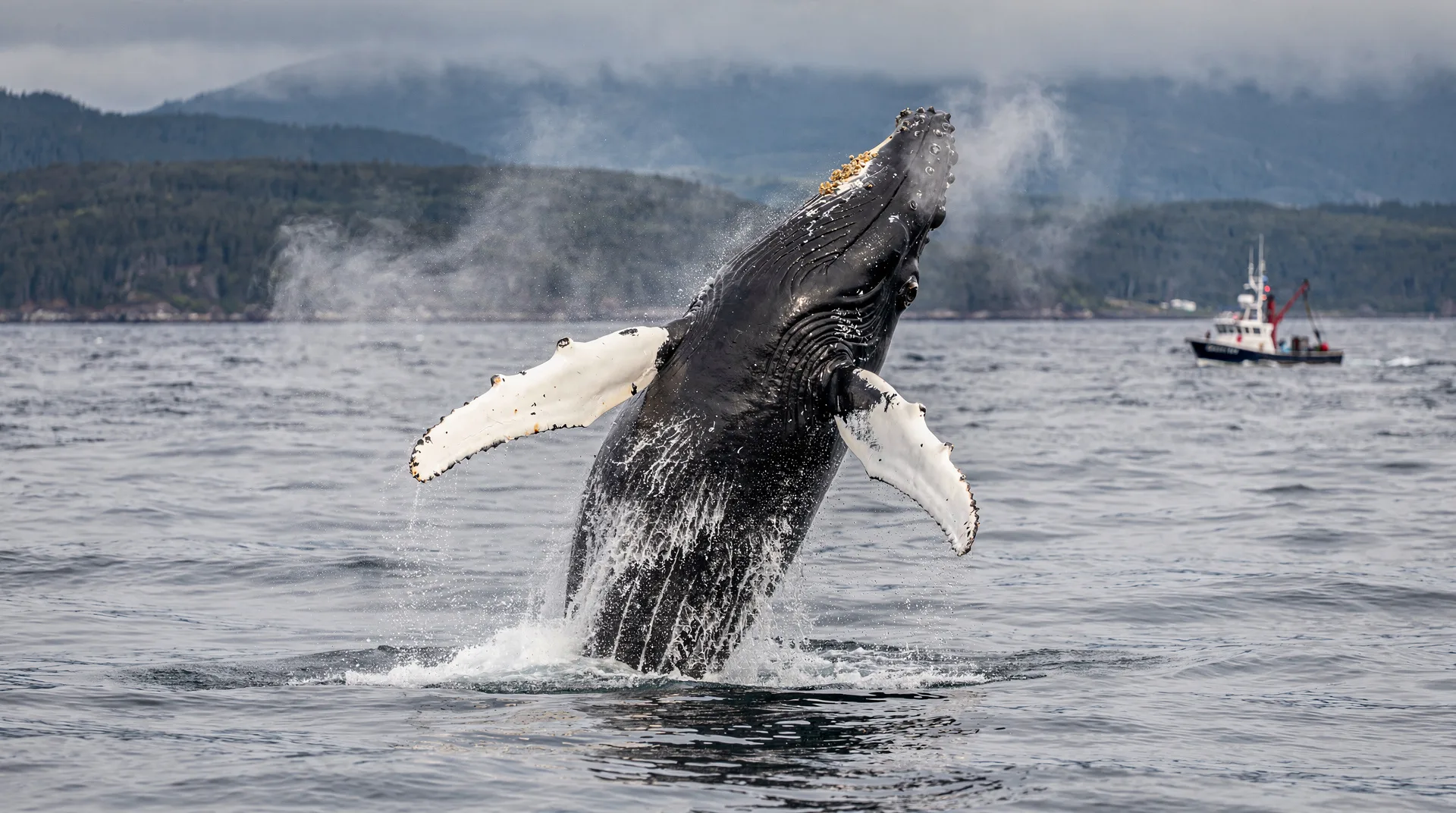
Humpback whales disappeared from BC coastal waters for most of the 20th century following commercial whaling. Their recovery since the 1980s has been remarkable — humpbacks now regularly feed in the Salish Sea and are seen on the majority of whale watching trips from Victoria during their season (roughly April through November).
Humpbacks are exuberant animals. They breach (leap out of the water), lunge-feed (surfacing suddenly with mouth open through schools of fish), tail-lob (slap the water with their flukes), and spy-hop (hold their heads vertically above the water, apparently looking around). They are excellent photographic subjects and their sheer size — up to 16 metres and 36 tonnes — makes any close encounter viscerally memorable.
Grey whales
Pacific grey whales migrate from breeding lagoons in Baja California to Arctic feeding grounds each spring, passing through Juan de Fuca Strait from late February through May. An estimated 20,000 grey whales make this migration — one of the longest of any mammal. Victoria tours occasionally encounter grey whales during spring, though the Tofino area on Vancouver Island’s west coast is a better destination for dedicated grey whale watching.
Some grey whales stop to feed in the shallow bays of the Saanich Peninsula near Victoria and can remain through summer. These feeding individuals are approachable and provide excellent viewing.
Other marine life
Victoria whale watching tours frequently encounter Steller and California sea lions (on rocky haulouts in Juan de Fuca Strait), harbour seals, Dall’s porpoise (which bow-ride in front of vessels), Pacific white-sided dolphins, and bald eagles. Marine bird diversity is exceptional — rhinoceros auklets, pigeon guillemots, marbled murrelets, and various loon and grebe species.
Book a whale watching tour from Victoria BC on GetYourGuideBest season for whale watching from Victoria
April–May: Humpbacks returning. Grey whales in Juan de Fuca Strait during migration. Resident orcas beginning their seasonal movements. Fewer crowds than summer.
June–August: Peak season for southern resident orcas. Humpbacks active. Bigg’s orcas present. Longest days (sunset after 9 pm) allow evening sailings. Summer weather is the most settled.
September–October: Humpbacks particularly active — feeding intensifies before their southern migration. Resident orca sightings remain good. Bigg’s orcas continue. September is often considered the finest month for combined whale diversity.
November–March: Southern residents move to lower Strait of Juan de Fuca and outer coast. Humpbacks depart. Some operators run winter tours focusing on Bigg’s orcas, which are present year-round. Gray whales return to the strait from February.
Choosing a tour and vessel type
Zodiac (inflatable rigid hull) boats
Zodiacs are small (10–12 passengers), fast, and sit low on the water. The proximity to water level gives an extraordinary perspective on whale encounters — when a humpback surfaces 20 metres from a zodiac, you feel the displacement wave. Zodiacs are louder, wetter, and less comfortable than covered vessels. Bring waterproof gear, expect spray, and wear the immersion suit or splash suit provided.
Zodiacs are better for photography (more maneuverability, closer distances), more exciting, and generally preferred by fit adults who want immersion in the experience.
Not recommended for: People with back or neck injuries (the boat impacts on waves transmit through the body), pregnant women, children under approximately 6 years, anyone with severe seasickness.
Covered whale watching vessels
Covered boats carry 30–60 passengers, have interior seating, heating, and windows. They are more comfortable in rain or cold and appropriate for families with young children, those with physical limitations, or anyone prone to seasickness. They maintain slightly larger distances from whales than zodiacs in most cases.
Prince of Whales and Eagle Wing Tours both operate a mix of vessel types and have strong safety and sighting records. Springtide Whale Tours is well-regarded for naturalist quality.
What to wear
BC marine weather in summer feels warm onshore but temperature drops sharply on the water, particularly at zodiac speeds. Even on a sunny 22°C Victoria day:
- Wool or synthetic base layer (nothing cotton — cotton holds cold when wet)
- Fleece mid-layer
- Waterproof jacket (many operators provide immersion suits over your clothing for zodiac trips)
- Warm hat and gloves for zodiacs
- Sunscreen (even on cloudy days — glare on water intensifies UV)
- Motion sickness medication if susceptible — take it the night before, not 30 minutes before boarding
Costs
| Tour type | Typical duration | Price (CAD) |
|---|---|---|
| Zodiac whale watching | 3 hours | $120–160/adult |
| Covered vessel | 3 hours | $100–135/adult |
| Half-day (premium) | 4–5 hours | $175–220/adult |
| Children (under 12) | — | 20–30% discount typical |
Online booking saves 5–15%. Most operators have a guarantee policy — a credit or second trip if no cetaceans are seen, though this is rarely triggered during peak season.
Responsible whale watching
Canadian regulations (Transport Canada Marine Safety) require:
- Minimum 200 m approach distance to southern resident orcas (can be extended by Fisheries and Oceans Canada in specific situations)
- No vessel to put itself in the path of a whale’s travel direction
- Engine-off or minimum throttle within the approach zone
Responsible operators in Victoria follow these regulations and have internal protocols that exceed the minimums. Look for boats with Whale Watching Operators Association of BC membership and Pacific Whale Watch Association accreditation.
Browse Vancouver Island wildlife tours including whale watching on GetYourGuideCombining whale watching with a Victoria visit
Victoria has enough to fill 2–3 days comfortably. The Butchart Gardens (20 km from downtown) are a national historic site with elaborate cultivated gardens in a former limestone quarry. The Royal BC Museum covers the province’s natural and Indigenous history with exceptional collection quality. Fisherman’s Wharf is a floating community of houseboats with excellent fish and chips. The Inner Harbour walkway is one of the finest urban waterfronts in Canada.
For day-trippers from Vancouver: the BC Ferries Tsawwassen–Swartz Bay route takes 95 minutes and is itself a scenic experience. A Victoria day trip with a 3-hour whale watching tour is an excellent full-day itinerary from Vancouver. See the BC Ferries guide for booking information.
Extending your trip beyond whale watching
Victoria makes an easy base for a longer Vancouver Island loop. Pair a whale watching morning with an afternoon in Butchart Gardens territory or push further into the Vancouver Island 7 days itinerary to add Tofino, where grey whales and a wilder west-coast landscape complement Victoria’s reliable orca access — see the whale watching in Canada guide for how the two destinations compare.
Wine lovers can extend inland toward the Okanagan Valley after a coastal few days, though that’s a multi-hour drive and better treated as a separate leg. If you’re routing from Vancouver rather than flying direct, the BC ferries guide covers timing the crossing around your tour departure.
Planning around your tour
A whale watching tour works best as one piece of a wider Vancouver Island plan rather than a stand-alone outing. If you are still deciding where to base yourself, the Vancouver vs Victoria comparison lays out how the two cities differ for a short stay, and the Vancouver to Victoria guide explains the crossing options in more detail. For the garden half of a combined day, the Butchart Gardens guide helps you decide how much time to set aside.
Timing matters as much as the vessel you pick. The best time to visit BC page puts the whale season in the context of the province’s weather, which helps if your dates are flexible. Pack for the water rather than the city, and the Canada packing list is a useful cross-check for layers and rain gear.
Wildlife encounters on the coast reward patience and good manners. The Canada wildlife safety guide covers the general principles of keeping distance from animals, and the same attitude applies on the water. If whales leave you wanting more, the Gulf Islands are a natural next stop, with the Gulf Islands comparison guide to help choose between them. For a broader look at the island itself, start with the Vancouver Island destination page, and for something more active on the same coast, the kayaking in Canada guide shows how to experience these waters at paddle pace.
Frequently asked questions about Whale watching in Victoria BC: tours, seasons and species
Is whale watching from Victoria better than from Vancouver?
Victoria has significantly better orca access than Vancouver. The southern resident territories include the waters immediately adjacent to Victoria; Vancouver tours typically travel 2+ hours to reach the same waters. For orca specifically, book from Victoria. For humpbacks, both cities are productive in season.
What is the sighting success rate for orca from Victoria?
Peak season (June–September) sighting rates for orca are typically 85–95% across the major operators. Overall cetacean sighting rates (any species) approach 95%+ during summer. Outside peak season, rates are lower but operators are selective about running trips in genuinely low-probability conditions.
Can I see orca from shore in Victoria?
Orcas are occasionally visible from Cattle Point in Oak Bay, Clover Point, and other east-facing shorelines in Victoria, but sightings from shore are not reliable. A boat trip gives far better access, proximity, and viewing conditions.
How far does the boat travel from Victoria?
Most whale watching tours travel 30–80 km from Victoria into Juan de Fuca Strait, Haro Strait, or the Gulf Islands, depending on where whales were reported. Trip range is determined by the morning’s wildlife scout reports — operators communicate by radio and the fleet concentrates on productive areas.
Is seasickness a concern on Victoria whale watching tours?
The waters of the Strait of Juan de Fuca can develop significant chop, particularly with summer afternoon winds. On zodiac tours in active conditions, this can be quite rough. If you are prone to motion sickness, take medication the evening before (non-drowsy options available), choose a covered vessel, and sit toward the centre of the boat.
Is a Victoria whale watching tour worth it in winter?
Tours run year-round, but December-February sightings are less predictable than summer. Bigg’s (transient) orcas are present year-round and are the main draw in the colder months, since southern residents often move to the outer coast. Dress for genuinely cold conditions on the water and expect fewer daily departures than in summer.
Can I combine whale watching with Butchart Gardens in one day?
Yes, though it makes for a full day. A typical pairing is a morning whale watching tour followed by an afternoon at the gardens (about 20 km from downtown), or the reverse if your tour departs later. Book both in advance during summer, since morning tour slots and garden entry times can both fill up.