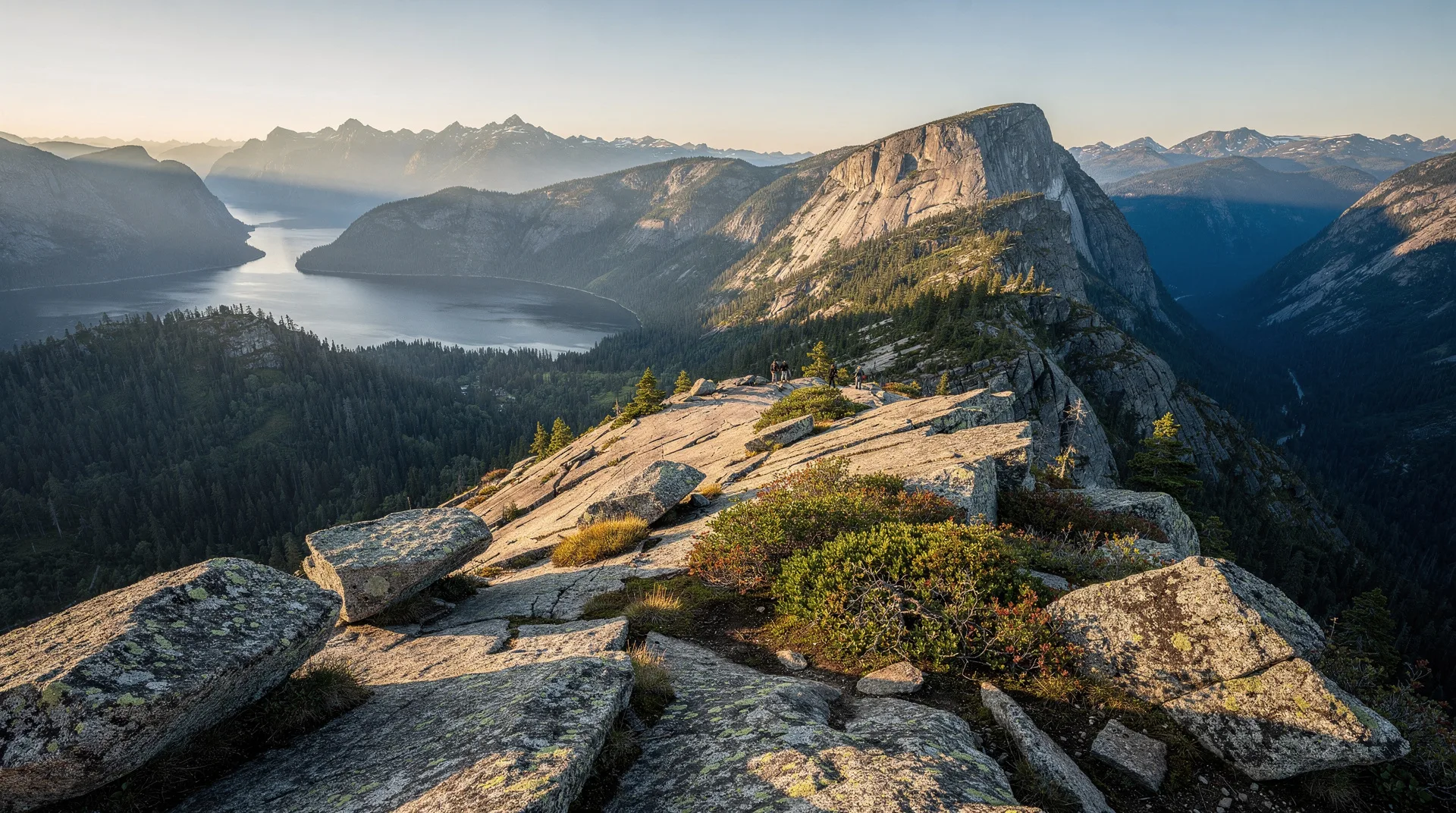
The Stawamus Chief hike: three peaks above Squamish
How long does it take to hike the Stawamus Chief?
The First Peak takes most hikers 2–3 hours return (3.2 km, 410 m gain). The Second Peak adds about 1 hour. Completing all three peaks is 8–10 km with over 600 m of gain and takes most hikers 5–7 hours. The route involves chains and ladders in the upper sections.
The Stawamus Chief stands above Squamish like a gravitational field, pulling the eyes of every person who drives Highway 99 northward through Howe Sound. The 700-metre granite monolith is one of the largest granite faces in the world — a statistic that means something tangible when you stand at its base and look up at the vertical rock that technical climbers ascend on routes that take a full day. But the Chief has a secret that surprises many visitors: you can reach its summit by hiking trail.
The trail to the Chief’s peaks is steep, involves chains and fixed ladders in the upper sections, and delivers views of Howe Sound, the Tantalus Range, and on clear days the full sweep of the Sea-to-Sky corridor from Vancouver to Whistler. It is one of the most rewarding half-day hikes in British Columbia, and completing all three peaks in a single day is a legitimate objective for fit, motivated hikers.
At a glance
| Where | Shannon Falls Provincial Park, Highway 99, 2 km south of Squamish |
| Cost | Parking and trail access are free; no permit required |
| Time needed | 2–3 hours (First Peak) to 5–7 hours (all three peaks) |
| Getting there | Around 1 hour drive from Vancouver, or BC Transit bus to Squamish then a short rideshare |
| Best time | May–October for dry rock; avoid the chains in ice or heavy rain |
Understanding the three peaks
The Stawamus Chief has three distinct summits accessible by trail, each with its own character and perspective.
First Peak (702 m) is the lowest and most visited summit. It sits directly above the Shannon Falls Provincial Park parking area and delivers the most immediately striking view — straight down the granite face to the highway and, beyond, across Howe Sound. This is the standard objective for most hikers and takes 2–3 hours return.
Second Peak (706 m) is slightly higher than the First, reached by a connecting trail from the First Peak summit. The rock slabs on the approach to the Second Peak have excellent views up the Squamish River valley. Add approximately 1 hour from First Peak.
Third Peak (681 m) is the most remote of the three, sitting furthest from the parking area and requiring the most sustained effort to reach. The Third Peak views extend north toward Garibaldi Provincial Park and have a different, wilder quality than the south-facing views from the First and Second peaks. Add another 1–1.5 hours from Second Peak.
Trail basics
Trailhead: Shannon Falls Provincial Park parking area on Highway 99, 2 km south of Squamish. Signed clearly from the highway.
Distance:
- To First Peak: 3.2 km return
- To First + Second Peak: approximately 5 km return
- All three peaks: approximately 8–10 km return (depending on route)
Elevation gain:
- First Peak: 410 m
- Second Peak: additional 120 m from First
- Third Peak: additional 80 m from Second (with some descent and re-gain)
Typical time:
- First Peak only: 2–3 hours return
- First + Second: 3.5–5 hours return
- All three peaks: 5–7 hours
Difficulty: Strenuous for all-three-peaks. The chains and fixed ladders in the final approach to each summit are the technical crux — not technically difficult, but exposed. Comfortable with heights is a prerequisite.
The trail in detail
From Shannon Falls to the Chief trail junction
The trail begins from the Shannon Falls parking area and immediately passes Shannon Falls itself — the third-highest waterfall in BC at 335 metres, worth a brief stop. The main trail forks at a signed junction: left to Shannon Falls viewpoints, right to the Chief trail.
The Chief trail enters the forest and begins climbing through Douglas fir and cedar, crossing a boulder field before reaching the base of the granite. The trail here is rocky and can be slippery when wet — good footwear matters. From the highway, the vertical ascent to the forest edge feels gradual; it accelerates significantly in the upper sections.
The chains and ladders
Approximately halfway up to the First Peak, the trail emerges from the forest onto open granite slabs. Fixed chains bolted into the rock assist with balance on the exposed slabs, and sections of fixed ladder provide secure ascent on the steepest parts. These sections are well-maintained by BC Parks and are safe for anyone comfortable with exposure and secure footing. They are not suitable for those with a strong fear of heights.
Go slowly on the chains. Many incidents on the Chief occur from rushing — the chains are a safety tool, not a speed aid. Coming down the chain sections requires particular care. Use three points of contact at all times.
First Peak summit
The First Peak summit is a broad, open granite platform with 360-degree views. The southern panorama — down Howe Sound toward Vancouver, with islands scattered across the sound and the ferry terminals at Horseshoe Bay visible on clear days — is exceptional. The western face drops vertically below you, a genuine exposure that reminds you where you are.
The summit has two main viewing areas and tends to fill with hikers on weekends by 11 am. Arrive before 9 am for relative solitude. Bring a windproof layer — the summit is exposed and temperatures drop significantly with any wind.
Second and Third peaks
The trail between peaks traverses through forest and open rock, losing some elevation before gaining it again. The Second Peak adds a different angle on the Squamish River valley and Garibaldi Provincial Park to the north. The Third Peak requires the most additional effort but is the least crowded of the three — the majority of hikers turn around at the First or Second Peak.
Best time to hike
May–June: The trail is snow-free from late April on most years. Mornings are cool (8–15°C) and views are often clearer than in summer before the haze builds. Wildflowers in the forested section.
July–August: Peak season. Hot at lower elevations (25–30°C) but the summit stays cooler. Start very early (6–7 am) to avoid the crowds and heat. The parking lot at Shannon Falls can overflow on summer weekends.
September–October: Often the finest hiking weather of the year. Cooler temperatures, clear air, autumn colour in the deciduous trees. October is a favourite month for locals.
November–March: The chains and slabs can be icy — crampons or microspikes are required. The summit views in winter, on clear days, are extraordinary, but the consequences of a slip on icy chains are severe. Only experienced hikers should attempt the Chief in winter conditions.
Seasonal conditions at a glance
| Season | Trail conditions | Crowds |
|---|---|---|
| May–June | Snow-free, cool mornings, wildflowers | Moderate, busier on weekends |
| July–August | Hot lower down, dry granite, peak season | Very high; arrive before 7 am |
| September–October | Best overall conditions, autumn colour | Moderate, locals’ favourite |
| November–March | Ice on chains and slabs; microspikes needed | Low, experienced hikers only |
Nearby hikes if the Chief is full or not for you
Squamish and the Sea-to-Sky corridor have alternatives worth knowing about. The best hikes in British Columbia guide covers a wider range of difficulty levels if the chain sections sound too exposed. Further north, the Garibaldi Lake trail and Joffre Lakes trail offer a different kind of BC scenery — turquoise glacial lakes rather than granite summits — without the fixed chains. Cyclists and less strenuous days can also base themselves around Vancouver to Whistler for a broader Sea-to-Sky itinerary.
Planning the day around the hike
The Chief sits in the middle of the Sea-to-Sky corridor, so it slots easily into a wider trip. Our Squamish destination page covers the town itself, and the Garibaldi Provincial Park page shows what lies behind the Chief’s northern views if you want to plan a longer outing another day. Visitors based in the city can read the Vancouver destination page for the wider picture, while those continuing north will find the Whistler destination page a natural next stop.
If you are comparing the Chief with other effort-versus-reward walks, the Grouse Mountain guide is worth a look, and the best hikes in Canada guide puts the Chief alongside bigger objectives across the country. Spring visitors may also enjoy the Vancouver in spring guide when deciding which weekend to pick for the hike.
Rock climbing versus hiking
The Stawamus Chief is equally famous as a rock climbing destination. The granite face visible from the highway is covered in traditional climbing routes, with the most famous being the multi-pitch routes to the summits on the South Face. These are entirely separate from the hiking trail and require full climbing gear and experience.
For visitors interested in climbing the face rather than hiking the trail, guided ascents are available from Squamish-based guide services. See the rock climbing in Squamish guide for details on the climbing scene and guide services.
Browse outdoor adventure tours in the Vancouver and Sea-to-Sky corridorWhat to pack
- 1.5–2 litres of water minimum (no water sources on the Chief)
- Lunch and snacks for 4–6 hours of activity
- Waterproof jacket — summit is exposed to wind and sudden rain
- Windproof mid-layer — it is always cooler at the summits
- Sturdy trail shoes or hiking boots with good grip (critical on granite slabs)
- Sunscreen and hat
- Trekking poles (useful on descent but awkward on chain sections — consider collapsing them for the upper approach)
- Gloves (for the chains — protects hands and improves grip)
Costs and logistics
Parking at Shannon Falls Provincial Park is free. There is no trail permit required. The trail is open year-round.
Transit: Squamish is served by BC Transit from Vancouver, and the Shannon Falls parking area is approximately 2 km from the Squamish town centre — a short rideshare or bike ride from any accommodation.
Squamish accommodation: The town has a range of options from campgrounds to hotels. Alice Lake Provincial Park, 13 km north, has camping. The downtown Squamish area has several hotels within easy reach of the trailhead.
Safety
Good preparation makes the day smoother: the Canada packing list is a useful checklist for layers and footwear, and the Canada wildlife safety guide explains how to behave if you meet wildlife on a forest trail.
The Stawamus Chief is the site of a meaningful number of search and rescue calls each year. The majority involve hikers who have become stuck on the chain sections in wet conditions, or those who have overextended their fitness on the all-peaks route.
- Do not attempt the chain sections in rain or with wet footwear
- Turn around if you feel uncomfortable on the exposed sections
- Start early to avoid being on the summit in afternoon lightning storms
- The descent on chains requires as much care as the ascent — most slips occur going down
- Cell coverage is intermittent — inform someone of your plans
Combining with Shannon Falls and Squamish
Shannon Falls (335 m) is directly at the trailhead and takes 10 minutes return from the parking area. It is one of the finest waterfalls in BC and worth seeing before or after the Chief hike. The spray zone at the base is significant — bring a rain jacket or expect to get wet.
Squamish town centre is 2 km north of Shannon Falls and has excellent post-hike food options. The Copper Coil and Howe Sound Brewing are popular post-hike destinations for food and local craft beer. The white-water rafting in BC guide covers Elaho and Cheakamus River options accessible from Squamish. For the full Sea-to-Sky picture, see the best hikes in British Columbia guide.
Explore guided adventures in Squamish and Whistler on GetYourGuideFrequently asked questions about The Stawamus Chief hike: three peaks above Squamish
Are the chains and ladders safe?
Yes — they are professionally installed, regularly inspected by BC Parks, and designed for public use. They are safe for anyone comfortable with heights and following basic chain technique (maintain three points of contact, go slowly, do not rush). They are not suitable for people with a significant fear of heights or vertigo.
Can children hike the Stawamus Chief?
The First Peak is achievable for children aged 10 and above who hike regularly and are comfortable with heights. The chain sections require maturity and confidence. Ages 8–10 with experienced parents who supervise closely on the chains can manage it. Younger children should hike to the Shannon Falls area only.
Is the Stawamus Chief harder than Grouse Grind?
The Chief to First Peak is comparable to the Grouse Grind in distance and elevation gain, but the chain and slab sections require more technical comfort. The all-three-peaks route is significantly harder than the Grind. Neither is technically difficult in the traditional sense, but the Chief has more genuine exposure.
What happens if it rains?
Turn around or cancel the trip. The granite slabs become extremely slippery when wet, and the chain sections become genuinely hazardous. If you are already on the summit when rain begins, descend immediately and carefully — do not wait for it to stop.
How early do I need to arrive at Shannon Falls in summer?
On summer weekends, the Shannon Falls parking lot fills by 8:30–9 am. Arrive by 7:30 am to be safe, or consider arriving at 6 am and hitting the trail before the main crowds. The parking area does overflow onto the highway shoulder during peak periods.
Do I need a park pass for the Stawamus Chief?
No. Stawamus Chief Provincial Park is managed by BC Parks, not Parks Canada, and there is no day-use fee or pass required to hike here — unlike the national parks in the Rockies, which do require a park pass.
Can I combine the Stawamus Chief with other Sea-to-Sky stops?
Yes. Many visitors pair the hike with a stop at the Sea to Sky Gondola (ticketed) a short drive south, or continue north to Whistler for the day. See the Vancouver to Whistler guide for a full corridor itinerary.