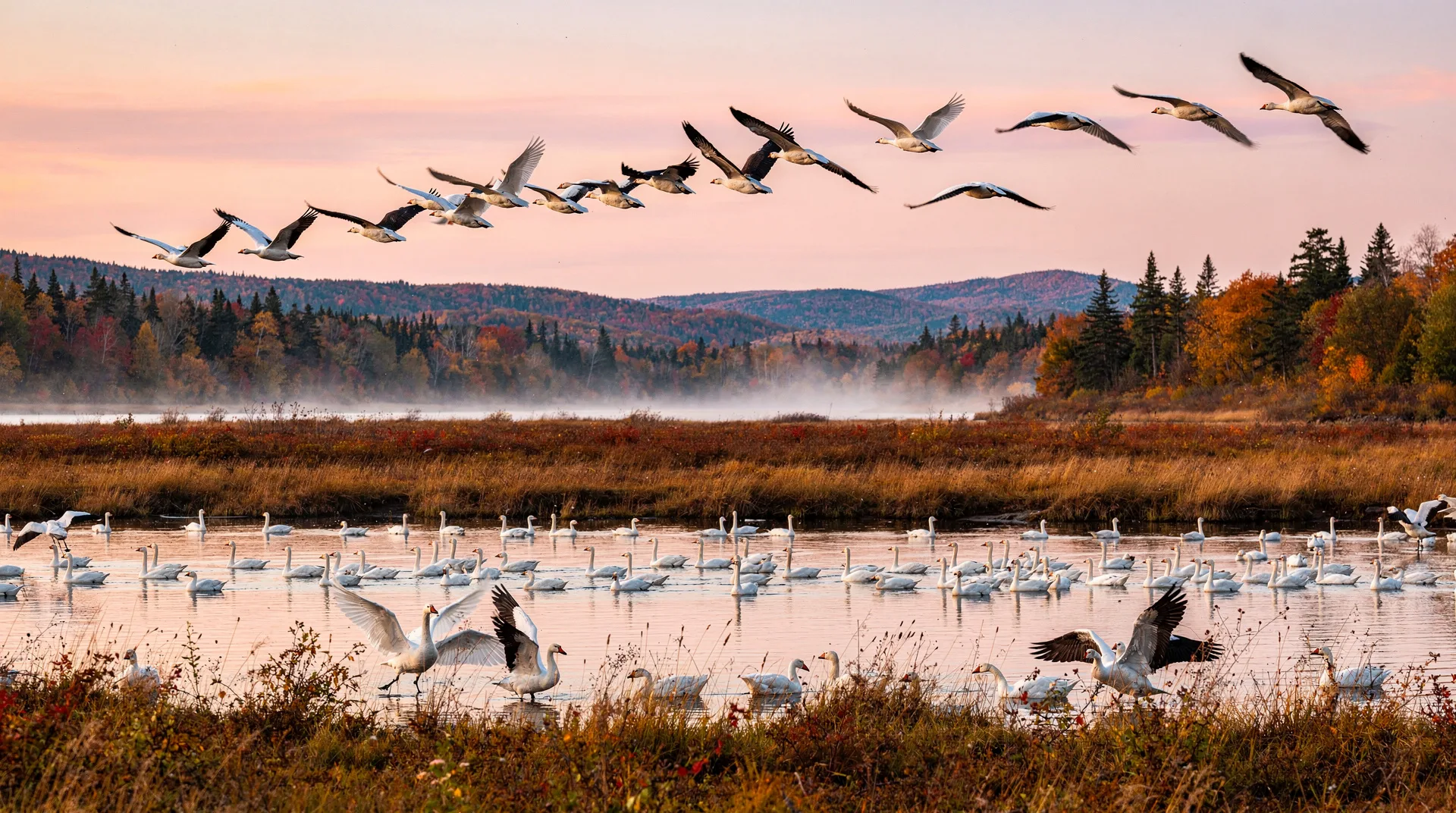
Snow Geese Migration Quebec: 500,000 Birds in October and April
When is the best time to see snow geese in Quebec?
Two peaks: late April (northbound migration, approximately April 15–May 10) and mid-October to early November (southbound migration). Cap Tourmente National Wildlife Area near Quebec City is the primary viewing site.
Twice a year, the lower St. Lawrence valley hosts one of the largest concentrations of birds anywhere in North America. The greater snow goose (Chen caerulescens atlantica) — a large white goose that breeds in the high Arctic and winters on the US Atlantic coast — uses the St. Lawrence valley as its primary migration corridor. The entire world population of greater snow geese, estimated at approximately 1.2 million birds, passes through the Quebec portion of the St. Lawrence in spring and again in autumn, stopping to feed on the eel grass and sedge roots exposed in the vast tidal flats of the estuary.
The numbers are not easily conceptualised. At peak stopover in late April, half a million or more snow geese may be concentrated within a 100-kilometre stretch of the south shore of the St. Lawrence between Montmagny and Deschambault. When this concentration decides to lift off simultaneously — triggered by an eagle or a disturbance — the sound is like a rolling wave of white noise, the sky fills with white birds, and the scale of what is happening is briefly impossible to process as a normal wildlife encounter. It is, by any measure, one of the great biological events of North America.
| At a glance | |
|---|---|
| Where | Cap Tourmente National Wildlife Area, 45 km northeast of Quebec City; also Montmagny and Ile aux Grues |
| Cost | Around a modest entry fee at Cap Tourmente; guided boat tours and festival excursions cost extra |
| Time needed | A half-day visit is enough to see the spectacle; 3-5 days maximises the chance of peak concentrations |
| Getting there | Car from Quebec City on Highway 138/132; no direct public transport to Cap Tourmente |
| Best time | Mid-to-late April (spring) or mid-October to early November (autumn) |
The snow goose: who they are
The greater snow goose is North America’s largest all-white goose — adults reach 3.5–3.8 kg, with a wingspan of approximately 150 cm. Their bill is pink with a distinctive “grinning patch” (a dark area at the edges that creates the illusion of a grin). Adult birds are pure white except for black wingtips. Immature birds in their first year are grey-brown, gradually acquiring white plumage over 2–3 years.
The species breeds almost exclusively in the Canadian high Arctic — primarily on Bylot Island, Southampton Island, and Baffin Island — and winters on the Atlantic coast of the United States, primarily in the Chesapeake Bay area of Maryland and Virginia. The migration route between these two extremes passes almost entirely through the St. Lawrence valley, making Quebec the critical bottleneck in the population’s annual cycle.
Population trajectory: The greater snow goose population has grown dramatically over the past 50 years. From an estimated 50,000 birds in the 1960s (when hunting pressure and habitat loss had reduced the population severely), the population has recovered to 1.2+ million birds by 2020. This recovery is considered too successful — the large population now overgrazes its Arctic breeding habitat and the south shore wintering marshes in ways that are damaging both ecosystems. Management hunts have been introduced (a special spring season and extended autumn seasons) to try to limit population growth.
| Month | Migration status | Weather | Crowds |
|---|---|---|---|
| Mid-March to early April | Very early spring arrivals, low numbers | Cold, variable | Quiet |
| Mid-to-late April | Spring peak | Cold fronts can stall birds and create huge concentrations | Busy on weekends |
| Early May | Spring migration tapering off | Milder | Quiet |
| Mid-October | Autumn peak, overlaps with Festival de l’Oie Blanche at Montmagny | Crisp, fall colour at its best | Busy, especially festival weekends |
| Early November | Late autumn migration | Colder, greyer | Quieter |
Where to stay and how long to plan
For committed birdwatchers or photographers, basing in Quebec City and driving out for 3-5 days across the migration peak gives the best odds of catching a major liftoff — a single day trip risks arriving on a quiet day with birds spread thin across the flats. Staying overnight in Montmagny or Saint-Jean-Port-Joli puts you closer to the south shore sites and allows early-morning starts, when light and bird activity are often best.
If combining the trip with a broader Quebec visit, the migration windows line up naturally with either Quebec in April for spring or Quebec in October for autumn, both of which cover wider seasonal trip planning beyond the geese themselves. Photographers focused on the autumn colour-and-goose combination should also check where to find Quebec’s fall foliage for timing the drive along the south shore.
Cap Tourmente National Wildlife Area: the premier viewing site
Cap Tourmente, approximately 45 km northeast of Quebec City on the south shore of the St. Lawrence, is where the snow goose migration is most intensively concentrated and most reliably observed. The site is a federal National Wildlife Area managed specifically for snow goose habitat — the tidal marshes here, where common three-square bulrush (Schoenoplectus pungens) and eel grass grow in the brackish tidal zone, provide the primary food source for geese stopping on both the spring and autumn migrations.
The site has been managing and studying the goose congregation since the 1970s. A visitor centre, interpretive trails, and managed viewing platforms bring visitors close to the geese without disturbing them. During peak migration, the experience of standing on the Cap Tourmente marsh edge with hundreds of thousands of geese within sight — the sound alone is disorienting, a continuous high-pitched cacophony that fills every direction — is extraordinary.
Access: The National Wildlife Area is open to visitors during migration season (spring and autumn). A modest entry fee applies. The site is accessible by car from Quebec City via Highway 138 east; the exit for Cap Tourmente is clearly marked. No public transport serves the site directly; a car is practical.
Infrastructure: The visitor centre is staffed with interpreters during migration season. Observation towers along the marsh edge provide elevated views over the tidal flats. The trails through the managed marsh bring you to within 30–50 metres of feeding geese at peak times.
Volunteer counters: Environment Canada maintains continuous bird counts at Cap Tourmente during migration. The real-time data on goose numbers at the site is sometimes published on provincial wildlife websites or available by calling the visitor centre.
The spring migration: April and May
The northbound spring migration typically arrives in the Cap Tourmente area in the second week of April and builds to a peak in the last two weeks of April and first week of May. The geese are heading north from their US wintering grounds toward their Arctic breeding territories — a journey they must complete, including fat accumulation during the St. Lawrence stopover, in time to arrive at the breeding colonies before the brief Arctic summer progresses too far.
What distinguishes the spring migration: The birds are in better condition, having wintered in good habitat. The spring arrivals include mixed flocks of adults in brilliant white plumage, year-old birds in mottled grey, and some individuals showing the coloration that reflects their Caribbean stopover. The behaviour is energetic — the birds feed intensively to build fat reserves for the long Arctic flight and for breeding.
Weather sensitivity: Cold fronts and north winds will push the geese back south temporarily; warm southerly winds accelerate their northward movement and lead to sudden massive departures. A cold week can stall hundreds of thousands of birds at Cap Tourmente for several days, creating exceptional concentrations.
The liftoffs: The most spectacular moments of the migration are collective liftoffs of large portions of the flock. These occur when the geese decide simultaneously to move — either to a different feeding area within the site, or to resume the northward migration. When tens of thousands or hundreds of thousands of birds lift off at once, the noise reaches a level that is almost painful at close range, and the sky fills with white for several minutes. The triggers for these liftoffs include the approach of a raptor (eagles and hawks will put an entire feeding flock to flight), disturbance from the water edge, or simply the social decision to move that sweeps through a flock as a wave.
The autumn migration: October and November
The southbound migration peaks 2–4 weeks later in autumn than the spring peak — typically from mid-October through early November. The birds arrive from the Arctic in family groups (adults with their goslings from the summer’s breeding season) and tend to be more cautious than in spring, having spent the summer in areas where hunters pursue them.
What distinguishes the autumn migration: The juvenile birds of the year are visible in the flocks — smaller, with the typical grey-brown first-year plumage that is noticeably different from the white adults. The family group social structure means flocks contain mixed-age birds rather than the relatively homogeneous adult composition of spring groups.
Numbers: The autumn concentration can be as large as or larger than spring at Cap Tourmente, but the distribution is slightly different — some portions of the population may stop at different sites in the autumn compared to spring.
Combination with fall colours: Mid-October at Cap Tourmente combines snow goose watching with the peak of fall colour in the lower St. Lawrence valley. The combination of the white geese on the tidal marsh with the red and gold maple forest immediately behind the site, and the St. Lawrence visible beyond, is one of the most visually remarkable scenes in Quebec.
Book Quebec nature and wildlife tours on GetYourGuideOther viewing sites along the south shore
While Cap Tourmente is the primary and most accessible site, the snow geese use the entire south shore tidal zone and can be found in large numbers at several other locations.
Montmagny: A small city approximately 70 km northeast of Quebec City on the south shore, known as the “Capital of Snow Geese” in Quebec tourism marketing. The tidal flats at Montmagny host large goose concentrations during both migrations, and the city has organised its autumn migration season as a festival — Festival de l’Oie Blanche — with guided tours, boat excursions on the St. Lawrence to see geese on the water, and educational programming. The festival typically runs in the second and third weeks of October.
Bas-Saint-Laurent south shore: The snow geese continue east along the south shore through Kamouraska and the lower St. Lawrence zone. Large concentrations stop at the tidal flats in the Kamouraska–L’Islet area, particularly during the spring migration when northerly weather holds them back.
Île aux Grues: An inhabited island in the St. Lawrence between Quebec City and Montmagny, accessible by a small ferry. The island’s tidal flats are prime goose habitat and the island’s intimate scale makes the experience of being surrounded by migrating geese particularly immediate.
Saint-Joachim area (near Cap Tourmente): The farmland behind the tidal marsh is used by geese that overflow from the marsh itself — agricultural fields of spilled grain and waste crops attract large numbers. Driving the secondary roads near Cap Tourmente in the late afternoon often reveals additional concentrations.
Practical photography guide
Snow goose migration is one of the most photogenic wildlife spectacles in North America and requires some specific preparation.
Equipment: A telephoto lens of 300–500mm is ideal for individual bird portraits and small flock details. A wider angle (70–200mm) captures the flock scale and landscape context. A tripod or monopod for the telephoto work. A circular polariser can help manage the bright white plumage against the sky.
Exposure challenges: White birds against varied backgrounds — dark water, grey sky, bright tidal flat — require careful exposure management. The white plumage of adult birds reflects strongly; slight overexposure blows out the detail. Exposing to the right (bright, but not clipped highlights) and then recovering in post-processing works well.
Liftoffs: The most dramatic frames. These are essentially impossible to predict precisely but certain conditions (eagle sightings, large disturbances, early morning when the flock decides to move) increase probability. Being ready with the camera up, continuous AF enabled, and shutter speed above 1/1000 second is the preparation. The liftoff begins at the edge closest to the disturbance and spreads outward — identifying the disturbance source gives about 10–15 seconds of warning before the wave reaches the nearest birds.
Golden hour: The tidal flat environments at Cap Tourmente and Montmagny are oriented to catch excellent low-angle light in morning (eastern exposure) and afternoon. The low light on white birds — turning them golden — with dark water or autumn forest behind is the signature shot of the migration.
Getting there: Quebec City as base
Quebec City is the ideal base for snow goose watching. The city is 45 km from Cap Tourmente and 70 km from Montmagny — both under an hour by car on Highway 132 or 138. Hotels in Quebec City or in the towns along the south shore (Montmagny, Saint-Jean-Port-Joli) work as bases.
Timing your visit: The peak of both spring and autumn migrations at any given site lasts 1–3 weeks. Arriving at the start of the peak and spending 3–5 days in the area maximises the probability of experiencing optimal concentrations and dramatic liftoffs.
Weather: Cold fronts and strong north winds concentrate geese by preventing northward movement (spring) or by pushing them to lower elevations (autumn). A cold, calm day after a frontal passage is often the best combination for seeing concentrated birds.
Book Montreal and Quebec region nature tours on GetYourGuideWhen geese share the landscape: other species during migration
The snow goose migration coincides with the passage of other migratory species through the St. Lawrence valley.
Canada geese: Present alongside the snow geese in smaller numbers, identifiable by the black head and white cheek patch. The contrast between the two species in a mixed flock is a good lesson in field identification.
Greater white-fronted geese: Occasional individuals or small groups mixed with snow geese — identifiable by the brown plumage, orange bill, and distinctive white forehead patch.
Ducks: The tidal marshes during migration host large numbers of dabbling ducks (American black duck, mallard, green-winged teal) and diving ducks (scaup, bufflehead, common goldeneye) alongside the geese.
Raptors: The goose concentrations attract predators. Bald eagles are common during migration, soaring over the flats and occasionally making passes at the goose flocks that trigger spectacular collective liftoffs. Peregrine falcons and rough-legged hawks (from their tundra breeding grounds) are also regular.
Shorebirds (spring): The spring migration of shorebirds through the St. Lawrence south shore overlaps with the goose migration (May primarily for shorebirds). The tidal flats that host geese also provide habitat for dunlins, semipalmated sandpipers, and other migratory shorebirds moving north.
Book Canada bird watching and wildlife tours on GetYourGuideRelated pages
- Quebec whale watching complete guide — Quebec’s other great wildlife spectacle
- Blue whale viewing in Quebec — marine wildlife in the same region
- Kamouraska — salt marsh shorebird watching south shore
- Bas-Saint-Laurent region — the south shore corridor
- Tadoussac — marine wildlife hub
Frequently asked questions about Snow Geese Migration Quebec: 500,000 Birds in October and April
What is the best day to see snow geese at Cap Tourmente? Impossible to predict exactly, but: mid-to-late April for spring, mid-to-late October for autumn. Visiting for several days rather than a single day dramatically increases the probability of experiencing optimal concentrations and liftoffs. Weekday visits are quieter than weekends at the site.
Can you hear the geese from a distance? Absolutely. A large concentration of snow geese produces a continuous roar of calls that is audible from several kilometres under the right conditions. At peak concentration, the sound at Cap Tourmente fills the landscape completely.
Are there guided tours to see the snow geese? Yes. Several tour operators from Quebec City offer guided excursions to Cap Tourmente and Montmagny during the migration season. The Festival de l’Oie Blanche at Montmagny in October includes organised boat tours on the St. Lawrence and guided marsh walks with naturalists. Independent visits to Cap Tourmente require no guide — the site is managed for self-directed visits.
Is Cap Tourmente worth visiting outside migration season? The site is interesting year-round for committed birdwatchers — the marsh supports nesting species in summer and resident species through winter — but the migration spectacle is the defining experience. Visiting outside the April and October windows means missing the central attraction.
Do snow geese make noise? Continuously, at volume. The high-pitched, somewhat nasal call of the snow goose — a rolling, overlapping “ka-wee” repeated at high frequency — is the sound that marks the migration. A flock of 100,000 birds calling simultaneously produces a noise that has been described as “a waterfall” and “a roar.” It is one of the most memorable sensory experiences in North American wildlife observation.
Can I combine the snow goose migration with other Quebec City sightseeing? Yes easily. Cap Tourmente is under an hour from Old Quebec, so a morning at the marsh and an afternoon exploring the Old Quebec guide highlights or the drive along the Montreal to Quebec City corridor works well as a single-day combination.