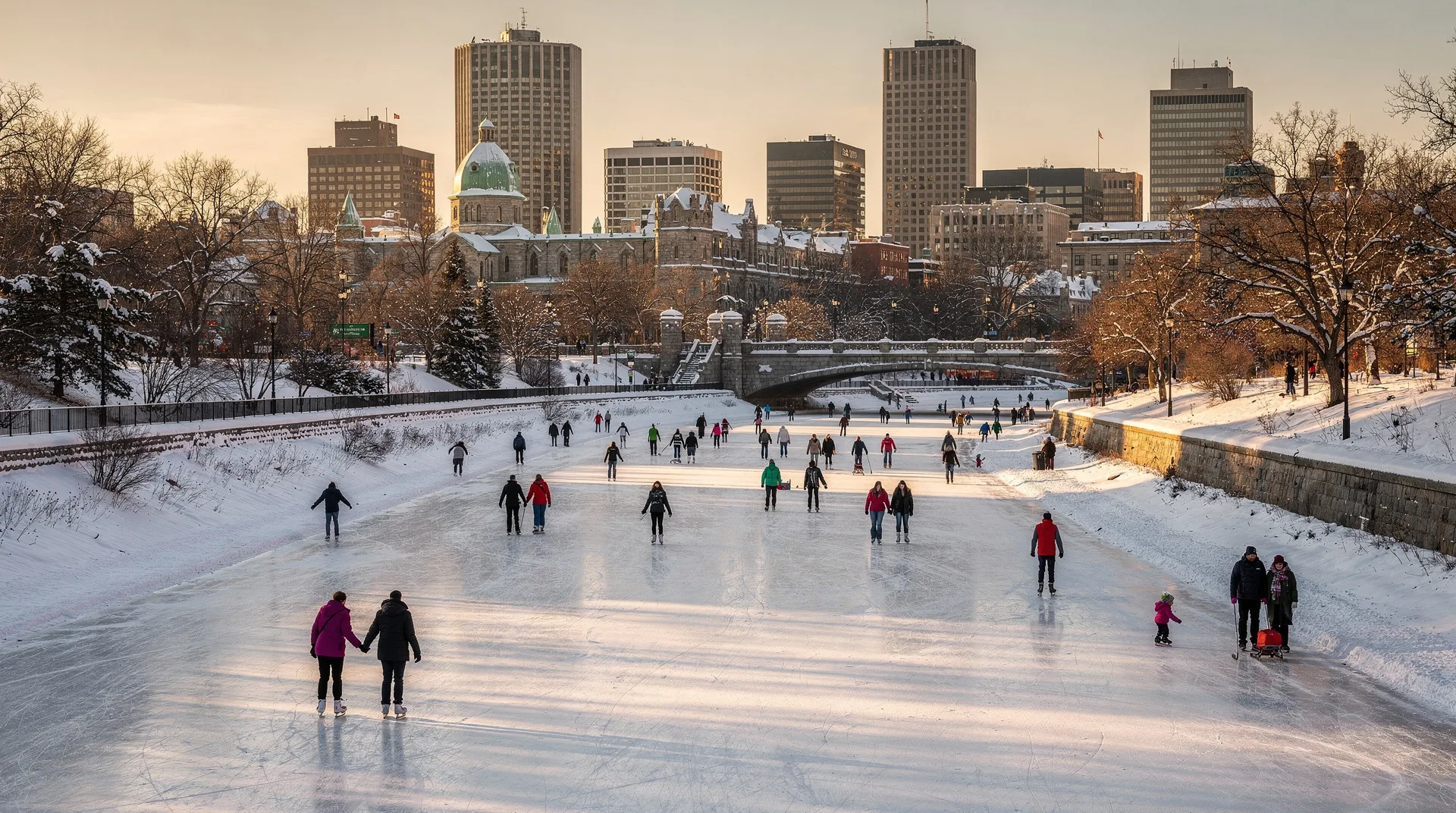
Skating the Rideau Canal in Ottawa: the complete guide
When does the Rideau Canal skating season open?
The Rideau Canal skateway typically opens in late January, when ice thickness reaches 30 cm along the full 7.8 km route. The season usually runs through late February or early March. Opening dates vary by year depending on temperatures — check the National Capital Commission website for current status.
The Rideau Canal skateway is one of Canada’s most iconic winter experiences — a 7.8 km stretch of naturally frozen canal running through the heart of Ottawa that the Guinness World Records recognises as the world’s largest naturally frozen skating rink. From the Chateau Laurier and Parliament Hill at the northern end of the route, south through Dows Lake and the Glebe neighbourhood to Hartwell Locks, the canal becomes a linear community in winter: commuters in suits skating to work, families with toddlers in sleds, tourists stopping for beaver tails mid-route, and serious speed skaters carving long arcs on the maintained surface.
The canal is a UNESCO World Heritage Site — a 200-kilometre waterway built between 1826 and 1832 to connect Ottawa with Kingston on Lake Ontario. In winter, a 7.8 km section of the canal is maintained as a skateway by the National Capital Commission, with groomed ice surfaces, skating hut facilities offering skate rentals and warming stations, restrooms, and the legendary beaver tail pastry stands that are a mandatory mid-skate stop.
| At a glance | |
|---|---|
| Where | Downtown Ottawa, from the Chateau Laurier / Parliament Hill south to Carleton University |
| Cost | Free to skate; skate rental around CAD 15–20/day, a full day out for two roughly CAD 60–80 |
| Time needed | 30–60 minutes for a casual outing; 2–3 hours for the full 15.6 km round trip |
| Getting there | 10-minute walk from most downtown hotels; OC Transpo serves multiple access points |
| Best time | Weekday mornings for quiet skating; late January to late February for the fullest season |
Ottawa in winter: building a longer trip around the canal
Canal skating pairs naturally with a broader Ottawa winter itinerary, since most of the city’s other winter draws sit within walking distance or a short transit ride. Parliament Hill’s grounds are free to explore year-round, and several national museums add a low-cost indoor option for warming up between skating sessions.
If your trip coincides with Winterlude in February, expect a livelier but busier canal, especially on festival weekends — weekday visits are still the better bet for uncrowded skating even during the festival. Travellers arriving by rail from Toronto or Montreal can time their trip around the Via Rail Canadian guide for the transcontinental option, or check the Via Rail booking guide for the more common Toronto–Ottawa or Montreal–Ottawa corridor fares.
When the Rideau Canal opens
The Rideau Canal skateway does not open on a fixed date — it opens when the ice has reached the required 30 cm minimum thickness along the full 7.8 km route. This depends entirely on that winter’s temperatures. Average opening:
- Earliest opening on record: January 2
- Latest opening on record: February 18
- Typical opening: Third to fourth week of January
- Typical closing: Third week of February to early March
The National Capital Commission publishes daily ice thickness measurements on their website (ncc-ccn.gc.ca) and via social media once conditions begin developing in December and January. Many Ottawa regulars follow the NCC’s ice reports with the same attention given to weather forecasts — the canal opening is a significant local event.
In years with mild winters (increasingly common), the canal may have a very short season (2–3 weeks) or in extreme years may not open at all. The 2023–24 season was notably brief. Check current season status before making travel plans specifically for canal skating.
The skateway route
The 7.8 km skateway runs from the Ottawa Locks (at the Rideau Canal’s northern terminus below the Chateau Laurier hotel and Parliament Hill) south to Hartwell Locks at Carleton University. The canal passes under multiple bridges, through Dows Lake (a broader section where the canal widens into a small lake), and through the Glebe — Ottawa’s most attractive residential neighbourhood.
The route is divided by the NCC into manageable sections with access points approximately every 800 m to 1 km:
Northern section (Locks to Bank Street): The most iconic section, passing below the Parliament Buildings and the Chateau Laurier’s copper-roofed silhouette. The skating hut at the Locks is the main northern facility.
Central section (Bank Street to Dows Lake): Past the Pretoria Bridge, through some of the canal’s prettiest urban stretches. The Fifth Avenue skating hut is a popular mid-route stop.
Dows Lake section: The canal widens into Dows Lake — a slightly broader, more open skating experience. The Dows Lake Pavilion is the main mid-route hub with its large heated changing area, skate rentals, food service, and the famous beaver tail stand.
Southern section (Dows Lake to Hartwell Locks): Quieter section through the Arboretum and Carleton University area. Less crowded than the northern section and popular with long-distance skaters.
The full round trip (Locks to Hartwell and back) is 15.6 km — achievable in 2–3 hours for intermediate skaters; a comfortable 90-minute route for strong skaters. Most visitors do the northern section (Locks to Dows Lake and back, approximately 8–10 km round trip) as a more casual experience.
What to wear
Ottawa in January and February is genuinely cold — average temperatures of -10°C to -15°C, with wind chill often reaching -20°C or below on the open canal. Dressing properly is critical:
- Thermal base layer: Merino wool or synthetic long underwear (top and bottom)
- Mid-layer: Fleece or down mid-layer
- Outer layer: Insulated, wind-resistant winter jacket (not a ski jacket — you want hip mobility; a parka style works well)
- Winter trousers: Insulated; or athletic tights plus wind pants over them
- Warm hat covering ears: Essential on the open canal
- Balaclava or neck gaiter: Recommended for cold days
- Mittens: Warmer than gloves; you need finger warmth for long skating sessions
- Wool socks: At least one pair; two pairs if your feet run cold
Skate blades conduct cold through the boot. Quality skates with insulated liners help; rented skates may not have this advantage. Pack heat-activated chemical foot warmers as a backup.
Skate rentals and facilities
Skate rentals are available at multiple locations along the canal:
Rental locations: The main skating huts at the Locks, Fifth Avenue, Dows Lake Pavilion, and Hartwell Locks all offer skate rentals, typically CAD 15–20 for the day. Bring your own skates if you have them — rental skates are serviceable but own-boots make a significant difference in comfort over 5+ km.
Skatewear lockers: Available at skating huts for storing street shoes and bags.
Blade sharpening: Available at Dows Lake Pavilion and some hut locations.
Skate aids (frames with handles): Available for children and adults learning to skate or looking for extra stability.
Helmets: Recommended (mandatory for children under 18 in Ontario) and available to rent.
Beaver tails — the essential stop
The Beaver Tail is a Canadian pastry so associated with canal skating that it has become part of the experience’s identity. A Beaver Tail (BeaverTails is the brand name; the pastry itself is sometimes called a queue de castor in French) is a flat, hand-stretched whole-wheat dough, deep-fried and served with a range of toppings: the classic is cinnamon sugar; others include chocolate-hazelnut, maple butter, garlic butter, or pizza-style savoury toppings.
The BeaverTails stand at Dows Lake Pavilion is the most famous midpoint on the canal route. Stopping there to warm up with a hot chocolate and a fresh beaver tail is one of the rituals of canal skating that every visitor should complete. There is also a BeaverTails stand at the northern Locks section.
The experience of eating a warm fried pastry covered in cinnamon sugar while standing on the ice of a UNESCO Heritage canal with the Parliament Buildings visible in the distance is as Canadian as it gets.
How to get to the canal
From downtown Ottawa: The northern entrance (Locks and Canal Rink) is adjacent to the Rideau Centre shopping mall, the Chateau Laurier hotel, and a 10-minute walk from most downtown hotels. OC Transpo (Ottawa’s transit) serves multiple canal access points. Parking along the canal is extremely limited in winter; transit or walking from central hotels is strongly recommended.
From the airport: OC Transpo Route 97 connects Ottawa Airport with downtown in approximately 25–35 minutes. Taxi and rideshare are available from the airport.
From Toronto or Montreal: The Ottawa train station (Fallowfield) and the central Rideau station on the Confederation Line LRT are both on OC Transpo routes connecting to the canal area. VIA Rail connects Ottawa to both Toronto (4.5 hours) and Montreal (2 hours).
Browse Ontario tours and day trips including Ottawa experiencesCosts
Canal skating itself is free — there is no admission charge to skate the Rideau Canal. Costs involved:
| Item | Cost (CAD) |
|---|---|
| Skate rental | CAD 15–20 per day |
| Helmet rental | CAD 5–10 |
| Skate sharpening | CAD 8–12 |
| BeaverTail pastry | CAD 6–10 |
| Hot chocolate at hut | CAD 4–6 |
| Locker rental | CAD 2–5 |
A full canal skating day for two people (renting skates, stopping for beaver tails and hot chocolate) budgets at approximately CAD 60–80. Bring your own skates and the cost drops to CAD 20–30. See our Canada budget guide for broader costs.
Other winter activities in Ottawa
Ottawa in winter extends well beyond the canal:
Winterlude: Ottawa’s major winter festival runs for three weekends in February, centred on the canal and Jacques Cartier Park on the Gatineau side of the river. The festival includes an ice sculpture competition (Confederation Park), snow and ice sculpture galleries in Gatineau, family activities, and Canadian entertainment. Winterlude coincides with peak canal season and creates a particularly festive atmosphere.
Parliament Hill and the National Capital Region: The Parliament Buildings are free to visit year-round. The Rideau Hall (Governor General’s official residence) grounds are open for public winter activities including skating and snowshoeing. The Canadian Museum of History in Gatineau is one of the finest museums in the country and worth a full afternoon visit.
Skiing nearby: Mont Cascades and Edelweiss ski areas are within 45–60 minutes of downtown Ottawa. Both are modest in size compared to the Laurentians or the Rockies, but provide a convenient day of skiing for Ottawa-based visitors. The Gatineau Park cross-country ski network is excellent — 200+ km of groomed trails within 20 minutes of the city.
ByWard Market: Ottawa’s historic market district, immediately north of Parliament Hill, has excellent restaurants and cafés — a recommended warm-up stop after canal skating. If you want a local guide for the market and the nearby sights, you can compare guided tours in Ottawa before you go.
See our Canada in February guide for the full winter travel picture. If you’re extending north into cottage country, the Algonquin fall colors guide shows the same region in a very different season, and Ontario’s other winter skating options are covered alongside the Toronto to Niagara Falls guide for a broader Ontario winter loop.
Building the canal into a longer Ottawa stay
Skating fills a morning or an evening, not a whole trip, so it helps to plan the rest of your days around it. Our Ottawa destination page lays out the city’s neighbourhoods, and the Ottawa weekend itinerary shows one way to combine the canal with museums and markets without rushing. The Parliament Hill guide covers the buildings you will be skating beneath, which makes a good daytime visit before an evening on the ice.
If you are weighing Ottawa against another big city for a winter break, the Toronto vs Ottawa comparison explains the trade-offs, and the Toronto to Ottawa road trip or the Toronto to Ottawa driving guide help if you would rather arrive by car. Keep in mind that winter roads can slow a drive, so leave generous margins.
Visitors who enjoy the canal often want more time outdoors on skis or snowshoes. The cross-country skiing guide and the snowshoeing guide cover how to get started, and the Quebec winter activities guide is a natural next step if you continue east across the river into Quebec.
Practical tips
Check the NCC website before visiting: Ice conditions change — a warm spell can cause sections to close or the full skateway to shut down temporarily. Always verify the canal status at ncc-ccn.gc.ca or their social media accounts on the morning of your visit.
Weekday mornings are quietest: Weekend afternoons in peak canal season (late January, Winterlude weekends) can be crowded, particularly in the northern Locks section. Weekday mornings and evenings are dramatically quieter.
Watch for zamboni warnings: The NCC grooms the ice surface with a small ice resurfacer at regular intervals. Grooming sessions (usually 2–3 per day) require skaters to temporarily clear the surface. Follow the NCC staff direction; the freshly groomed surface is significantly smoother than the skated-up surface before grooming.
The southern section is less crowded: The stretch from Dows Lake south to Hartwell Locks attracts far fewer tourist skaters than the northern section. If you are an experienced skater wanting to cover distance without weaving through crowds, head south.
Evening skating is magical: The canal is lit along its full length after dark. Evening skating under the lights with the illuminated Parliament Buildings visible above the northern section is one of the most atmospheric winter experiences in Canada.
Frequently asked questions about Skating the Rideau Canal in Ottawa: the complete guide
How long does it take to skate the full Rideau Canal?
The 7.8 km one-way route (Locks to Hartwell) takes approximately 45–75 minutes for average adult skaters skating without stops. The round trip (15.6 km) takes 2–3 hours including stops at the skating huts and the BeaverTails stand at Dows Lake. Most visitors skate 2–4 km of the northern section as a casual outing, which takes 30–60 minutes.
Do I need to be a good skater to enjoy the canal?
No — the canal surface is well-maintained and broad enough to skate at your own pace without feeling pressured by more experienced skaters. Beginners and children are common on the canal. Skate aids (metal frame supports) are available to rent for those who need them. The canal is not a speed skating track; the pace varies enormously across different users.
Is the canal always open during winter?
No — the canal opens only when sufficient natural ice has formed (minimum 30 cm thickness along the full route) and closes when the ice becomes unsafe. In mild winters, this can mean the full season lasts only 2–3 weeks; in extreme cases the canal does not open at all. The NCC makes opening and closing decisions based on daily ice thickness measurements. Always check current status before travelling specifically to skate the canal.
Can I bring young children to skate the canal?
Yes — families with young children are very common on the canal. The NCC rents sleighs (sled-style seats with handles that an adult pushes across the ice) for toddlers and very young children. Older children who can skate are completely welcome; helmets are required for those under 18 in Ontario. The Dows Lake Pavilion has enclosed warm facilities good for a warming break with children.
What happens if the weather gets too warm?
If temperatures rise significantly, the NCC closes sections of the canal and eventually the full skateway when ice thickness drops below safe levels. This can happen mid-season — a warm spell in February has cut short canal seasons in multiple recent years. Monitor the NCC website; when sections close, it is announced there and on social media. The canal re-opens if temperatures drop and ice rebuilds quickly enough.
Is there a fee to skate the Rideau Canal?
The ice itself is free — no charge to skate the Rideau Canal. The skating huts, change rooms, and toilet facilities are also free. You pay only for skate rentals (CAD 15–20), locker use, food, and any other services you choose. This makes it one of Canada’s great free winter experiences.
What other winter activities are near Ottawa?
Gatineau Park (across the river in Quebec) has over 200 km of groomed cross-country ski trails and snowshoeing routes — among the best accessible cross-country skiing near a major Canadian city. The ski hills at Camp Fortune and Edelweiss are within Gatineau Park. In the city, the Rideau Hall grounds have free public skating and snowshoeing. The Canada in February guide covers the full Ottawa winter season.
Can I bring my own skates or must I rent?
Both are fine, and bringing your own is recommended if you skate regularly — rental skates are serviceable but generally have less insulation and a less precise fit, which matters over several kilometres of ice. If you don’t own skates or are travelling light, rentals are available at every skating hut along the route for CAD 15–20 a day.
How does the Rideau Canal compare to Lake Louise skating?
They’re very different experiences. The Rideau Canal is a 7.8 km urban skateway through the middle of a capital city, free and open-ended. Lake Louise skating (covered in a separate guide) is a smaller, mountain-backed rink experience in Banff National Park, requiring a park pass and offering a more scenic but far shorter skate. Both are worth doing if your trip covers Ottawa and the Rockies; see the Lake Louise skating guide for details.