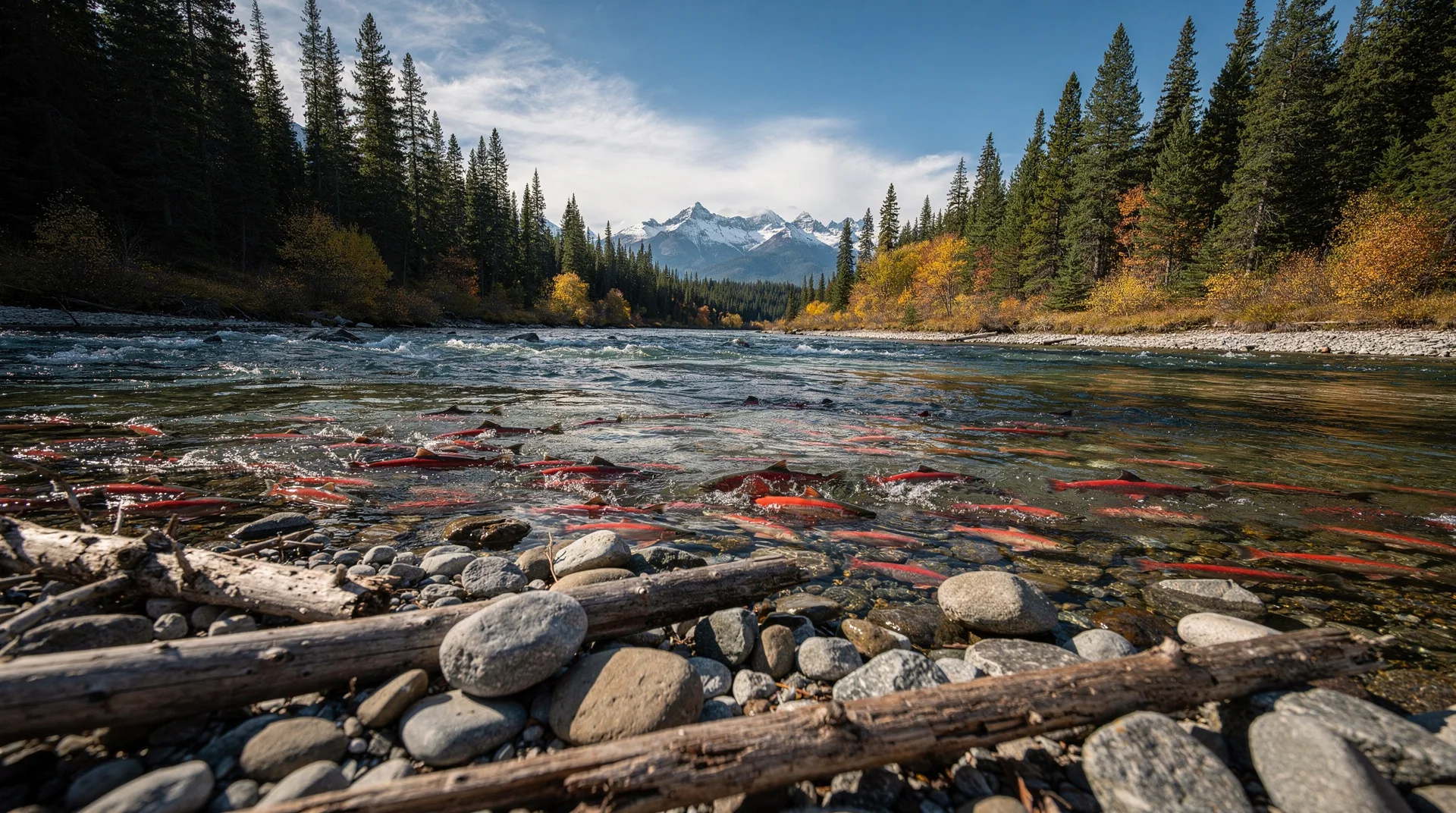
BC salmon run: Adams River, Goldstream, and where to see the migration
When is the best time to see the salmon run in BC?
The peak Adams River sockeye run occurs in mid-October of dominant years (next dominant run: 2026). Goldstream Provincial Park sees coho and chum from late October through December. Squamish sees the chum run in November. Most salmon runs peak in September through November depending on species and location.
Every autumn, one of the most extraordinary wildlife spectacles in North America unfolds in British Columbia’s river systems. Pacific salmon — chinook, sockeye, coho, pink, and chum — return from the open Pacific Ocean to the exact freshwater streams and rivers where they were born, navigating hundreds of kilometres upstream on an instinct that science has still not fully explained. They spawn, and they die, and in dying they transform the rivers and forests around them, delivering nutrients from the ocean deep into the interior of BC’s landscapes.
The BC salmon run is not a single event. It is a sequential series of runs by different species on different rivers, beginning with the earliest chinook in July and extending through the chum runs in December. Understanding which run is happening where — and when the specific rivers within each system peak — is the key to timing a viewing trip. The scale ranges from millions of sockeye turning the Adams River red in the dominant years to the intimate spectacle of 200 coho finning in a pool at Goldstream Provincial Park while bald eagles line the alder branches overhead.
At a glance
| Where | Adams River (near Kamloops), Goldstream Park (near Victoria), Squamish, Harrison River |
| Cost | Mostly free to view; guided boat tours around CAD 75-140 per person |
| Time needed | Half a day at one site, or 3-5 days to combine two or three regions |
| Getting there | Self-drive is easiest; Adams River is 4.5-5 hours from Vancouver, Goldstream is 20 minutes from Victoria |
| Best time | Mid-October for Adams River sockeye, November for coho/chum at Goldstream and Squamish |
The Pacific salmon: five species and their runs
The five species
Sockeye salmon are the most visually dramatic species at the salmon run. Their spawning colouration — fire-engine red body with a bright green head — makes a creek full of spawning sockeye look like a scene from another world. Adams River is the most famous sockeye viewing site in North America.
Chinook (king) salmon are the largest Pacific salmon, reaching 45+ kg. Their runs begin earliest (July–September) and they are the primary prey species for coastal orca whales. Fraser River chinook are the most significant stock, spawning in tributaries throughout the BC Interior.
Coho salmon spawn in smaller coastal streams in October through December, reaching rivers that sockeye and chinook cannot navigate. Goldstream Provincial Park outside Victoria is one of the most accessible coho viewing sites in BC.
Pink salmon run on two-year cycles, with odd years (2025, 2027) producing massive runs and even years producing very small ones. They’re the most numerous Pacific salmon by count and spawn in lower river sections and estuary areas.
Chum salmon are the last species to spawn, running October through December. The Squamish River and its tributaries host one of the largest accessible chum runs in the Lower Mainland area.
Why salmon die after spawning
Pacific salmon are semelparous — they spawn once and die. The biochemistry of the spawning process degrades their bodies progressively; the deterioration begins at ocean re-entry and accelerates after spawning. The death is programmed and serves the ecosystem: decomposing salmon bodies deliver marine-derived nitrogen and phosphorus into river and forest ecosystems. Bears, eagles, ravens, mink, and dozens of other species feed on the carcasses. Nutrients from the ocean thus flow through the salmon into the trees — old-growth temperate rainforest along BC salmon rivers literally incorporates marine nitrogen into its wood, detectable in core samples.
Adams River: sockeye capital of the world
The dominant run
The Adams River sockeye run operates on a four-year cycle with a “dominant” year producing dramatically more fish than the off-years. The 2022 dominant run brought an estimated 2+ million sockeye to the Adams River within a 2-week window. The 2026 dominant run is the next peak — making this autumn the best time in four years to visit.
During the dominant run, the Adams River — only about 10 km long, flowing from Adams Lake to the Thompson River near Roderick Haig-Brown Provincial Park — becomes solid red with fish. The density is almost impossible to believe: fish stacked side by side, churning the water, fins breaking the surface, filling every visible metre of river. The smell of decomposing salmon carries hundreds of metres into the surrounding forest. Ravens, bald eagles (hundreds congregate), and black bears work the river margins.
Roderick Haig-Brown Provincial Park
The park at the Adams River is designed specifically for salmon viewing. A network of boardwalks and viewing platforms along the riverbank allows close observation of spawning fish without entering the river or disturbing the gravel beds. Interpretive signs explain the salmon lifecycle and the ecological significance of the return. Guided tours are offered by BC Parks in peak years.
Location: Near Chase, BC, approximately 50 km east of Kamloops on Highway 1. The drive from Vancouver is 4.5–5 hours.
Best timing: The dominant sockeye run peaks in mid-October, typically between October 8–25. The 2026 dominant run peak will be announced on BC Parks’ website as it approaches — water temperature is the primary predictor of peak arrival.
Facilities: Parking area, toilets, interpretive centre (seasonal), and trail network. Viewing is free. The area becomes extremely busy on autumn weekends during peak run — arrive before 9 am or consider a weekday visit.
Accommodation near Adams River: Chase, BC has motels and B&Bs. Shuswap Lake Provincial Park (near Sorrento) has campgrounds if you want to stay in the region. Kamloops (50 minutes west) offers full hotel options.
Goldstream Provincial Park: Victoria’s salmon river
Why Goldstream is special
Goldstream Provincial Park, only 16 km from Victoria’s inner harbour on the Trans-Canada Highway, brings the salmon run within easy reach of British Columbia’s capital city. The Goldstream River hosts runs of coho, chum, and some chinook from late October through December, with peak activity typically in November.
The combination of accessibility (a 20-minute drive from downtown Victoria), beautiful old-growth forest, and reliable annual run makes Goldstream one of the most-visited salmon viewing sites in the province. On a peak November morning, hundreds of large coho and chum are visible in the river pools below the highway bridge, while bald eagles perch in the cottonwood gallery above.
Key viewing spot: The main parking area at the nature house and the footbridge over the Goldstream River. The river is visible from the bridge and from riverbank trails in both directions. No specialty equipment required — fish are visible with naked eyes.
Best timing: Late October through late November for the coho and chum runs. Some years produce peak activity in early December. The Nature House staff can advise on current conditions.
Naturalist programs: Goldstream runs “Salute to the Sockeye” interpretive programming during the salmon run, with naturalists stationed along the river on weekends to answer questions and explain what visitors are seeing.
Getting there from Victoria: Drive north on the Trans-Canada (Highway 1) for 16 km from downtown Victoria; the park entrance is well-signed. Also accessible by BC Transit from Victoria.
Squamish River: chum run near Vancouver
The Squamish chum run
The Squamish River system, with the Cheakamus River tributary being particularly important, hosts one of the largest accessible chum salmon runs in the Lower Mainland. The run typically peaks in November and attracts one of the largest concentrations of bald eagles in BC — 2,000–3,000 eagles have been counted along the Squamish estuary in peak viewing years, earning the area the nickname “eagle country.”
Brackendale Eagles Provincial Park, in the Squamish Valley, is the formal protected area for eagle viewing during the salmon run. The park’s dyke trails along the Squamish River provide views of both salmon and the eagles feeding on them. Guided eagle walks and boat tours are available from Squamish operators in November.
Best timing: Mid-November through mid-December for peak chum run and eagle concentrations.
Getting there: Squamish is 1 hour north of Vancouver on the Sea-to-Sky Highway — easily combined with rock climbing at the Stawamus Chief or other Sea-to-Sky activities. See the rock climbing Squamish guide and the Vancouver to Whistler guide.
Other notable BC salmon viewing sites
Harrison River (near Harrison Hot Springs)
The Harrison River, a short channel connecting Harrison Lake to the Fraser River near Agassiz, hosts one of the largest aggregations of bald eagles in North America each November, as the birds concentrate to feed on spawning and dead chum, pink, and coho salmon. The Harrison River Eagle Festival in November organises guided boat tours and hiking events.
The Harrison area is 2 hours from Vancouver. Harrison Hot Springs (a resort village with thermal pools on Harrison Lake) is a natural overnight combination.
Vedder/Chilliwack River
The Vedder River near Chilliwack, an hour and a half east of Vancouver on Highway 1, produces very visible coho, chinook, and chum runs from September through November. The river runs through Cultus Lake area agricultural land with numerous access points. Fly fishing and wildlife watching coexist here with casual visitors.
Capilano River Hatchery (Vancouver)
The Capilano River Hatchery, operated by Fisheries and Oceans Canada on the North Shore of Vancouver, provides one of the most urban and accessible salmon viewing experiences. Chinook return to the hatchery from July through October; coho arrive October through November. Viewing windows inside the hatchery show fish moving through the facility, and spawning fish are visible in the outdoor channel. Free admission. Easy to combine with a Grouse Mountain visit — see the Grouse Mountain guide.
Stamp Falls Provincial Park (Port Alberni, Vancouver Island)
Stamp Falls on Vancouver Island is an exceptional fall salmon viewing site where chinook and coho are visible leaping up the Stamp Falls on their upstream migration, often within metres of the viewing platform. Port Alberni is a 2-hour drive from Nanaimo or 4 hours from Victoria. The Stamp River system feeds into Alberni Inlet, which also hosts whale-watching opportunities in spring and fall.
Conservation and why the run matters
Pacific salmon populations in BC have declined significantly over the past century due to habitat loss, warming river temperatures, and historic overfishing, which makes an active dominant-year run like Adams River in 2026 genuinely significant to witness rather than a guaranteed annual spectacle. Fisheries and Oceans Canada and provincial conservation groups monitor run strength closely, and some smaller runs are now subject to fishing closures to protect stock recovery. Visitors do not need to do anything special to help beyond staying on marked boardwalks and trails, keeping dogs leashed near spawning channels, and not disturbing redds (the gravel nests where eggs are laid) by wading into shallow spawning water.
Building a salmon run trip into a wider BC itinerary
A salmon viewing stop rarely needs to be the whole reason for a journey. Most of the sites in this guide sit on or near routes that visitors already take, so the run can slot in as a half-day detour rather than a separate expedition. Our BC in 7 days itinerary and the longer BC in 10 days itinerary both pass through regions where autumn runs happen, and you can shift a day or two to line up with the fish.
If you are heading to Victoria for Goldstream, the Victoria destination page and the Vancouver to Victoria guide cover how to get across and what else is worth your time in the capital. For travellers coming from the Interior side, the Kamloops destination page is the natural base for the Adams River, and the Okanagan Valley makes a good wine-country extension afterwards.
Because river conditions and weather shape the whole experience, it is worth reading the best time to visit BC guide alongside this one, and the BC fall colors guide if you want to pair spawning fish with autumn foliage. Driving between sites is straightforward, but the BC driving distances guide helps you judge how much road time to allow so you are not rushing to be at the river at dawn.
Photography tips for the salmon run
Bring a telephoto lens (200mm+) for eagle and bear shots from a safe distance, and a polarizing filter is close to essential for cutting glare on the water to photograph fish beneath the surface. Overcast days often produce better colour saturation on spawning sockeye than harsh sunlight. Early morning light at Goldstream and Squamish, when eagles are most active, is also when boardwalks are least crowded — a rare case where the best photography conditions and the best viewing conditions align. If you plan to combine salmon viewing with broader BC wildlife photography, our bear watching Canada guide has additional field craft tips that carry over directly.
Wildlife watching the salmon run
Bears
All five BC salmon species attract bears to river corridors during their runs. The famous Great Bear Rainforest grizzly bear viewing (see the bear watching Canada guide) is fundamentally salmon-run bear watching. Even in the Lower Mainland, black bears are active at Squamish River tributaries during the chum run. Adams River has resident black bears that feed on sockeye.
Bald Eagles
Bald eagles aggregate wherever salmon runs occur. The Harrison River and Brackendale areas near Squamish see the largest counts — but any active salmon stream from October through December will have eagles. Immature brown-plumaged birds mix with white-headed adults. Early mornings before human activity peaks are the most productive viewing times.
Mergansers and other diving birds
Common Mergansers, Bufflehead, and other diving ducks follow salmon carcasses for aquatic insects and flesh. Kingfisher activity intensifies around spawning areas. Dippers — small dark thrush-like birds that walk underwater — are found at most salmon streams year-round and become more visible when salmon are present.
Find guided Vancouver and BC wildlife tours including salmon run viewing on GetYourGuide.
Best time summary by site
| Location | Species | Peak Timing |
|---|---|---|
| Adams River | Sockeye | Mid-October (dominant years: 2026) |
| Goldstream Park | Coho, chum | November |
| Squamish/Brackendale | Chum | November–December |
| Harrison River | Chum, pink | November |
| Capilano Hatchery | Chinook, coho | Aug–November |
| Stamp Falls (Port Alberni) | Chinook, coho | September–November |
How to get the most from a salmon run visit
Timing: Check BC Parks and Fisheries and Oceans Canada websites for current run conditions before visiting. Run timing varies by 2–4 weeks between years depending on ocean conditions and river temperatures. Arriving a week early or late can mean the difference between millions of fish and empty gravel.
Go on weekdays: Salmon run viewing at Adams River and Goldstream is extremely popular on fall weekends. Weekday visits are dramatically less crowded and more peaceful.
Early morning: Eagles are most active in the first 2–3 hours after sunrise. Bears are visible at dawn. Fish activity is higher in low light.
Waterproof footwear: The riverbanks around most salmon viewing sites are muddy from October rainfall and heavy visitor traffic. Rubber boots or waterproof trail shoes are the practical choice.
Polarized sunglasses: Cutting surface glare dramatically improves underwater visibility for counting and watching fish in the current. Essential for any serious salmon watching.
Costs
Most BC salmon run viewing is free. The main costs are transportation and accommodation:
Roderick Haig-Brown/Adams River: Free entry Goldstream Provincial Park: Free entry (no park pass required for day use) Brackendale Eagles Provincial Park: Free entry Capilano River Hatchery: Free Guided eagle and salmon boat tour (Harrison River): CAD 75–140 per person Adams River area accommodation (Chase, BC): Motels from CAD 100–160/night Camping (Shuswap Lake area): CAD 28–42/night
Where to stay
Adams River (near Kamloops): Chase, BC has the closest accommodation to Roderick Haig-Brown Provincial Park. Sun Peaks Resort is 45 minutes away and has extensive accommodation. Kamloops offers the widest range of hotel options.
Goldstream: Victoria is 20 minutes away and has extensive accommodation at all price points. For the salmon run, staying in Victoria and making day trips to Goldstream is the standard approach.
Squamish: See the Squamish climbing guide for accommodation. Hotel and campground options are solid.
Harrison Hot Springs: The Harrison Hot Springs Resort is the primary accommodation in the area (CAD 200–400/night). More affordable motels are available in Agassiz and Hope.
Frequently asked questions about BC salmon run: Adams River, Goldstream, and where to see the migration
When is the next dominant Adams River sockeye run?
The 2026 run is the next dominant year run. Dominant years produce dramatically more fish — typically 10x or more — than off-years. The 2022 dominant run brought over 2 million fish. Planning a visit to the Adams River in October 2026 gives you the best possible conditions.
Is the BC salmon run free to watch?
Yes — all major publicly accessible salmon viewing sites (Adams River, Goldstream, Brackendale, Capilano Hatchery) are free to enter. Guided tours add cost but also add knowledge and the best positioning. The only costs are transportation, accommodation, and optional national/provincial park fees where applicable.
Can you catch salmon to eat during the run?
Sport fishing for salmon on rivers during the spawning run is tightly regulated by Fisheries and Oceans Canada. Most spawning river sections are closed to fishing during the peak run. Check current DFO (Fisheries and Oceans Canada) regulations before any fishing activity. Ocean salmon fishing on tidal waters follows separate rules.
Why do Pacific salmon die after spawning?
Unlike Atlantic salmon, Pacific salmon (genus Oncorhynchus) are genetically programmed to die after spawning — a trait called semelparity. The biological theory is that death of the parent after reproduction delivers maximum nutrients to the next generation of smolts through the decomposing carcass. The ocean nutrients imported by the adult salmon then cycle into the river ecosystem, feeding insects that the juvenile fish eat.
Do the salmon smell bad?
During peak spawning and after peak, when large numbers of carcasses are in the river and along the banks, yes — the smell of decomposition is noticeable and strong near active viewing sites. This is part of the authentic experience and carries important ecological meaning, but those sensitive to strong organic smells should be aware.
Can children visit the salmon run?
Absolutely. The salmon run is one of the most accessible and spectacular free wildlife experiences in BC for families. Children are typically fascinated by the scale of the fish, the eagles, and the visual drama of the spawning colour. Boardwalks at Roderick Haig-Brown and Goldstream are stroller-accessible. Suitable for all ages.
Can I combine a salmon run visit with a trip to Whistler or Vancouver Island?
Yes. Squamish sits directly on the route between Vancouver and Whistler, so a chum run stop is an easy add-on to a Vancouver to Whistler day trip. Goldstream pairs naturally with a Victoria or wider Vancouver Island itinerary.
What should I wear to a salmon run viewing site?
Waterproof or water-resistant footwear, layered clothing (riverbanks are shaded and cooler than open ground), and a rain jacket, since October and November are wet months across coastal BC. Polarized sunglasses significantly improve underwater visibility for spotting fish.