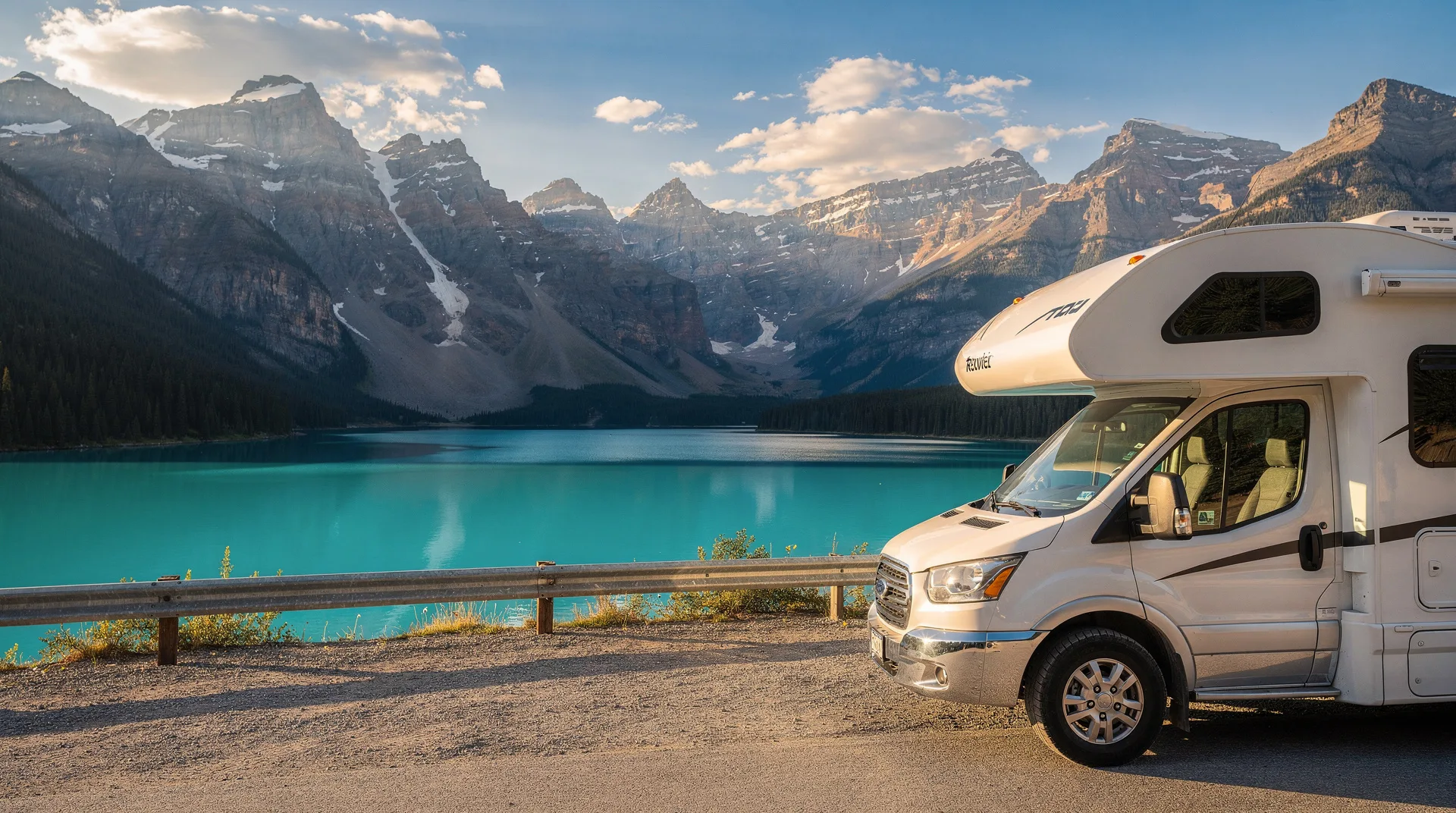
RV and camper van travel in Canada
Is Canada good for RV and camper van travel?
Canada is one of the world's great RV destinations. Vast distances, excellent highways, a dense national park campground network, and dramatic scenery along routes like the Icefields Parkway make it ideal. The main challenge is booking campgrounds well in advance.
There is arguably no better way to experience Canada than from the road, sleeping where the day ends, waking up to mountain views or lakeside silence. Canada’s highway network is vast, its campground infrastructure is excellent, and its distances reward exactly the kind of unhurried, self-directed travel that an RV or camper van enables.
This guide covers everything from choosing the right vehicle to booking campgrounds, planning routes, managing costs, and surviving Canadian weather in a van. If you are still deciding how to move around the country, our getting around guide compares the options, and the Canada car rental guide is the place to start if a standard car might suit you better than a motorhome.
At a glance
| Where | Best across BC, Alberta and the Rockies, Atlantic Canada and Ontario cottage country |
| Cost | Around CAD $130-350/night for the vehicle, plus CAD $20-90/night for campsites |
| Time needed | 10 days minimum for a Rockies loop; 2-3 weeks for a coast-to-coast section |
| Getting there | Pick up from a rental depot in Vancouver, Calgary, Toronto or another major hub |
| Best time | July-August for full facilities and weather; September for fewer crowds |
Why Canada is ideal for RV and camper van travel
The case for driving rather than flying around Canada is strong:
The distances make sense in a vehicle: Unlike a country where a 400km drive is a trek, Canada’s scale means road trips are assumed and catered for. Highways are well maintained, rest stops are frequent, and services (fuel, food, mechanics) are never impossibly far apart on main routes.
The scenery is the point: The Icefields Parkway between Banff and Jasper is widely considered one of the world’s most beautiful drives. The Sea-to-Sky Highway between Vancouver and Whistler is another. The Cabot Trail in Nova Scotia. The Trans-Canada through the Prairies at sunrise. Experiencing these by road, at your own pace, is categorically different from seeing them from an airplane.
Campground infrastructure: Parks Canada operates over 2,000 individual campsites across Canada’s national parks, many with full services (electricity, water, sewage dump stations). Provincial parks add thousands more. The network is genuinely excellent.
Cost advantages: A well-planned RV trip can be cheaper than equivalent hotel-and-restaurant travel, especially for families or groups. Self-catering eliminates restaurant costs, and campsite fees (CAD $20–60/night) are far below hotel prices.
Choosing your vehicle
Class A motorhomes
Large, bus-sized motorhomes — typically 8–12 metres long. Full kitchen, bathroom, sleeping for 4–8 people. Highest comfort but significantly more difficult to drive, park, and manoeuvre in national park campgrounds. Not ideal for first-time RVers. Fuel costs are substantial.
Class C motorhomes
Built on a truck or van chassis with a cab-over sleeping section. Typically 6–9 metres. More manageable than Class A but still a significant vehicle. Sleeps 4–6. Good balance of space and drivability for families. Most popular choice for families renting for the first time.
Class B camper vans
Converted vans (Sprinter, Transit, Promaster) — the camper van format. Most manoeuvrable, easiest to park in cities and national parks, best fuel economy. Limited interior space — typically sleeps 2, sometimes 4 in larger models. Ideal for couples and solo travellers. The fastest-growing segment of the RV rental market in Canada.
Truck campers and trailer setups
A truck with a mounted camper or a travel trailer towed behind an SUV or truck. Flexible — you can detach the trailer and use the truck independently for day trips. Towing requires practice and confidence; not ideal for first-timers on mountain roads.
Rental companies in Canada
Cruise Canada / Cruise America
The largest RV rental network in Canada and North America. Wide fleet of Class C motorhomes, extensive depot network across Canada. Reliable, well-maintained fleet. Prices run CAD $200–350/night in summer depending on vehicle size and location. Book 3–6 months ahead for July and August.
Fraserway RV
Western Canada specialist with depots in Vancouver, Calgary, Whitehorse, and other BC and Prairie locations. Excellent for Rockies and BC coast trips. Good reputation for vehicle quality and customer service.
CanaDream
Strong presence in Western Canada. CAD $180–320/night for Class C vehicles. Offers one-way rentals between depots (e.g., Vancouver pickup, Calgary drop-off), which suits Rockies itineraries well. One-way fees apply.
Indie Campers / Outdoorsy / RVshare
Marketplace platforms where private owners rent their vehicles. Often cheaper than traditional rental companies (CAD $100–200/night for smaller units). Quality varies more widely — read reviews carefully. Good for camper van formats.
Buying versus renting
For trips longer than 6–8 weeks, some travellers buy a used camper van in Vancouver (the used van market is active, particularly on Facebook Marketplace and Kijiji), travel for the summer, and sell before flying home. This can be significantly cheaper for long trips. It requires more research but is a legitimate strategy.
Essential routes
The Icefields Parkway (Jasper to Banff, Alberta)
The definitive Canadian road trip. 230km through Banff and Jasper National Parks, past glaciers, alpine lakes, waterfalls, and mountain peaks. Allow 3–4 days to do it properly, stopping at the Columbia Icefield, Peyto Lake, Bow Lake, and Athabasca Falls.
National park campgrounds along the route require advance reservation — book the moment Parks Canada’s reservation system opens in January for summer dates. Popular campgrounds (Rampart Creek, Wilcox Creek, Columbia Icefields) sell out within days.
If you’re not renting an RV: guided Banff and Jasper tour from CalgaryVancouver Island and the BC Coast
Take the BC Ferries crossing from Tsawwassen to Swartz Bay (ferries accommodate RVs and camper vans — reserve ahead). Our BC Ferries guide explains how the booking works, and the Vancouver Island 7-day itinerary shows how a week on the island can be paced. Explore Victoria, Cathedral Grove (ancient forest), Pacific Rim National Park, and Tofino. The island’s highway is well-maintained and the campgrounds are excellent. Allow 7–10 days to explore properly.
Day trip from Vancouver to Whistler — the Sea-to-Sky Highway is one of BC’s great drivesThe Sea-to-Sky Highway (Vancouver to Whistler to Lillooet)
90km of extraordinary coastal mountain scenery between Vancouver and Whistler. Continue north to Lillooet for a quieter, more remote route through the BC interior. Camping at Alice Lake Provincial Park (near Squamish) is excellent.
The Cabot Trail (Nova Scotia)
One of Canada’s great coastal drives: 300km around Cape Breton Island through the Cape Breton Highlands National Park. Celtic culture, whale watching, dramatic cliffs, and some of the best hiking in Eastern Canada. For a fuller picture of the drive, read our Cabot Trail guide and the Cape Breton destination page. Campgrounds at Chéticamp and Ingonish are the main stopping points.
Ontario’s Cottage Country and Algonquin
From Toronto, head north on Highway 60 into Algonquin Provincial Park — one of Canada’s most beautiful provincial parks, famous for moose, canoe routes, and fall colours. The Western Uplands campground network is excellent. Further north, the Trans-Canada leads to Sudbury and Lake Superior Provincial Park — a dramatically underrated road trip destination.
The Trans-Canada Highway
The full coast-to-coast drive from St. John’s, Newfoundland to Victoria, BC covers approximately 7,800km. Most travellers do sections rather than the whole route. The Prairie section (Manitoba through Saskatchewan to Alberta) is flat and fast but has a stark, open beauty — sunsets over the Prairies from a campervan are genuinely spectacular.
Campground booking: everything you need to know
Parks Canada reservations
National park campgrounds are booked through reservation.pc.gc.ca. The system opens in January for the upcoming summer season. Popular campgrounds in Banff, Jasper, and the Pacific Rim release spots that sell out within minutes of the booking window opening.
Strategy:
- Have the site loaded and your account ready before the booking opens
- Know your exact dates and preferred campgrounds in advance
- Have backup options ready
- Book immediately when the window opens
Walk-in sites (a small percentage of each campground’s capacity) are available first-come-first-served — arrive at the campground by 10am for the best chance.
Provincial park campgrounds
Each province operates its own booking system. Ontario Parks (ontarioparks.com), BC Parks (bcparks.ca), and Alberta Parks all have online booking with different opening windows. Equally in-demand in peak season — check each system individually.
Private campgrounds
KOA, Jellystone, and independently operated private campgrounds offer more services (full hookups, wifi, laundry, pools) but higher prices (CAD $50–90/night for full hookup). Less scenically dramatic than national park sites but offer more infrastructure. Good backup option when parks are full.
Free camping (Crown land)
On federal Crown land and many provincial Crown lands in Canada, dispersed free camping (boondocking) is permitted. This is common practice in rural BC, the Yukon, and the Prairies. Rules vary by province — check before camping, and see our Canadian camping rules guide for the general principles. Free camping sites are not listed in any central database; the iOverlander app and GAIA GPS are the tools most frequently used by experienced overlanders.
Insurance and the Parks Canada Discovery Pass
Rental companies include basic liability insurance in the quoted price, but the standard deductible is often CAD $2,500-5,000 — pay close attention to the optional deductible-reduction add-on if you are not comfortable with that exposure. Separately, if your route touches more than two or three national parks, the Parks Canada Discovery Pass (around CAD $145/family/year) pays for itself quickly compared to buying single-day passes at each park gate, and it covers entry fees for Banff, Jasper, Yoho and dozens of other parks nationwide.
Practical RV travel tips
Fuel and range planning
Fuel (gas/petrol) is widely available on major highways. Remote routes (Cassiar Highway in BC, Dempster Highway to the Yukon) have much larger gaps between fuel stops — in some cases 300km+. Always fill up when you see a fuel station on remote routes. Fuel costs in Canada are similar to UK prices (roughly CAD $1.55–1.80/litre in 2026 depending on province and global oil prices).
Dump stations
Waste dump stations are available at most Parks Canada campgrounds, many provincial campgrounds, and designated road-side dump stations on major highways. Apps like Sanidumps.com and iRV2’s dump station finder list locations across Canada. Never dump grey or black water illegally.
Propane
Propane (LPG) for cooking and heating is widely available at Canadian Tire, Home Hardware, gas stations, and some campgrounds. The Linde/AmeriGas exchange program (tank swap for a full one) is the most convenient option in urban areas. In remote areas, carry a larger supply.
Bear safety at campgrounds
For general wildlife precautions beyond the campground, see our Canada wildlife safety guide and the bear watching guide. Bears visit campgrounds throughout Canada. Rules are strict and must be followed:
- All food, waste, and scented items must be stored in the vehicle or a bear-resistant container when not in use
- Never leave food out
- Never cook inside a tent or sleep in clothes you cooked in
- Report all bear sightings to campground staff
RVs and camper vans are actually the safest option for bear country camping — everything is locked inside a solid vehicle.
Weather preparedness
Summer nights in the Rockies can be cold (5–10°C), even in July. Shoulder season nights (September) can drop below 0°C. Ensure your vehicle has adequate heating and carry extra blankets. Rain and sudden storms are common in BC, the Maritimes, and the mountains.
Winter RV travel in Canada is possible but requires a properly winterised vehicle (antifreeze in the water system, insulated pipes, a proper furnace). It’s not for first-timers.
Budget breakdown
| Item | Cost range (CAD) |
|---|---|
| Class C motorhome rental | $200–350/night |
| Class B camper van rental | $130–220/night |
| National park campsite | $28–55/night |
| Provincial park campsite | $20–45/night |
| Fuel (per 100km, Class C) | $25–40 |
| Groceries per person/day | $25–45 |
| Parks Canada Discovery Pass | $145/family/year |
| Dump station (where charged) | $5–15 |
A couple in a camper van, travelling for 14 days with the Parks Canada Discovery Pass, self-catering most meals, spending 10 nights in national park campgrounds and 4 nights in provincial parks, can expect total costs (excluding rental) of approximately CAD $1,200–1,800.
Recommendations by traveller type
Couples: Class B camper vans are ideal — easier to drive, better fuel economy, fits in most campground sites, allows free camping on Crown land.
Families: Class C motorhomes give children real space and the full kitchen makes self-catering practical. Worth the additional size and fuel cost for trips of 7+ days.
First-time RVers: Rent a mid-size Class C from a major operator (Cruise Canada, CanaDream) for confidence in vehicle quality and support. Avoid one-way rentals until you know the vehicle.
Budget travellers: Camper van + Crown land camping + self-catering is genuinely affordable. The van is your biggest cost; minimize campsite fees through free camping where possible.
Adventure travellers: The Yukon, Dempster Highway, and Cassiar Highway routes are the most remote and spectacular. Require more preparation (spare tyre, satellite communicator, extra fuel capacity), but the experiences are extraordinary. Also consider a loop through Tofino and Vancouver Island’s west coast for a mix of remote driving and accessible amenities.
Frequently asked questions about RV and camper van travel in Canada
Do I need a special licence to drive an RV in Canada?
For most rental RVs (under a certain weight, typically 11,000kg GVW), a standard Class 5 or Class G (provincial) driver’s licence is sufficient. Visitors from most countries can drive on their home licence for up to 90 days. Check the specific weight and licence requirements with your rental company.
Can I drive an RV through national parks?
Yes — RVs and camper vans are permitted on all major national park roads. Some specific areas (Moraine Lake Road, certain backcountry access roads) have size restrictions or vehicle type bans. Check Parks Canada’s website for current restrictions before planning your route.
How far in advance should I book campgrounds?
For national parks in peak summer (July–August): book the moment the Parks Canada reservation system opens in January. For shoulder season (June, September): 4–8 weeks ahead is generally sufficient. Winter: most national park campgrounds are closed; check individual park status.
Is RV travel cheaper than hotels and restaurants?
For couples: it depends on the rental cost and how much you self-cater. A camper van costing CAD $150/night plus CAD $35 camping plus CAD $40 food = CAD $225/day for two, versus CAD $200/night for a mid-range hotel plus restaurant costs. It’s roughly comparable for couples, significantly cheaper for families of 4+.
What is the best time of year for an RV trip in Canada?
July and August are the most popular and logistically simplest — longest days, warmest temperatures, everything open. September is arguably better for the Rockies: fewer crowds, superb fall colour beginning, bears actively foraging (frequently visible). October is beautiful in Eastern Canada but marks the end of the season in the mountains.
Can I take a rental RV to the USA?
Some Canadian RV rental companies permit cross-border travel into the USA with advance notice and a cross-border fee (typically CAD $300–500 plus additional insurance). Not all operators allow it — ask when booking.
What should I do if the RV breaks down in a remote area?
All major rental companies provide 24-hour roadside assistance. Save the emergency number in your phone before departure. In genuinely remote areas (Dempster Highway, north of Watson Lake on the Alaska Highway), a satellite communicator (Garmin inReach) is strongly recommended.
Do I need a park reservation even with a Discovery Pass?
Yes. The Discovery Pass covers entry fees only, not campsite reservations. You still need to book individual campsites through reservation.pc.gc.ca for national parks, or the relevant provincial system, well ahead of your travel dates in peak season.
Is it safe to free-camp (boondock) alone in Canada?
Generally yes on legal Crown land, but use common sense: park somewhere already used by others when possible, avoid isolated dead-end forest roads at night if travelling solo, and let someone know your general route. It is far more common and normalised in Canada than in many countries, particularly in BC, the Yukon and the Prairies.