Quebec Whale Watching Complete Guide: Every Port, Every Species, Every Season
When is the best time for whale watching in Quebec?
Late June through early October, with August offering the greatest species diversity. Blue whales peak in August–September; belugas are present year-round in the estuary.
Quebec is home to one of the world’s most remarkable whale watching environments. Where the Saguenay River meets the St. Lawrence, cold nutrient-rich water wells up from the depths of the St. Lawrence estuary, triggering an extraordinary marine food web that supports nine species of whale regularly, year after year, from late June through early October. This includes blue whales — the largest animals on Earth — as well as fin whales (the second largest), humpbacks, minkes, and the resident St. Lawrence beluga population, which has lived in these waters continuously for approximately 10,000 years.
This guide covers every practical aspect of whale watching in Quebec: which species you’ll encounter, at which ports, in which months, on which types of boats, and with what probability of success. It is the planning document for anyone who wants to make the most of a whale watching visit to the St. Lawrence region.
| At a glance | |
|---|---|
| Where | Tadoussac and the St. Lawrence estuary ports (Les Escoumins, Baie-Sainte-Catherine, Rivière-du-Loup, Havre-Saint-Pierre) |
| Cost | Around CAD $80-120 for a standard boat tour, adult; free from shore viewpoints |
| Time needed | A half-day for the boat tour itself; a full day once travel from Quebec City or Montreal is included |
| Getting there | Self-drive via Highway 138 and the free Saguenay ferry, or an organised tour from Quebec City |
| Best time | Late June through early October; August for the widest species diversity |
Species probability by port and month
| Port/period | Beluga | Minke | Fin | Blue |
|---|---|---|---|---|
| Tadoussac, June-Sept | Near-certain | Most trips | Regular | Good in Aug-Sept |
| Les Escoumins, June-Sept | Near-certain | Most trips | Regular | Occasional |
| Rivière-du-Loup, south shore | Regular | Primary species | Regular | Less common |
| Havre-Saint-Pierre, Mingan | Uncommon | Regular | Regular | Documented feeding range |
Species guide: who’s in the water
Blue whale (Balaenoptera musculus): The largest animal that has ever existed. Adults regularly reach 25 metres and 150 tonnes. They feed almost exclusively on krill, and the St. Lawrence concentration of krill — particularly in the Tadoussac zone and the Mingan Archipelago area — supports the largest blue whale population on Canada’s east coast. The species was hunted to near-extinction in the North Atlantic and recovery has been slow; the St. Lawrence population is estimated at 400–450 individuals. Blue whale encounters are possible from mid-July through September, with August and early September typically offering the best probability.
Fin whale (Balaenoptera physalus): The second-largest animal on Earth, reaching 24–27 metres. Faster swimmers than blue whales, often visible at speed. Feed on both krill and small fish (herring, capelin). Present in the St. Lawrence from late June through October. Fin whales arrive earlier in the season than blue whales and tend to be the first large rorqual sighting of any given trip.
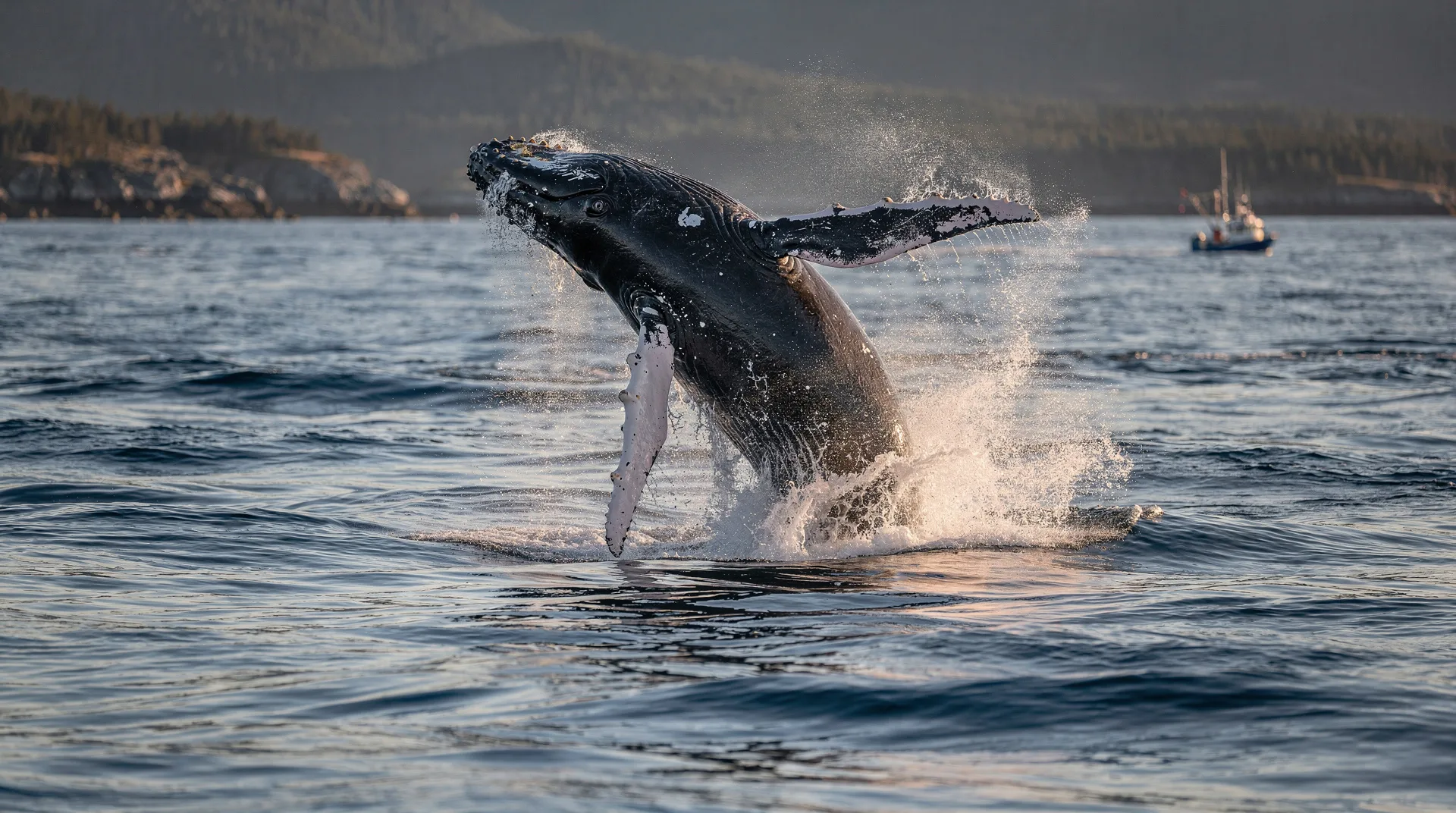
Humpback whale (Megaptera novaeangliae): The “showboat” of the St. Lawrence cetaceans — known for breaching (leaping from the water), tail-slapping, and the bubble-net feeding behaviour (corralling fish by releasing rising curtains of bubbles). Not as numerous as fin whales or minkes but memorable when encountered. Humpbacks are present irregularly in the St. Lawrence; their numbers vary significantly from year to year depending on fish availability.
Minke whale (Balaenoptera acutorostrata): The smallest baleen whale regularly seen in the St. Lawrence, reaching 8–10 metres. The most frequently encountered whale species on most St. Lawrence tours. Minkes are fast, curious, and often approach boats. They are present in good numbers throughout the season from June through October, often in nearshore areas accessible from multiple ports.
St. Lawrence beluga (Delphinapterus leucas): The St. Lawrence population of approximately 900 belugas is a distinct subspecies, resident year-round and genetically isolated from other North American beluga populations. They are small (3–5 metres), white as adults, and famously social and vocal — described historically as “sea canaries” for their above-water sounds. The beluga population is in poor reproductive health due to toxic contamination, boat traffic noise, and prey depletion; it is the subject of one of Canada’s most intensive marine mammal conservation programs.
Sei whale (Balaenoptera borealis): An occasional visitor to the deep outer estuary; less regularly seen than the other rorquals but present in some years.
Sperm whale (Physeter macrocephalus): Rare but documented in the deep outer Gulf. Not typically encountered on standard St. Lawrence tours.
Harbour porpoise (Phocoena phocoena): Small (1.5–1.8 m), dark-backed, rarely jumping. Present throughout the estuary and Gulf. Often seen from ferries and shore viewpoints.
White-sided dolphin (Lagenorhynchus acutus): Seen in the Gulf of St. Lawrence, less commonly in the upper estuary. Occasional visitors to the Tadoussac area in years of high prey abundance.
The whale watching ports
Tadoussac: the benchmark
Tadoussac is where the Saguenay River meets the St. Lawrence, creating the upwelling conditions that concentrate prey species and attract whales. It is the most intensively developed whale watching destination in Quebec, with multiple operators, a marine mammal interpretation centre (CIMM), and a 40-year track record of tour operations.
The typical Tadoussac tour runs 3–4 hours on either a Zodiac inflatable boat or a larger covered vessel. Zodiacs offer immediacy — water level, speed, manoeuvrability — but are cold and wet in rough conditions. Larger boats carry more people and offer better stability for those prone to seasickness.
Probability of sightings from June through September at Tadoussac: beluga sightings on nearly every trip (they are resident); minke whales on most trips; fin whales regularly; blue whales with good probability in August and September.
Les Escoumins: the quieter alternative
50 km east of Tadoussac on the north shore, Les Escoumins has a Parks Canada marine mammal interpretation facility and several tour operators who access the same whale habitat as the Tadoussac boats with considerably less competition for space on the water. The tours from Les Escoumins are typically smaller boat operations — more intimate, often run by guides who have worked the same waters for decades.
The underwater observatory at Les Escoumins (a structure lowered into the water that allows non-swimmer observation of the marine environment) is a distinctive feature not available elsewhere on the north shore.
Baie-Sainte-Catherine: the north shore alternative
Directly across the Saguenay from Tadoussac, Baie-Sainte-Catherine has several operators and serves as an alternative departure point for the same Tadoussac-area waters. The free government ferry between the two communities runs continuously, and some visitors prefer to depart from Baie-Sainte-Catherine to avoid the more crowded Tadoussac waterfront.
Rivière-du-Loup: the south shore option
Croisières AML operates from Rivière-du-Loup’s wharf on the south shore, offering access to the estuary whale population from a different angle. Minke whales are the primary species encountered; belugas and fin whales appear regularly. Blue whale sightings are less common from the south shore than from the Tadoussac zone but do occur.
The Rivière-du-Loup tours are useful for travellers on the south shore who don’t want to cross to the north shore, and for those breaking the Quebec City–Gaspésie drive at Rivière-du-Loup.
Havre-Saint-Pierre: blue whales in the Mingan zone
The waters of the Mingan Archipelago (200 km east of Sept-Îles on the north shore) are within the documented blue whale feeding range, and tours from Havre-Saint-Pierre offer the combination of archipelago geology, seabird wildlife, and blue whale potential. This is the most remote and logistically demanding of the whale watching options but produces some of the least crowded encounters.
Book a Quebec whale watching tour on GetYourGuideSeasonal calendar
Late May–early June: The whale watching season begins. Belugas are always present. Minke whales and fin whales arrive first. Water is cold; fog is frequent; tours are less numerous. The first blue whale sightings of the year occur in late June in good years.
July: The season builds. Fin whales are well-established. Humpbacks appear in variable numbers. Blue whale sightings increase through the month. Beluga calves are born in June–July and small families with calves are visible. The days are long (sunset after 8:30pm), the water temperature rises to 12–15°C in the surface layer, and the tours begin filling. Book well in advance for any July weekend.
August: Peak season. The greatest diversity and numbers of whale species are present. Blue whale sightings reach their best probability. Humpback breaching events occur. Belugas are everywhere. Temperatures are warmest (air 22–26°C; water 15–18°C). Tours are most heavily booked. Accommodation is hardest to find. The effort to secure a reservation is worthwhile.
September: Excellent and underappreciated. Large whales remain in good numbers through the month. Blue whales are still present in the first two to three weeks. Crowds begin to thin from mid-September. Autumn colours begin on the Saguenay hillsides by mid-September. The water temperature drops (to 12°C by late September), which requires warmer clothing for Zodiac tours.
October–November: The season winds down. Fin whales and minkes linger into October. Blue whales depart. Belugas remain. Most tour operators close by mid-October. Shore-based beluga viewing at Baie-Sainte-Marguerite (within Saguenay-St. Lawrence Marine Park) continues as long as the belugas use the bay.
Boat types: Zodiac vs. larger vessel
Zodiac inflatable boats: 8–12 passengers maximum. Low water level, high manoeuvrability, speed for following whale behaviour. The experience is more immediate — you feel the spray and the motion much more than from a larger boat. Required: warm, waterproof clothing regardless of air temperature; seasickness medication if prone.
Large cruise vessels: 50–200 passengers. Covered sections available; upper deck open. Better stability, better height for photography (you’re looking down at whales rather than across). More social atmosphere; narration over a sound system. Less intimate.
Kayak: Several operators in the Tadoussac and Saguenay area offer guided kayak tours in areas of known beluga activity. Kayak encounters with belugas are not guaranteed but the probability is higher than by random chance because the guides know the territories the belugas frequent. Humpback and minke whales have been encountered from kayaks in the Saguenay; precautions to avoid displacement of the animals apply.
Regulations and whale protection
Canadian regulations require that boats stay at minimum distances from different whale species (varies by species, typically 100–400 metres for the large rorquals and a different protocol for belugas given their resident status). The GREMM researchers who monitor the population have documented the impact of excessive boat traffic on the belugas, and the regulatory framework has tightened significantly over the past decade.
All licensed whale watching operators in Quebec’s marine park area are trained in the regulations and adhere to them. Visitors on licensed tours can expect operators who know when to approach and when to maintain distance.
Practical tips
Clothing: Dress warmer than you think necessary. The St. Lawrence estuary is cold, and Zodiac speeds create significant wind chill even in August. A windproof and waterproof outer layer, a warm mid-layer, and gloves are appropriate for Zodiac tours throughout the season. Larger boats offer windproof sections that reduce the cold exposure.
Photography: For large whale photography, a telephoto lens of at least 200mm equivalent is recommended; 400mm is better for surface behaviour shots. Blue whale surfacing shots typically involve the back and dorsal fin only (the head is usually below the surface when the back is visible). Humpback breaches require fast shutter speed and anticipation. Belugas are more cooperative subjects and can be captured with a wider range of focal lengths.
Booking: Book in advance for July and August — weeks in advance for weekday tours, months in advance for weekend tours in the busiest periods. Most operators have online booking. Cancellation policies vary; understand them before booking if your schedule is tight.
Seasickness: A real consideration on smaller boats and in rough conditions. Ginger supplements, Gravol (dimenhydrinate), and scopolamine patches are the common approaches. Take medication before boarding if you’re prone to motion sickness; taking it after symptoms start is much less effective.
Find St. Lawrence and Quebec wildlife tours on GetYourGuideShore-based whale watching
Several locations offer good whale watching from land without a boat:
Pointe-Noire, Baie-Sainte-Catherine: The cliff viewpoint at the mouth of the Saguenay facing the Tadoussac shore. This is one of the best shore-based locations for the large rorquals — the deep water channel runs close to shore here and whales pass at predictable times related to tidal movement. Parks Canada operates an interpretation station here in summer.
Baie-Sainte-Marguerite: A shallow bay 15 km up the Saguenay south shore where belugas regularly aggregate for resting in summer. The beach and cliff viewpoints above the bay are the best guaranteed beluga viewing from land in Quebec.
Cap-Bon-Ami, Forillon National Park: The 200-metre cliffs at the tip of the Gaspésie offer elevated views over the Gulf, and humpback and minke whales are regularly visible feeding offshore in summer.
Combining whale watching with the broader Quebec travel circuit
Quebec whale watching is most efficiently combined with:
- Charlevoix: Drive the north shore through this scenic region en route to Tadoussac. The Charlevoix coast itself has shore-based beluga viewing at Baie-Saint-Paul and similar points.
- Saguenay Fjord: The fjord park extends from Tadoussac up the Saguenay — kayaking, hiking, and the beluga congregation at Baie-Sainte-Marguerite are all within the park.
- Gaspésie circuit: Whale watching from the north coast of the peninsula (Sainte-Anne-des-Monts, Forillon) complements the terrestrial attractions of the peninsula.
- Côte-Nord drive: Highway 138 east from Tadoussac passes through whale habitat for its entire length to Havre-Saint-Pierre.
Fitting whale watching into a wider trip
Because most whale watching ports are 2.5-3 hours from Quebec City and further from Montreal, few visitors treat it as a standalone day trip. It works best folded into a longer Quebec loop. Our Quebec 10-day itinerary and Quebec 14-day itinerary both build in a Tadoussac stop with an overnight, which avoids the long same-day round trip and leaves room for a shore-based viewing session in addition to the boat tour. If food and wildlife are both priorities, the Quebec food deep dive covers the Charlevoix stretch you’ll pass through en route.
Related pages
- Tadoussac — the premier whale watching destination
- Blue whale viewing in Quebec — the blue whale in detail
- Côte-Nord region — the north shore whale watching corridor
- Rivière-du-Loup — south shore whale watching
- Forillon National Park — whale watching from Gaspésie
Frequently asked questions about Quebec Whale Watching Complete Guide: Every Port, Every Species, Every Season
Is whale watching guaranteed in Quebec? No sighting is ever guaranteed. Probability from Tadoussac and Les Escoumins is high — the combined species encounter rate across belugas, minkes, and fin whales is over 90% on most tours from July through September. Blue whale sightings specifically (larger boats, right timing in August–September) run at 60–80% probability in good conditions from operators who know the territory.
Can children participate in Quebec whale watching tours? Zodiac tours typically have a minimum age (often 8–10 years) due to the physical requirements (sitting on the inflatable tube, holding on in motion). Larger cruise vessels are fully family-appropriate with no age restriction. Children tend to be highly engaged by whale encounters; the experience is strongly recommended for family trips.
What is the best whale watching port in Quebec? Tadoussac for the combination of species diversity and established infrastructure. Les Escoumins for a quieter experience with equivalent access to the same whale habitat. Both are on the north shore and require getting across the St. Lawrence from the south shore cities.
How do I get to Tadoussac from Quebec City? Highway 138 east through Charlevoix to Baie-Sainte-Catherine, then the free ferry across the Saguenay to Tadoussac. Approximately 200 km, 2.5–3 hours depending on ferry wait. The scenic route through Charlevoix adds 30–40 minutes but is worth it.
When do blue whales arrive in the St. Lawrence? Blue whales are typically first seen from mid-July, with numbers building through August and remaining strong into mid-September before the migration south begins. They are never guaranteed on any single trip, but August and early September give the best odds.
Is it worth combining whale watching with the Charlevoix region? Yes — Charlevoix sits directly on the route between Quebec City and Tadoussac, and offers its own shore-based beluga viewing at Baie-Saint-Paul along with a well-regarded food and art scene, making it a natural overnight stop rather than a detour.