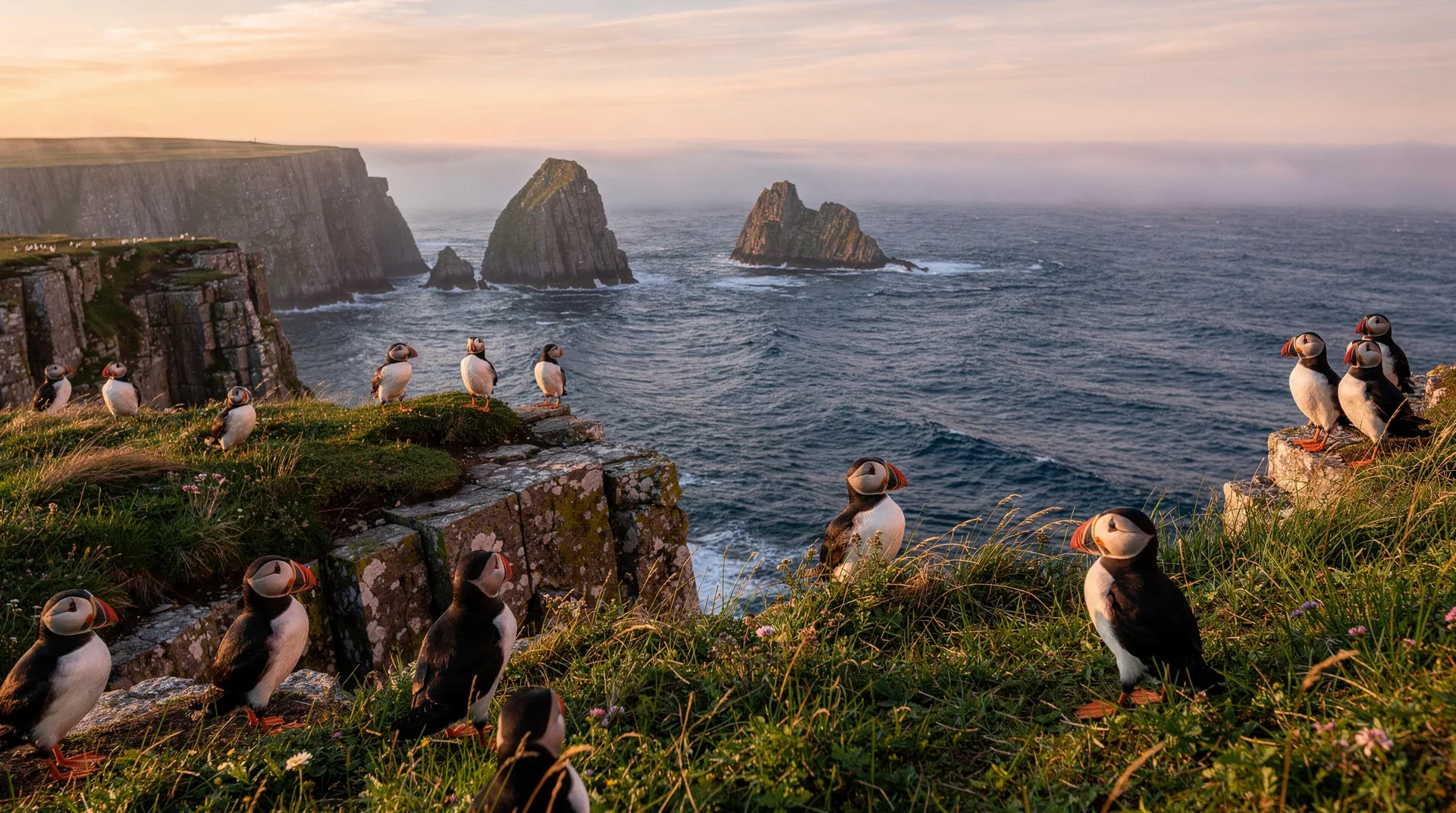
Puffin watching in Newfoundland: best colonies & tours
Where is the best place to see puffins in Newfoundland?
Witless Bay Ecological Reserve, 30 km south of St. John's, hosts North America's largest Atlantic puffin colony with over 260,000 breeding pairs. Elliston, on the Bonavista Peninsula, offers free cliff-top viewing with puffins nesting just metres from visitors. Peak season is June to August.
Atlantic puffins are one of the most improbably photogenic birds on earth — compact bodies in tuxedo black and white, enormous candy-coloured bills, and a slightly bewildered expression that suggests they are permanently surprised to find themselves this famous. And for sheer accessible density of puffin encounters, nowhere on the planet beats Newfoundland. The province hosts several of the largest Atlantic puffin colonies in North America, and the proximity at which you can observe these birds — in some cases, literally within arm’s reach — is extraordinary.
This guide covers the two premier puffin destinations in Newfoundland, how to access them, what else you can see alongside the puffins, and how to build the best possible puffin-watching experience into your visit.
| At a glance | |
|---|---|
| Where | Witless Bay Ecological Reserve (near Bay Bulls, 30 km south of St. John’s) and Elliston (Bonavista Peninsula, around 280 km northeast of St. John’s) |
| Cost | Witless Bay boat tours around CAD $50-75/adult; Elliston shore viewing is free (donations welcomed) |
| Time needed | Half a day for a Witless Bay boat tour; an hour or two at Elliston |
| Getting there | Both are reachable by rental car from St. John’s; Bay Bulls is a 25-30 minute drive, Elliston is roughly 3.5-4 hours |
| Best time | Late May through mid-August, peaking June to late July |
Atlantic puffins in Newfoundland: the basics
Atlantic puffins (Fratercula arctica) spend most of their lives far out at sea, rarely approaching land except to breed. Their breeding season in Newfoundland runs from approximately late April through August, during which time they congregate on offshore islands, cliffs, and coastal headlands to nest in burrows dug into the soft soil or within rocky crevices.
Newfoundland’s cold, productive waters — particularly the Labrador Current that sweeps down the eastern coast — provide ideal conditions for the capelin, sand lance, and herring that puffins feed their chicks. The province’s largely uninhabited offshore islands provide nesting habitat free from the terrestrial predators (rats, foxes, mink) that have devastated puffin colonies elsewhere in the Atlantic.
The result is a puffin population of genuinely remarkable scale. Newfoundland hosts an estimated 95% of North America’s total Atlantic puffin breeding population.
Season: Late May through mid-August. Peak activity (largest bird numbers, chick-feeding activity, maximum visual entertainment) is June through late July.
Witless Bay Ecological Reserve
The Witless Bay Ecological Reserve consists of four offshore islands — Great Island, Gull Island, Green Island, and Pee Pee Island — located 5-10 km off the coast of the Avalon Peninsula, about 30 km south of St. John’s. Together they host:
- Over 260,000 breeding pairs of Atlantic puffins (North America’s largest colony)
- The second-largest Leach’s storm-petrel colony in the world (approximately 620,000 pairs)
- Significant numbers of common murre, thick-billed murre, razorbill, black-legged kittiwake, and black guillemot
The islands themselves are closed to the public (the ecological reserve designation protects the nesting habitat), but boat tours from Bay Bulls and Witless Bay bring visitors around and between the islands for views that are extraordinary in scale. On a calm June day, the air above the islands is thick with puffins in flight — thousands of birds circling, landing, departing, and carrying fish in their bills. The noise and energy is overwhelming in the best way.
Boat tours from Bay Bulls
Bay Bulls, about 30 km south of St. John’s on Route 10, is the primary departure point for Witless Bay tours. Several operators run tours of 2-2.5 hours that circle the islands, getting within close proximity of nesting and resting puffins.
Tours typically include:
- Close approach to puffin colonies on Great Island and Gull Island
- Views of the storm-petrel colony (best observed at dusk when birds return from sea)
- Regular humpback whale encounters in the same productive waters — this is one of the few tours where you reliably see both puffins and whales on the same excursion
- Seabird observation including gannets, shearwaters, and murres
The combination of puffins and humpback whales on the same tour is Witless Bay’s defining advantage — it is essentially unmatched anywhere in eastern North America.
Browse Newfoundland wildlife tours and puffin experiencesPractical notes: Tours run multiple times daily from June through August. Morning tours generally have calmer seas; afternoon light is better for photography of the eastern cliffs. Booking a day or two ahead is advisable in peak season. Bring warm layers — the water offshore is cold even in July.
Elliston: puffin viewing from shore
If Witless Bay is the spectacle, Elliston is the intimacy. The small fishing village of Elliston, on the Bonavista Peninsula about 280 km northeast of St. John’s, has a puffin colony that nests directly on rocky headlands accessible by a short walking path. Visitors can sit within 2-3 metres of nesting puffins — watching them come and go with fish, squabbling over burrow entrances, preening, and displaying — without any boat or any fee.
Elliston bills itself as the “Root Cellar Capital of the World” (for its collection of traditional vegetable storage caves cut into hillsides) but the puffins have thoroughly eclipsed this distinction. The headland colony is small by Witless Bay standards but the access is incomparable. Puffins here appear genuinely unbothered by human presence, making sustained observation and photography easier than anywhere else in the province.
Getting there: Elliston is on Route 238, off the main Bonavista Peninsula highway (Route 230). Drive to the village, follow signage to the puffin viewing area, and walk the short path to the headland. No admission charge; donations to local conservation efforts are welcomed.
Best time at Elliston: July and early August, when chick-feeding activity peaks and the puffins are most active during daylight hours.
Cape St. Mary’s Ecological Reserve
Cape St. Mary’s, at the southwestern tip of the Avalon Peninsula, is primarily known as a gannet colony rather than a puffin site — but it deserves mention in any Newfoundland seabird guide. The reserve hosts approximately 24,000 northern gannets nesting on Bird Rock, a sea stack that can be approached to within 10 metres by walking the coastal path from the interpretive centre.
A small number of puffins are present in the crevices below the gannet colony. The main draw at Cape St. Mary’s is the gannets: the combination of the sea stack, the continuously airborne birds, and the sound and smell of a gannet colony at full activity is one of the most intense wildlife experiences in Atlantic Canada.
See our 7-day Newfoundland itinerary for how Cape St. Mary’s fits into an Avalon Peninsula road trip.
Other puffin sites in Newfoundland
Gull Island, Witless Bay (visible from shore): The view from the shore-side lookout near Bay Bulls gives some sense of the colony scale even without taking a boat.
Baccalieu Island Ecological Reserve: One of the world’s largest Leach’s storm-petrel colonies, with a significant puffin population. Not accessible by regular tourism boats, but visible from the northern shore of Trinity Bay.
Funk Island: A remote offshore island far to the northeast, accessible only by rough-weather boat trips — the site of the last colony of great auks (hunted to extinction in 1844) and now hosting very large populations of murres and other seabirds. Not practical for most visitors.
Combining puffins with other Newfoundland wildlife
The Avalon Peninsula’s concentration of wildlife makes it one of the finest wildlife watching areas in eastern North America. Within a reasonable drive of St. John’s:
- Witless Bay: puffins, whales, storm petrels
- Cape St. Mary’s: northern gannets, puffins, murres
- Random Passage Historic Site (New World Island area): moose, bald eagles
- The Avalon Peninsula moose population is exceptionally dense — moose sightings are almost inevitable on any drive through wooded areas
For iceberg viewing, combine the Avalon with the best time to see icebergs guide and the iceberg viewing guide for a complete Newfoundland wildlife experience.
Where puffin watching fits in a wider Newfoundland trip
Puffin watching pairs naturally with a longer Newfoundland itinerary rather than standing alone. Our 7-day Newfoundland itinerary builds a route around St. John’s, the Avalon Peninsula, and beyond. If you are adding other regions, you can also compare tours and activities across Canada before you book. If you’re weighing Newfoundland against the Maritimes for a single Atlantic Canada trip, the Maritimes vs Newfoundland guide breaks down the trade-offs, and the Newfoundland vs Labrador guide clarifies which side of the province rewards which kind of traveller.
For those extending north along the Great Northern Peninsula, the Viking Trail Newfoundland guide and its companion Viking Trail itinerary cover L’Anse aux Meadows and Gros Morne, both well outside puffin range but easily combined into a longer visit.
Photography tips for puffin watching
At Witless Bay (boat tours):
- A 200-400mm telephoto is ideal; the birds are close but the boat’s movement requires continuous autofocus
- Continuous shooting mode is essential — puffins in flight are fast and direction changes are abrupt
- Target landing and takeoff moments for the most dynamic shots; birds carrying fish in their bills are the classic image
- Overcast light produces better colour rendition of the bill than harsh direct sun
At Elliston (shore-based):
- A 70-200mm or even 50-135mm lens is sufficient given the proximity
- Shoot from ground level (sitting or lying down) to get a puffin’s-eye perspective that removes human scale from the frame
- Early morning and late afternoon light is warmest; midday is harshest
- The birds are surprisingly tolerant; patience rewards with natural behaviour rather than a flight reaction
Getting to Witless Bay from St. John’s
Route 10 (the Irish Loop) runs south from St. John’s through the communities of the southern Avalon Peninsula. Bay Bulls is approximately 30 km from downtown St. John’s — a 25-30 minute drive. Witless Bay village (slightly beyond Bay Bulls) is the same route.
The Irish Loop itself (the full circuit of the southern Avalon) is an excellent half-day to full-day drive that passes Cape Broyle, Ferryland (with its excellent picnic-and-lunch-in-nature concept), and eventually Cape St. Mary’s if you continue far enough south.
Practical information
Season: Puffins are present from approximately late April through mid-August. Peak numbers and activity are June through late July. By mid-August, birds begin departing for open ocean.
Boat tour cost: Approximately CAD $50-75 per adult for a 2-hour Witless Bay tour.
Accommodation: St. John’s is the most logical base for Witless Bay tours — a large selection of accommodation at all price points, 25-30 minutes from Bay Bulls. For those wanting a slower pace, small B&Bs operate in the Bay Bulls area.
What to bring: Warm layers, waterproof jacket, binoculars (even on boat tours, binoculars reveal detail impossible to see with naked eyes), camera with telephoto. Boats can be cold and wet; dress accordingly.
Seasickness: The Witless Bay boat trip is relatively short (2-2.5 hours), but Atlantic swells can be significant. Take precautions if you are susceptible.
Frequently asked questions about Puffin watching in Newfoundland: best colonies & tours
Are puffins easy to see in Newfoundland?
Yes — Witless Bay boat tours have essentially a 100% puffin sighting rate in season. Elliston is reliable from June through late July. These are not elusive birds during breeding season; they are present in enormous numbers and generally unbothered by respectful human presence.
Can I see puffins from shore at Witless Bay?
The islands are not accessible, and puffins are primarily seen from boat tours. However, you can sometimes spot puffins from the coastal lookout near Bay Bulls on very calm days when birds rest on the water surface near shore.
What other birds can I see in Newfoundland?
Enormous diversity: northern gannet (Cape St. Mary’s), common murre, thick-billed murre, razorbill, black guillemot, Leach’s storm-petrel (Witless Bay), bald eagle, osprey, and a variety of arctic breeding species. Newfoundland is on a major migration corridor and hosts unusual boreal and arctic species that rarely appear farther south.
How does Elliston compare to Witless Bay?
Witless Bay is about spectacle and scale — thousands of birds, whales, open ocean. Elliston is about intimacy — sitting metres from individual puffins in their natural habitat at no cost. Both are worth visiting if you have time; Witless Bay if you can only do one.
Should I combine puffin watching with iceberg viewing?
Yes, if your dates allow it. Iceberg season runs roughly May to June, overlapping with the start of puffin season (late May onward). Late May to early June is the best window to potentially see both; see our best time to see icebergs guide for exact timing, which varies year to year.
Do I need a car to see the puffins?
Yes for Elliston, and it’s the practical choice for Witless Bay too. Bay Bulls tour operators are a 25-30 minute drive from St. John’s; while some tours offer pickup, a rental car gives more flexibility, and it’s essential for reaching Elliston on the Bonavista Peninsula.