Prince Edward Island National Park guide: red dunes, beaches and Green Gables
What is Prince Edward Island National Park known for?
PEI National Park protects a stunning stretch of the island's north shore, famous for its brilliant red sand dunes, warm shallow beaches, and the Green Gables Heritage Place — the farmstead that inspired L.M. Montgomery's Anne of Green Gables. The park is one of the warmest swimming destinations in Atlantic Canada.
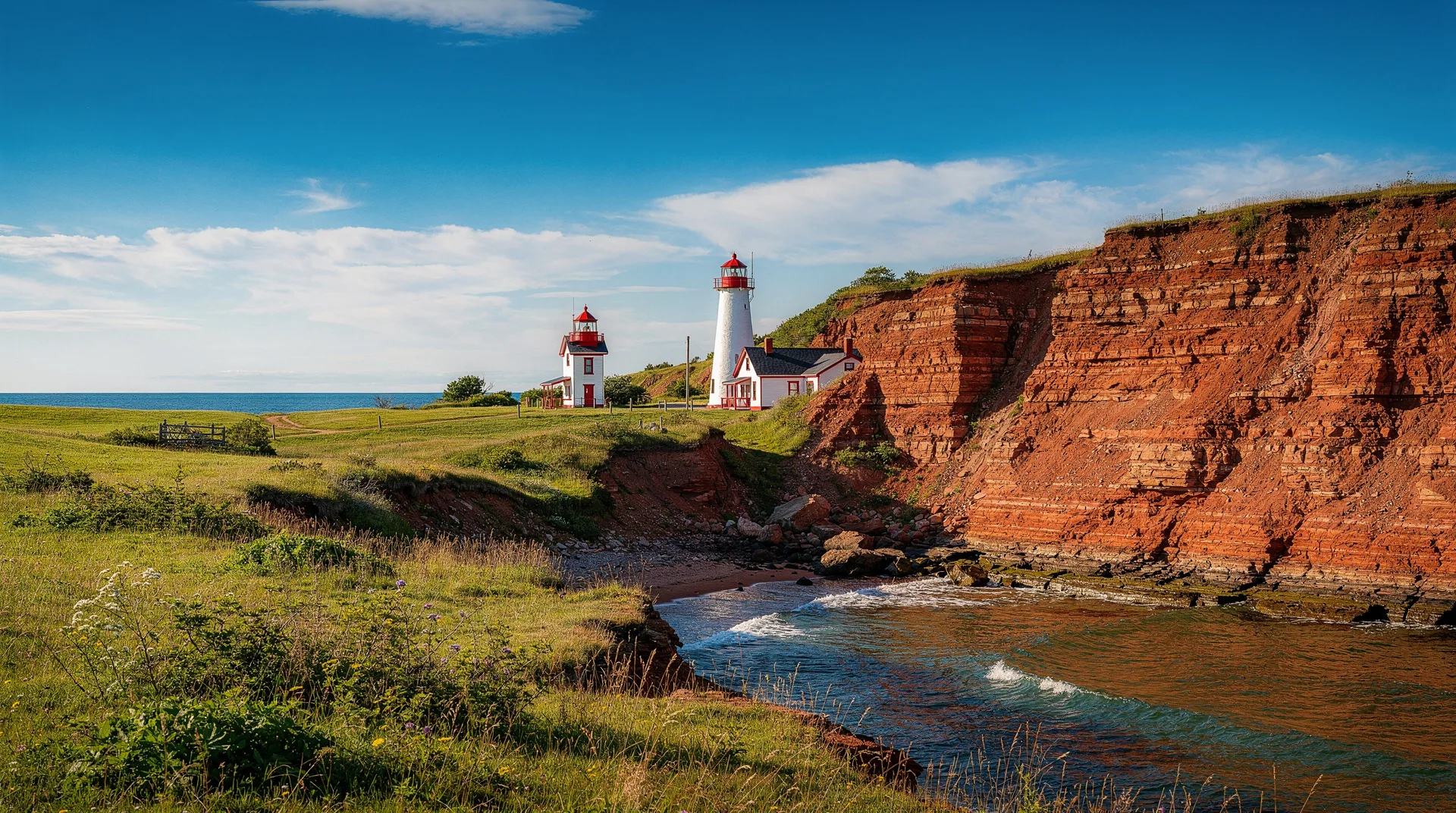
Prince Edward Island National Park is unlike any other national park in Canada. There are no mountains, no glaciers, no boreal wilderness. What the park protects instead is the fragile, distinctive beauty of PEI’s north shore: a 60-kilometre ribbon of red sand beaches, sculpted dunes, saltwater lagoons, and red sandstone cliffs against the warm waters of the Gulf of St. Lawrence. The red comes from the island’s iron-rich sandstone bedrock, which colours everything from the soil to the sand to the cliffs that crumble imperceptibly into the sea.
The park was established in 1937 and expanded to its current form over subsequent decades. It comprises three non-contiguous sections along the north coast: the Cavendish section in the west, the Greenwich section in the east, and the Brackley-Dalvay section in the centre. Each has a distinct character. Cavendish is the busiest, anchored by the internationally famous Green Gables Heritage Place — the farmstead that inspired L.M.
Montgomery to create Anne of Green Gables and the most visited single site in Atlantic Canada. Brackley and Dalvay offer quieter beaches and the park’s finest dune ecosystems. Greenwich, the most remote section, contains the park’s most scientifically significant parabolic dune system and a walking trail across wetlands and forest to the Gulf shore.
PEI National Park is Canada’s most popular park for beach swimming. The shallow Gulf of St. Lawrence warms to 20°C or higher by mid-July, making Cavendish Beach one of the warmest ocean swimming destinations north of Virginia. Families with children who have come for Anne of Green Gables often discover that the park’s beaches are the real revelation.
| At a glance | |
|---|---|
| Where | PEI’s north shore, in three sections: Cavendish (west), Brackley-Dalvay (centre), Greenwich (east, near St. Peters Bay) |
| Cost | Park entry pass required — around CA$9.50/adult per day, or the CA$167.50 annual Discovery Pass if visiting multiple Parks Canada sites |
| Time needed | A half-day covers Cavendish Beach and Green Gables; 2-3 days lets you add Greenwich, cycling, and kayaking |
| Getting there | Fly into Charlottetown (YYG), or drive over the Confederation Bridge from New Brunswick (around CA$50 toll, charged on the return crossing) |
| Best time | Late June to mid-September for swimming; September for warm water and thinner crowds |
A park shaped by sand, sea, and story
The north shore landscape is geologically young and constantly changing. The red sandstone cliffs erode at an average rate of 30 centimetres per year, continually supplying fresh red sand to the beaches and dunes. The dunes themselves are dynamic structures — the parabolic dunes at Greenwich migrate slowly inland, burying forest and wetland as they move. The beach grass (Ammophila breviligulata) that anchors the dunes is one of the park’s most important and carefully managed plant species; walking on dunes outside marked paths accelerates erosion significantly.
The lagoons — particularly Covehead Bay, New London Bay, and the Greenwich wetland complex — provide crucial habitat for shorebirds during migration. Blue herons are a daily sight in the shallows; ospreys nest on platforms throughout the park. The dunes and adjacent shrubland are nesting habitat for the threatened piping plover, one of the rarest shorebirds in North America. Much of the park’s conservation management revolves around protecting plover nests from predators and human disturbance during the May-August nesting season.
Culturally, the park carries the weight of L.M. Montgomery’s legacy in every square kilometre around Cavendish. Anne of Green Gables — published in 1908 and never out of print — created a global image of PEI that still drives a significant portion of the island’s tourism. The heritage site, the literary landscape, and the book’s ongoing cultural resonance (particularly in Japan, where Anne has a fervent following for over a century) make the Cavendish section as much a pilgrimage destination as a natural park. Understanding both dimensions enriches the visit enormously.
Top things to do in PEI National Park
Swim at Cavendish Beach
Cavendish Beach is the park’s centrepiece and one of the finest family beaches in Canada. The broad expanse of red sand is backed by dunes and faces the gently shelving Gulf, which warms to swimable temperatures by mid-July and stays warm into September. The park maintains changing rooms, washrooms, and a lifeguard station at the main beach access. The beach can be crowded on summer weekends; arrive early for a quieter experience, or walk 15 minutes east or west along the shore to find less-trafficked stretches.
Beyond Cavendish, the park’s other beaches — Brackley Beach, Stanhope Beach, and Dalvay Beach — are quieter and equally beautiful. Dalvay Beach, backed by the Dalvay-by-the-Sea National Historic Site (a Victorian manor built by a Standard Oil millionaire in 1895), has a particularly refined atmosphere.
Browse guided tours and experiences based in CharlottetownVisit Green Gables Heritage Place
Green Gables Heritage Place is the farmstead that Lucy Maud Montgomery knew as a child, owned by cousins of her family and used as the model for the Cuthbert farm in Anne of Green Gables. The green-shuttered farmhouse has been restored and interpreted by Parks Canada to reflect the period setting of the novel; costumed interpreters bring the Edwardian farm to life. The visitor centre adjacent to the house has excellent displays on Montgomery’s life and the extraordinary global reach of the Anne books.
The farm sits at the centre of a broader heritage landscape that includes the Haunted Wood trail (walking through the woodland that appears in the novel), the Balsam Hollow trail, and access to the Cavendish cemetery where Montgomery is buried. The heritage place is one of the busiest single sites in Atlantic Canada in July and August — arrive before 10 am or after 3 pm to avoid the heaviest crowds.
Find PEI cultural and heritage tour experiencesCycle the Confederation Trail
The Confederation Trail — a rail trail conversion running 470 kilometres across all of PEI — passes through the park’s hinterland, and the network of park roads and secondary routes creates a superb cycling destination. The relatively flat island terrain, with red dirt roads winding through potato fields and past ocean views, is ideal for recreational cyclists. Several outfitters in Cavendish and Charlottetown offer bike rentals; the park visitor centre can provide route maps. The Cavendish to North Rustico Harbour coastal cycling route is a particular highlight, passing over the red cliffs and through the dunes.
Walk the Greenwich Dunes Trail
The Greenwich section of the park (35 km east of Cavendish, accessed separately via St. Peters Bay) contains PEI’s most impressive dune system. The Greenwich Dunes Trail (5.6 km return, easy) crosses forested wetlands on a floating boardwalk — one of the most photogenic walks in the park, particularly in autumn — before reaching the active parabolic dunes that migrate inland at a rate of several metres per year, burying entire forest stands. A boardwalk climbs over the dune crest to the Gulf beach beyond. The Greenwich wetlands are exceptional for birding, particularly during spring and fall migration.
Kayak the coastal lagoons
The saltwater lagoons behind the barrier dunes — Covehead Bay, New London Bay, and the channels near Brackley — are sheltered and ideal for sea kayaking, paddleboarding, and canoe exploration. The lagoon ecology is distinct from the open Gulf: eelgrass meadows support shoals of young fish, great blue herons stalk the shallows, and the red cliffs reflected in calm water on a sunny day produce spectacular photography. Several outfitters along the park’s coastal road offer rental equipment and guided tours.
Wildlife watching for piping plovers
The piping plover — a small, sand-coloured shorebird listed as threatened in Canada — nests on the open beach above the tide line from May to August. PEI National Park hosts one of the most significant piping plover breeding populations on the island; Parks Canada rangers rope off nesting areas and actively manage predators to protect the nests. Visitors can ask at the visitor centre for information on where active nests can be observed at a respectful distance. Seeing these tiny birds and understanding the conservation effort behind their protection is a genuine park highlight.
Best hikes and trails
Greenwich Dunes Trail — 5.6 km return, easy. Floating boardwalk through wetland and forest to the active parabolic dune system and Gulf beach. The park’s finest trail.
Bubbling Springs Trail — 3.5 km return, easy. Peaceful forest walk through mature Acadian woodland near Dalvay. Good for songbirds and forest atmosphere.
Haunted Wood Trail — 1.5 km loop, easy. Follows the wooded path described in Anne of Green Gables, linking to Green Gables Heritage Place. Atmospheric in early morning.
Cavendish Beach Trail — 8 km one way, easy. Walks the entire length of Cavendish Beach from one end to the other, passing through dunes and along the Gulf shore.
Homestead Trail — 9 km loop, easy. Cycling and walking trail through the farmland landscape behind Cavendish, passing ponds, forest, and the historical landscape of the Montgomery heritage area.
Reeds and Rushes Trail — 1.2 km loop, easy. Interpretive boardwalk trail at Cavendish through wetland habitat. Excellent for frogs, songbirds, and wetland plant identification.
Wildlife you might see
The park’s diverse habitats — dunes, beach, lagoon, wetland, and Acadian forest — support a rich variety of wildlife. The piping plover is the flagship species; ask rangers for current nesting status. The common tern and Arctic tern nest on barrier beaches and dunes, often mobbing walkers who approach too close to colonies.
Bald eagles are frequent visitors to the coast and lagoons, particularly in spring and fall. Osprey nest on dedicated platforms throughout the park and are easily observed diving for fish in the clear lagoon waters. Great blue herons are a constant presence. The Greenwich wetland section is especially productive for birding during migration, with waterfowl, rails, and shorebirds concentrated around the pond margins.
Red foxes are abundant — the PEI fox population, isolated on an island without wolves or coyotes for much of its history, has limited fear of humans and can approach closely. While charming, they are wild animals; do not feed them. White-tailed deer browse at the forest edge in the mornings.
Harbour seals haul out on sandbars near the river mouths; scan from the coastal lookouts at dawn or dusk. Minke whales are occasionally spotted offshore from the headland viewpoints.
Comparing PEI National Park to other Atlantic options
Travellers weighing PEI against other Atlantic Canada destinations should note the very different character on offer. Cape Breton’s Cabot Trail is dramatic coastal driving and highland scenery rather than warm-water beaches — see our Cape Breton vs PEI comparison for a direct breakdown. If icebergs and rugged wilderness are more the draw, Newfoundland compares very differently to the Maritimes in pace and scenery.
For getting onto the island itself, our Confederation Bridge vs ferry guide breaks down the two crossing options in more detail, and the PEI 5-day itinerary shows how the national park fits into a full-island trip. Foodies should not skip the island’s famous PEI lobster suppers as a complement to a day at the park.
Planning around the park
The park works best as one chapter of a longer island stay. If beaches are the main draw, our Cavendish beaches guide and the Cavendish destination page go deeper on the sand, the village and where to base yourself. For the wider picture, the Prince Edward Island destination page shows how the north shore fits with the rest of the island.
Readers of the novel will want to pair the park with the Anne of Green Gables circuit and our Anne of Green Gables on PEI blog post, which give the literary side of the trip more room than a park guide can. When you want a city evening after a day on the dunes, Charlottetown is the natural counterpoint.
If you are visiting several Parks Canada places on the same trip, read our Parks Canada Discovery Pass guide before you pay for single-day entries, and check the Canada in September guide if you are leaning towards the quieter shoulder season. Travellers extending the trip across the Maritimes can chain this park into the Maritimes loop itinerary, and those who also want marine wildlife can look at whale watching in Atlantic Canada.
Getting there
PEI is connected to New Brunswick by the Confederation Bridge, a 12.9-kilometre fixed link crossing the Northumberland Strait — at its opening in 1997 it was the longest bridge over ice-covered water in the world. Crossing by car from Cape Jourimain, New Brunswick to Borden-Carleton, PEI takes about 10 minutes. The toll (approximately CA$50 per vehicle) is charged only on the eastbound crossing back to the mainland.
Charlottetown Airport (YYG), the island’s main airport, receives direct flights from Toronto, Montreal, Halifax, Ottawa, and Boston. The airport is 45 kilometres from Cavendish. Car rental is available at the airport and is essential for exploring the park.
The Northumberland Ferries service between Caribou, Nova Scotia and Wood Islands, PEI (May to December) provides an alternative crossing, taking approximately 75 minutes.
Within the park, a car is necessary to move between the Cavendish, Brackley, and Greenwich sections. The distances are manageable — Cavendish to Greenwich is about 40 km by road.
Where to stay
Cavendish is the main tourism centre, with dozens of motels, cottage resorts, B&Bs, and tourist cabins along the Route 6 strip. The Cavendish Beach area has a full range of accommodation from budget to comfortable mid-range. The Cavendish Campground (Parks Canada) is one of the park’s largest, with serviced and unserviced sites.
Dalvay-by-the-Sea — the Victorian grand hotel at the park’s eastern end — offers a luxury experience within the park boundaries, operating as a heritage inn with dining and beach access. Book well in advance for summer.
Brackley Beach area has quieter accommodation with direct park access and is popular with visitors who prefer a less commercialised base than Cavendish.
Charlottetown, 45 km from Cavendish, provides the widest range of hotels and dining, including fine dining featuring PEI’s celebrated seafood. The city makes a good overnight base for those combining the national park with urban attractions.
Best time to visit
July and August are peak season. Gulf water temperatures peak at 20-21°C in late July and August — ideal for swimming. Green Gables is fully operational. Cavendish is busy; Brackley and Greenwich sections quieter.
June is excellent: wildflowers in bloom along the dunes, piping plover chicks hatching, and crowds light. Water is still cool for swimming (15-17°C).
September is often the finest month: warm, calm weather, water still swimmable (18-20°C), beaches nearly empty, and fall colours beginning in the forest sections. Services are reduced after Labour Day but main facilities remain open.
October is increasingly popular for the golden dune grass and red maple colours. Cool temperatures but spectacular light for photography. Most park facilities close in mid-October.
Winter: The park is open for walking year-round but services are closed November–April. Cross-country skiing on groomed trails is possible at Cavendish. The red cliffs in winter light are strikingly beautiful.
Practical info
Park entry fee (2026): Adult CA$10.00/day, family/group CA$19.50/day. Green Gables Heritage Place may charge a separate fee for the interpretive programs — check Parks Canada pricing. The Discovery Pass (CA$83.50/adult, CA$167.50 family/group) covers all Parks Canada sites for 12 months.
Piping plover protection: Roped-off nesting areas must be respected at all times from May to August. Keep dogs on leash throughout the park; dogs are not permitted on beaches during nesting season (May 1–August 31) in the main nesting zones.
Beach safety: Lifeguards are on duty at Cavendish, Brackley, and Stanhope during peak season. Riptides can develop at beach openings in the barrier dunes; follow posted swimming area boundaries.
Green Gables hours: Open daily late May to mid-October. Check Parks Canada for current hours; the site is closed on some days early and late in the season.
Frequently asked questions about Prince Edward Island National Park guide: red dunes, beaches and Green Gables
Is PEI National Park good for families?
PEI National Park is one of the best family destinations in Canada. The warm, shallow beaches are ideal for children; the Green Gables site appeals to readers of all ages; cycling is accessible on flat roads; and the park’s dunes and tidal pools provide hours of exploratory play. The Cavendish campground is excellent for families with full facilities and evening interpretive programs.
When is the water warm enough to swim?
The Gulf of St. Lawrence warms gradually from May onward. Water is typically comfortable for swimming (18°C or above) by mid-July and peaks at 20-21°C in late July and August. September often has warm water well into the month. The Gulf is significantly warmer than the Atlantic coast of Nova Scotia or New Brunswick.
Do I need to book Green Gables in advance?
Green Gables Heritage Place does not require advance booking for standard visits, but it can become very crowded between 10 am and 3 pm in July and August. Arriving early or late in the day is recommended. Special interpretive programs and theatrical performances associated with the site may require advance registration — check the Parks Canada website.
Can I bring my dog to the beach?
Dogs are welcome in the park and on some beach sections year-round, but are prohibited on the supervised beach sections during the nesting season (May 1 to August 31) to protect piping plover nests. Dogs must be on leash throughout the park at all times. Check Parks Canada for current seasonal restrictions on specific beach sections.
What is the Greenwich section of the park like?
Greenwich is the quietest and most ecologically significant section of PEI National Park, located 35 kilometres east of Cavendish near St. Peters Bay. It contains PEI’s most impressive parabolic dune system — active dunes that migrate inland, burying forest. The Greenwich Dunes Trail with its floating boardwalk is the park’s most scenic walking trail. The wetlands are exceptional for birding. There are no beaches or services at Greenwich — bring water and plan the visit as a half-day hiking and nature excursion.
What else is worth seeing near the park?
Cavendish itself has commercial attractions including a waterpark and amusement rides that appeal to children. Charlottetown, 45 minutes east, is a handsome Victorian capital with excellent restaurants (PEI oysters, mussels, and lobster are world-class) and the Confederation Centre of the Arts. The island’s scenic red-dirt farm roads, lobster suppers at community halls, and farm-gate stands selling potatoes and strawberries are quintessential PEI experiences that complement the national park visit.
Is PEI National Park accessible to people with mobility limitations?
The park has made significant investments in accessibility. The Cavendish boardwalk provides accessible beach access; the Green Gables Heritage Place farmhouse and visitor centre are accessible; the boardwalk section of the Greenwich Dunes Trail is fully accessible. The park visitor centre can advise on current accessibility conditions for specific trails and facilities.
How does PEI National Park compare to Cape Breton or Cabot Trail for a first-time Atlantic Canada trip?
They serve very different purposes. PEI National Park is about warm-water beaches, gentle cycling, and Green Gables heritage — relaxed and family-friendly. Cape Breton’s Cabot Trail is dramatic coastal driving and highland hiking with cooler water. See our Cape Breton vs PEI guide for a fuller comparison if you’re choosing between them or deciding how to split time.
Can I visit PEI National Park as a day trip from Charlottetown?
Yes. Cavendish is about 45 minutes from Charlottetown by car, making a day trip to the beach and Green Gables entirely practical. For a fuller visit that includes Greenwich and the quieter beaches, plan at least one overnight near Cavendish or Brackley.