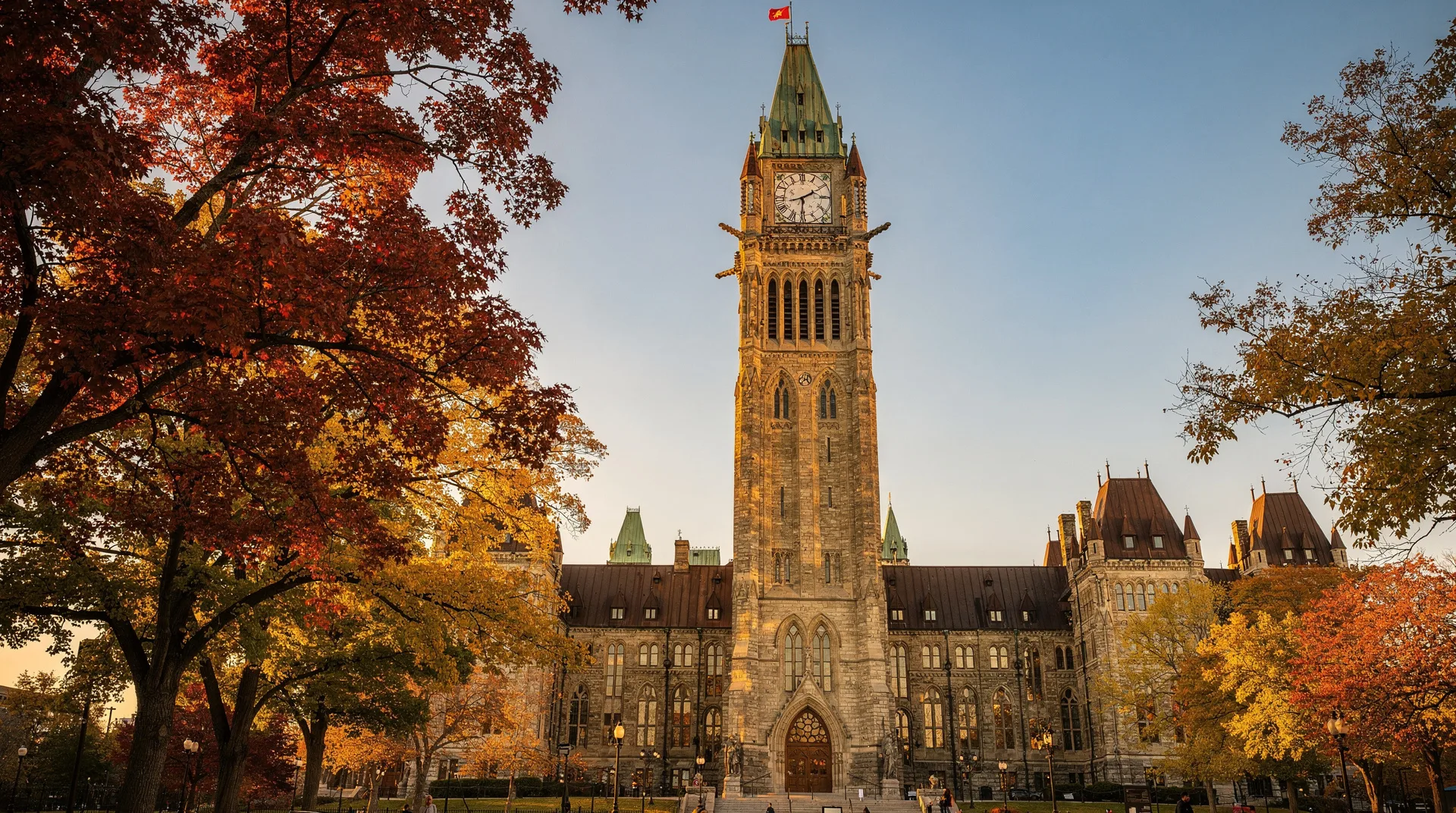
Parliament Hill Ottawa: tours, Changing of the Guard and Peace Tower
Can I tour the inside of Canada's Parliament?
Yes, free guided tours of Parliament Hill are available, though Centre Block is currently undergoing major restoration. East Block and West Block remain accessible, with the historic Senate Chamber relocated to the Senate of Canada Building. Tours book up quickly — reserve online in advance through the Parliament of Canada website.
Canada’s democratic stage on the Ottawa River
There is something about Parliament Hill that stops you when you first see it. Coming down Sparks Street toward Wellington Street and then — suddenly — the view opens and there it is: the Gothic Revival towers rising above the Ottawa River, the Peace Tower at the centre with its clock face and carillon bells, the East and West blocks flanking the central precinct, the vast green lawn sweeping to the cliff’s edge above the river. It is one of the great civic vistas in North America.
| At a glance | |
|---|---|
| Where | Wellington Street at Sparks Street, central Ottawa |
| Cost | Grounds and guided tours are free; national museums nearby are ticketed |
| Time needed | Around 2-3 hours for grounds plus a tour; half a day with ByWard Market |
| Getting there | Walkable from central Ottawa; nearest transit hub is Rideau Centre / O-Train |
| Best time to visit | Summer for the Changing of the Guard; shoulder season for smaller crowds |
Parliament Hill (Colline du Parlement in French) is the symbolic heart of Canadian democracy and one of the country’s most visited attractions. The precinct sits on a limestone promontory above the Ottawa River, and the Parliament Buildings — originally completed in 1876 following the catastrophic fire of 1916 that destroyed much of the original complex — are among the finest examples of Victorian Gothic Revival architecture in the world.
Beyond the architecture, the Hill is a working parliamentary precinct. The Senate and House of Commons sit here. Prime Ministers have walked these corridors. Canada’s most consequential decisions have been debated in these chambers. A visit to Parliament Hill is a direct encounter with the living story of Canadian democracy.
The Parliament Buildings: what’s open
Centre Block — the main building containing the House of Commons and Senate chambers — is currently closed for a major restoration project expected to continue through the late 2020s. This is the most ambitious renovation in the building’s history, addressing everything from the roof and stone facades to the internal mechanical systems. The flame of the centennial eternal flame on the front lawn continues to burn.
East Block is open for guided tours and contains four meticulously restored 19th-century rooms: the original Governor General’s office, the Prime Minister’s office as it appeared to early prime ministers, the Privy Council Chamber, and the office of one of Canada’s Fathers of Confederation. These rooms are frozen in time — no modern intrusions — and the tours are genuinely remarkable.
West Block now houses the working House of Commons chamber, relocated here during Centre Block’s restoration. Tours of the temporary chamber are available and provide an unusual opportunity to see parliamentary process in action in an adapted space.
The Senate of Canada Building — the former Government Conference Centre across Wellington Street — now houses the relocated Senate Chamber during the Centre Block restoration. Tours are available, and the beaux-arts architecture of the former railway station is spectacular.
Find Ottawa and Eastern Canada tour experiences on GetYourGuideThe Changing of the Guard ceremony
One of the most theatrical moments on the Parliamentary calendar, the Changing of the Guard ceremony has been performed on Parliament Hill each summer since 1959. It takes place daily at 10am from late June through late August (weather permitting) on the central lawn in front of the Peace Tower.
The ceremony lasts approximately 30 minutes and involves the Ceremonial Guard — typically the Governor General’s Foot Guards and the Canadian Grenadier Guards — in their distinctive scarlet tunics and bearskin hats, performing precision drill movements, inspections, and the formal transfer of guard duty. A regimental band provides musical accompaniment.
The ceremony is free to observe. Arrive by 9:45am to secure a good viewing position near the fence. The front steps area fills quickly. Photography is unrestricted during the ceremony.
On rainy or extremely windy days, the ceremony is cancelled. Check the Parliament website for cancellations on the morning of your visit.
The Peace Tower
The Peace Tower (Tour de la Paix) at the centre of Centre Block is Ottawa’s most recognisable structure — a 92.2-metre Gothic spire containing a carillon of 53 bells, a memorial chamber, and an observation deck. It was completed in 1927 as a memorial to the Canadians who died in the First World War.
Memorial Chamber: The ground floor of the tower contains the Memorial Chamber, where the Books of Remembrance — containing the names of over 118,000 Canadians who died in military service — are displayed. Pages are turned daily in a solemn ceremony. The chamber’s stonework includes stones from famous First World War battlefields.
Carillon: The 53-bell carillon plays each day at 12pm from a keyboard played by a Dominion Carillonneur. Free carillon concerts are also given periodically throughout the summer.
Observation deck: The Peace Tower observation deck (when Centre Block is open) offers panoramic views over Ottawa, the Ottawa River, and Gatineau across the river. Access is by elevator and is included in Centre Block tours.
Rideau Hall: the Governor General’s residence
Rideau Hall is the official residence and workplace of the Governor General of Canada — the Crown’s representative in Canada. Located about 2 km east of Parliament Hill in the Rockcliffe Park area, the 79-room mansion and its 36-hectare grounds are open to the public for free guided tours and public walks on the grounds.
Tours of the ceremonial rooms (the ballroom, the throne room, the aide-de-camp reception room) run approximately one hour. The gardens, including the rink that was Canada’s first outdoor skating rink, are open year-round. Rideau Hall is a surprisingly under-visited Ottawa attraction, offering a more intimate look at Canadian state protocol than the formal Parliament buildings.
The Canadian Museum of History and the Hull-Ottawa axis
Directly across the Ottawa River in Gatineau, Quebec, the Canadian Museum of History is one of Canada’s most architecturally distinctive and content-rich institutions. The building by Indigenous architect Douglas Cardinal features sinuous curved walls of Indiana limestone that seem to flow like glacial terrain. Inside, the Grand Hall houses the world’s largest indoor collection of standing totem poles, an astonishing display of Northwest Coast Indigenous art and culture. The Canada Hall covers Canadian history from pre-contact Indigenous civilization to the 20th century across a vast, immersive exhibition space.
The museum is a 10-minute walk across the Alexandra Bridge from Parliament Hill. Allow at least 3 hours. Admission is approximately CAD $20.
See also the Canadian museums guide for this museum in broader context.
ByWard Market: Ottawa’s food and culture hub
The ByWard Market neighbourhood, three blocks east of Parliament Hill, is Ottawa’s historic market district — a lively neighbourhood of restaurants, bars, boutiques, and the original farmers’ market building (operating since 1826). In summer the outdoor stalls sell local produce, maple products, and crafts; the surrounding streets are dense with restaurants at every price point.
BeaverTails, the Canadian fried pastry chain, was born in ByWard Market. The original stall still operates here. Standing in line for a BeaverTail with maple and lemon on a cold Ottawa evening is a properly Canadian moment. If you would rather have a local guide tie the market, the Hill and the canal together, you can browse guided tours in Ottawa.
Best time to visit Parliament Hill
Summer (June–August) is peak season. The Changing of the Guard operates daily, Sound and Light shows run on the lawn at dusk, and the Hill is fully animated. Canada Day on July 1st brings 100,000+ people to Parliament Hill for the national celebration — if visiting on Canada Day, arrive extremely early.
Fall (September–October) is quieter and beautiful, with autumn colours in the Ottawa Valley. Guided tours continue and the weather is comfortable.
Winter (December–February) brings the UNESCO-recognized Rideau Canal Skateway to life — 7.8 km of natural ice skating through the city, beginning a few blocks from Parliament Hill. The Hill itself is beautiful in snow, though outdoor ceremonies do not operate.
Spring (May–June) features the Canadian Tulip Festival on Dow’s Lake and throughout the city, the world’s largest tulip festival with millions of flowers in bloom. The tulip beds on Parliament Hill are part of the display.
Planning your Ottawa visit around Parliament Hill
Parliament Hill works well as the anchor of a weekend in the capital. Our Ottawa weekend itinerary builds a two-day plan around the Hill, ByWard Market, and the national museums. If you are coming from Toronto, both driving Toronto to Ottawa and taking the train are realistic options — see the Toronto to Ottawa road trip guide for the driving route, or our Toronto vs Ottawa comparison if you are still deciding which city to prioritise.
In winter, the Rideau Canal Skateway guide covers renting skates and the practicalities of the UNESCO-listed skate a few blocks from the Hill — a natural pairing with a winter visit to Parliament.
Practical tips: visiting Parliament Hill
Guided tours: Free. Book through the Parliament of Canada website (parl.gc.ca) as far ahead as possible — tours fill up weeks ahead in summer.
Security: All Parliament buildings require going through security screening (metal detector, bag X-ray). No large bags, food, or photography equipment with tripods inside buildings.
Getting there: Parliament Hill is at the intersection of Wellington and Sparks Streets. The nearest transit hub is at the Rideau Centre / O-Train stations. Ottawa is compact and the Hill is walkable from most central accommodation.
Parking: Limited and expensive near the Hill. Public transit or cycling is recommended.
Cycling: Ottawa has excellent cycling infrastructure; BIXI bike share is available in the centre.
For broader Ottawa trip planning, see the Canadian museums guide for the Museum of History and other institutions, and Ottawa destinations for accommodation and restaurants.
Frequently asked questions about Parliament Hill Ottawa: tours, Changing of the Guard and Peace Tower
Can I visit the House of Commons or Senate while Parliament is in session?
Yes, members of the public can attend debates in both chambers from the public galleries. Check the Parliament website for sitting schedules. Demand for seats during Question Period (typically weekday afternoons when Parliament sits) is high; tickets must be requested in advance.
Is the Changing of the Guard cancelled in bad weather?
Yes, the ceremony is cancelled if it rains or conditions are unsafe. The Parliament website and official Twitter account announce cancellations on the morning of each ceremony. Having a backup plan for the morning is wise.
Can I walk freely on the Parliament Hill lawn?
Yes. The grounds are open to the public during daylight hours. The lawn and gardens are pleasant for a stroll. The eternal flame at the front of the precinct is accessible throughout the day.
What is the difference between the Senate and House of Commons?
Canada has a bicameral Parliament. The House of Commons is the elected chamber, where 338 Members of Parliament sit. The Senate is the appointed upper house, with 105 senators. Legislation must pass both chambers. The Senate is currently located in the former Government Conference Centre (Senate of Canada Building) during the Centre Block restoration.
Are there any free things to do at Parliament Hill?
Yes: the grounds are free, the Changing of the Guard is free, and guided tours of Parliament Buildings are free (book in advance). The carillon concerts at noon are free from outside the Peace Tower.
How long should I budget to visit Parliament Hill?
Two to three hours covers a guided building tour, the exterior grounds, and the Peace Tower viewing deck (when available). Allow an extra hour if you attend the Changing of the Guard. Half a day total, including ByWard Market for lunch, is a natural combination.
What else can I do in Ottawa besides Parliament Hill?
Ottawa is rich in free or low-cost institutions: the National Gallery of Canada (spectacular architecture, excellent permanent collection), the National War Museum, the Museum of History, the Canada Science and Technology Museum, and the Rideau Canal. The city’s concentration of national museums and heritage sites per capita is exceptional.