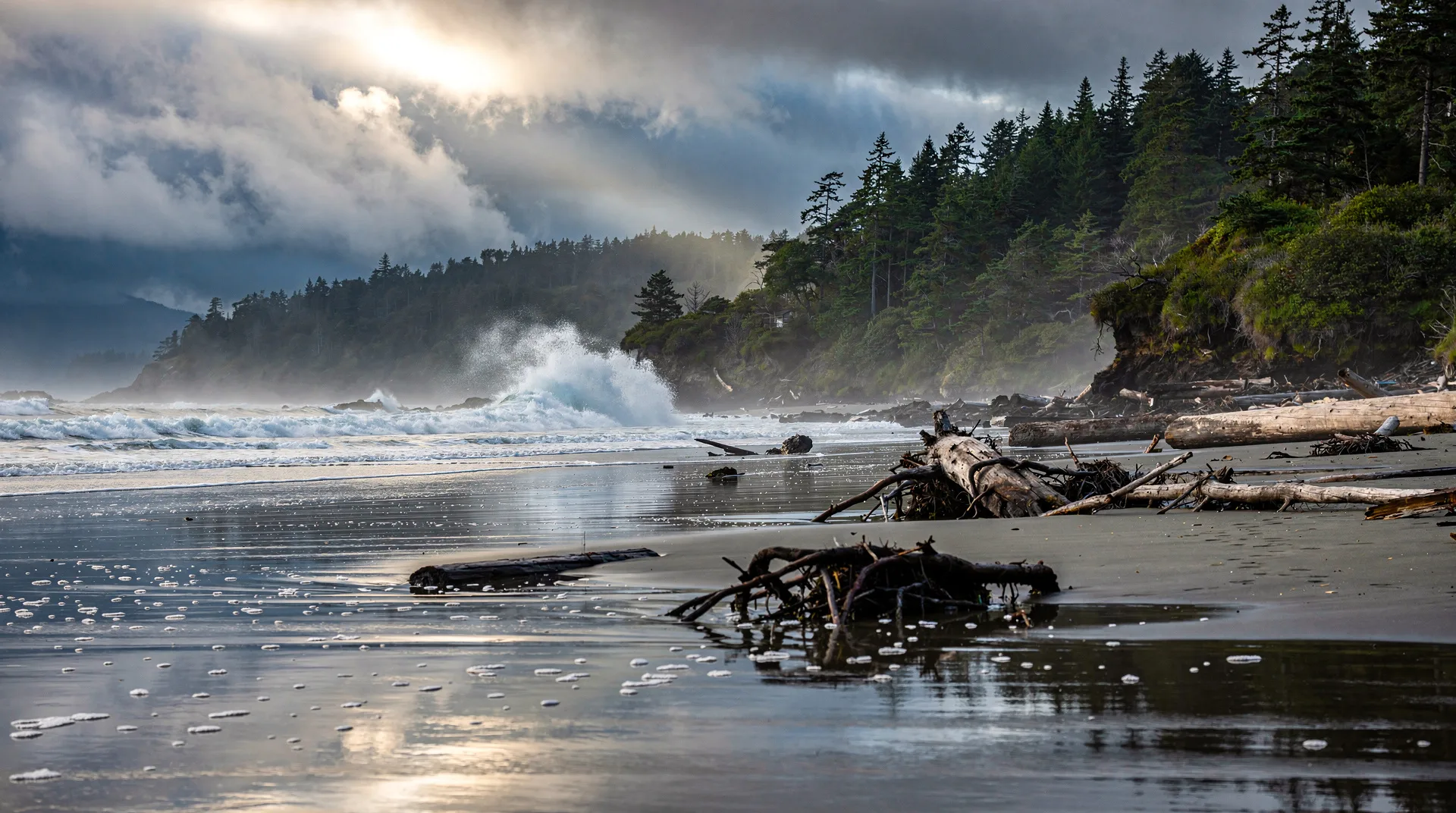
Pacific Rim National Park Reserve: the wild west coast of Vancouver Island
What makes Pacific Rim National Park special?
Pacific Rim protects 75 km of wild Pacific coastline on Vancouver Island's west coast, combining world-class surfing, old-growth temperate rainforest, and one of Canada's most challenging backcountry trails. Tofino, at the park's northern end, is Canada's surf capital and storm-watching destination.
Pacific Rim National Park Reserve is where the Pacific Ocean meets the ancient temperate rainforest of Vancouver Island’s west coast — a collision of ecosystems that produces some of the most dramatic coastal scenery in Canada. The park encompasses three separate units: the Long Beach Unit (the most accessible, fronting the broad surf beach near Tofino and Ucluelet), the Broken Group Islands (a network of 100+ islands in Barkley Sound, accessible by kayak or boat), and the West Coast Trail Unit (the famous 75-km wilderness backpacking route between Bamfield and Port Renfrew).
Together these three units protect a 75-kilometre stretch of Pacific coastline that has been sculpted by the same ocean swells that travel uninterrupted from Japan. The rainforest behind the beaches contains Sitka spruce and western red cedar trees that were old-growth before European contact. Sea otters, grey whales, black bears, and countless seabirds use this coastline as their home.
The town of Tofino, at the northern end of the Long Beach Unit, has evolved from a remote fishing village into one of Canada’s most distinctive travel destinations — simultaneously a serious surf town, a luxury spa retreat, and a genuine wilderness gateway. The combination is unusual and entirely compelling.
At a glance
| Where | Vancouver Island’s west coast, around Tofino and Ucluelet |
| Cost | Parks Canada Discovery Pass or day pass required; West Coast Trail registration around CAD 250 per person |
| Time needed | 3-5 nights for Long Beach and Tofino; 5-7 days for the West Coast Trail |
| Getting there | No mainland road access — ferry to Vancouver Island first, then roughly 3 hours’ drive from Nanaimo |
| Best time | June-September for beach weather and surfing lessons; October-February for storm watching |
Getting to Pacific Rim and Tofino
Pacific Rim National Park Reserve is on Vancouver Island’s west coast, approximately 305 km from Victoria and about 200 km from Nanaimo (the main ferry terminal from the mainland). There is no road access from the mainland — you must cross to Vancouver Island by ferry from Horseshoe Bay (near Vancouver) or Tsawwassen to Swartz Bay (near Victoria) or Nanaimo’s Duke Point terminal.
From Nanaimo, Highway 4 crosses the island over the mountains through Cathedral Grove (old-growth forest) to Port Alberni, then continues west to Ucluelet and the Pacific Rim Highway junction. The drive from Nanaimo takes about 3 hours.
For those without a car, Pacific Coach Lines runs services from Vancouver (including the ferry crossing) to Tofino, and seasonal floatplane and scheduled air services connect Tofino to Vancouver and other points.
Browse Vancouver Island tours and experiences including Tofino transfersLong Beach: surfing and coastal exploration
Long Beach is the centrepiece of the park’s most accessible unit — an 18-km stretch of Pacific beach exposed to open ocean swells, backed by rainforest. The sand is grey and firm, the surf consistent, and the Pacific fog that rolls in on many mornings gives the coast an atmospheric quality unlike any Caribbean or Mediterranean beach.
Surfing at Long Beach and Cox Bay
Tofino has been Canada’s surf capital since the 1960s when local fishermen first adapted to the waves. The surf scene has since matured into a genuine culture with professional-quality instruction, equipment rental, and a community of year-round wave riders. The waves at Long Beach, Cox Bay, and Chesterman Beach are suitable for beginners through advanced surfers depending on season and conditions.
Summer (June-August) brings smaller, more manageable swells and warmer air temperatures — the best time for beginners. Autumn and winter bring the big Pacific swells generated by North Pacific storms; November and December surfing, in a thick wetsuit while storms pass through, is an experience as exhilarating as any in Canada. The water temperature is cold year-round (9-14°C) and a good wetsuit is always required.
Multiple surf schools in Tofino offer lessons for all levels. Pacific Surf Co., Tofino Surf Adventures, and Surf Sister (one of Canada’s best surf schools and specifically inclusive of women and children) all have excellent reputations.
Beach walks and coastal trails
Several short trails access the Long Beach coastline and the surrounding forest:
Rainforest Trail: Two 1-km loop trails through old-growth western red cedar and Sitka spruce. The trees are massive — some over 800 years old — with root systems colonised by moss and ferns. Interpretive signs explain the ecosystem. Both loops are boardwalked and accessible in all weather.
South Beach Trail: A 1-km walk from the Wickaninnish Centre parking area to a rocky, exposed beach on the south side of the Long Beach peninsula — quieter and more dramatic than Long Beach itself.
Schooner Cove Trail: 2.4 km through rainforest to a sheltered sandy cove. The trail passes a tidal lagoon and some of the largest Sitka spruce in the park.
Green Point Campground Trail: The park’s primary campground sits directly above the beach; a short trail descends to an excellent stretch of Long Beach.
Wildlife watching on Long Beach
The intertidal zone along Long Beach is exceptionally productive. Tide pools at the rocky headlands (Combers Beach, Florencia Bay) contain sea stars, anemones, chitons, purple sea urchins, and hermit crabs. Low tides, when the tide pools are accessible, are the best time for intertidal exploration — check tide tables before visiting.
Grey whales migrate past this coast in March-April (northbound) and November (southbound) and many individuals remain to feed in local waters through summer. Shore-based whale watching from the beach and headlands is possible with binoculars, and boat tours from Tofino offer closer encounters. Sea otters, once extirpated from BC, have been reintroduced and are now commonly seen floating on their backs in kelp beds offshore.
Black bears are present throughout the park, particularly along the forest edge and on beaches at dawn and dusk. They are habituated to human presence and generally uninterested in park visitors, but the usual bear-country precautions apply. Bald eagles are almost comically common — expect to see several on any day’s outing.
Storm watching: Tofino’s winter specialty
Tofino has reinvented the concept of winter tourism in Canada. Between October and March, Pacific storms roll in from the open ocean, generating surf of extraordinary power and creating a spectacle of wind, rain, and breaking waves that has become one of BC’s signature travel experiences.
Storm watching involves little more than positioning yourself on the beach or at a sheltered viewpoint as Pacific fronts arrive. Wave heights of 6-8 metres (measured at sea) produce surf that crashes over rocky headlands and sends spray dozens of metres into the air. The sound — a continuous deep bass roar punctuated by explosive detonations as waves hit rock — is impossible to capture in photographs and unforgettable in person.
The key is comfortable, waterproof clothing and knowing that Tofino’s luxury accommodation has designed itself around exactly this experience. The Wickaninnish Inn, the original storm-watching destination, has floor-to-ceiling ocean-facing windows in its rooms and one of the finest spa operations in western Canada. Checking in to a cliffside room on the night a major Pacific storm arrives — warm, dry, watching the ocean explode outside your window — is one of the great Canadian travel experiences.
The West Coast Trail
The West Coast Trail is one of the most famous backcountry routes in Canada — a 75-km wilderness trek along the southern unit of Pacific Rim National Park Reserve between Bamfield (in the north) and Port Renfrew (in the south). Originally established as a life-saving trail for sailors shipwrecked on this treacherous coast (the “Graveyard of the Pacific”), it was opened to hikers in 1973 and has since become a legendary multi-day experience.
The trail takes 5-7 days, passes through old-growth forest, along sea cliffs, across tidal flats, and through some of the most remote coastal terrain in BC. River crossings are by cable car and suspension bridges. The trail is rated “challenging” — it involves significant elevation change, wet conditions (averaging 3,100 mm of annual rainfall in the corridor), muddy terrain, and physical demands that have turned back many hikers who underestimated it.
Permits: The West Coast Trail has a strict quota system. A total of 90 hikers per day enter the trail at each end (Bamfield and Port Renfrew). Reservations open in January for the full season (May 1 to September 30) and fill quickly. The registration fee is approximately CAD $250 per person including Parks Canada fees and ferry crossings.
Preparation: The trail requires serious preparation — a genuine multi-day wilderness experience, not a day hike. Parks Canada’s mandatory trail orientation session covers safety, tidal tables (required for beach travel), and cable car operation. Proper gear including a reliable tent, warm layers even in summer, bear canisters, and a comprehensive first aid kit is essential.
Broken Group Islands
The middle unit of Pacific Rim, Broken Group Islands, is a paddler’s paradise — a 100-island archipelago in Barkley Sound offering multi-day sea kayaking through calm waters with old-growth forest, wildlife, and First Nations cultural sites. The islands are accessible by boat (the MV Lady Rose, a classic freight and passenger vessel, runs from Port Alberni) or by joining a guided sea kayaking tour from Ucluelet.
Ucluelet: the quieter alternative to Tofino
At the southern end of the Long Beach Unit, Ucluelet (pronounced “you-CLUE-let”) is Tofino’s less famous and more affordable neighbour. The Wild Pacific Trail — a network of coastal walking paths around the Ucluelet peninsula — offers spectacular wave-watching with fewer crowds than the park beaches. The Ucluelet Aquarium, operated on a catch-and-release basis with all animals returned to the ocean at season’s end, is an excellent small facility focused on local marine life.
Where Tofino has leaned into luxury, Ucluelet has remained more of a working fishing town with good mid-range accommodation and a local atmosphere that many visitors prefer.
Tofino: where to stay and eat
Tofino proper (population 2,000) sits on a narrow peninsula, and the best accommodation is spread along the coastline south of town on Chesterman Beach, Cox Bay, and the headlands above the surf.
The Wickaninnish Inn (Chesterman Beach): The benchmark Tofino experience, and one of the finest coastal hotels in Canada. Every room faces the ocean. The on-site Pointe Restaurant serves exceptional BC seafood with a view that makes everything taste better. Book many months in advance for storm season.
Pacific Sands Beach Resort (Cox Bay): A good mid-range option with direct beach access to the surf break. Self-catering suites with fireplaces and kitchen facilities make it work well for longer stays and families.
Long Beach Lodge (Cox Bay): Beautifully designed lodge with great surf views, an excellent restaurant, and a warm communal atmosphere. Slightly more affordable than the Wickaninnish.
In town: Several smaller boutique hotels and B&Bs in Tofino town proper offer more affordable options with easy walking access to restaurants and shops.
Eating in Tofino: The Wolf in the Fog has an outstanding reputation (Book ahead — it fills fast). Tacofino, which started as a food truck on the beach, has grown into a proper restaurant and remains excellent for casual seafood tacos. The Spotted Bear Bistro serves good breakfast and lunch.
Practical planning
When to visit:
- June-September: Best weather, warmest temperatures, all services open. Peak crowding in July-August. Book accommodation 3-6 months ahead.
- October-February: Storm watching season. Dramatically fewer crowds, lower prices. Surfing is at its most impressive. The Wickaninnish Inn’s storm-watching packages are excellent value relative to summer rates.
- March-April: Grey whale migration. Some services may still be transitioning from winter. Good shoulder season with reasonable availability.
Parks Canada passes: Required for entry and parking at Pacific Rim. The Discovery Pass covers all national parks and pays for itself quickly.
Bear safety: Black bears are common throughout the park. Store food and scented items properly (in bear boxes at campgrounds, in vehicle trunks away from the beach). Do not leave food unattended on the beach or at campsites.
For more on the broader Vancouver Island experience, see our British Columbia guide and our Vancouver travel guide.
Tofino or Ucluelet: choosing a base
Both towns sit on the same Long Beach Unit stretch of coastline, but the choice of base changes the trip. Our Tofino vs Ucluelet comparison guide goes into more detail, but the short version: Tofino has the destination restaurants, the luxury storm-watching hotels, and the surf schools; Ucluelet has lower prices, a quieter working-town feel, and the Wild Pacific Trail. Anyone learning to surf should also read the dedicated Tofino surfing guide before booking lessons, and hikers planning the multi-day trek should read the full West Coast Trail guide rather than relying on this overview alone.
Storm watching deserves its own planning pass too — see the BC storm watching guide for month-by-month conditions and what to pack. Travellers building a longer loop around the island can use the 7-day Vancouver Island itinerary to see how Pacific Rim fits alongside Victoria and the rest of the island.
More frequently asked questions
Is a rental car necessary for storm watching? Not strictly — Pacific Coach Lines connects Vancouver and Tofino year-round, and most storm-watching hotels are within walking distance of the beach. A car does make it easier to reach Ucluelet’s Wild Pacific Trail and the Broken Group Islands departure point in Port Alberni.
Can Pacific Rim be visited as a day trip from Victoria or Nanaimo? Technically yes from Nanaimo (about 3 hours each way), but it makes for a very long day with almost no time on the coast. An overnight stay, even just one night, is strongly recommended given the driving distance.
Frequently asked questions about Pacific Rim National Park Reserve: the wild west coast of Vancouver Island
Is Tofino worth visiting in winter?
Absolutely. Many experienced travellers argue that November-February is the best time to visit Tofino. The storm watching, the dramatic surf, the near-empty beaches, and the atmospheric fog make a compelling case. Accommodation is more available and less expensive than in summer. The only trade-off is cold, wet weather requiring proper waterproof gear.
How long should I spend at Pacific Rim?
For the Long Beach area and Tofino, a minimum of 3 nights allows time to settle in, experience the beach at multiple tide conditions, do several short trails, and try surfing. Five nights or more is ideal. The West Coast Trail requires 5-7 days hiking plus travel time on each end.
Can a beginner learn to surf in Tofino?
Yes. Tofino is one of the best places in Canada to learn to surf, with several well-regarded schools offering lessons on appropriate beginner beaches. Summer conditions (smaller, more consistent waves) are the most suitable for beginners. A full-day lesson typically includes gear rental, wetsuit, and 2-3 hours of instruction.
Do I need a car to visit Pacific Rim?
A car makes the visit significantly more flexible but is not strictly required. Shuttle services run from Nanaimo and other Vancouver Island points to Tofino in summer. Pacific Coach Lines operates Vancouver-Tofino services (including the ferry). Within the park, a free Parks Canada shuttle system operates on the Long Beach Unit in summer, connecting campgrounds and trailheads.
What is the weather like at Pacific Rim?
The west coast of Vancouver Island is one of the wettest places in Canada — Ucluelet averages about 3,300 mm of annual rainfall. Summer (July-August) averages around 15-20°C with a mix of fog, sun, and occasional rain. Autumn brings storms and rain. Winter is wet, windy, and mild by Canadian standards (5-10°C). Waterproof clothing is essential at any time of year.
When does the West Coast Trail open and how do I book it?
The West Coast Trail is open May 1 to September 30. Reservations open in January through the Parks Canada reservation system (reservation.pc.gc.ca) and the most popular departure dates sell out quickly — typically within days of opening. The quota is 90 hikers per day at each trailhead.