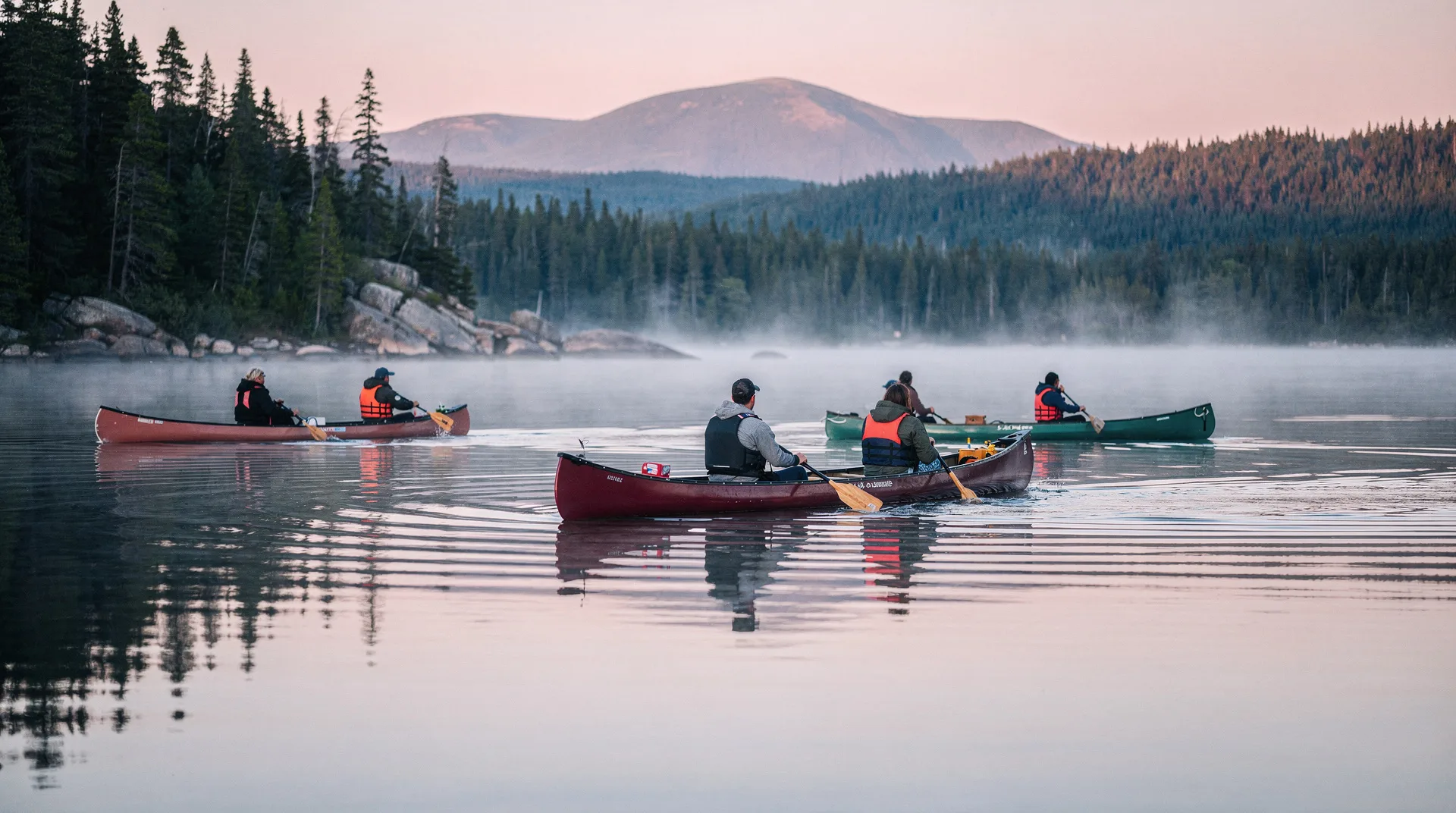
Best Canoeing Routes in Ontario: Algonquin, Killarney & Quetico
What is the best canoeing route in Ontario?
The Algonquin Interior is Ontario's most iconic canoe destination — over 1,500 km of interconnected routes for all experience levels. For more remote wilderness, Quetico Provincial Park near the Manitoba border rivals anything in Canada.
Ontario is arguably the finest canoe-tripping destination on earth. The Canadian Shield’s glacially carved lake-and-river systems, the vast provincial parks protecting millions of hectares of roadless wilderness, and a culture of canoe travel that goes back centuries — Indigenous peoples, fur trade voyageurs, and wilderness explorers — have made Ontario the place where the canoe trip was essentially invented as a recreational experience.
This guide focuses on the three major wilderness parks — Algonquin, Killarney, and Quetico — with recommended routes at different difficulty levels, permit information, and practical advice for planning your trip.
| At a glance | |
|---|---|
| Where | Algonquin, Killarney and Quetico provincial parks, central and northwestern Ontario |
| Cost | Interior camping around CAD 14/person/night plus a vehicle permit; canoe rentals roughly CAD 45-60/day |
| Time needed | A weekend for an easy Algonquin loop, up to 7-10 nights for the more remote Quetico or Killarney traverses |
| Getting there | Algonquin and Killarney are reachable by car from Toronto or Ottawa; Quetico is accessed via Atikokan in northwestern Ontario, a long drive or flight-plus-drive |
| Best time | Late May-June for high water and quiet, July-August for warm paddling, September-early October for the best all-round conditions |
Choosing between Algonquin, Killarney and Quetico
| Park | Character | Best for | Permit difficulty |
|---|---|---|---|
| Algonquin | Accessible, well-signed, huge route network | First-time canoe-trippers, families, weekend trips | Moderate — popular entry points sell out fast |
| Killarney | Rocky, dramatic, technically demanding | Paddlers wanting scenery and a physical challenge | Hard — main circuit sells out within hours |
| Quetico | Remote, unmarked, no motors | Experienced paddlers seeking genuine wilderness | Easier — daily numbers rarely sell out |
Algonquin Provincial Park canoe routes
Algonquin’s interior canoe network is the most accessible and the most frequently paddled in Ontario. With over 1,500 kilometres of canoe routes and dozens of entry points along the Highway 60 corridor and surrounding access roads, the park accommodates everyone from first-time canoe-campers to serious multi-week expeditions.
How the permit system works
Interior camping in Algonquin requires an interior permit purchased through Ontario Parks. Permits allocate specific entry points on specific dates; each campsite is first-come, first-served once you are in the interior (there is no campsite reservation for interior routes). Permits are available online from January; summer entry points like Canoe Lake and Rock Lake are in high demand and should be booked well in advance.
Fees: Interior camping is charged per person per night (approximately CAD 14). The vehicle permit fee for the park applies additionally.
Recommended routes: beginner to intermediate
Canoe Lake loop (2–3 nights, easy–moderate)
Canoe Lake is the most popular entry point — the starting point of Tom Thomson’s final, fatal trip in 1917, and the hub of the park’s most accessible interior. From Canoe Lake, paddlers can loop through Smoke Lake, Ragged Lake, and Joe Lake in a 40-50 kilometre circuit with manageable portages (none over 1 kilometre). The scenery is quintessential Algonquin — rocky shorelines, mixed hardwood-boreal forest, loons, and absolute quiet from the second campsite onward.
Opeongo Lake to Hailstorm Creek (3–5 nights, moderate)
Opeongo Lake is Algonquin’s largest lake — a 58-kilometre paddle in itself if you cross the main body. Most trippers use Opeongo as a staging lake, paddling to the far end and entering the Hailstorm Creek and East River system to the north. This route takes paddlers into genuine wilderness within a day’s paddle of the road — moose sightings are nearly guaranteed, and loon calls at night are incessant. The portages are moderate (up to 2 kilometres) and the fishing for lake trout in Opeongo is outstanding.
Rain Lake to White Trout Lake system (4–6 nights, moderate)
The southwest interior of Algonquin, accessed from Rain Lake or Kingscote Lake via Highway 60 south entries, offers a quieter network than the Canoe Lake area. The White Trout Lake chain links through a series of medium-sized lakes with excellent campsites and lower traffic density than the main corridor entries. Brook trout fishing in the connecting streams is very good in spring and fall.
Recommended routes: advanced
Complete interior traverse: Kiosk to Canoe Lake (7–10 nights, advanced)
This north-to-south traverse of the park’s interior covers approximately 150 kilometres through remote terrain with significant portages. Entry at Kiosk via Highway 17 (north access) and exit at Canoe Lake (Highway 60) requires a car shuttle or taxi arrangement but provides the most immersive Algonquin experience — days pass without seeing another paddler, wolf tracks appear on sandbar portage trails, and the northern boreal forest character of the park is fully revealed.
Killarney Provincial Park canoe routes
Killarney’s canoe routes are shorter, more technically demanding, and visually more dramatic than Algonquin’s. The quartzite ridges of the La Cloche Mountains create steep portages and rocky lake approaches; the lakes themselves — George Lake, Killarney Lake, O.S.A. Lake — are among the clearest and most beautiful in Ontario.
Permit information
Killarney interior camping reservations open in January through Ontario Parks and sell out extremely fast for summer — George Lake and the main circuit entry points are gone within hours. Try for mid-week entries in June or the September shoulder season if you cannot get peak summer dates.
The classic Killarney Circuit (4–6 nights, moderate–advanced)
The standard Killarney canoe route links George Lake (the main access point) through Killarney Lake, O.S.A. Lake, and Freeland Lake in a loop of approximately 80–100 kilometres depending on the route variant chosen. The portages are rocky and sometimes steep — bring proper canoe-carrying yoke padding and be prepared for physical work.
The payoff is exceptional: O.S.A. Lake’s turquoise water surrounded by white quartzite ridges is one of the most beautiful canoe camping destinations in Canada. Sunsets from the ridge above O.S.A. Lake, looking out over the La Cloche range with Georgian Bay visible in the distance, are extraordinary.
Fishing: Killarney’s lakes support walleye, northern pike, and smallmouth bass. The clear water means fish are visible at depth — sight fishing for bass from the canoe is a particular pleasure.
Book a guided Ontario canoeing and wilderness camping tourThe Bell Lake system (2–3 nights, moderate)
For a shorter Killarney trip, the Bell Lake access point on the park’s northern edge offers a self-contained two or three-night loop through Bell Lake, Johnnie Lake, and connecting waterways. This avoids the La Cloche circuit’s steep portages while still providing genuine Killarney scenery. Good for intermediate paddlers making a first Killarney visit.
Quetico Provincial Park
Quetico is Ontario’s wilderness canoe destination for experienced paddlers who want genuine remoteness. The park has no interior roads, no motors on any interior lakes, and strictly limited entry numbers. Combined with Minnesota’s Boundary Waters Canoe Area Wilderness across the border, Quetico forms part of one of the largest roadless canoe areas on earth.
Who Quetico is for
Quetico routes are not marked. There are no maintained portage trails in the interior — paddlers navigate by topographic map and compass, finding portages by searching shorelines. This is not a park for canoe beginners; prior experience with map and compass navigation, difficult portages (some through boulder fields, muskeg, or fallen timber), and remote self-sufficiency is required.
The payoff: Days without seeing another paddler. Lakes that receive almost no fishing pressure, with walleye and lake trout responding to nearly any presentation. Wolves heard at night. Moose encountered on portage trails. The Quetico experience is categorically different from Algonquin — quieter, wilder, and more demanding.
Permit system
Quetico interior requires a Quetico interior fee plus a camping permit. Permits are available through Ontario Parks online — unlike Algonquin and Killarney, Quetico rarely sells out because the park limits daily numbers aggressively. You are more likely to get a permit on short notice, but advance planning is still wise.
The Atikokan access point (Dawson Trail Campground) is the main entry for Quetico’s southern interior. Several US entry points exist for paddlers approaching from Minnesota.
Recommended route: French Lake to Quetico Lake (5–8 nights, advanced)
A classic Quetico traverse — from the Beaverhouse or French Lake entry, paddling northwest through a chain of remote lakes to Quetico Lake in the park’s interior. This route covers approximately 100–150 kilometres of unmapped wilderness, with portages found by reading the topographic map and searching the shoreline. A week in the Quetico interior covering this circuit provides a wilderness experience available almost nowhere else in Canada east of the Rockies.
Essential gear for Ontario canoe tripping
The canoe: For multi-day tripping with portages, a Royalex or Tuffstuff composite canoe in the 16–17 foot range is standard. Tandems are most practical for portage routes. Kevlar canoes are significantly lighter (important for long portages) but more fragile on rocky shores. Rental canoes are available from outfitters at Canoe Lake (Algonquin) and Killarney’s access points.
Portaging: A good padded canoe yoke is essential. Portage packs — flat-bottom packs designed to carry gear under the canoe thwarts — make double-portaging (carrying gear, then returning for the canoe) more manageable. For any route with portages over 2 kilometres, the weight of your loaded canoe becomes a significant physical factor.
Navigation: A 1:50,000 topographic map of your route area and a baseplate compass are mandatory. Algonquin’s interior routes are signed at portage takeouts; Quetico has no marking whatsoever. Download your maps in advance using Ontario’s topographic base or the National Topographic System.
Safety: A personal floatation device (PFD) is legally required for every paddler in Ontario. Wear it in open water and whenever conditions are rough. Ontario’s interior lakes can generate significant waves in strong winds — know your limits and wait out weather on exposed crossings.
Food and water: Treat all backcountry water (filter, UV pen, or chemical treatment). A three-season trip averages 3,000–4,000 calories per person per day; calorie-dense, waterproof food (freeze-dried meals, nuts, hard cheese, pemmican, and dried fruit) is standard. Fishing can supplement your food supply — pack a basic fishing kit if licence conditions allow.
Outfitters and guided trips
If you want the experience without self-provisioning, guided canoe trips are available through several operators, and you can also browse guided tours across Ontario to combine a paddle with other activities:
Algonquin: Portage Store at Canoe Lake, Opeongo Algonquin, and Wild Rock Outfitters in Peterborough offer canoe rentals, shuttle services, and guided group trips. Portage Store’s guided trips include all gear and leadership — a good option for small groups or solo paddlers wanting company.
Killarney: Killarney Outfitters and Killarney Mountain Lodge offer rentals and guided options. The lodge is one of the few comfortable accommodation options near the park.
Quetico: Canoe Canada Outfitters in Atikokan is the primary Quetico outfitter — canoe and gear rentals, water taxi services to remote entry points, and guided trip planning assistance.
Best times to canoe in Ontario
Late May to mid-June: Blackflies are present but diminishing; the park is quiet, water levels are high (good for swift-water sections), and spring light is beautiful. Not ideal for beginners who find bugs discouraging.
July and August: Peak season — warm paddling water, long days, and full park infrastructure. Interior lakes are busy on summer weekends; seek mid-week starts for quieter routes.
September and early October: The best time for experienced paddlers. Bugs are gone, colours begin in late September, lakes are calm and warm enough for swimming, and the parks are significantly quieter. This is the local’s choice for Ontario canoe tripping.
Building a paddle into a wider Ontario trip
A canoe trip rarely needs to be the whole holiday. Many paddlers use it as the wilderness chapter of a longer journey, and the parks sit comfortably alongside other things Ontario does well.
If Algonquin is your target, the more detailed canoeing in Algonquin guide goes deeper into the interior than this overview can, and the Algonquin Provincial Park guide covers the park beyond the water. For Killarney, the Killarney Provincial Park destination page is the place to start, and it pairs naturally with time on Georgian Bay, whose shoreline you can glimpse from the ridges above the La Cloche range.
Those heading further north for a more remote feel can read the northern Ontario guide or look at Lake Superior Provincial Park, which suits paddlers who want big-water scenery. Timing matters too: the best time to visit Ontario helps you decide between the quiet of early summer and the colour of autumn, and the Ontario fall colors guide explains how to catch the foliage from the water. If you want a gentler base between paddles, Muskoka offers lakeside comfort without the portaging.
Related guides
- Algonquin fall colors guide — timing and conditions for autumn canoe trips
- Ontario provincial parks guide — broader park information beyond canoeing
- Ontario 10-day itinerary — incorporating a canoe trip into a wider Ontario visit
- Algonquin Provincial Park destination guide — day hikes, wildlife and non-canoeing activities in the park
- Canadian camping rules — food storage, fire regulations and backcountry etiquette
- Canada wildlife safety — bear and moose safety for backcountry paddlers
Frequently asked questions about Best Canoeing Routes in Ontario: Algonquin, Killarney & Quetico
Do I need canoeing experience to paddle in Algonquin’s interior?
Basic paddling competence (you can control the canoe in a straight line, make turns, and brace in waves) is sufficient for the easier interior routes in Algonquin. Canoe Lake entry loops with short portages are manageable for first-timers with some practice. More remote routes require self-rescue skills and open-water crossing confidence.
Can I rent a canoe in the park?
Canoe rentals are available at Portage Store (Canoe Lake, Algonquin), Opeongo Outfitters, and from private operators near the park. Killarney Outfitters rents from outside the park gate. Quetico requires organizing rentals through Atikokan outfitters before arrival.
Is fishing allowed on interior canoe routes?
Yes — fishing is permitted in Ontario’s provincial parks on interior routes with a valid Ontario Sport Fishing Licence. Walleye, bass, lake trout, and brook trout are the main target species. Check individual park regulations for any lake-specific restrictions; some lakes in Killarney and Quetico have special regulations to protect recovering fish populations.
What is a portage?
A portage is an overland carry between two lakes or around a rapid — the term comes from the French voyageur tradition. Portage lengths in Ontario are marked in metres (e.g., “780m portage”). The standard technique involves carrying the canoe overland on your shoulders using a yoke, then returning for the packs, or carrying both in a single trip if distances are short. Portages are the main physical challenge of canoe tripping and largely determine route difficulty.
Which Ontario park is best for a first canoe trip?
Algonquin, and specifically the Canoe Lake area — it has short, well-marked portages, a first-come-first-served interior campsite system, and enough traffic that help is nearby if something goes wrong. Killarney and Quetico are better suited to paddlers with at least one prior interior trip under their belt.
Do I need a permit just for day paddling, or only for camping?
Day paddling on most lakes with public access does not require an interior camping permit, but a vehicle permit or park day-use fee still applies. Interior camping permits are specifically required for overnight stays in the backcountry of Algonquin, Killarney and Quetico.