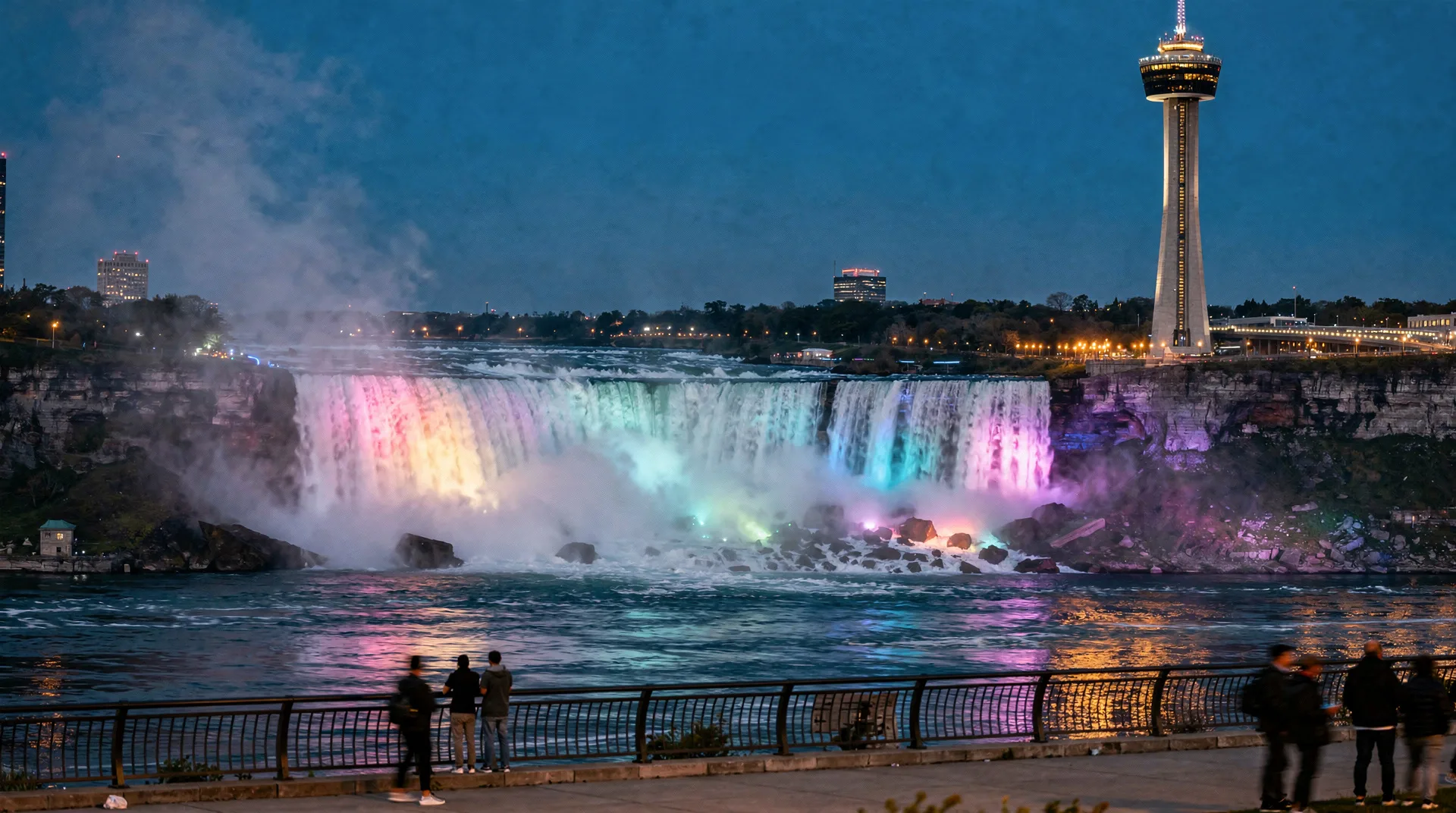
Niagara Falls: Canadian side vs US side
Is the Canadian side or US side of Niagara Falls better?
The Canadian side offers dramatically better views of both the Horseshoe Falls and the American Falls, plus more developed tourist attractions, dining, and accommodation. The US side is better if you want to walk directly beside the American Falls and feel the mist up close. For most visitors, the Canadian side is the stronger choice — but crossing to the US side adds genuine value.
Niagara Falls sits on the international border between Ontario, Canada and New York, USA. The falls divide into three sections: the large Horseshoe Falls (also called Canadian Falls) on the Canadian side, and the narrower American Falls and Bridal Veil Falls on the US side. The border runs down the middle of the Niagara River.
The difference between the two sides is not subtle. Most travel writers, photographers, and repeat visitors agree that the Canadian side provides the better overall experience. The views are demonstrably superior, the infrastructure is more developed, and the Horseshoe Falls — the largest of the three sections at 57 metres high and 670 metres wide — faces the Canadian shoreline.
This guide covers both sides honestly, explains when the US side adds value, and helps you plan a visit whether you are staying on one side or crossing to see both.
| At a glance | |
|---|---|
| Where | Ontario, Canada / New York, USA — Rainbow Bridge connects both sides |
| Cost | Canadian-side viewing free; paid attractions around CAD $20-35 each; US state park entry free, parking around USD $20-35 |
| Time needed | Half day for the Canadian side alone, a full day to cross and see both |
| Getting there | Around 90 minutes from Toronto by car via the QEW, or from Toronto day tours |
| Best time | Year-round; see also Niagara Falls in winter and Niagara Falls in December for the quiet season |
The falls: what you’re seeing from each side
From the Canadian side
The Canadian side looks directly across at the full width of the Horseshoe Falls in a sweeping panoramic view. Standing at Table Rock — the observation platform at the base of the Horseshoe Falls — you are close enough to feel the spray and see the water volume clearly. The view takes in the full 670-metre width of the falls with the American Falls visible in the background.
The perspective from the Canadian side is what appears in most photographs of Niagara Falls. The angle creates the classic crescent shape of the Horseshoe Falls, and the lighting in the afternoon and early evening is optimal for photography.
From the US side
The US side is adjacent to the American Falls and Bridal Veil Falls rather than the Horseshoe Falls. The proximity to the American Falls is genuinely closer — you can walk to within metres of the edge on the Observation Deck. The view of the Horseshoe Falls from the US side is from the side rather than face-on, which is less dramatic but different.
Goat Island (US) sits between the two falls sections and is accessible by walkways. The Three Sisters Islands extend further into the river and offer unusual perspectives of the rapids.
Attractions on each side
Canadian side attractions
Table Rock Centre is the main observation point — a broad terrace at the brink of the Horseshoe Falls with unobstructed views. Free to access from the outdoor terrace; the Journey Behind the Falls tunnels are ticketed.
Journey Behind the Falls takes visitors through tunnels cut in the rock behind the Horseshoe Falls, emerging at two outdoor portals within metres of the falling water. The noise, spray, and scale are overwhelming in the best way. Ponchos provided. Book in advance in summer.
Hornblower / Niagara City Cruises (the Canadian boat tour) operates from the Canadian dock and sails into the spray basin of the Horseshoe Falls — dramatically closer to the Horseshoe Falls than the US Maid of the Mist. The Niagara Falls tour with Journey Behind the Falls and boat ride combines both in one ticket.
Skylon Tower offers panoramic views from 236 metres including the revolving dining room and observation decks. The night illumination of the falls is best viewed from the Skylon.
Fallsview Casino and the tourist strip on Clifton Hill offer entertainment, restaurants, and — for some visitors — the full spectrum of tourist attraction kitsch.
Niagara-on-the-Lake (19 km north): One of Canada’s most charming historic towns, with 19th-century architecture, Shaw Festival theatre, and excellent wineries along the Niagara Escarpment wine route. A natural addition to a Niagara overnight trip.
Night illumination: Both Canada and the US illuminate the falls at night with coloured lights (typically from dusk until midnight). The view from the Canadian side is superior for the light show as well.
Explore the full range of Canadian side Niagara Falls tours and experiences and Niagara cruises on the Canadian side.
US side attractions
Niagara Falls State Park (New York) is the oldest state park in the US, established in 1885. Admission is free; parking is charged. The park covers Goat Island and several smaller islands, with walkways to the brink of the American Falls.
Cave of the Winds is a walkway descent to the base of the Bridal Veil Falls — visitors stand on a platform metres from the falling water. This is the US side’s best unique experience; the proximity to the Bridal Veil is impressive.
Maid of the Mist (US boat tour) operates from the US dock, visiting both the American Falls and the edge of the Horseshoe Falls spray zone — good but not as close to the Horseshoe Falls as the Canadian boat tour.
Niagara Falls Observation Tower offers elevated views of the falls from the US side — a different perspective from the Canadian panorama.
Goat Island and Three Sisters Islands: Walkable from the state park, offering unusual perspectives of the upper rapids.
| Canadian side | US side | |
|---|---|---|
| View of Horseshoe Falls | Panoramic, face-on | Side view |
| View of American Falls | Background | Up close |
| Boat tour | Niagara City Cruises (closer to HF) | Maid of the Mist |
| Behind the falls | Journey Behind the Falls (tunnel) | Cave of the Winds (walkway) |
| Infrastructure | Well-developed tourist area | More park-like, less commercial |
| Night illumination view | Superior | Good |
| Cost | Higher overall | State park entry free |
Cost comparison
Canadian side
- Table Rock observation deck: Free
- Journey Behind the Falls: CAD $30–$35/adult
- Niagara City Cruises boat tour: CAD $30–$35/adult
- Skylon Tower observation: CAD $22–$28/adult
- WEGO bus day pass (hop-on hop-off Niagara): CAD $12/person
- Accommodation (Niagara Falls, Ontario): CAD $150–$350/night mid-range; CAD $400–$600 for Fallsview hotel rooms
US side
- Niagara Falls State Park entry: Free (parking USD $20–$35)
- Cave of the Winds: USD $23/adult
- Maid of the Mist: USD $23–$28/adult
- Observation Tower: USD $1/adult
- Accommodation (Niagara Falls, NY): USD $100–$250/night mid-range
The US side is modestly less expensive if you are based there. Most tours from Toronto arrive on the Canadian side and charge in CAD.
Getting there
From Toronto
Niagara Falls is 130 km from Toronto — about 90 minutes by car on the QEW highway. This is the most common day trip from Toronto (see our Toronto to Niagara Falls guide).
GO Transit operates seasonal train service from Union Station to Niagara Falls, Ontario. Via Rail has periodic service. Organized day tours from Toronto are plentiful and the most hassle-free option for first-time visitors.
Crossing the border
The border between the Canadian and US sides is crossed by three road bridges: Rainbow Bridge (Niagara Falls), Whirlpool Rapids Bridge (NEXUS lanes only), and the Lewiston-Queenston Bridge (15 km north). The Rainbow Bridge is the most central for tourists.
Border crossing requires a valid passport. US citizens need a passport or passport card. Line-ups on the Rainbow Bridge can be 30–60 minutes in summer; early morning crossings are faster.
Accommodation strategy
Stay on the Canadian side if your primary goal is views and access to the Horseshoe Falls. Fallsview hotels directly overlooking the falls command premium prices (CAD $300–$600/night for views) but the convenience of watching the illuminated falls from your room is genuinely memorable.
Stay on the US side if budget is the main concern — New York accommodation is cheaper and the state park is excellent. The trade-off is a less dramatic immediate environment and the need to cross the bridge for the best Horseshoe Falls views.
A practical middle ground: stay on the Canadian side for one night, cross to the US for a half-day to see Cave of the Winds and the American Falls from close proximity, return to Canada for the evening illumination.
Winter at Niagara Falls
Winter (January to March) is an underrated time to visit Niagara Falls. The tourist crowds thin dramatically, icicles form on the surrounding rocks, and the falls themselves slow slightly (they never freeze solid due to volume) creating dramatic ice formations. The Winter Festival of Lights illuminates the falls area from November through February.
Accommodation rates drop 40–60% from summer peaks. The Rainbow Bridge and Canadian attractions remain open year-round.
Extending the trip: wine country and the Escarpment
Niagara Falls sits at the southern end of the Niagara Escarpment, a UNESCO Biosphere Reserve that also creates the microclimate behind Niagara wine country. If you have more than a day, both are easy additions from the Canadian side:
- Niagara-on-the-Lake wineries: Around 20 minutes north of the falls, this is Ontario’s best-known wine region, with tastings generally CAD $10-20 per flight. See the full Niagara wineries guide for which estates to prioritise.
- The Bruce Trail and Escarpment hikes: Hikers with a car can combine the falls with a short walk along the Niagara Escarpment; see the Niagara Escarpment and Bruce Trail guide for accessible day-hike sections near Niagara.
- A weekend itinerary: If you’re building a longer trip around the falls, our Toronto and Niagara weekend itinerary sequences the falls, wine country and a Toronto day into one realistic plan.
Best for…
Stay on the Canadian side if you:
- Want the best photographs and panoramic views of the Horseshoe Falls
- Are visiting on a day trip from Toronto or visiting Ontario
- Want the most complete tourist infrastructure (dining, entertainment, boat tours)
- Are visiting for the night illumination or Winter Festival
- Don’t need to see the US side specifically
Visit the US side if you:
- Want to walk beside the American Falls and experience Cave of the Winds
- Are arriving from New York State
- Are on a budget (state park entry is free)
- Want the different perspective from Goat Island
- Are combining with US destinations southward
Visit both if you:
- Have a full day or overnight at Niagara
- Have a passport and want the complete experience
- Are interested in the scale of the falls from every angle
Our verdict
Canadian side wins on every measure that matters for most visitors: the views, the boat tour access to the Horseshoe Falls, the Journey Behind the Falls, and the overall experience of one of the world’s great waterfalls. The panoramic perspective from Table Rock is simply the definitive Niagara view.
The US side is not without value — Cave of the Winds is genuinely impressive, and the American Falls proximity is different from anything on the Canadian side. Visitors with a full day should cross to see it. Visitors with half a day should spend it entirely on the Canadian side.
See also: Toronto to Niagara Falls guide, From Toronto guide, Canada vs USA first trip.
Frequently asked questions about Niagara Falls: Canadian side vs US side
Is the Canadian side better than the US side for Niagara Falls?
For views: yes, decisively. The Canadian side looks face-on at the Horseshoe Falls, the largest of the three falls sections. The US side offers a side view of the Horseshoe Falls and a close view of the smaller American Falls. For the complete experience, both sides add value — but the Canadian side is the better base.
Can I cross from the Canadian side to the US side at Niagara Falls?
Yes. The Rainbow Bridge connects Niagara Falls, Ontario (Canada) with Niagara Falls, NY (USA). You need a valid passport. US citizens can use a passport or passport card. Border crossing time varies from 5 minutes to over an hour depending on traffic; summer afternoons are slowest.
Do I need to pay to see Niagara Falls?
The Canadian side has a free outdoor observation area at Table Rock. Paid attractions (Journey Behind the Falls, boat tour, Skylon Tower) are optional additions. The US side’s Niagara Falls State Park charges for parking but the park entry is free; paid attractions (Cave of the Winds, Maid of the Mist, Observation Tower) are additional.
Which boat tour is better — Canadian or US?
The Canadian boat tour (Niagara City Cruises) is generally considered better: it sails closer to the base of the Horseshoe Falls, the larger of the two main falls sections. The US Maid of the Mist visits both falls but is not as close to the Horseshoe Falls. Both tours soak passengers thoroughly — ponchos are provided.
How long should I spend at Niagara Falls?
A half day covers the Canadian side highlights (Table Rock, boat tour, Journey Behind the Falls). A full day allows the US crossing for Cave of the Winds and Goat Island. An overnight adds the night illumination, Niagara-on-the-Lake, and a more relaxed pace. Most day trippers from Toronto budget 4–6 hours.
Can I do Niagara Falls as a day trip from Toronto?
Yes, and it is one of the most popular day trips in Ontario. The drive takes about 90 minutes on the QEW. GO Transit operates seasonal trains. Organized day tours from Toronto handle transport and include the main attractions in a single ticket — generally the most convenient option for first-time visitors. See our Toronto to Niagara Falls guide for logistics.
Is Niagara Falls worth visiting outside summer?
Yes. Spring and autumn are quieter with comfortable weather, and winter has its own appeal: ice formations, the Winter Festival of Lights and dramatically thinner crowds, though the boat cruise and Journey Behind the Falls close for part of the cold season. See Niagara Falls in winter and Niagara Falls in December for month-by-month detail.