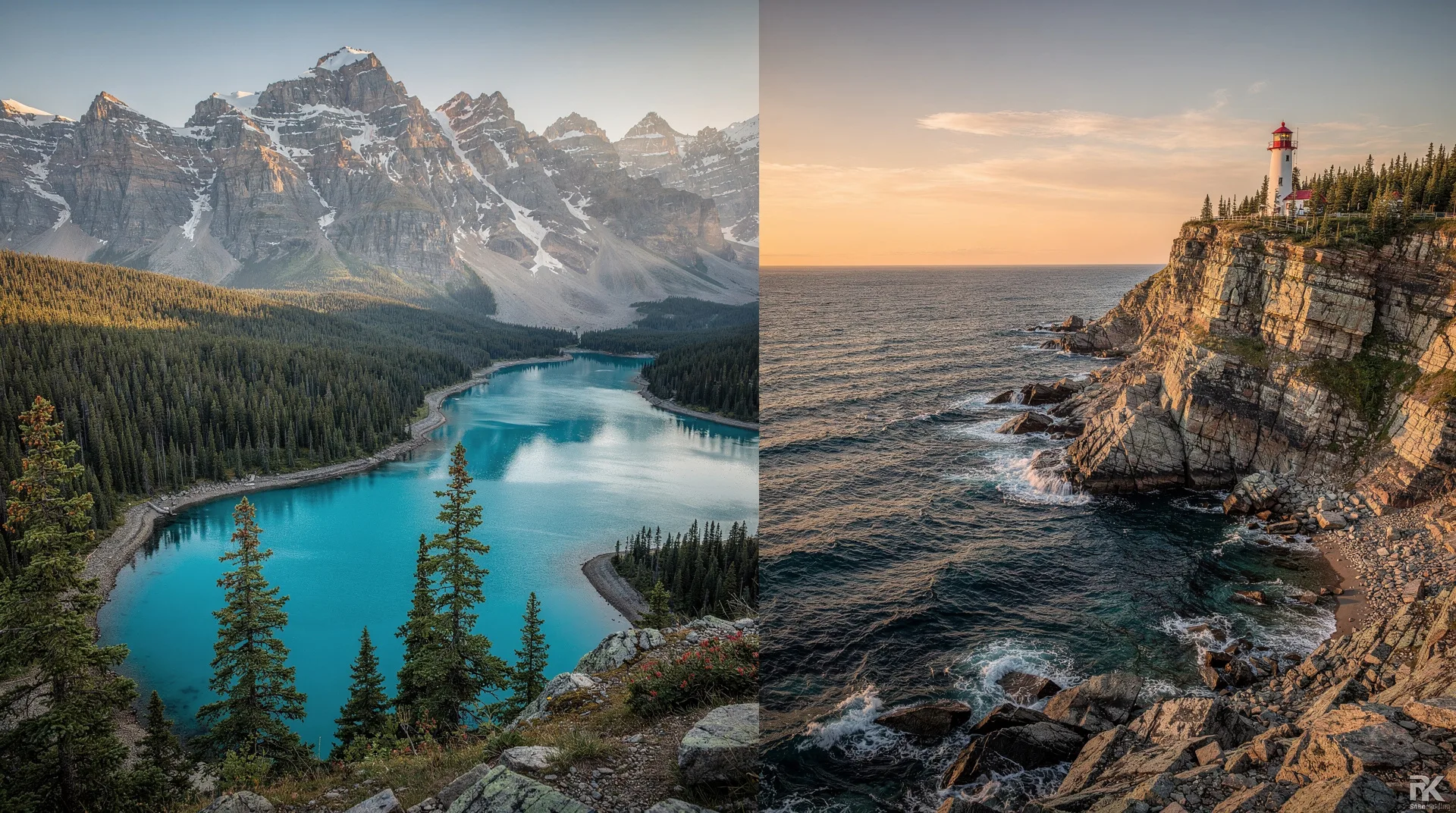
Maritimes vs Newfoundland: which Atlantic Canada trip?
Should I visit the Maritimes or Newfoundland?
Choose the Maritimes (Nova Scotia, New Brunswick, PEI) for a drivable loop with lobster suppers, red beaches, vineyards, and the Cabot Trail. Choose Newfoundland for dramatic coastal cliffs, icebergs, puffins, and a Celtic-influenced culture that feels different from the rest of Canada. For 7 days, pick one. For 14+, do both.
| At a glance | |
|---|---|
| Maritimes access | fly into Halifax (YHZ) or Moncton (YQM), drive a connected loop |
| Newfoundland access | fly (90 min from Halifax) or take the Marine Atlantic ferry (6-16 hours depending on route) |
| Minimum time | 7 days for either region alone; 18-21 days minimum to do both |
| Best season | July-August for reliable weather; June for Newfoundland icebergs and puffins |
| Cost | broadly similar; Newfoundland skews higher due to ferry costs and longer driving distances |
Atlantic Canada is not one destination — it’s two very different ones. The Maritimes (Nova Scotia, New Brunswick, Prince Edward Island) form a connected, drivable region with shared history and cuisine. Newfoundland and Labrador sits further east, separated by a six-hour ferry or a short flight, and operates on its own time zone and its own cultural wavelength.
This guide helps you decide which suits your trip — or whether you should try to do both.
The short answer
The Maritimes are easier logistically, gentler in terrain, and packed with classic Canadian east coast experiences: Cabot Trail drives, Anne of Green Gables sites, Halifax harbour seafood, Bay of Fundy tides. They work for a first-time Atlantic Canada trip, a family holiday, or anyone who wants the quintessential “lighthouses and lobster” experience.
Newfoundland is wilder, rockier, and more cinematic. The landscapes feel more like Iceland or the Scottish Highlands than anywhere else in Canada. The culture — musical, friendly, distinct — is unlike anywhere in North America. But it takes more effort to reach and more time to see properly.
Geography and access
The Maritimes are connected by road and short bridges. You can land in Halifax (YHZ) or Moncton (YQM), pick up a car, and drive a loop that takes in all three provinces in 7-10 days. The Confederation Bridge links PEI to New Brunswick. Ferries connect parts of Nova Scotia.
Newfoundland sits 90 minutes by flight from Halifax or 6-8 hours by Marine Atlantic ferry from North Sydney, Nova Scotia. Within the island, distances are vast. St. John’s to Gros Morne National Park is a 7-hour drive. You need at least a week to see the highlights and preferably ten days.
Scenery
Maritimes: rolling farmland, red sandstone cliffs, gentle coves, lighthouse-studded shores, and the surreal tidal range of the Bay of Fundy. The Cabot Trail in Cape Breton is the scenic peak — a 298 km loop through highland wilderness and fishing villages.
Newfoundland: jagged fjords, iceberg-dotted bays in late spring, tablelands of exposed mantle rock at Gros Morne, cliffs that drop straight into the Atlantic. Less agricultural, more elemental. Weather changes fast.
Both are beautiful. The Maritimes are pastoral beauty; Newfoundland is raw beauty.
Culture and food
The Maritimes blend Acadian French, Scottish, Irish, Indigenous Mi’kmaq, and loyalist British heritage. Cuisine centres on lobster, scallops, Digby oysters, Solomon Gundy pickled herring, and PEI potatoes in every form. Celtic music is alive in Cape Breton. Acadian identity thrives in parts of New Brunswick.
Newfoundland culture is its own thing. An Irish-influenced dialect can be hard to parse at first. Kitchen parties with fiddles and bodhrans are authentic, not staged. Food includes cod tongues, jiggs dinner, toutons, screech rum, and bakeapples (cloudberries). The “Newfoundland screech-in” ceremony is a widely practiced tourist ritual that locals genuinely enjoy.
Wildlife
Both have whales. Both have seabirds.
- Maritimes: humpback and minke whales off Nova Scotia and the Bay of Fundy, rare North Atlantic right whales near Grand Manan, moose in Cape Breton Highlands, seals everywhere.
- Newfoundland: humpbacks, minkes, orcas, puffins (over 260,000 pairs nest at Witless Bay), icebergs May-June, caribou on the Avalon Peninsula.
Newfoundland has the edge for iceberg viewing (May-June) and puffin colonies. The Maritimes edge out for diversity of coastal mammals.
Costs
Both are mid-range destinations. Expect:
- Rental car: CAD $55-90/day
- Mid-range hotel: CAD $150-250/night
- Seafood dinner: CAD $35-70 per person
- Bay of Fundy tour or whale watching: CAD $65-95
Newfoundland skews slightly more expensive due to ferry costs (CAD $130+ per adult foot passenger one way) and longer driving distances.
How long you need
- Maritimes only, highlights: 7 days
- Maritimes full loop with Cabot Trail and PEI: 10-14 days
- Newfoundland, west coast + St. John’s: 7 days
- Newfoundland in depth including Fogo Island: 10-14 days
- Both combined: 18-21 days minimum
Best for specific trips
- First Atlantic Canada trip: Maritimes
- Family holiday with kids: Maritimes (easier driving, PEI beaches)
- Photography and dramatic landscapes: Newfoundland
- Icebergs and whales together: Newfoundland in June
- Lobster, vineyards, and genteel coastal towns: Maritimes
- Celtic music and folk culture: Cape Breton (Maritimes) or anywhere in Newfoundland
Best time to go
Both regions share a compressed summer season. July and August are warmest and most reliable. June is excellent for Newfoundland icebergs and puffins. September offers great weather with fewer crowds. Fall foliage in Cape Breton peaks mid-October. Winter travel is possible but limits options heavily.
| Month | Maritimes | Newfoundland |
|---|---|---|
| May-June | Mild, shoulder season, quieter | Iceberg season starts, cold, some services still ramping up |
| July-August | Warmest, busiest, all services running | Warmest, Argentia ferry running, best access |
| September | Great weather, fewer crowds | Good weather, whale watching still strong |
| October | Cabot Trail fall foliage peaks mid-month | Cooling fast, many seasonal operations closing |
| Winter | Limited touring, some ski/snow activities | Very limited; Argentia ferry closed, Port aux Basques still runs |
Practical logistics: combining the two
If time allows the full 18-21 days, the natural sequence is Maritimes first (fly into Halifax, loop through Nova Scotia, New Brunswick, and PEI), then cross to Newfoundland via the Marine Atlantic ferry from North Sydney rather than flying, since you’re already in Cape Breton at the end of the Cabot Trail loop.
This avoids backtracking and turns the ferry crossing into part of the trip rather than a separate flight. For the Newfoundland portion specifically, decide up front whether you’re prioritising western Newfoundland (Gros Morne, the Viking Trail, reached via the Port aux Basques crossing) or eastern Newfoundland (St. John’s, the Avalon Peninsula, reached faster via the seasonal Argentia crossing or by flying).
For deeper planning on the Newfoundland side, the Newfoundland vs Labrador guide clarifies a common point of confusion, and the Viking Trail Newfoundland guide covers the western circuit in detail. On the Maritimes side, the Bay of Fundy tides and Cape Breton’s Cabot Trail are the two anchor experiences worth building a route around.
Frequently asked questions
Can I visit both the Maritimes and Newfoundland in one week?
Not comfortably. A week is enough for a highlights trip to one region, but splitting seven days between both means arriving exhausted and seeing little of either properly. If time is limited to a week, pick one region rather than trying to combine them.
Is the Marine Atlantic ferry included in a Maritimes-only trip?
No — the ferry only matters if Newfoundland is on the itinerary. A Maritimes-only loop (Nova Scotia, New Brunswick, PEI) never requires it; see the Marine Atlantic ferry guide for full route and booking details if Newfoundland is added later.
The honest verdict
If this is your first trip to Atlantic Canada, start with the Maritimes. The logistics are simpler, the variety is high, and the infrastructure supports easy touring. Nova Scotia alone gives you lighthouses, lobster, the Cabot Trail, and Halifax — a generous itinerary.
If you’ve already done the Maritimes, or if you crave wilder landscapes and a place that feels genuinely unlike the rest of Canada, Newfoundland delivers experiences you can’t get anywhere else on the continent. Just give it enough time to do it justice.