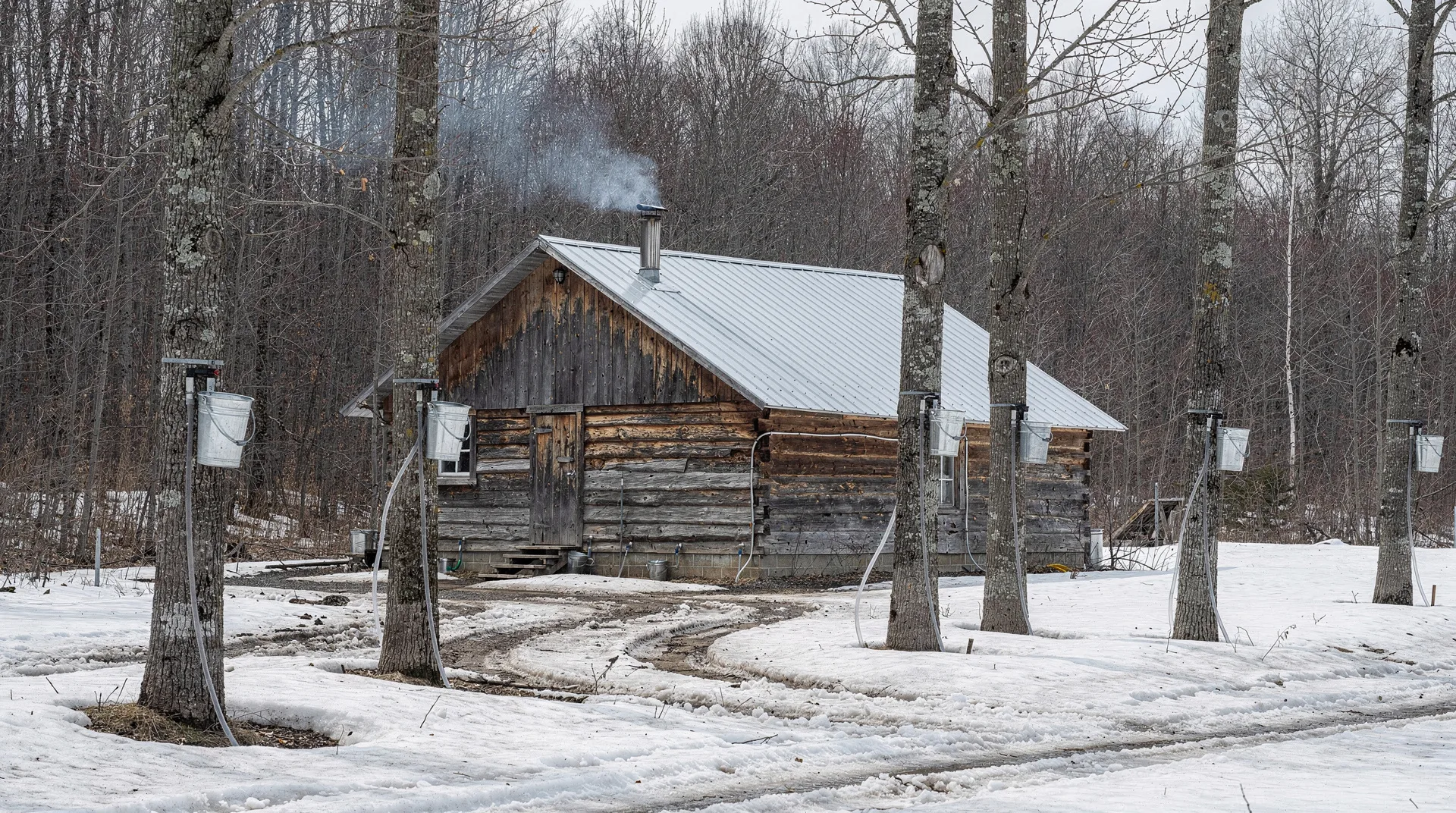
Maple syrup tours: Quebec's sugar shacks and beyond
When is maple syrup season in Quebec?
The season runs from late February to late April, peaking in March and early April when freezing nights and warm days cause sap to run. Most sugar shacks host visitors during these 6–8 weeks for meals, tours and activities. Outside this window, many offer year-round static experiences.
| At a glance | |
|---|---|
| Where | Sugar shacks near Montreal, Quebec City, and southwestern Ontario |
| Cost | around CAD $30-55 for a traditional meal, $80-120+ for premium operations like Au Pied de Cochon |
| Time needed | half a day for a meal and tire sur la neige, a full day for a guided sugar shack trip with transport |
| Getting there | private car is easiest; guided day-trip tours run from Montreal and Quebec City in season |
| Best time | mid-March to mid-April for peak production, book weekends well ahead |
Maple syrup is so thoroughly associated with Canada that the maple leaf sits on the national flag — yet the depth of the tradition around its production is something most visitors don’t discover until they’re seated at a long wooden table in a sugar shack, tucking into a plate of maple-baked beans, ham, and eggs while a jug of freshly drawn syrup is passed down the table. This is the cabane à sucre experience — the sugar shack — and it is one of the most distinctively Canadian experiences available.
Canada produces about 72% of the world’s maple syrup, and Quebec produces about 90% of Canada’s total. The province’s maple industry is substantial — over 13,000 producers, nearly 8,000 of them in Quebec, tapping around 50 million trees annually. The St. Lawrence Lowlands, the Laurentian foothills, and the Eastern Townships (Cantons-de-l’Est) are the heart of the maple belt, and in late winter they fill with the smell of sap being boiled down to syrup in the sugar houses.
How maple syrup is made
Maple syrup comes from the sap of sugar maples (Acer saccharum), the tree responsible for the iconic red leaves on Canada’s flag. The sap runs when temperatures cycle above and below freezing — warm days cause pressure in the tree’s vascular system and drive sap toward the taps; cold nights stop the flow. This cycle, typically occurring in late February through April, defines the entire production calendar.
Each tap inserted into a maple tree yields between 35 and 50 litres of raw sap over the season. The raw sap is almost colourless and contains only 2–3% sugar — it takes roughly 40 litres of sap to make one litre of syrup. The sap is collected (via traditional buckets or, in modern operations, a network of plastic tubing under vacuum pressure) and transported to the sugar house where it is boiled in long flat evaporator pans until the water evaporates and the sugar concentration reaches 66–68%. The result is syrup.
The grade and flavour of the syrup depends on when in the season it is produced. Early-season sap makes Golden and Amber syrup — lighter, more delicate, with a pronounced maple flavour. Later-season sap, as temperatures rise and the trees begin to bud, produces Dark and Very Dark syrup with stronger, more robust flavour and more intense caramel notes. Both have their uses; the very dark grades are particularly good for baking.
The cabane à sucre experience
The sugar shack as a visitor experience goes far beyond watching the evaporator run. At its best, the cabane à sucre is a celebration of spring, community, and Québécois food culture that offers one of the most genuinely local food experiences in Canada.
A traditional cabane à sucre meal includes: pea soup, baked beans cooked in maple syrup, oreilles de crisse (fried salt pork rinds — better than they sound), omelette or scrambled eggs cooked with maple syrup, ham, pouding chômeur (a traditional Quebec bread pudding with warm maple cream sauce), and as much syrup on everything as physics allows. The serving style is typically communal and abundant — refills are expected.
The outdoor component of most sugar shack visits includes the classic tire sur la neige demonstration: boiling syrup poured in a thin line onto fresh snow and then rolled on a stick as it cools to a soft, chewy candy. This is apparently irresistible to every human who has ever tried it, regardless of age.
Beyond food, most sugar shacks offer tours of the production operation (in season, you can watch the evaporator in action and see the sap lines), horse-drawn wagon rides, live folk music, and outdoor games for children.
Browse Quebec City tours and food experiencesBest sugar shacks near Montreal
Montreal is the obvious base for Quebec maple tourism, with dozens of operating sugar shacks within 45–90 minutes by car.
Cabane à sucre Au Pied de Cochon (St-Benoit-de-Mirabel): Chef Martin Picard’s sugar shack is the most famous in Canada — a high-gastronomy take on the traditional experience that manages to be both reverent and extravagant. The meal is an extended, gluttonous celebration of maple and Québécois ingredients. Reservations open months ahead and sell out within hours. Worth serious advance planning.
Érablière Au Bord du Lac (St-Esprit): A large, well-run operation 75 km north of Montreal offering the full traditional experience with live music, wagon rides, and outstanding tire sur la neige. Authentic and excellent value.
Sucrerie de la Montagne (Rigaud): A heritage-designated property west of Montreal with exceptional atmosphere — wood buildings, forest setting, live folk music every visit. One of the best for first-time visitors wanting the full traditional experience.
La Cabane d’à Côté (Mirabel): Chef François Brouillard’s acclaimed establishment focuses on locally sourced products alongside the maple tradition. A more refined experience without sacrificing authenticity.
Cabane à sucre Constantin (Mirabel): Large family operation, excellent value, traditionally generous portions. Consistently well-reviewed for groups.
Browse Old Montreal guided tours and food experiencesBest sugar shacks near Quebec City
The Eastern Townships and the Beauce region south of Quebec City are equally maple-rich, with a concentration of sugar shacks accessible from the provincial capital.
Érablière Lac Beauport (Lac-Beauport): 15 km from Quebec City, excellent for daytrip visitors. Stunning forest setting; the meal service is smooth and the outdoor activities are well-organised.
Domaine de la Forêt Perdue (Saint-Camille): In the Eastern Townships, this operation combines excellent maple products with a beautiful rural setting. The maple forest itself is accessible for walks when not in production.
Cabane à sucre du Rang Boisé (St-Apollinaire): A family operation in the Beauce known for generous portions and an authentic atmosphere far from tourist infrastructure. Recommended by Québécois rather than guidebooks, which is generally a good sign.
Quebec City’s Maple Experience festival
Quebec City hosts the Maple Experience (Expérience Érable) event each spring, typically in late March, centred on the Lower Town and Grande-Allée area. Participating restaurants incorporate maple into special menus, producers set up pop-up tasting stations in public spaces, and guided tours of the city’s maple food culture are offered. Even visitors who miss the peak season can experience the breadth of maple’s place in Québécois cuisine through this event.
Ontario sugar shacks
Ontario maple production is concentrated in the southwestern part of the province — Simcoe County, Grey and Bruce counties (the Bruce Peninsula and Georgian Bay area), and the areas around Lanark County east of Ottawa. The season is similar to Quebec, though slightly variable depending on the year.
Elmira, Ontario: The Elmira Maple Syrup Festival, held annually on the last Thursday of March in the heart of Mennonite country, is the world’s largest single-day maple syrup festival. Over 60,000 visitors attend. The combination of Mennonite food culture and maple production is uniquely southwestern Ontario.
Maple Leaf Farms (Newmarket): One of the most accessible Ontario sugar shacks for Toronto-based visitors. Traditional meals, outdoor activities, maple product sales. A half-day excursion from Toronto.
Bruce Peninsula Sugar Shack operations: The Bruce Peninsula’s maple bush operations, concentrated around Wiarton and Owen Sound, offer a quieter, more intimate sugar shack experience than the Quebec counterparts. Less touristy; the maple forest setting on the Bruce is particularly beautiful.
Maple products beyond syrup
A sugar shack visit opens access to a range of maple products that most visitors haven’t encountered:
Maple butter (beurre d’érable): Syrup whipped to a creamy, spreadable consistency. Extraordinary on toast, pancakes, or eaten directly off a spoon. Not actually containing butter — it’s pure maple product.
Maple taffy (tire d’érable): The soft candy made by pouring hot syrup on snow. Produced at the shack; try to replicate it at home.
Maple vinegar: Made by fermenting maple sap rather than boiling it. A genuine Quebec artisanal product with a complex, mild sweetness.
Maple cream cookies (biscuits à la crème d’érable): The standard souvenir cookie, better than it sounds and genuinely characteristic of Quebec pastry culture.
Maple mustard, maple BBQ sauce, maple salad dressing: Practical take-home condiments produced by most sugar shack operations.
Ice wine/maple wine: Several Quebec producers make wine from maple sap. Unusual; a category worth exploring if you encounter it.
Book a Montreal hop-on hop-off tour to explore the city’s food cultureBest time to visit Quebec for maple season
Late February: Some operations open if weather permits early sap runs. Maple cream can be purchased but live production less certain.
First two weeks of March: Production typically beginning in southern Quebec (Montreal area, Montérégie, Eastern Townships). Good for sugar shack visits; crowds light early in the season.
Mid-March to mid-April: Peak season. Production at maximum. All sugar shacks operating. The classic tire sur la neige is always available. Weekends are very busy; book ahead for popular operations.
Late April: Season ending, particularly in northern Quebec (Laurentians). Southern operations may continue through early May in cold years. Syrup grades shifting to dark as season advances.
Outside maple season: Many sugar shacks offer year-round dining in their traditional setting, though the production activity is absent. Some, like Sucrerie de la Montagne, are popular year-round destinations for the food and atmosphere.
Costs (in CAD)
| Item | Approximate cost |
|---|---|
| Traditional cabane à sucre meal (adult) | $30–$55 |
| Cabane Au Pied de Cochon (premium) | $80–$120+ per person |
| 1 litre maple syrup (at the shack) | $22–$35 depending on grade |
| 500 ml maple butter | $12–$18 |
| Return transport Montreal to sugar shack | $40–$60 (shared shuttle) |
What to bring
- Comfortable outdoor shoes (you will be in the forest and around farm buildings)
- Warm layer (March and April in Quebec are still cold; evenings are cold)
- Appetite: the meals are generous; arrive hungry
- Cash or credit card for product purchases; the meal may be cash-only at smaller operations
Getting to the sugar shacks
Most sugar shacks are accessible only by private car, as they are typically located in rural areas 30–100 km from city centres. Several Montreal tour operators offer guided sugar shack day trips during the season, which provide transport, a guide, and often a pre-selected reputable sugar shack experience. This is the simplest option for visitors without a car.
From Quebec City, rental cars are available at the airport and downtown; most sugar shack destinations are under an hour’s drive. For an overview of the province’s food scene beyond maple, see the Quebec food deep dive and the Quebec food markets guide; Montreal’s own food identity is covered in the Montreal food guide.
Pairing a sugar shack trip with fall colours or the wider province
Sugar shack season (roughly late February to late April) does not overlap with Quebec’s other big seasonal draw — autumn foliage, which peaks late September to mid-October. Treat them as two separate trips rather than trying to combine them. If maple season doesn’t fit your travel dates, the Quebec fall foliage guide and the Quebec in fall guide cover the equivalent autumn experience, and a 7-day Quebec fall itinerary is available for that season.
For visitors deciding between Quebec regions for maple specifically, the Quebec maple regions guide and the Quebec maple season guide go deeper into exact regional timing than this guide does. Beyond the products themselves, the maple beyond the bottle guide covers what to buy and take home.
Choosing between a self-drive visit and a guided day trip
Self-driving gives flexibility on timing and lets you choose a specific sugar shack, but requires a rental car and comfort with rural Quebec roads (signage is often French-only outside major routes). A guided day trip from Montreal handles transport, language, and typically includes a pre-vetted operation, which removes the risk of ending up at an overly touristy or poorly run shack — a real risk given how many operations exist. For a first visit without a car, the guided option is the safer choice; for a return visit where you already know which sugar shack you want (Au Pied de Cochon, for instance), self-driving is more efficient.
Frequently asked questions about Maple syrup tours: Quebec’s sugar shacks and beyond
Do I need to book a sugar shack visit in advance?
For popular operations and weekend visits during peak season (mid-March to mid-April), advance booking is essential. Some of the best-known shacks — particularly Cabane Au Pied de Cochon — require booking months ahead. Midweek visits require less advance planning; many operations accept walk-ins Monday through Thursday.
Is the sugar shack experience suitable for vegetarians?
Traditional cabane à sucre menus are heavily meat-based. Some progressive operations offer vegetarian alternatives; check with specific shacks before booking. The experience is less satisfying for strict vegetarians, though the maple products and desserts are universally plant-based.
Can I visit a sugar shack without speaking French?
Yes, particularly at larger operations accustomed to tourists. Major shacks near Montreal have English-speaking staff or guides. Smaller, more authentic rural operations may be French-only; this is part of the experience and is manageable with basic French or a translation app.
What is the difference between syrup grades?
Canada uses a four-grade system: Golden (delicate, best for pancakes and fresh use), Amber (medium), Dark (robust, good for baking and cooking), and Very Dark (very strong, mainly for food processing). At a sugar shack in March, you will typically find Amber and Dark grades, as Golden is most common early in the season.
Where can I buy maple syrup outside sugar shack season?
Maple syrup is sold in every grocery store across Canada year-round. For premium products, specialist food stores and airport duty-free shops stock a wide range. IGA and Metro supermarkets in Quebec carry good selections of local producers’ products.
How is Canadian maple syrup different from imported maple-flavoured syrup?
Enormously. The “maple-flavoured syrup” sold outside Canada is typically high-fructose corn syrup with artificial maple flavouring. Genuine Canadian maple syrup is a pure single-ingredient product: reduced maple sap, with a complex flavour profile that varies by grade, season, and terroir. The difference is not subtle.
Can I combine a sugar shack visit with fall foliage viewing?
No — the two seasons don’t overlap. Sugar shack season runs roughly late February to late April, while Quebec’s fall colours peak late September to mid-October. Plan them as separate trips; see the Quebec fall foliage guide for the autumn equivalent.
Are sugar shacks near Montreal or Quebec City better for a day trip without a car?
Montreal has more guided day-trip tour operators and a denser concentration of well-known sugar shacks within reach, making it the easier base without your own vehicle; Quebec City options exist but with fewer organised tour choices.