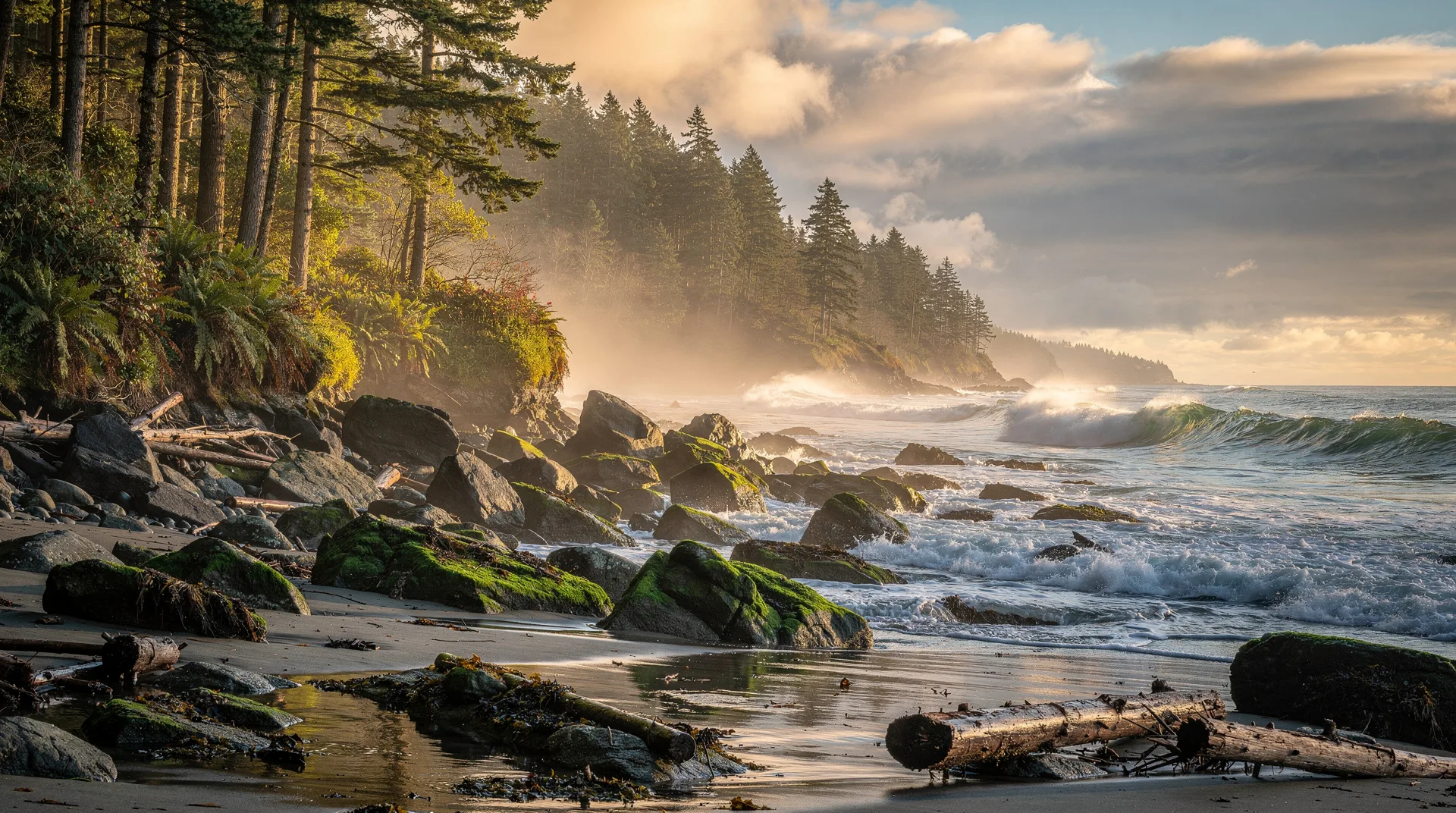
Juan de Fuca trail: coastal backpacking on Vancouver Island
Do you need a permit for the Juan de Fuca Trail?
No permit is required to hike the Juan de Fuca Trail. The trail has no quota system, making it freely accessible for both day hiking and multi-day backpacking year-round. Camping fees apply at designated campsites — approximately CAD 10/night, payable through the BC Parks self-registration system at each site.
The Juan de Fuca Trail is Vancouver Island’s great democratic alternative to the West Coast Trail. No quotas. No reservation system that opens in January and sells out by January afternoon. No CAD 280 permit fee. Just 47 kilometres of wild Pacific coast between China Beach (near Jordan River) and Botanical Beach (near Port Renfrew), open year-round, accessible to anyone who shows up with a pack and reasonable footwear.
| At a glance | |
|---|---|
| Where | Juan de Fuca Provincial Park, southwest Vancouver Island, between China Beach and Botanical Beach |
| Distance | 47 km one-way, in four sections |
| Time needed | Around 2–4 days for the full trail; a single afternoon for the Mystic Beach day hike |
| Cost | Around CAD 10/night/person camping plus a small vehicle parking fee — no permit fee |
| Getting there | Rental car from Victoria via Highway 14, around 1.5–2.5 hours depending on trailhead |
| Best time | June–September for driest trail conditions; April–May for whales and fewer crowds |
This is not to say it is easy. The Juan de Fuca Trail (JDF) has sections of deep mud, rooted forest trail, beach boulder walking, and creek crossings that demand full attention. But it is the most accessible multi-day coastal backpacking experience in BC, and for those who cannot get a West Coast Trail permit — or who want a more casual introduction to coastal backpacking before attempting the WCT — it is outstanding.
The trail runs through Juan de Fuca Provincial Park on Vancouver Island’s southwestern coast, within sight of the Strait of Juan de Fuca that separates Canada from the Olympic Peninsula in Washington State. Bald eagles are a daily presence. Grey whales feed offshore in spring. The rainforest above the beaches is old-growth Sitka spruce and Douglas fir. Tide pools at Botanical Beach are among the richest in BC. And the whole thing is three hours from Victoria.
Route overview
The Juan de Fuca Trail runs 47 km between China Beach in the east and Botanical Beach in the west (near Port Renfrew). Like the West Coast Trail, it is linear — most hikers arrange a vehicle shuttle between trailheads.
The trail is divided by three marine campsite clusters that function as natural staging points for a multi-day trip:
China Beach: Eastern trailhead, day-use area with vehicle camping. Starting point for east-to-west hikers.
Mystic Beach (2.9 km from China Beach): The closest campsite to China Beach and the destination for many day hikers. A waterfall drops directly onto the beach, making this one of the most photographed spots on the trail.
Bear Beach (16 km from China Beach): Large campsite with beach access. The section from Mystic Beach to Bear Beach is the most technically demanding, with significant mud, rooted trail, and some steep sections.
Payzant Creek/Chin Beach (24 km): Midpoint area with camping in the forest above the beach. The terrain around here is more moderate than the eastern sections.
Botanical Beach (47 km): Western trailhead and destination. Botanical Beach itself is extraordinary — a flat sandstone platform at low tide reveals tide pools of exceptional density, including sea stars, anemones, urchins, and nudibranchs. Plan your arrival to coincide with low tide.
The four character sections
Section 1: China Beach to Mystic Beach (2.9 km)
This is the classic day hike and the easiest section of the JDF. The trail descends through old-growth rainforest to Mystic Beach, a curved sandy bay with a sea cave accessible at low tide and a waterfall on the east end. This section is gentle enough for families with children. The beach is a 20-minute walk from the parking area.
Section 2: Mystic Beach to Bear Beach (13 km)
The character of the trail changes dramatically after Mystic Beach. Deep mud sections, rooted trail, steep ups and downs over headlands, and one significant creek crossing (at Chin Beach, cable car assisted at high water). This section takes 5–8 hours and is the reason the JDF has a reputation among those who underestimate it. Pack gaiters.
The views from the headlands — particularly the high point between Loss Creek and Bear Beach — are exceptional, with the full expanse of the Strait of Juan de Fuca and, on clear days, the Olympic Mountains of Washington State.
Section 3: Bear Beach to Payzant Creek (8 km)
The terrain moderates somewhat in this section, though mud and roots remain present. Bear Beach itself is wide and open, with offshore rocks that often host sea lions. The section passes through increasingly old-growth forest with impressive Sitka spruce.
Section 4: Payzant Creek to Botanical Beach (13 km)
The final section is the most varied, alternating between beach walking (pace-dependent on tides) and forest trail. The approach to Botanical Beach passes through some of the most beautiful forest on the trail. Botanical Beach itself is the exclamation point at the end: plan to arrive at low tide (tide tables are available at trailheads and online) to access the full tide pool platform.
Camping
No permit required for day hiking or multi-day trips. Campsites along the trail are self-registration — pay the fee (approximately CAD 10/night/person) at the site using the envelope and cash system or, where available, online through BC Parks. Bring exact change or a cheque if paying in person.
Campsite facilities: Each site has pit toilets, food storage caches (bear boxes), and tent pads. Fresh water is available at creek crossings, but all water must be filtered or treated. No campfires are permitted (use a camp stove).
Capacity: Unlike the WCT, the JDF has no quota. During peak summer weekends, the campsites (especially Mystic Beach and Bear Beach) can fill early in the day. Arrive before 2 pm to secure a spot at popular sites.
Getting there
China Beach: From Victoria, take Highway 14 west toward Sooke and continue approximately 70 km to the China Beach Provincial Park turnoff. Total drive approximately 1.5 hours.
Botanical Beach: Continue on Highway 14 past Jordan River and Sombrio Beach to Port Renfrew (approximately 2.5 hours from Victoria). Follow signs to Botanical Beach.
Vehicle shuttle: Most hikers arrange a two-car shuttle between trailheads, or use the West Coast Trail Express shuttle bus service that passes through Port Renfrew and Jordan River in season.
No transit service reaches the trailheads directly. A rental car from Victoria or a guided hiking trip is the practical option for visitors without a vehicle.
Browse outdoor and hiking tours from Victoria on GetYourGuideBest time to hike
April–May: Spring wildflowers, grey whale season offshore. Weather is variable — expect rain, but also brilliant clear days. Fewer hikers than summer.
June–September: Peak season. Summer weather brings more dry days, warmer temperatures, and the full range of wildlife activity. August is the driest month on average. Trail can be muddy year-round but is at its wettest in winter.
October–November: Storm watching season begins. The coast in October and November has dramatic Pacific swells, dramatic cloud formations, and very few other hikers. Rain gear essential.
December–March: Hikeable for experienced backpackers, but conditions are wet, trail is muddy, and some creek crossings can be high. The JDF is far more accessible in shoulder season than the WCT, which is closed in winter.
Wildlife
The Juan de Fuca coast has remarkable wildlife density:
- Pacific grey whales: Common offshore in March–May during migration; some individuals linger through summer
- Bald eagles: Year-round, multiple individuals per day on most sections
- Orcas: Occasional — the Strait of Juan de Fuca is Bigg’s (transient) orca territory
- Black bears: Common throughout, especially at creek mouths; store food properly
- Sea lions and harbour seals: On offshore rocks, visible from headland viewpoints
- River otters: At creek mouths and in tidal areas
- Shorebirds: Extraordinary diversity in fall migration
At Botanical Beach, the tide pools host one of the most accessible and diverse intertidal communities in BC: purple sea urchins, giant green anemones, ochre sea stars (recovering from sea star wasting disease), goose barnacles, nudibranchs, and sculpin fish.
Gear list
- Backpack 45–65L with rain cover
- Tent with waterproof fly (coastal weather can arrive without warning)
- Sleeping bag rated to 5°C minimum
- Rain gear: jacket and pants
- Gaiters (not optional — the mud on sections 2 and 3 is deep)
- Waterproof or gaitered hiking boots
- Camp sandals or footwear for creek crossings
- Trekking poles (helpful on rooted downhill sections)
- Water filter
- Camp stove and fuel
- Tide tables (download and print before you go — critical for Botanical Beach and some beach sections)
- Bear spray (optional but recommended)
- First aid kit
Costs
| Item | Cost (CAD) |
|---|---|
| Trail access | Free |
| Camping per person/night | ~$10 |
| Vehicle parking (China Beach) | $10/day |
| Car shuttle service | $60–100 depending on group size |
How the JDF compares to the West Coast Trail
| Factor | Juan de Fuca Trail | West Coast Trail |
|---|---|---|
| Distance | 47 km | 75 km |
| Duration | 2–4 days | 6–8 days |
| Permit required | No | Yes (CAD 250–280) |
| Quota | None | 75/day |
| Difficulty | Moderate-strenuous | Strenuous |
| Season | Year-round | May–September |
| Cost | ~CAD 40 | ~CAD 280 |
The WCT is the more dramatic and more complete experience. The JDF is the more accessible, flexible, and affordable one — and not a consolation prize. The Botanical Beach tide pools alone justify the trip.
See the West Coast Trail guide for full WCT logistics. For a broader look at Vancouver Island hiking, see the best hikes in British Columbia guide.
Explore Vancouver Island tours and outdoor adventures on GetYourGuideCombining it with the rest of Vancouver Island
Most visitors do not fly to Victoria purely for the JDF — it fits naturally into a wider Vancouver Island loop. Pair it with a few nights around Tofino or Pacific Rim National Park Reserve on the west coast (a Parks Canada pass is required there, unlike the JDF), and use our Vancouver Island 7 days itinerary as a starting framework to slot the trail in around the surf towns and old-growth groves further north. If you are deciding between the two coastal surf-and-forest bases, the Tofino vs Ucluelet guide is useful for planning where to base yourself before or after the hike.
For packing, our general Canada packing list covers clothing layers and documents, but treat it as a baseline only — the JDF-specific gear list above (gaiters, tide tables, bear cache discipline) matters more than anything generic.
Guided and supported options
Hikers who want logistics handled — shuttle booking, gear rental, or a guide for the technically demanding Mystic Beach to Bear Beach section — can book a day tour or multi-day guided trip from Victoria rather than self-organising. This is a reasonable option for those attempting their first coastal backpacking trip, or for the Mystic Beach day-hike segment if you are short on time and do not want to manage a shuttle.
Frequently asked questions about Juan de Fuca trail: coastal backpacking on Vancouver Island
Is the Juan de Fuca Trail suitable for beginners?
The Mystic Beach section (2.9 km return) is suitable for beginners and families. The full 47 km trail requires multi-day backpacking experience, physical fitness, and comfort with uneven, muddy terrain. Beginners should not attempt the Bear Beach section as their first backpacking trip.
Can I day hike the Juan de Fuca Trail?
Yes — each campsite can be reached as a day hike return from China Beach or from Botanical Beach. Mystic Beach (2.9 km from China Beach) and Botanical Beach itself are excellent day hike objectives. Sombrio Beach (accessible from a separate parking area off Highway 14) is another excellent day hike to a long surf beach.
Is there a bag storage option at the trailheads?
No official bag storage exists. Some Port Renfrew accommodation options may store luggage for a fee.
Are bears a serious concern?
Black bears are present throughout the trail and encounters are not rare, particularly at creek mouths and campsite food storage areas. Use bear caches at campsites, do not cook food near tents, and make noise while hiking. Bear spray is optional but provides peace of mind.
What are the tides at Botanical Beach?
Check the Canadian Hydrographic Service tide tables for Port Renfrew, which is the nearest tide station. The optimal time to visit Botanical Beach is 1–2 hours before the lowest low tide of the day. Very low tides (below 0.3 m) are the best for tide pool exploration.
How does the JDF compare to hiking near Tofino or Pacific Rim?
The JDF is a dedicated multi-day backpacking route with no park pass required. Pacific Rim National Park Reserve near Tofino, by contrast, is a Parks Canada park requiring a pass, with shorter, more accessible boardwalk trails (the Wild Pacific Trail, Rainforest Trail) alongside big surf beaches. They suit different trips — many visitors do the JDF as a standalone backpacking objective, then add a few relaxed nights in Tofino afterward.
Do I need to book a shuttle in advance?
Booking ahead is strongly recommended in July and August. The seasonal shuttle service and private shuttle operators fill up on weekends; outside of a two-car self-shuttle, do not assume you can arrange transport on arrival.