Ice fishing in Canada: best lakes, operators and what to expect
Is ice fishing worth trying as a first-time experience?
Yes — guided ice fishing is one of the most genuinely Canadian winter experiences available. You drill a hole, drop a line into a frozen lake, and sit in a heated hut waiting for walleye, pike, or perch to bite. No prior fishing experience needed. Guides handle equipment, bait, and licences.
Ice fishing is one of the most authentically Canadian winter experiences — more so, in some ways, than skiing or snowshoeing. It requires patience, a tolerance for cold, and a willingness to sit on a frozen lake waiting for a fish to decide it is hungry. In return, it offers something rare: genuine stillness in winter wilderness, a reason to be outside in the deep of January rather than inside looking out, and occasionally, a very good meal.
Canada has some of the world’s best freshwater ice fishing. The country’s lake system is extraordinary — millions of lakes covering vast areas of Ontario, Quebec, Manitoba, Saskatchewan, and British Columbia, most of them freezing reliably by December or January and holding fish populations that benefit from relatively low fishing pressure compared to the United States. Northern pike, walleye, yellow perch, lake trout, and whitefish are the primary targets depending on region and lake.
For first-time visitors, guided ice fishing tours provide everything you need: a heated hut (or at minimum a windbreak), a drilled hole, rental equipment, bait, fishing licence assistance, and a guide who knows where the fish are. Some operators will clean and cook what you catch. No prior fishing experience is required. If you want to book ahead, you can compare guided tours across Canada before choosing a lake.
At a glance
| Where | Ontario (Lake Simcoe, Kawarthas), Quebec (Laurentians, Lac Saint-Pierre), Saskatchewan and Manitoba (northern lakes, Lake Winnipeg) |
| Cost | Around CAD 80-150/person for a guided day trip; fly-in northern lodges run CAD 500-1,200+/person/day |
| Time needed | A half day (3-6 hours) covers a first taste; a full day (6-8 hours) is normal for serious anglers |
| Getting there | Self-drive from Toronto, Montreal or Winnipeg for the southern lakes; fly-in access for remote northern Saskatchewan/Manitoba lodges |
| Best time | January-February for the widest choice of safe, thick ice and active operators |
How ice fishing works
The basics are simple. When a lake freezes sufficiently (typically 15–20 cm of clear ice for safe walking, 25+ cm for snowmobile access), ice anglers drill holes through the ice using a hand or power auger — a spiral drill that cuts through ice in seconds. A fishing line is dropped through the hole with a baited hook or artificial lure, and the angler jiggles it to attract fish.
Tip-ups are an alternative to actively holding a rod — these are mechanical devices placed over the hole that flag when a fish takes the bait, allowing you to tend multiple holes simultaneously.
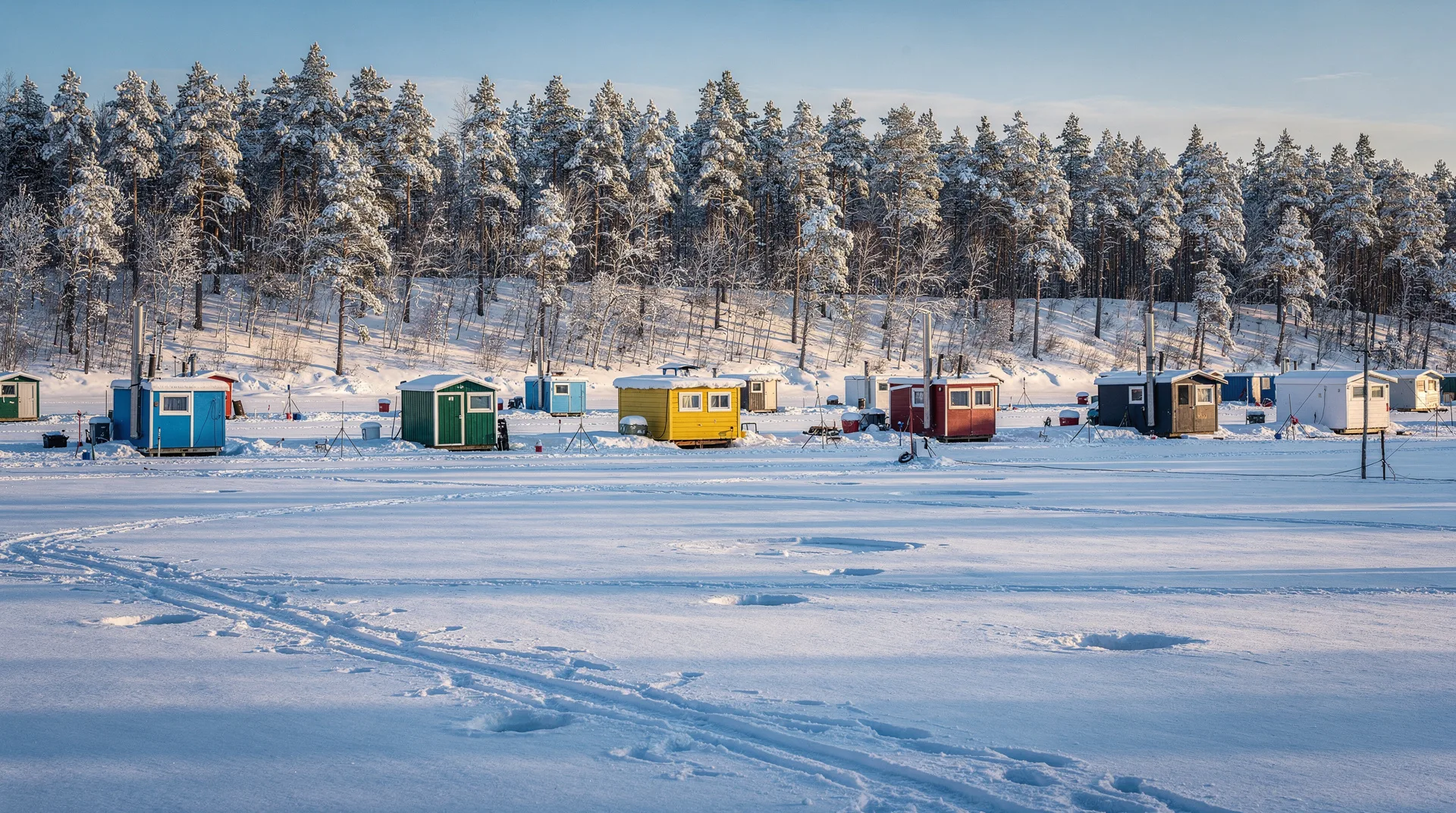
Ice huts (also called ice fishing shelters, shanties, or huts) range from simple windbreaks to fully heated portable cabins with televisions and propane stoves. Heated huts with comfortable seating are standard on guided tours.
The entire operation can be surprisingly comfortable — the inside of a well-heated ice hut at -20°C outside is warm enough to remove your jacket.
Best ice fishing lakes and regions
Ontario: Lake Simcoe and the Kawartha Lakes
Lake Simcoe, one hour north of Toronto, is the most popular ice fishing destination in Ontario and one of the busiest in Canada. The lake is famous for its lake trout and whitefish fishery under the ice — during peak season (January–February), the lake is dotted with hundreds of ice huts from commercial operators and private ice fishers.
The Georgina area (south shore) and Barrie and Orillia areas (north shore) have concentrated ice fishing operations with heated huts available for day rental. This is an accessible day trip from Toronto.
The Kawartha Lakes region (Peterborough area) offers excellent walleye and perch fishing on a chain of connected lakes. The Kawarthas are less crowded than Lake Simcoe and offer a quieter, more traditional ice fishing experience.
Quebec: Lac Saint-Pierre and the Laurentians
Lac Saint-Pierre, the broad widening of the St. Lawrence River between Montréal and Québec City, is one of Canada’s most important freshwater fisheries and produces exceptional yellow perch and pike ice fishing. The town of Maskinongé is a hub for ice fishing outfitters on the lake.
Quebec’s ice fishing culture is deeply embedded — the province has its own traditions around fishing huts (cabanes de pêche), and the experience has a distinctly Quebec character that differs from Ontario.
The Laurentian Lakes north of Montreal provide easy access from the city — dozens of lakes within 1–2 hours hold perch, pike, and walleye. Several outfitters around Saint-Donat and Rawdon offer guided day trips with heated cabins.
Saskatchewan: Lac La Ronge and northern lakes
Saskatchewan’s northern lake country — centred on Lac La Ronge and the vast boreal lake network — offers world-class wilderness ice fishing. The targets here are larger: lake trout to 10+ kg, northern pike in the 5–15 kg range, and walleye in quantities that genuinely impress experienced anglers.
The northern Saskatchewan experience is different from southern Ontario — you are dealing with true northern wilderness, often accessible only by plane or snowmobile. Several fly-in ice fishing lodges operate here, providing everything from transport to equipment to gourmet meals after the day’s fishing.
Cost: Fly-in packages run CAD 500–1,200+ per day per person but include flights, accommodation, equipment, guide, and typically meals.
Manitoba: Lake Winnipeg and Whiteshell Provincial Park
Lake Winnipeg — one of the world’s largest freshwater lakes — produces exceptional walleye and perch ice fishing from January through March. The town of Gimli, on the western shore, has several ice fishing operations.
The Whiteshell Provincial Park lakes east of Winnipeg are more intimate and offer a mix of perch, pike, and walleye in a beautiful forested landscape.
Browse guided ice fishing and winter outdoor experiences across CanadaTop operators and guided experiences
Ice Hut Rentals (Lake Simcoe): Multiple operators around Lake Simcoe rent fully-heated ice huts by the day with holes drilled, bait supplied, and optional guide services. Expect CAD 150–300 per hut per day (accommodates 4–6 people), with guide services extra.
La Pourvoirie du Lac à Jim (Quebec): A classic Quebec fishing outfitter north of Montréal offering ice fishing packages with heated cabins, equipment, and guide on Lac Jim. Day packages from approximately CAD 80–120 per person.
Otter Air (northern Saskatchewan/Manitoba): Fly-in ice fishing packages to remote northern lakes — the choice for serious anglers wanting genuinely remote, world-class walleye and trout. All-inclusive packages from CAD 600/day.
Frontier Fishing Lodge (Lake Athabasca, Saskatchewan): One of Canada’s most remote fishing operations — the lodge sits on the shore of Lake Athabasca in the far north. Ice fishing for lake trout from January through April.
Fishing licences
Every angler in Canada requires a valid provincial or territorial fishing licence. Licence requirements vary by province:
- Ontario: Sports Fishing Licence required (Ontario residents and non-residents pay different rates). Available online from the Ontario government or from tackle shops. Approximately CAD 27 (resident) to CAD 52 (non-resident) for a season licence.
- Quebec: Fishing licence required from the provincial government. Day licences available for non-residents.
- Saskatchewan: Non-resident licences available for specific species (trout, walleye, pike have separate licence categories in some areas).
Guided operators typically assist with licence purchase or include it in their package — confirm when booking.
Best time for ice fishing in Canada
| Month | Region | Ice conditions | Target species |
|---|---|---|---|
| December | Southern Ontario | Variable; early season, thin ice in places | Perch (cautious access) |
| January | Ontario, Quebec, Manitoba | Full season; safe ice on most lakes | Walleye, perch, pike, trout |
| February | All regions | Peak season; thickest ice, most operators active | Best all-round month |
| March | Northern Ontario/Quebec/Saskatchewan | Still good in north; south thawing | Northern pike (active in late ice) |
| April | Northern Canada only | Ice deteriorating in south; north still hard | Last of the season in accessible areas |
February is the optimal month across most of Canada — ice is thick and safe, fish are active (particularly walleye), and the full range of operators is running. Late February into early March produces some of the year’s best pike fishing as the fish become more active approaching spring.
Costs in CAD
| Experience | Estimated cost (CAD) |
|---|---|
| Day ice hut rental (Lake Simcoe, 4–6 people) | 150–300/hut |
| Guided day ice fishing (Ontario/Quebec) | 80–150/person |
| Fishing licence (Ontario, non-resident day) | 15–20 |
| Fishing licence (Ontario, non-resident season) | 52 |
| Fly-in ice fishing lodge (northern SK/MB) | 500–1,200/person/day |
| Ice auger rental | 20–30/day |
| Rod and tackle rental | 15–25/day |
What to bring and wear
Ice fishing involves long periods of inactivity sitting in cold conditions — even inside a heated hut, temperatures are cold. Dress warmer than you think you need to.
Footwear: Insulated, waterproof winter boots with good grip are essential. Ice can be slippery, particularly near hut entrances where snow compacts. Cleats or microspikes are popular among regular ice anglers.
Outer layers: Heavyweight insulated pants (not ski pants — more insulated) and a quality winter parka. Many ice anglers wear one-piece snowmobile suits.
Hand protection: Your hands will be handling cold equipment, wet fish, and cold bait. Warm gloves or mitts (with the ability to remove them for fine tasks) and possibly hand warmers are recommended.
Seating: If renting a guided hut, seating is provided. If accessing independently, bring a folding chair or bucket.
Where to stay
Ontario (Lake Simcoe): Barrie is the main service city for Lake Simcoe ice fishing — full hotel options available. Orillia and Innisfil (south shore) are closer to many Simcoe hut operators.
Quebec (Laurentians): Saint-Donat, Mont-Tremblant, and Rawdon area accommodation — from hotels to rental chalets. See our Mont-Tremblant skiing guide for nearby options.
Northern Saskatchewan/Manitoba: Fly-in lodges include accommodation as part of the package — this is typically the only accommodation option in these remote areas.
Ice fishing etiquette and lake safety
Ice fishing lakes are shared spaces, and a few unwritten rules keep the day pleasant for everyone. Keep a respectful distance from other huts and tip-up lines — crowding a productive spot is considered poor form, even on a busy lake like Simcoe. Pack out everything you bring in, including bait containers and fishing line, which is a genuine hazard to wildlife if left on the ice. If you drill your own hole, mark it with a branch or flag so snowmobiles and other anglers can see it after dark or under fresh snow.
Ice conditions change through the day and through the season, even when a lake is officially “open” for fishing. Commercial operators check thickness daily on their own access routes, but that does not guarantee safety away from the marked area — never wander off the operator’s track to explore unfamiliar ice. Cracking and booming sounds are normal on a freezing lake and do not necessarily mean danger, but soft or slushy patches, dark ice, or standing water on the surface are signs to turn back.
Combining ice fishing with other winter activities
Ice fishing pairs naturally with a broader Canadian winter trip rather than standing alone as the only activity. Visitors basing themselves in Quebec often combine a day on the ice with the province’s wider winter activities, from skating to sugar shacks. Those coming from the Rockies side of the country sometimes ask whether ice fishing exists there too — it does on some Alberta lakes, though the province is better known for ice walks through frozen canyons and dog sledding near Banff and Canmore.
If you want more time outdoors between fishing sessions, snowshoeing and cross-country skiing suit the same frozen-lake landscapes, while snowmobile tours and snowmobiling in Quebec cover more ground. Travelling with children? Our guide to Canada with kids helps you judge which winter activities suit which ages.
Prairie and lakeside bases also deserve a look: the town of Gimli and Whiteshell Provincial Park in Manitoba, the Kawarthas in Ontario and the Laurentians in Quebec each make a natural starting point for a first day on the ice.
For a wider view of what a winter visit to Canada involves, see our Canada in winter overview or the dedicated two-week winter itinerary, and check our packing list before you go — cold-weather layering mistakes are the single biggest complaint from first-time ice anglers.
Frequently asked questions about Ice fishing in Canada: best lakes, operators and what to expect
Can I combine ice fishing with other winter activities on the same trip?
Yes. Southern Ontario and Quebec ice fishing bases are within a few hours of skiing, skating and other winter activities, so a multi-day winter trip rarely needs to revolve around fishing alone. Northern fly-in lodges are more self-contained, since remoteness is part of the appeal.
Is ice fishing worth it if I don’t care about catching fish?
Often yes. Many first-time visitors describe the appeal as the stillness and the novelty of sitting on a frozen lake in a heated hut rather than the fishing itself. If the social and scenic side matters more to you than the catch, a shorter half-day trip on an accessible lake like Simcoe delivers that experience without the cost of a full fly-in package.
Do I need fishing experience to try ice fishing?
No. Ice fishing is more accessible than most people expect — the technique is simple, and on a guided trip, you will have someone set up your rod, show you how to jig, and handle any fish you catch. The experience is about being on a frozen lake in a heated hut as much as it is about catching fish.
Is ice fishing safe?
When ice is the correct thickness (15 cm minimum for foot travel, 25 cm for snowmobiles), ice fishing is safe. Operators check ice thickness daily and will not open operations on unsafe ice. The risks are real but managed — always follow your guide’s instructions, avoid ice near inlet and outlet streams (thinner ice), and do not venture onto unmarked ice without local knowledge.
What fish can I catch, and can I eat them?
The main targets by region: walleye and perch (Ontario, Quebec, Manitoba — excellent eating), northern pike (all regions — good eating, many bones), lake trout (Ontario, Saskatchewan — excellent, especially smoked), and whitefish (Lake Simcoe — underrated eating fish). Most operators will clean your catch; some will cook it for you on-site.
How long does an ice fishing outing typically last?
Guided day trips typically run 3–6 hours. A full day on the lake is 6–8 hours. Arrival, setup, and ice drilling take 20–30 minutes; the rest is fishing and waiting. Having a book, music, or good conversation helps with the waiting — the experience is genuinely meditative rather than fast-paced.
What is the youngest age appropriate for ice fishing?
Children as young as 6–7 can comfortably enjoy guided ice fishing, particularly in a heated hut. Younger children require careful supervision near holes. Children do not require fishing licences in most provinces up to a certain age (typically 17 and under in Ontario fish free).