Gros Morne National Park guide: Newfoundland's UNESCO wilderness
What is Gros Morne National Park known for?
Gros Morne is a UNESCO World Heritage Site on Newfoundland's west coast, famous for the Tablelands — ancient exposed mantle rock that helped prove plate tectonics — and Western Brook Pond, a dramatic landlocked fjord. The park combines geological wonder with coastal scenery and exceptional hiking.
At a glance
| Where | Newfoundland’s west coast, around 540 km from St John’s via the Viking Trail |
| Cost | Around CA$11.50/day adult, or the Discovery Pass (~CA$145/adult) if visiting multiple national parks |
| Time needed | 3 days minimum, 5 days to see it properly |
| Getting there | Fly into Deer Lake (YDF), then a rental car — no public bus serves the park |
| Best time | July-August for warmth and full services; September for quieter trails and settled weather |
Few national parks in Canada carry the geological and visual weight of Gros Morne. Stretching across 1,805 square kilometres of Newfoundland’s west coast, this UNESCO World Heritage Site presents a landscape that reads like a compressed chapter of Earth’s own autobiography. Ancient seabed thrust upward by tectonic forces, coastal lowlands shaped by retreating glaciers, and landlocked fjords of impossible depth — Gros Morne is simultaneously a scientific landmark and one of the most beautiful places in the country.
The park takes its name from the second-highest peak in Newfoundland, Gros Morne Mountain itself, rising to 806 metres above the Long Range Plateau. But the park’s fame rests as much on what lies beneath your feet as what towers above you. The Tablelands — a vast, rust-coloured plateau of peridotite rock — represent exposed mantle from deep within the Earth, forced to the surface when ancient continental plates collided roughly 500 million years ago. Scientists studying the Tablelands in the 1970s found some of the strongest evidence ever gathered for the theory of plate tectonics, earning Gros Morne its UNESCO designation in 1987.
Despite its scientific celebrity, Gros Morne remains remarkably uncrowded by the standards of Canadian national parks. The combination of remote location, Atlantic weather, and rugged terrain keeps visitor numbers manageable. Those who make the journey are rewarded with a park that feels genuinely wild, genuinely surprising, and unlike anywhere else in North America.
Why Gros Morne belongs on your Canada itinerary
The UNESCO designation tells part of the story: Gros Morne contains rock formations that cannot be found anywhere else in such accessible, dramatic form. The Tablelands alone would justify a visit — that otherworldly orange plain, largely devoid of vegetation because the peridotite rock is toxic to most plant life, is one of the most visually striking landscapes on the continent. Walk across it and you are quite literally walking on the Earth’s mantle.
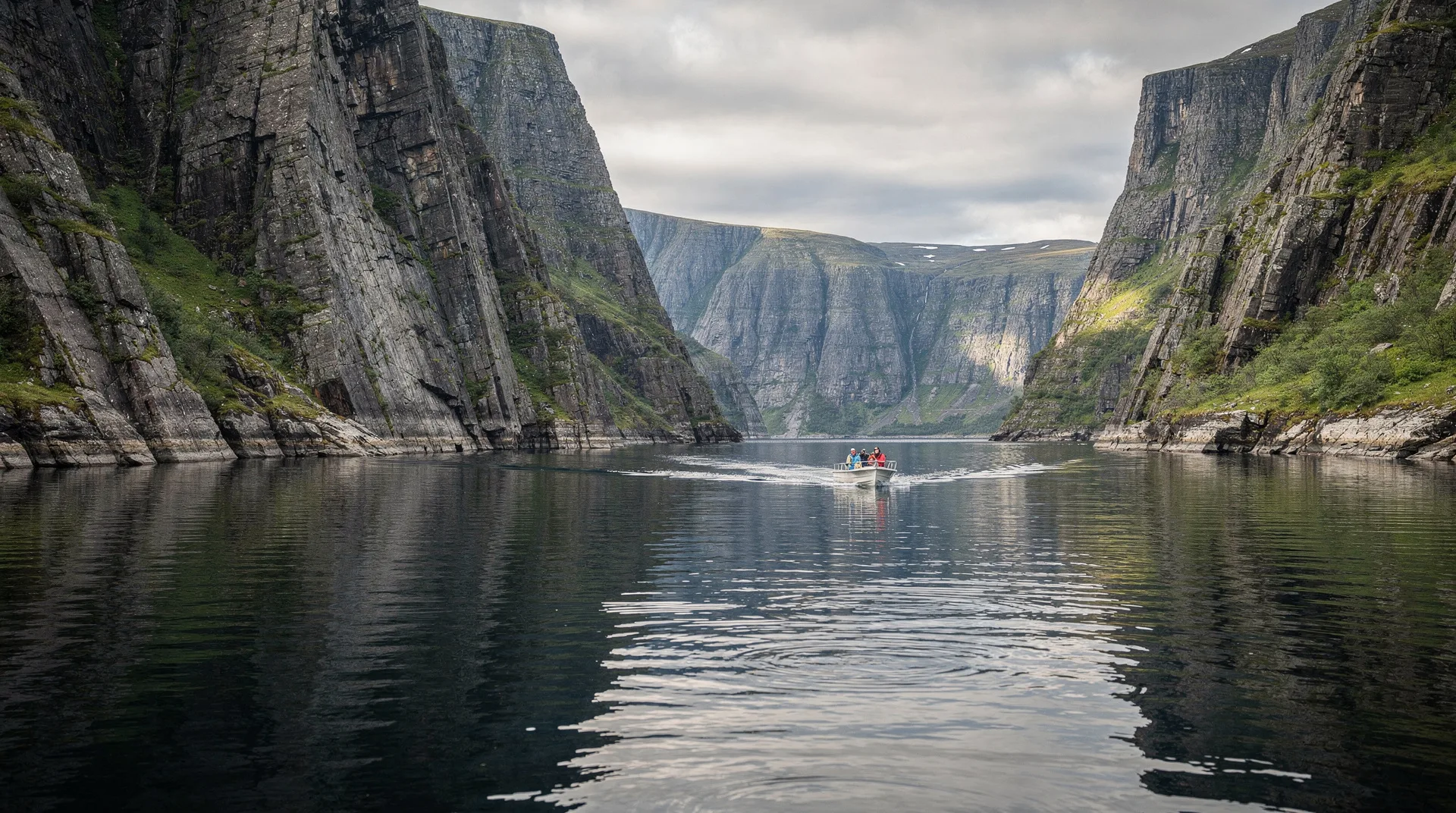
Then there is Western Brook Pond. Despite its modest name, this is a landlocked fjord, cut off from the sea when the land rebounded after the last ice age. Vertical cliffs of ancient Precambrian rock rise 600 metres from water of extraordinary clarity, fed by waterfalls that appear as silver threads high above. A boat tour across its 16-kilometre length is one of the great Canadian experiences — the silence inside those canyon walls is profound, interrupted only by the distant thunder of falling water.
Beyond the geological drama, Gros Morne is a park of diverse ecosystems. Coastal bogs, boreal forest, alpine tundra, and saltwater fjords exist within kilometres of each other. Moose are so abundant they have fundamentally altered the forest structure. Woodland caribou pick their way across the Long Range Plateau. Black bears patrol the berry patches in late summer. Whales pass the coast from June to October. The park rewards unhurried exploration at every scale, from the sweeping panorama to the orchid hidden in a roadside bog.
Top things to do in Gros Morne National Park
Western Brook Pond boat tour
The boat tour on Western Brook Pond is the park’s signature experience and should be booked before you arrive in Newfoundland. The journey begins with a 3-kilometre flat walk across coastal bogs to the pond’s outlet, crossing plank boardwalks over carnivorous plant colonies and past beaver dams. At the dock, a small boat carries passengers into the fjord itself, dwarfed almost immediately by walls of grey and ochre rock rising sheer from the water.
The canyon deepens as you travel inland, waterfalls appearing from unseen plateaus high above, including the 350-metre Pissing Mare Falls, one of the highest unobstructed waterfalls in eastern North America. The tour guide provides geological and ecological commentary throughout the 2.5-hour round trip. Tickets must be purchased in advance through Ocean Quest Adventures; the tours operate from June to early October and sell out well ahead in peak season.
Browse guided nature and adventure tours in NewfoundlandWalk the Tablelands
The Tablelands Trail (4 km return, easy to moderate) begins from the Tablelands parking lot on Route 431, south of Woody Point. The trail crosses a flat valley of burnt-orange peridotite, a rock so alien in chemistry that few plants grow on it — the bare scree gives the plateau its Mars-like appearance. Interpretive panels explain the geological significance in accessible terms, describing how the rock formed in the Earth’s mantle and was thrust to the surface during a tectonic collision half a billion years ago.
The full trail reaches a waterfall at the valley’s head, with views back across the orange plain to Bonne Bay. The Tablelands are particularly striking in afternoon light, when the low sun turns the peridotite a deep amber. This is also one of the best spots in the park to appreciate the stark contrast between the barren tableland and the lush boreal forest surrounding it.
Summit Gros Morne Mountain
The Gros Morne Mountain Trail (16 km return, strenuous) is the park’s most demanding and most rewarding day hike. The route climbs through dense forest to the base of a steep quartzite scree slope, where a 1.5-kilometre scramble on all fours gains nearly 400 metres of elevation — the trail is marked with cairns rather than a formal path. The summit plateau is a wide, otherworldly tableland of lichens and stunted krummholz, with views encompassing the entire park, the Gulf of St. Lawrence, and on clear days, the coast of Quebec.
Allow 6 to 8 hours. The scramble is not technically difficult but requires sure footing and should not be attempted in wet or foggy conditions. Fog is common on the plateau; check the Parks Canada forecast before departing. A ranger station at the trailhead dispenses advice and registers hikers.
Kayaking Bonne Bay
Bonne Bay is a deep saltwater fjord that cuts into the heart of the park, dividing the park into northern and southern sections. Sea kayaking on Bonne Bay provides a water-level perspective on the mountains that no road can match. Several outfitters based in Woody Point and Norris Point offer guided half-day and full-day paddling tours, including sunset paddles that linger as the sky turns crimson above the peaks. The protected inner bay is suitable for beginner paddlers; the outer bay and coast require more experience. If you would rather not organise gear yourself, compare guided outdoor tours in Canada before you book.
Explore the Discovery Centre and Visitor Centre
Parks Canada operates two main interpretation centres. The Park Visitor Centre in Rocky Harbour features displays on the park’s geological history, ecology, and Dorset Palaeoeskimo heritage. The Discovery Centre in Woody Point, on the southern side of Bonne Bay, focuses specifically on the geological significance of the Tablelands and the evolution of plate tectonic theory, with hands-on exhibits suitable for all ages. Both centres provide trail conditions, weather forecasts, and bear activity updates.
Lighthouse and coastal walk at Lobster Cove Head
The Lobster Cove Head Lighthouse, a few kilometres north of Rocky Harbour, marks the entrance to Bonne Bay and offers one of the park’s finest coastal views. A short interpretive trail (2 km return) winds along the headland past sea stacks, tidal pools, and wildflower meadows. The lighthouse itself dates from 1897 and is open for tours in summer. Minke whales, humpback whales, and harbour porpoises are commonly spotted from the headland between June and September.
Cycling the park roads
The park roads — particularly the loop through the Meadows, Sally’s Cove, and St. Paul’s — offer excellent cycling through coastal lowland scenery. The flat terrain and light traffic make this an ideal way to see the park at a pace that allows wildlife stops and photography. Bike rentals are available in Rocky Harbour. The Green Gardens Trail trailhead, accessed from the cycling route on Route 430, leads to sea stacks and volcanic pillow lava formations on the coast — one of the park’s hidden highlights.
Best hikes and trails
Gros Morne Mountain Trail — 16 km return, strenuous. The classic summit hike with scrambling on quartzite scree. Allow 6-8 hours. Access from the Berry Hill Campground trailhead. Cairn-marked plateau section. Exceptional views when clear.
Green Gardens Trail — 9 km return (coastal loop), moderate-strenuous. Descends from highland meadows to dramatic sea stacks and pillow lava formations on the coast. Wildflowers in June. One of the park’s most scenic but least-visited trails.
Tablelands Trail — 4 km return, easy-moderate. Flat walk across peridotite plateau to a waterfall. Outstanding geology interpretation. Best introductory hike in the park.
Western Brook Pond trail — 6 km return, easy. Flat bog walk to the boat dock. Pairs with the boat tour for a full day’s outing. Watch for insectivorous plants in the bogs.
Long Range Traverse — 35 km, strenuous multi-day backcountry route across the Long Range Plateau. Requires navigation skills, a permit, and experience with routefinding above tree line. Begins at Western Brook Pond and ends at Ferry Gulch. One of eastern Canada’s great wilderness backpacking routes.
Baker’s Brook Falls Trail — 9 km return, easy-moderate. Follows a coastal headland through boreal forest to a dramatic waterfall on Baker’s Brook. Good moose habitat.
Broom Point Trail — 1.5 km return, easy. Short coastal walk to a preserved fishing premise, offering insights into Newfoundland’s inshore fishing heritage.
Wildlife you might see
Gros Morne supports one of the highest moose densities of any park in Canada — the animals were introduced to Newfoundland in the early 1900s and have thrived without natural predators. Moose encounters are almost guaranteed; they are most active at dawn and dusk and frequent roadsides, bogs, and pond edges. Keep significant distance and never approach on foot.
Black bears are present throughout the park, particularly in berry-producing habitats in late summer. Arctic hares — large, white in winter, brown in summer — are frequently seen along the Long Range Plateau. Woodland caribou use the plateau in small numbers.
Bald eagles are a common sight along the coast and over Bonne Bay. Ospreys nest near ponds. Common and Arctic terns nest on coastal islands. In bog habitats, look for sundew, pitcher plants, and other carnivorous species — Newfoundland’s provincial flower is the pitcher plant.
The coastal waters of the Gulf of St. Lawrence support humpback, minke, and fin whales from June through September. Harbour seals haul out on rocks near the river mouths. Atlantic salmon return to the rivers in late summer — the park’s rivers are catch-and-release fishing destinations.
Getting there
Gros Morne is located on Newfoundland’s west coast, approximately 540 kilometres west of St. John’s via the Trans-Canada Highway (Trans-Canada Highway 1 to Route 430, the Viking Trail). The main park town of Rocky Harbour sits on Route 430.
Deer Lake Airport (YDF), 35 kilometres south of the park boundary, is the closest commercial airport. Air Canada operates daily direct flights from Toronto, Halifax, and Montreal, with connections throughout Canada. A rental car is essential — there is no public bus service to the park.
The ferry from North Sydney, Nova Scotia to Port aux Basques, Newfoundland (operated by Marine Atlantic) provides an alternative route for travellers bringing a vehicle from the mainland. The crossing takes approximately 6-7 hours and Port aux Basques is 250 kilometres south of the park via the Trans-Canada.
Where to stay
Inside or adjacent to the park:
Rocky Harbour is the main service centre, with motels, B&Bs, and a small selection of restaurants along Route 430. The Ocean View Hotel offers reliable waterfront accommodation with views of Bonne Bay. Woody Point, on the southern side of the bay, is a quieter, more characterful base with several heritage B&Bs and a notable arts scene (the Woody Point Writers Festival runs each August).
Parks Canada operates several campgrounds: Berry Hill Campground near Rocky Harbour (with hookups), Trout River Campground (small, beside the town), and Shallow Bay Campground on the coast north of Cow Head (open, windswept, with direct beach access). Backcountry camping is available on the Long Range Traverse with a permit.
Nearby towns:
Deer Lake, 35 kilometres south of the park, has a wider range of accommodation options and the area’s main airport. Corner Brook, 75 kilometres south, is Newfoundland’s second city and provides full urban services, including major hotel chains, restaurants, and medical facilities.
Best time to visit
July and August are the peak months, with the warmest temperatures (highs of 19-22°C) and the best conditions for the Western Brook Pond boat tour and summit hikes. Wildflowers bloom in June and early July. The boat tours operate from mid-June to early October.
June sees longer days and fewer crowds than peak summer, though some services are not yet fully open. Snow can linger on the Long Range Plateau into June.
September is often the finest month for hiking: crowds thin after Labour Day, fall colours begin in late September, and the weather is typically more settled than summer. Whale watching peaks in September.
October brings spectacular fall foliage and a dramatic coastal atmosphere, but many park services close after Thanksgiving weekend. The boat tours end in early October.
Winter (November–April) sees the park largely to itself. Cross-country skiing on the Long Range Plateau is possible for experienced winter travellers; snowshoeing the lower trails is rewarding. Rocky Harbour remains open year-round with limited services.
Pairing Gros Morne with the rest of Newfoundland
Gros Morne sits on the Viking Trail, the coastal route that also leads north to L’Anse aux Meadows, the UNESCO-listed Norse settlement site — a worthwhile extension if you have a full week. The broader Viking Trail guide covers the full drive north from Deer Lake.
Iceberg season along this coast typically runs May-June; see the best time for icebergs guide and the dedicated iceberg viewing guide for timing details that overlap loosely with Gros Morne’s shoulder season. Puffins nest along parts of the Newfoundland coast in summer — see the puffin watching guide for the best colonies, none of which are inside Gros Morne itself but several are a manageable drive away.
If you’re weighing Newfoundland against the rest of Atlantic Canada for a single trip, the Newfoundland vs Labrador guide and the driving Atlantic Canada guide both help with routing and realistic distances — Newfoundland’s geography is larger and slower to cross than first-time visitors expect.
If the park is your main reason for crossing to the island, the seven-day Newfoundland itinerary shows how to fit it around the rest of the west coast, and the Maritimes vs Newfoundland guide helps you decide whether to add the island to a wider Atlantic trip. For a second national park on the same island, Terra Nova National Park offers a gentler, more forested contrast to Gros Morne’s rugged relief.
Two practical reads before you go: the Marine Atlantic ferry guide explains the crossing if you are bringing a vehicle from the mainland, and the Parks Canada Discovery Pass guide helps you judge whether a multi-park pass makes sense for your route. Moose, bears and other large animals are part of everyday life here, so skim the Canada wildlife safety guide too, and see the whale watching in Atlantic Canada guide if the summer whales on the coast tempt you onto the water. The wider Gros Morne destination page gathers the surrounding villages and bases in one place.
Gros Morne vs other Newfoundland highlights
| Destination | Distance from Gros Morne | What it adds | Time needed |
|---|---|---|---|
| L’Anse aux Meadows | ~4 hrs drive north | UNESCO Norse settlement, Viking history | Half day |
| Terra Nova National Park | ~5 hrs drive east | Boreal forest, sea kayaking, easier terrain | 1-2 days |
| St. John’s | ~7 hrs drive east | Colourful downtown, Signal Hill, city services | 2-3 days |
| Twillingate area (icebergs) | ~5 hrs drive east | Peak iceberg viewing May-June | 1-2 days |
Practical info
Park entry fee (2026): Adult CA$12.25/day, family/group CA$24.50/day. The Parks Canada Discovery Pass (CA$83.50/adult, CA$167.50/family) covers all national parks for 12 months and pays for itself in about 7 days. Passes can be purchased at park gates or online at Parks Canada.
Western Brook Pond boat tours: Operated by Ocean Quest Adventures. Adult approximately CA$80. Book well in advance online — summer dates sell out weeks ahead.
Opening hours: The park is open year-round, though the visitor centres and some facilities have seasonal hours. The main visitor centre in Rocky Harbour is open daily from mid-May to mid-October.
Cell service: Limited. Rocky Harbour and Woody Point have reasonable coverage; the backcountry has none. Download offline maps before entering remote areas.
Bear safety: Black bears are present. Carry bear spray, store food properly at campgrounds, and report sightings to park staff.
Fog and weather: Atlantic weather can change rapidly. The summit of Gros Morne Mountain is frequently in cloud — check the forecast and be prepared to abandon the summit scramble if conditions deteriorate.
Frequently asked questions about Gros Morne National Park guide: Newfoundland’s UNESCO wilderness
Do I need to book the Western Brook Pond boat tour in advance?
Yes — absolutely. The tours operate once or twice daily (depending on season) and have limited capacity. In July and August they sell out weeks in advance. Book through Ocean Quest Adventures online as soon as your travel dates are confirmed. The tour is the highlight of most visitors’ trips and cannot be replicated independently.
How difficult is the Gros Morne Mountain hike?
The trail is rated strenuous. The lower section through forest is straightforward. The upper section involves a sustained scramble on loose quartzite scree — essentially climbing on all fours for about 1.5 kilometres. It is not technical rock climbing, but it requires reasonable fitness, good footwear, and comfort with exposed terrain. Do not attempt in wet weather or when visibility is poor on the plateau.
Is Gros Morne National Park suitable for families with young children?
Yes, very much so. The Tablelands Trail, Western Brook Pond walking trail, Lobster Cove Head trail, and Broom Point Trail are all accessible to families with school-age children. The boat tour on Western Brook Pond is an excellent family experience. The more demanding hikes like Gros Morne Mountain are best reserved for older children and teenagers with hiking experience.
When do the whales arrive?
Humpback, minke, and fin whales typically arrive in the waters off Newfoundland’s west coast in June and remain through September, with peak activity in July and August. The best whale-watching viewpoints are the Lobster Cove Head headland and the coast near St. Paul’s Inlet north of the park. Several boat tours from Rocky Harbour and nearby communities offer dedicated whale-watching excursions.
Can I see the Northern Lights at Gros Morne?
Yes. The park’s remote location and minimal light pollution make it an excellent aurora-viewing site. The shoulder seasons (September-October and March-April) offer the best combination of darkness and aurora activity. The Tablelands under aurora light is a genuinely extraordinary sight. Check aurora forecasts through Space Weather Canada and head to open coastal areas away from any village lights.
How many days do I need to see Gros Morne properly?
Minimum three days, ideally five. Day one: southern section, Tablelands and Bonne Bay exploration. Day two: Western Brook Pond boat tour plus the walking trail. Day three: Gros Morne Mountain summit hike (full day). Days four and five allow for the Green Gardens coast, cycling, and more leisurely exploration of the coastal villages. A week allows time to venture north to the Arches Provincial Park and L’Anse aux Meadows UNESCO Viking site.
What is the Tablelands, and why is it significant?
The Tablelands is a plateau of peridotite, a rock type that normally lies 30-60 kilometres below the Earth’s surface in the mantle. During a tectonic collision roughly 500 million years ago, a slab of ocean floor and underlying mantle was thrust over the edge of the North American plate, pushing deep mantle rock up to the surface. Because peridotite contains little calcium and phosphorus and is rich in heavy metals, it is toxic to most plant life — which is why the plateau appears bare and orange-brown while the surrounding land is lush forest. Scientists studying this geological anomaly in the 1970s found compelling evidence for plate tectonic theory, contributing to Gros Morne’s UNESCO World Heritage designation in 1987.
Is Gros Morne worth combining with L’Anse aux Meadows?
Yes, if you have at least five days on the island. L’Anse aux Meadows is roughly a four-hour drive north of Gros Morne along the Viking Trail, and it’s the only confirmed Norse settlement site in North America — a genuinely different kind of highlight from the park’s geology and hiking. Most visitors combine the two as bookends of a Newfoundland west coast road trip rather than day trips from a single base.
Do I need a car, or can I get around Gros Morne without one?
A rental car is effectively required. There is no public bus service within the park, distances between trailheads and villages are too great for walking, and the boat tour departure point, the Tablelands, and the Discovery Centre are all spread across a park that stretches more than 80 kilometres north to south. Some accommodation offers shuttle pickups for the boat tour, but a car is essential for the rest of the visit.