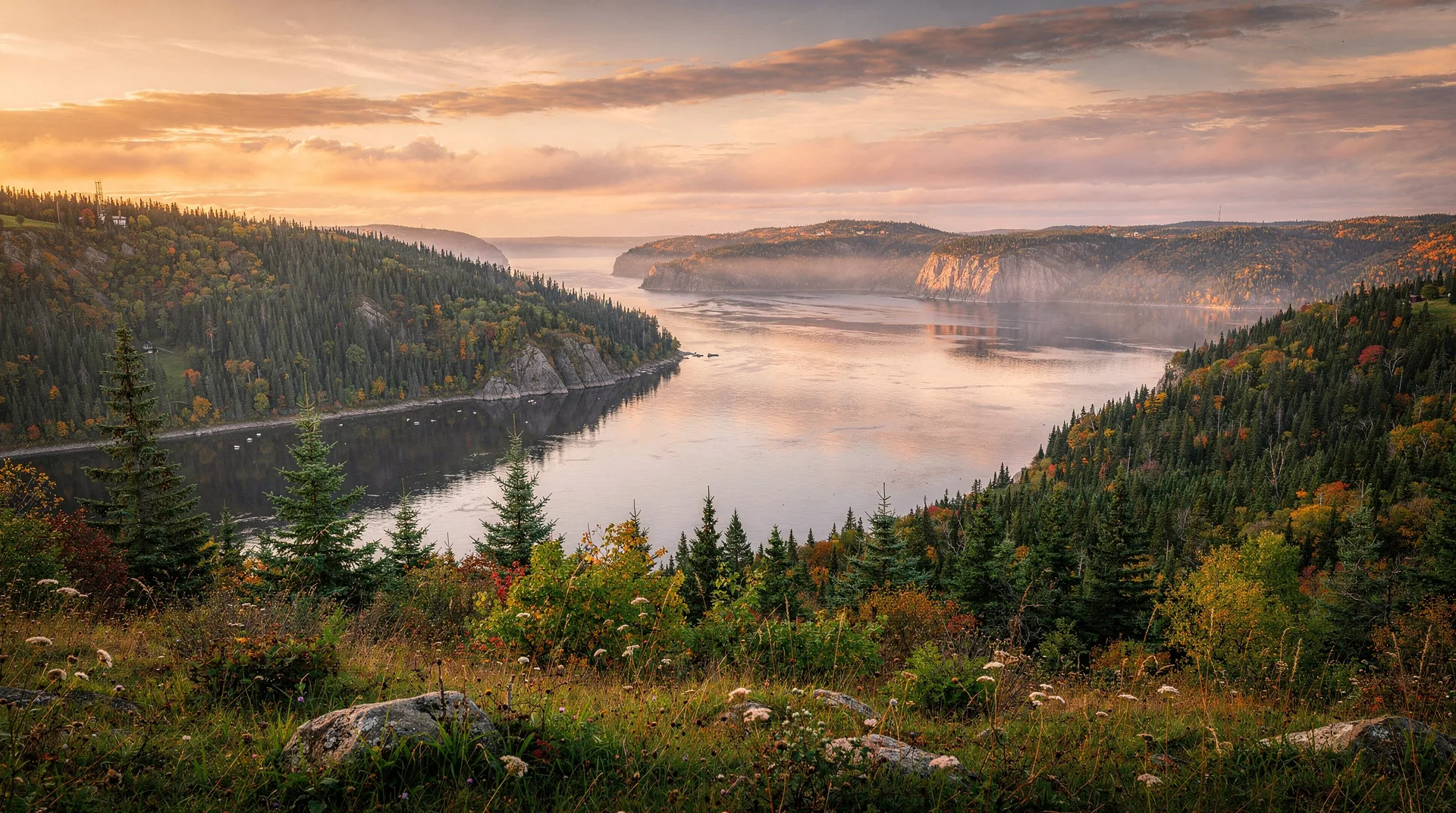
Best day trips from Quebec City
What are the best day trips from Quebec City?
The top day trips from Quebec City are Montmorency Falls (15 minutes east), Île d'Orléans (20 minutes east for a 67-km island circuit), Charlevoix (1–2 hours east for whale watching and mountains), and Tadoussac (2.5 hours for the best whale watching in Quebec). All are reachable by car, and some by bus or tour.
Quebec City’s geography gives its day trips a particular generosity. Follow the St. Lawrence River east and, within 15 minutes, Montmorency Falls appears — 83 metres of water dropping into the river, taller than Niagara Falls though narrower. Continue east across the bridge and the Île d’Orléans begins: a 34-kilometre-long island of farms and orchards that has been cultivated since the 17th century. Push further into the Charlevoix region and the St. Lawrence gradually widens, the mountains close in on both banks, and the river becomes a whale feeding ground of extraordinary productivity. The furthest destination — Tadoussac, where the Saguenay fjord meets the St. Lawrence — is 200 km from Quebec City and entirely worth the 2.5-hour drive.
A rental car greatly expands the possibilities; Montmorency Falls and Île d’Orléans are accessible by public bus, but Charlevoix and Tadoussac require a vehicle for practical exploration.
| At a glance | |
|---|---|
| Closest option | Montmorency Falls, around 15-20 minutes from Old Quebec |
| Furthest option | Tadoussac, around 2.5-3 hours, overnight recommended |
| Cost | Falls cable car and via ferrata are ticketed (around CAD 20-30); whale watching tours typically run CAD 70-110 |
| Best without a car | Montmorency Falls and Île d’Orléans by bus/taxi |
| Best time | June-October for whale watching; winter for the Montmorency ice cone; October for Charlevoix colour |
If you are still shaping the wider trip, the Quebec City destination page covers the city itself, and the Quebec City tours roundup lists guided options that pair well with the excursions below.
Day trip 1: Montmorency Falls
Distance from Quebec City: 12 km | Drive time: 15–20 minutes | Recommended time: 2–4 hours
The first and most essential day trip from Quebec City, Montmorency Falls is higher than Niagara (83 m versus 57 m) and arguably more dramatic in winter. The Parc de la Chute-Montmorency on the north shore of the St. Lawrence east of the city provides multiple ways to experience the falls.
Summer: The cable car ascends from the base to the top of the falls in 3 minutes. A suspension bridge crosses directly above the falls crest — looking down from the centre of the bridge while the water plunges past is a reliable test of acrophobia. A via ferrata route equipped with fixed iron rungs and safety cables runs down the cliff face beside the falls for those seeking a more physical encounter. The panoramic staircase (487 steps) descends from the top to the base of the falls. The Manoir Montmorency restaurant at the top is the most scenic dining location in the Quebec City area.
Book a Quebec City and Montmorency Falls full-day trip from MontrealWinter: The falls in winter are extraordinary. The spray from the falls builds a massive ice cone (the pain de sucre — sugar loaf) at the base, sometimes reaching 30 metres high. The ice changes colour through the day — white, pale blue, jade — and the frozen cliff faces around the falls create an ice architecture that is unique. The suspension bridge, the cable car, and the via ferrata (in crampons) all operate in winter, and the falls are illuminated at night.
Getting there: Bus 800 from Quebec City’s Old Town to Montmorency Falls runs regularly. By car, Highway 440 east to the Parc de la Chute-Montmorency exit. Parking is available at both the top and bottom of the falls.
Day trip 2: Île d’Orléans
Distance from Quebec City: 20 km | Drive time: 20–25 minutes | Recommended time: full day
Île d’Orléans is the island that Cartier called “l’île de Bacchus” in 1535 for the wild vines he found growing there. It has been farmed continuously since Champlain’s settlement at Quebec City, and the 67-kilometre ring road that circles it passes through six parishes of heritage farmhouses, sugar maple orchards, strawberry fields (the island’s famous fraises d’Île d’Orléans are sold from roadside stands from late June), and the kind of agricultural landscape that has been preserved, almost intact, from the 18th century.
Circuit of the island: Six villages in one day — Sainte-Pétronille (closest to Quebec City, with a fine view back toward the walled city and the falls), Saint-Laurent (the original ferry crossing and boat-building tradition), Saint-Jean (heritage manor houses), Saint-François (the island’s eastern tip, with the longest views up the St. Lawrence), Sainte-Famille (the oldest continuously operating church in North America, founded 1661), and Saint-Pierre (the main commercial village at the island entrance).
Food producers: The island’s agricultural producers are its main draw. The Chocolaterie de l’Île d’Orléans is a mandatory stop (dark chocolate, local berries, and the famous fondants). L’Érablière du Domaine Steinbach produces maple products year-round and explains the maple syrup process. Several wineries and cider producers operate on the island, most open for tasting May through October.
Cassis Monna et Filles: The most distinctive producer on the island — a black currant estate producing cassis liqueur, wine, vinegar, and confiture. The property is beautiful and the products excellent.
Cycling: The island is flat enough for comfortable cycling — the ring road has light traffic and the villages are within easy reach. Bicycle rentals are available at Sainte-Pétronille near the bridge. For more routes in the province, see the Quebec cycling routes guide.
For a deeper look at how the island compares with its neighbour downriver, the Île d’Orléans versus Île aux Coudres guide helps you choose between the two, and the Île d’Orléans is also a good place to taste local food if markets and producers are your priority.
Day trip 3: Côte de Beaupré and Sainte-Anne-de-Beaupré
Distance from Quebec City: 35 km | Drive time: 30–40 minutes | Recommended time: half day (can combine with Montmorency)
The Côte de Beaupré (the north shore of the St. Lawrence east of Quebec City, between Montmorency Falls and the beginning of the Charlevoix highlands) has two principal attractions:
Basilique Sainte-Anne-de-Beaupré: One of the most important pilgrimage churches in North America. The current basilica (1923, Gothic Revival) receives over a million visitors per year, drawn by the tradition of healing miracles attributed to Saint Anne that began in the 17th century. The interior is remarkable: 240 stained-glass windows, a ceiling mosaic, and the collection of crutches and braces left by those who claimed to have been healed. Whether or not the miraculous tradition is credited, the building is architecturally substantial.
Mont Sainte-Anne: 40 km east of Quebec City, the largest ski resort in eastern Quebec (65 runs, 625 m vertical drop). In summer, Mont Sainte-Anne operates a gondola for hiking access and one of the best mountain bike trail networks in Quebec.
Canyon Sainte-Anne: On the Saint-Anne River 5 km north of the coastal highway, a series of three waterfalls (the highest at 74 metres) in a narrow limestone canyon are accessible by suspension bridges from above. A different experience from Montmorency — more intimate, less crowded.
Day trip 4: Charlevoix
Distance from Quebec City: 100–150 km | Drive time: 1–1.5 hours | Recommended time: full day
The Charlevoix region begins where the Laurentian mountains meet the St. Lawrence: the river widens dramatically, the north shore rises steeply, and the light changes. Charlevoix is a UNESCO Biosphere Reserve — unusual for an area with human settlements and active agriculture — because of its exceptional biodiversity and the geological peculiarity of the Charlevoix meteor crater (one of the largest on earth, 350 million years old, 56 km in diameter, and still partially visible in the topography).
Baie-Saint-Paul: The art capital of Quebec. The town’s collection of galleries and the quality of its resident painters — attracted by the extraordinary light over the crater basin — has given it a reputation disproportionate to its size of 7,000. The Centre d’Art de Baie-Saint-Paul surveys the region’s artistic tradition from the first painters who came here in the 19th century. Several excellent restaurants make Baie-Saint-Paul a compelling lunch stop.
Whale watching from Les Éboulements or Saint-Irénée: The Charlevoix coast is within the beluga habitat and receives seasonal visits from fin whales and minke whales. Boat departures from Les Éboulements (50 km from Quebec City) operate in summer and offer a more intimate experience than the highly organised tours from Tadoussac.
Le Massif de Charlevoix: Quebec’s highest coastal ski mountain (770 m vertical drop, 53 runs), with the St. Lawrence River visible from the summit pistes. In summer, Le Massif operates the Train du Massif de Charlevoix — a scenic railway excursion from Quebec City’s Gare du Palais to Baie-Saint-Paul along the north shore of the St. Lawrence, with the river visible for much of the 2-hour journey.
The Charlevoix destination page and the four-day Charlevoix itinerary go further if one day turns out not to be enough.
La Malbaie: The resort town at the end of the Charlevoix circuit, where the Fairmont Le Manoir Richelieu sits on its cliff above the St. Lawrence — one of Canada’s most scenically positioned hotels, opened in 1899.
Browse all Quebec City area tours and day excursionsDay trip 5: Tadoussac and the Saguenay fjord
Distance from Quebec City: 200 km | Drive time: 2.5–3 hours | Recommended time: full day (or overnight strongly recommended)
Tadoussac is at the outer edge of comfortable day trip range from Quebec City, but the journey and the destination justify the distance. The drive along Highway 138 on the north shore of the St. Lawrence passes through the full Charlevoix landscape before reaching the Baie-Sainte-Catherine, where the free government ferry crosses the mouth of the Saguenay (15 minutes) to Tadoussac.
At the confluence of the Saguenay and the St. Lawrence, cold nutrient-rich water upwells continuously, creating one of the world’s most productive whale feeding grounds. Blue whales (the largest animals on earth), fin whales, humpback whales, minke whales, and the resident population of beluga whales all feed here from June through October. Boat tours from Tadoussac are among the most rewarding wildlife experiences in eastern Canada.
Beyond whale watching, the Saguenay fjord is visually dramatic: 100 km of steep basalt walls rising 200–300 metres from dark water, accessible from Tadoussac by boat or from the cliff-top trails of the Parc National du Fjord-du-Saguenay.
For more on the boats, the species and the seasons, the guide to the Quebec whale season and the kayaking on the fjord guide are the natural next reads.
The case for an overnight stay: Two hours from Quebec City and two hours back leave limited time in Tadoussac for justice. Staying overnight gives you two whale watching opportunities (morning and afternoon tours), a kayak excursion in the fjord, and the unhurried pleasure of the village at dusk when the day visitors have departed.
Day trip 6: Grosse Île and the Irish Memorial
Distance from Quebec City: 50 km by car + ferry | Drive time: 45 minutes to the Berthier-sur-Mer ferry pier | Recommended time: full day
Grosse Île is a small island in the St. Lawrence that served as Canada’s primary quarantine station for immigrants arriving by sea from 1832 to 1937. Over 5,000 Irish immigrants died here during the 1847 typhus epidemic — the island became an unintentional mass grave for those who had survived the Great Famine only to perish in the St. Lawrence on the last stage of their journey.
Parks Canada operates the island as a national historic site, accessible by boat from Berthier-sur-Mer (south shore) or Montmagny. The site is sobering and genuinely moving: the Celtic cross memorial erected by the Ancient Order of Hibernians in 1909, the preserved hospital buildings, and the mass graves make it one of the most significant Irish diaspora sites in North America.
The boat tour also passes several other islands in the Montmagny archipelago that serve as an important stopover for snow geese during the spring migration — over 350,000 geese use the area in late April, creating one of the great bird spectacles of the St. Lawrence Valley.
Practical tips for Quebec City day trips
Car rental: Available at Quebec City Jean Lesage Airport and from downtown agencies. Book well in advance in summer.
Public transit options: The Réseau de transport de la Capitale (RTC) bus 800 serves Montmorency Falls. Intercar buses serve destinations along the Charlevoix coast and as far as Tadoussac, though less frequently than self-driving allows.
Weather: The Quebec City area is subject to rapid weather changes, particularly along the St. Lawrence. Bring a waterproof layer even in summer for whale watching excursions.
Combining day trips: Montmorency Falls and Île d’Orléans are natural partners — both are east of the city and together make a comfortable full day. Charlevoix and Tadoussac can be combined as an overnight trip rather than a day trip.
Charlevoix or Tadoussac: which to prioritise
Travellers with only one long day free from Quebec City often ask whether to spend it on Charlevoix or push further to Tadoussac. Charlevoix rewards a single day well: Baie-Saint-Paul’s galleries, a lunch stop, and a coastal drive fit comfortably into 8-10 hours round trip. Tadoussac technically fits into a very long single day, but the whale watching itself is only 2-3 hours of a 5-6 hour round-trip drive, so the experience is disproportionately rushed compared to staying overnight.
For a first Quebec City visit with limited time, Charlevoix alone is the better single-day choice; those specifically prioritising whales should budget an overnight in Tadoussac rather than trying to compress it. Comparing the two regions in more depth — scenery, driving time, and what each does better — is covered in the Charlevoix versus Gaspésie guide, useful if you are deciding how far east to push beyond Quebec City.
Pairing a day trip with a Quebec City to Montreal itinerary
Travellers routing between Quebec City and Montreal can fold some of these day trips into the journey rather than treating them as separate round trips from a fixed base. The Montreal to Quebec City guide covers the drive and train options along the St. Lawrence corridor, and a stop at Île d’Orléans or Montmorency Falls works naturally as a detour on the way out of the city rather than requiring a dedicated return trip. Those unsure whether to base themselves in Quebec City or Montreal for day trips generally should also check the Quebec City versus Montreal comparison before deciding where to spend the extra nights.
Frequently asked questions about Best day trips from Quebec City
Is Montmorency Falls worth visiting even if I’ve been to Niagara? Yes — the character is different. Montmorency is narrower and more intimate; you can walk within metres of the plunging water and cross directly above it on the suspension bridge. In winter, the ice formations are extraordinary in a way that Niagara’s wider falls do not produce.
Can I visit Île d’Orléans without a car? The island is accessible from Quebec City by taxi or rideshare. Once on the island, cycling (rentals available) is the best way to explore — the ring road is 67 km but manageable as a full cycling day with several stops.
When is the best time for whale watching from Tadoussac? Late June to early October. August is peak season for species diversity, with blue whales most likely in August and September. Belugas are present year-round but boat tours operate only May through October.
Is Charlevoix worth the drive from Quebec City? For a full day, yes — Baie-Saint-Paul alone (the galleries, the restaurants, the crater basin view) justifies 1.5 hours of driving. Combining Charlevoix with Tadoussac makes a very full 2-day trip.
Is it better to see whales from Charlevoix or Tadoussac? Tadoussac has the more concentrated and reliable sightings because of the Saguenay-St. Lawrence confluence, but Charlevoix’s departures from Les Éboulements are closer to Quebec City and still productive, especially August through September.
Do I need to book Montmorency Falls tickets ahead? Walking the park and viewing the falls is free; the cable car, via ferrata and zipline are ticketed and worth booking online in advance during summer weekends and the winter ice season.