Frank Slide and Crowsnest Pass: history, hikes and how to visit
What happened at Frank Slide?
On April 29, 1903, approximately 82 million tonnes of limestone broke away from the summit of Turtle Mountain and buried the mining town of Frank, Alberta, in 100 seconds. An estimated 90 people were killed, making it Canada's deadliest rockslide. The Frank Slide Interpretive Centre tells this story on the edge of the still-visible debris field.
The Crowsnest Pass is a mountain gateway unlike any other in Alberta — a place where industrial history, geological drama, and mountain beauty collide in a corridor that most travellers to the Rockies completely overlook. The mountains here are lower and more intimate than the giants of Banff and Jasper; the communities smaller and less polished. But the story of the Crowsnest Pass — coal mining, labour history, prohibition, and the catastrophic morning of April 29, 1903 — is one of the most compelling in western Canada.
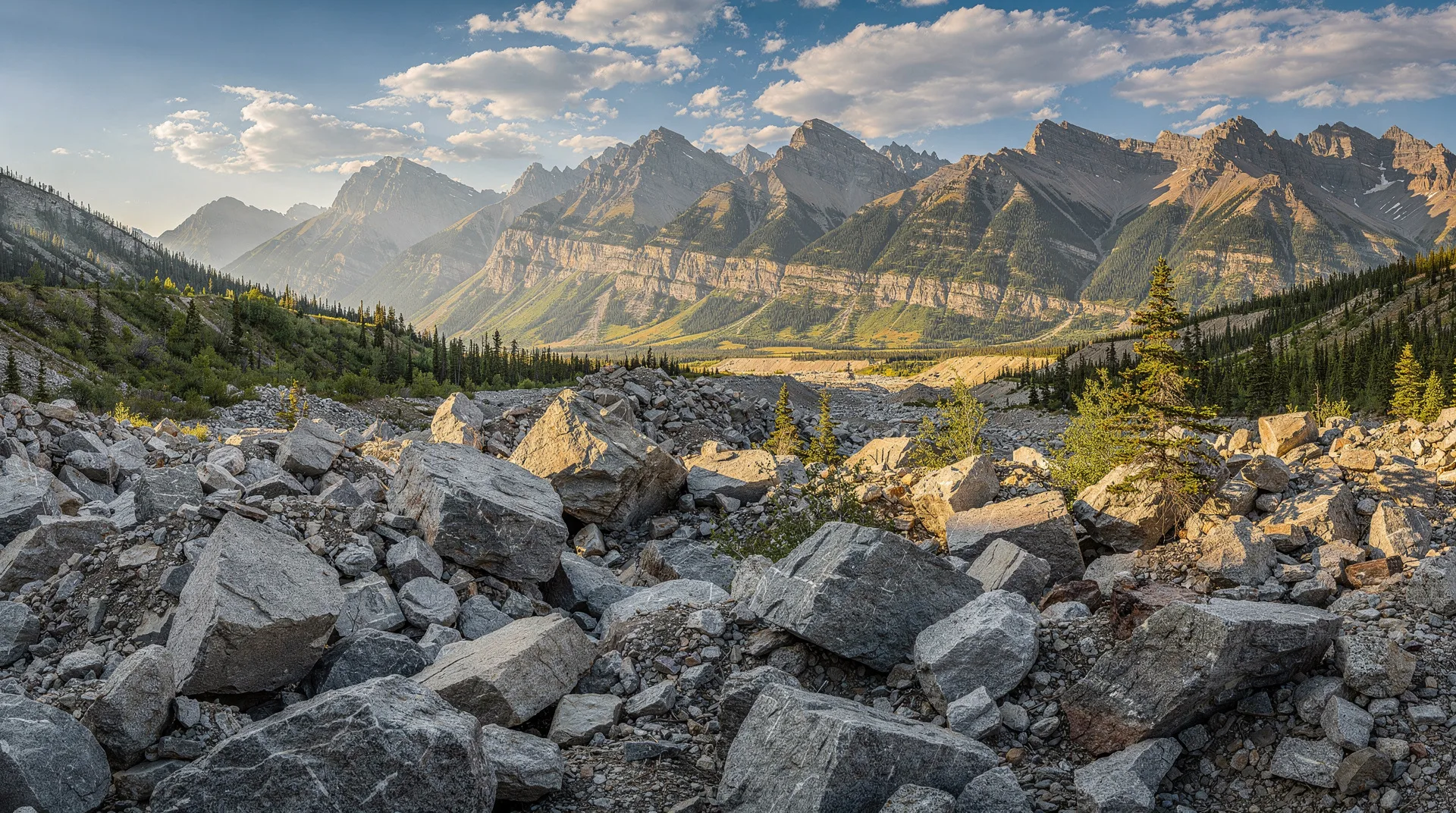
Frank Slide dominates any visit to the pass. The grey limestone debris field that buried the mining town of Frank is still visible as an alien landscape of jumbled boulders across the entire valley floor — an unchanged scene from the morning the mountain fell. Standing at the interpretive centre overlooking this wreckage, it is impossible not to feel the weight of those 90 seconds in 1903.
At a glance
| Where | Crowsnest Pass, southern Alberta, near the BC border |
| Cost | Interpretive centre admission a modest per-person fee; free to view the debris field from the highway |
| Time needed | Around 1.5-2 hours for the centre, half a day with a debris field walk |
| Getting there | Around 2.5 hours from Calgary via Highway 3 |
| Best time | Summer for full programming and guided debris walks; year-round access with winter tires |
The Frank Slide disaster
Turtle Mountain had been considered unstable by Blackfoot people for generations — the name they gave it reflected the characteristic of a turtle withdrawing into its shell, suggestive of instability. When coal mining began in the Frank area in 1901, some miners reported hearing ominous cracking sounds deep in the mountain. Their concerns were not acted upon.
At 4:10am on April 29, 1903, approximately 82 million tonnes of limestone — a section of Turtle Mountain approximately 425 metres wide, 900 metres tall, and 150 metres thick — broke away and descended onto the sleeping town of Frank in what is estimated to have been 100 seconds of geological catastrophe. The slide moved at speeds estimated at 100 km/h and buried 2 kilometres of the valley floor to depths of up to 30 metres.
Death toll: Approximately 90 people died, though the exact number is uncertain as the population of Frank was not precisely documented. Bodies remain under the debris field to this day — the scale and depth of the rockslide made recovery impossible for most victims.
Survivors: Seventeen coal miners trapped in the mine survived by digging through a blocked exit. Some residents of the residential areas of Frank on the unflooded side of the railway also survived. A remarkable infant — Frankie Slide, named for the event — was found alive in the debris, having been thrown clear of the houses by the slide’s shockwave.
Frank Slide Interpretive Centre
The Frank Slide Interpretive Centre is built on the edge of the debris field with dramatic views across the boulder-strewn valley floor. The building is thoughtfully designed to frame views of Turtle Mountain and the slide zone.
Inside, the interpretive centre presents the history of the slide through oral history recordings, photographs, geological models, and reconstructed scenes from pre-slide Frank. The geology section explains what made Turtle Mountain so vulnerable — the angle of rock strata, water infiltration, the undermining effect of coal mining at the mountain’s base, and the freeze-thaw cycles of April.
The Indigenous section of the interpretation is important context — the Blackfoot understanding of the mountain’s instability and the dismissal of that knowledge by colonial settlement and industrial development is presented honestly and thoughtfully.
Outdoor viewing deck: The centre’s deck overlooks the boulder field directly. The scale of the debris is nearly impossible to comprehend — boulders the size of houses scattered across the entire valley floor. In summer, interpretive staff lead walks onto the debris field itself.
Debris field walks: Guided walks onto the Frank Slide are offered in summer and provide a surreal experience of walking through a landscape unchanged since 1903. The sense of scale walking among the boulders is unlike any museum exhibit.
The Crowsnest Pass communities
The Crowsnest Pass is home to five communities that amalgamated into a single municipality in 1979: Frank, Blairmore, Coleman, Hillcrest, and Bellevue. Each has its own character and history, with the region’s coal mining heritage visible in preserved mine buildings, miners’ housing, and memorial sites.
Blairmore is the commercial centre of the pass with shops, restaurants, and services. The historic Cosmopolitan Hotel dates from the early coal boom years and still operates.
Coleman has a charming heritage streetscape and the Crowsnest Museum (the primary local museum covering the region’s coal mining, prohibition, and labour history).
Hillcrest is the site of Canada’s worst mine disaster — the Hillcrest Mine Explosion of 1914, which killed 189 miners. A memorial cemetery preserves the graves of many victims. This is a sobering and important site that receives far fewer visitors than it deserves.
Bellevue Underground Mine offers guided tours of an actual coal mine — visitors don hard hats and descend into the historic Bellevue Mine for an immersive interpretation of coal miners’ working conditions. This is one of the best heritage tourism experiences in southern Alberta.
Hiking in the Crowsnest Pass
The mountains around the Crowsnest Pass offer excellent hiking with far fewer people than the national parks to the north.
Crowsnest Mountain (2,785 m) — the iconic flat-topped peak visible for kilometres in all directions — is a demanding but rewarding scramble for experienced hikers. The standard route gains approximately 1,100 metres in 8 kilometres return. The summit plateau is exposed and the views are exceptional.
Seven Sisters peaks above Coleman provide a challenging ridge traverse for experienced mountaineers.
Allison Creek area south of Coleman has maintained hiking trails through coniferous forest with good wildflower displays in summer.
Lundbreck Falls — 30 kilometres east of the pass — is a short (10-minute) walk to impressive falls on the Crowsnest River, excellent for families.
Driving the Crowsnest Highway
Highway 3 (the Crowsnest Highway) cuts through the Crowsnest Pass connecting Lethbridge in Alberta with the Okanagan Valley and Vancouver in British Columbia. The Alberta section east of the BC border passes through the dramatic geology of the pass, with Turtle Mountain and the Frank Slide debris visible for a considerable distance before reaching the interpretive centre.
Route from Calgary: The most direct route from Calgary is via Highway 2 south to Fort Macleod, then west on Highway 3 through Pincher Creek to the Crowsnest Pass — approximately 2.5 hours.
Combining with Waterton: The Crowsnest Pass is 80 kilometres west of Waterton Lakes National Park via Secondary Highway 774 and Highway 3. This makes an excellent circuit: Calgary → Waterton → Crowsnest Pass → return to Calgary.
Continuing into BC: The Crowsnest Highway continues through the spectacular BC section of the Crowsnest Pass to Sparwood (a large open-pit coal mine with a massive truck on display) and then northwest through the Elk Valley to connect with the Okanagan. This makes the Crowsnest a natural link on a BC road trip.
Crowsnest Pass vs Waterton Lakes: which to prioritise
Many southern Alberta itineraries have room for one, not both, if time is tight. Here’s how they compare.
| Crowsnest Pass / Frank Slide | Waterton Lakes | |
|---|---|---|
| Focus | History, geology, coal-mining heritage | Mountain scenery, hiking, lake |
| Time needed | Half a day | 1-2 full days |
| Cost | Modest interpretive centre admission | Parks Canada park pass required |
| Crowds | Light, year-round | Busy in summer |
If you only have one day, Frank Slide is the faster stop; with two or more, combine both via the loop described above through the Waterton Lakes National Park guide.
Extending the trip
The Crowsnest Pass slots naturally into a longer southern Alberta or BC road trip. From Calgary, the fastest approach is via the driving Calgary to Banff corridor in reverse, or directly from Calgary south on Highway 2. On the BC side, the Crowsnest Highway continues toward the Okanagan Valley — worth considering if wine country is also on the itinerary; see the Okanagan wine guide for that leg.
Planning a day around the pass
The easiest way to do the corridor justice is to treat it as a slow day rather than a checklist. Start at the Frank Slide Interpretive Centre while your attention is fresh, because the story of 1903 gives everything else in the valley its meaning. Once you have seen the debris field from the viewing deck, the rest of the day can follow your interests: underground at Bellevue for the mining story, a quiet hour at the Hillcrest memorial, or a walk in the forest above Coleman for some air after a heavy morning.
Travellers who like to understand a landscape before they photograph it tend to enjoy the pass most. Read a little about the geology beforehand, and the shape of Turtle Mountain, the tilted strata and the scar left on its face will make far more sense when you are standing below them. Families with older children often find the oral histories and reconstructed scenes absorbing, while younger children usually do better with the open-air debris field and the chance to scramble safely among the boulders on the marked paths.
If you are building a larger southern Alberta trip, the pass pairs well with Waterton for scenery and with Cypress Hills or Writing-on-Stone for a very different, prairie-and-sandstone side of the province. For another chapter of Indigenous history on the plains, Head-Smashed-In Buffalo Jump adds essential context, and the wider Indigenous tourism overview helps you choose experiences led by Indigenous hosts.
Getting around and staying overnight
A car is the practical way to see the pass, since the communities are spread along the highway and public transport is limited. If you are flying into Alberta, read the Canada car rental guide before you book, and look at the Crowsnest Highway guide for the road itself, including how it feels to drive in different seasons.
Because accommodation in the pass is modest, many visitors choose to base themselves elsewhere and visit for the day. Calgary works for a long round trip, while those continuing west often overnight in Fernie or Cranbrook on the BC side. Anyone planning to camp should check the Canadian camping rules first, as regulations differ between provincial land, parks and private campgrounds.
Etiquette at a disaster site
Frank Slide is both a tourist attraction and a burial ground. Most of the people killed in 1903 were never recovered, so the debris field is, in a real sense, a grave. Stay on marked paths, keep voices low near the memorial areas, and resist the urge to move or stack rocks. The same respect applies at Hillcrest, where families still come to remember the miners lost in 1914. Treating both places quietly and unhurriedly is the best way to honour the history they hold.
For wider context on the mountains these valleys belong to, the Canadian Rockies overview shows how the pass fits into the larger range, and the overall Alberta destination page lists more places to build into your route.
Practical visitor information
Frank Slide Interpretive Centre hours: Open year-round. Summer (Victoria Day to Labour Day): daily 9am–6pm. Shoulder season: reduced hours. Winter: reduced days and hours. Check the Alberta Culture website.
Admission: Adult and family fees apply; seniors and youth rates available.
Best time to visit: Summer offers the fullest programming and guided debris field walks. The pass is accessible year-round but mountain roads can be icy in winter; winter tires are advisable.
Services: Blairmore has a grocery store, gas stations, and several restaurants. Coleman has similar services. No major hotels; the Crowsnest Pass has a handful of motels and bed-and-breakfast properties.
Book guided southern Alberta heritage and mountain tours from Calgary Book Canadian Rockies mountain and heritage toursFrequently asked questions about Frank Slide and Crowsnest Pass
How long should I spend at Frank Slide?
Around 1.5-2 hours covers the interpretive centre thoroughly. Add another hour or two in summer if you want to join a guided walk onto the debris field itself.
Can I visit Frank Slide as a day trip from Calgary?
Yes — it’s around 2.5 hours each way via Highway 3, so a day trip is feasible, though combining it with Waterton Lakes or an overnight in the Crowsnest Pass communities makes for a less rushed visit.