Elk Island National Park: day trip from Edmonton guide
Is Elk Island National Park worth visiting?
Absolutely. Elk Island is Canada's most accessible wildlife reserve — a 40-minute drive from Edmonton with virtually guaranteed bison sightings, good hiking, and one of the best dark sky stargazing experiences near any major Canadian city. A Parks Canada Discovery Pass is required.
Elk Island National Park, in Alberta, is a genuine surprise for travellers who expect Canada’s national parks to be remote and difficult to access. Just 40 kilometres east of Edmonton on the Yellowhead Highway, Elk Island is a 194-square-kilometre fenced wildlife reserve that protects the highest density of large mammals in Canada — and one of the most important conservation success stories in North American wildlife history.
| Details | |
|---|---|
| Where | Highway 16, around 40 km east of Edmonton, Alberta |
| Cost | Parks Canada Discovery Pass required (day pass or annual pass covering all national parks) |
| Time needed | Half a day for a drive-through and short hike; a full day with the beach, canoeing or dark sky evening |
| Getting there | Self-drive only — around 35-40 minutes from downtown Edmonton, no public transit |
| Best time | Year-round; June-September for swimming and canoeing, winter for photogenic snow and dark skies |
The park’s bison herds are its most famous feature. Both plains bison and wood bison (the world’s largest land animal) live within the park’s enclosure, and driving through either section of the park virtually guarantees sightings at close range. But Elk Island is also an excellent hiking park with a network of trails through boreal forest and aspen parkland, a dark sky preserve that ranks among the best near any major Canadian city, and a wetland and lake ecosystem that supports extraordinary bird diversity.
For travellers based in Edmonton — or anyone passing through central Alberta — Elk Island is a half-day or full-day excursion that delivers a wildlife experience comparable to parks that take hours to reach.
The conservation story: saving bison from extinction
Bison once roamed North America in herds so vast that early European travellers struggled to describe their scale — estimates of 30–60 million animals are commonly cited. By 1889, fewer than 1,000 remained on the entire continent, decimated by commercial hunting (primarily for hides), systematic military campaigns to deprive Indigenous peoples of their primary food source, and conversion of prairie habitat to agriculture.
Elk Island National Park was established in 1906 specifically to protect a remnant herd of plains bison. The conservation work done at Elk Island has had global consequences: the park’s bison herds have served as breeding stock for reintroduction programs across North America and beyond. Bison now roam again in Yellowstone, Wood Buffalo National Park (the largest national park in Canada), the Grasslands in Saskatchewan, and many other locations — and many of those animals trace their lineage to the Elk Island herds.
The park also played a critical role in saving wood bison. In 1965, a herd of wood bison — believed to be a pure subspecies — was discovered in a remote section of Wood Buffalo National Park. Animals from this herd were brought to Elk Island for protection, and the park’s wood bison section south of Highway 16 now holds an important component of the global wood bison population.
Plains bison vs wood bison
Visitors often ask about the difference between the two bison subspecies in the park:
Plains bison (Bison bison bison) — the classic buffalo of the Great Plains — are slightly smaller and have a more pronounced shoulder hump relative to their body. They live north of Highway 16 in the main section of the park around Astotin Lake.
Wood bison (Bison bison athabascae) — the world’s largest land animals — are heavier and taller, with a more massive head and horns and a coat that appears shaggier. They live south of Highway 16 in a separate enclosed section of the park.
Both subspecies are frequently visible from the road. Wood bison in particular are remarkably close to the roadway in many sections of the south part of the park.
Wildlife in Elk Island
Beyond bison, Elk Island supports a remarkable community of wildlife:
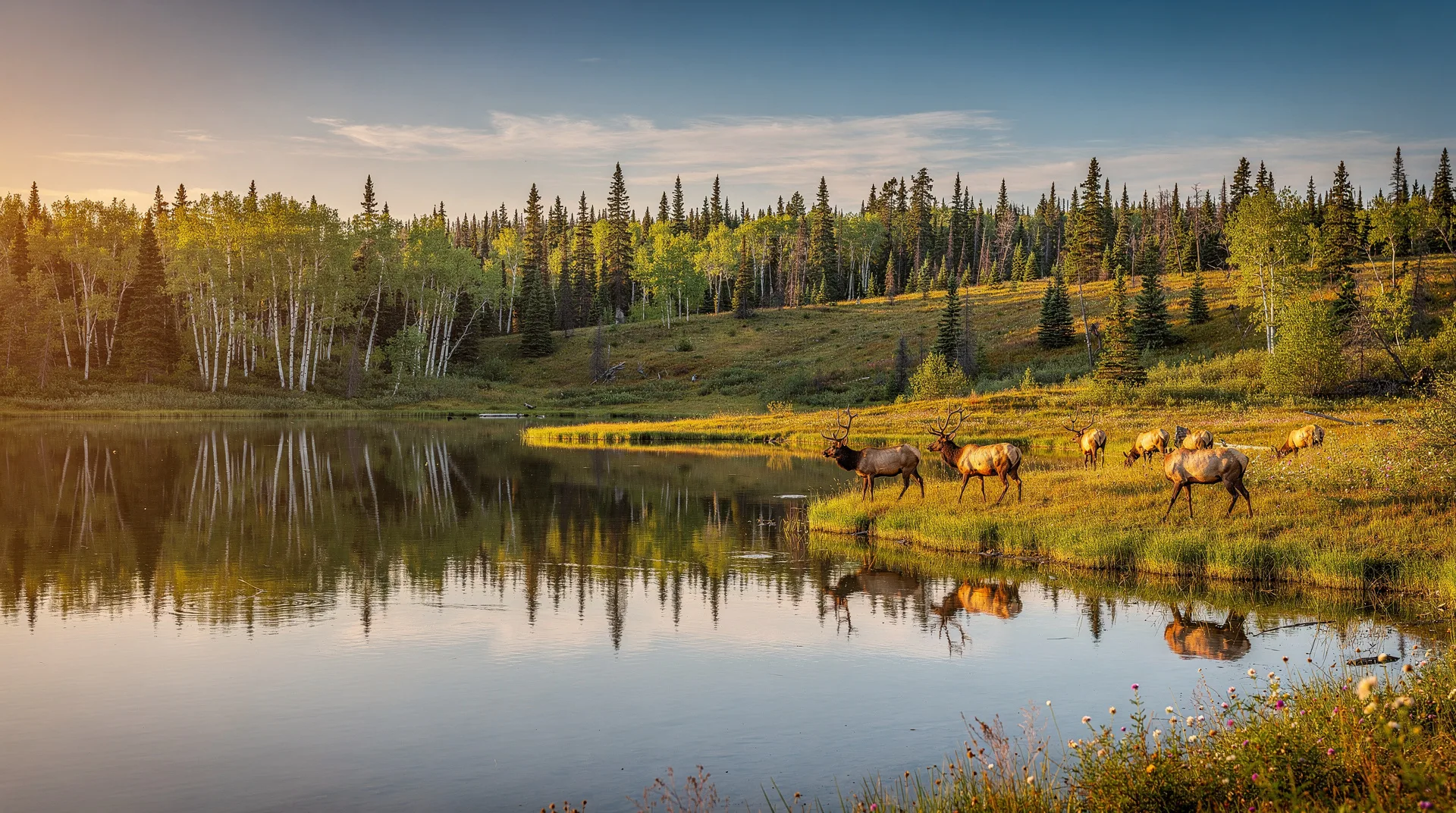
Elk (wapiti): Present throughout the park, particularly active at dawn and dusk. Bulls in autumn carry enormous antlers and their bugling calls are one of the great wildlife sounds of the Canadian boreal.
Moose: Large and reclusive, but the wetlands and aspen forests of Elk Island are excellent moose habitat. Early morning along the shores of Astotin Lake offers the best chances.
White-tailed deer and mule deer: Both species are present; white-tailed deer are more commonly seen.
Coyotes: Active year-round and frequently seen, particularly in winter when their tracks in snow reveal just how widespread they are.
Beaver: The wetland areas of the park have extensive beaver activity; dams and lodges are visible from many trailheads.
Birds: Elk Island has recorded over 250 bird species. The park is a significant stopover point for waterfowl during spring and fall migration. Trumpeter swans — a species brought back from near-extinction — breed at the park. Great grey owls are a winter specialty.
Hiking at Elk Island National Park
The park has 13 trails totalling over 100 kilometres, ranging from short nature walks to multi-kilometre loops through boreal forest and aspen parkland.
Astotin Lake Trail (9 km loop) — the main lake circuit around Astotin Lake, passing through open meadows, aspen stands, and wetland edges. Bison and elk are frequently encountered on this trail. The views over the lake are pleasant, and the trail can be divided into shorter sections.
Tawayik Lake Trail (3.8 km loop) — a shorter loop from the Astotin area through boreal forest to a smaller, quieter lake. Good birding.
Wood Bison Trails — the south section of the park (accessed via a separate entrance south of Highway 16) has three shorter trail loops totalling approximately 6 km. These trails pass through the wood bison range and are particularly rewarding for wildlife observation.
Hayburger Trail (10 km) — a longer trail through the park’s northern section that is excellent for spring wildflowers and autumn foliage.
Dark sky stargazing
Elk Island is a designated dark sky preserve — Parks Canada manages the park’s lighting to minimise light pollution. At 40 kilometres from Edmonton, the park is far enough from the city’s glow to provide excellent dark sky conditions on clear, moonless nights.
The Astotin Lake area has designated stargazing areas. In summer, Parks Canada operates organized dark sky events with telescopes, presentations, and interpretation. Check the Parks Canada event calendar for scheduled programs.
If dark skies are a highlight of your trip, you may also enjoy the dark sky guide for Saskatchewan, and photographers will find useful advice in the aurora photography guide. Dress in layers and bring a red-light torch, which preserves your night vision.
The Milky Way is clearly visible on clear nights, and Elk Island is one of the best locations for aurora borealis (northern lights) viewing within reasonable reach of Edmonton. Aurora viewing is best from late August through March.
Swimming and recreation at Astotin Lake
Astotin Lake has a supervised beach with swimming permitted in summer (when a lifeguard is on duty). The water is clean and the beach is sandy, making it a genuine lake swimming experience. Picnic facilities and a snack bar operate in summer at the beach area.
Canoe and kayak rentals are available at Astotin Lake in summer — paddling on the lake is a wonderful way to see waterfowl and potentially observe bison and elk from the water.
A golf course operates within the park (Elk Island Golf Course) — an unexpected but pleasant 9-hole facility.
Planning your day around the wildlife
Wildlife viewing rewards patience more than speed. Drive slowly, pull over only where it is safe, and let the animals come into view rather than chasing them. Our Canadian wildlife guide explains how to read animal behaviour, and the wildlife safety guide covers the distances and habits that keep both you and the animals safe. If Elk Island whets your appetite, wildlife watching in Alberta lists more places to continue.
Birders will find the park especially rewarding in migration season. The birding in Canada guide gives general tips on what to bring and how to approach the shoreline and wetland edges without disturbing nesting birds.
For a longer Alberta trip, many visitors treat Elk Island as a gentle first stop before heading west. It fits naturally at the start of a Canadian Rockies itinerary or a Calgary to Jasper road trip, giving you a wildlife warm-up before the mountains. If you would rather leave the driving to someone else on the rest of your trip, you can compare guided tours across Canada before you book. If you are weighing the big mountain parks afterwards, Jasper National Park and the Banff vs Jasper comparison will help you decide where to spend your time.
Getting there and practical details
Address: Highway 16 (Yellowhead Highway), 40 km east of Edmonton
Drive time: Approximately 35–40 minutes from downtown Edmonton
Parks Canada Discovery Pass: Required for all national park visits (see our Discovery Pass guide for how it works). Purchase at the park gate or in advance at the Parks Canada website.
Park hours: The park is open year-round; the visitor centre and facilities operate seasonally (Victoria Day through Labour Day for full service; reduced hours in shoulder seasons).
Gas and services: The park has no fuel. Fill up in Edmonton before leaving.
Combining trips: Elk Island pairs naturally with the Ukrainian Cultural Heritage Village, which sits immediately adjacent to the park’s eastern boundary. Combining these two creates an excellent full-day east-Edmonton excursion.
Book Alberta wildlife and national park toursElk Island in winter
Winter is arguably Elk Island’s most photogenic season. The bison herds are highly visible against snow, their steam-breath visible in cold air. Elk stand in snow-draped aspen groves. Coyote tracks cross the frozen lake surface.
Parks Canada maintains groomed cross-country ski trails at Elk Island in winter, and the park is one of the best locations near Edmonton for wildlife observation in snow. Dress warmly — temperatures can drop to −30°C or colder in January — and the experience is remarkable. If you are new to the sport, the cross-country skiing guide explains what to wear and how to get started, and the Canada in winter guide helps you plan the rest of a cold-season trip.
Comparing Elk Island to other Alberta wildlife stops
Elk Island is often weighed against other Alberta wildlife and park options, particularly for travellers deciding how to split limited time between Edmonton and Calgary.
| Park | Distance from a major city | Main draw | Best for |
|---|---|---|---|
| Elk Island | 40 min from Edmonton | Guaranteed bison sightings, dark sky | A quick, near-certain wildlife day trip |
| Banff National Park | 90 min from Calgary | Mountain scenery, glacial lakes | Landscape-first travellers with more time |
| Kananaskis | Under 90 min from Calgary | Rockies scenery with fewer crowds than Banff | Hiking without Banff’s traffic |
| Wood Buffalo National Park | Multi-day journey, far north | The largest wood bison range in Canada | Dedicated wildlife specialists only |
For a traveller based in Edmonton with a single free day, Elk Island is the clear choice — nothing else in Alberta offers comparable wildlife odds this close to a major airport.
Best times to see bison up close
Bison are visible year-round, but behaviour and visibility shift with the season. Spring (May-June) brings calving season — reddish-coloured calves are common sights near the herds, and animals are generally more active and mobile across the range. Summer sees bison spending more time in shaded aspen groves during the heat of the day, so early morning and evening drives produce better sightings than midday. Autumn (September-October) is the rut, when bulls are more vocal and visibly agitated — give them extra space from the car. Winter sightings are often the most striking, with bison silhouetted against snow and visible breath in cold air, though driving conditions require winter tires and caution.
Frequently asked questions about Elk Island National Park
Do I need a park pass to visit Elk Island National Park?
Yes. Elk Island is a Parks Canada national park, so a Discovery Pass or day pass is required for entry, purchased at the gate or in advance through the Parks Canada website. There is no free-entry exception for day trips.
Is Elk Island better than Banff for seeing wildlife?
For guaranteed close-range bison and elk sightings on a short trip, Elk Island is more reliable — the fenced reserve concentrates animals near the roads. Banff has more wildlife diversity and dramatically bigger scenery, but sightings are less predictable and it requires a longer drive from Edmonton or a Calgary base instead.