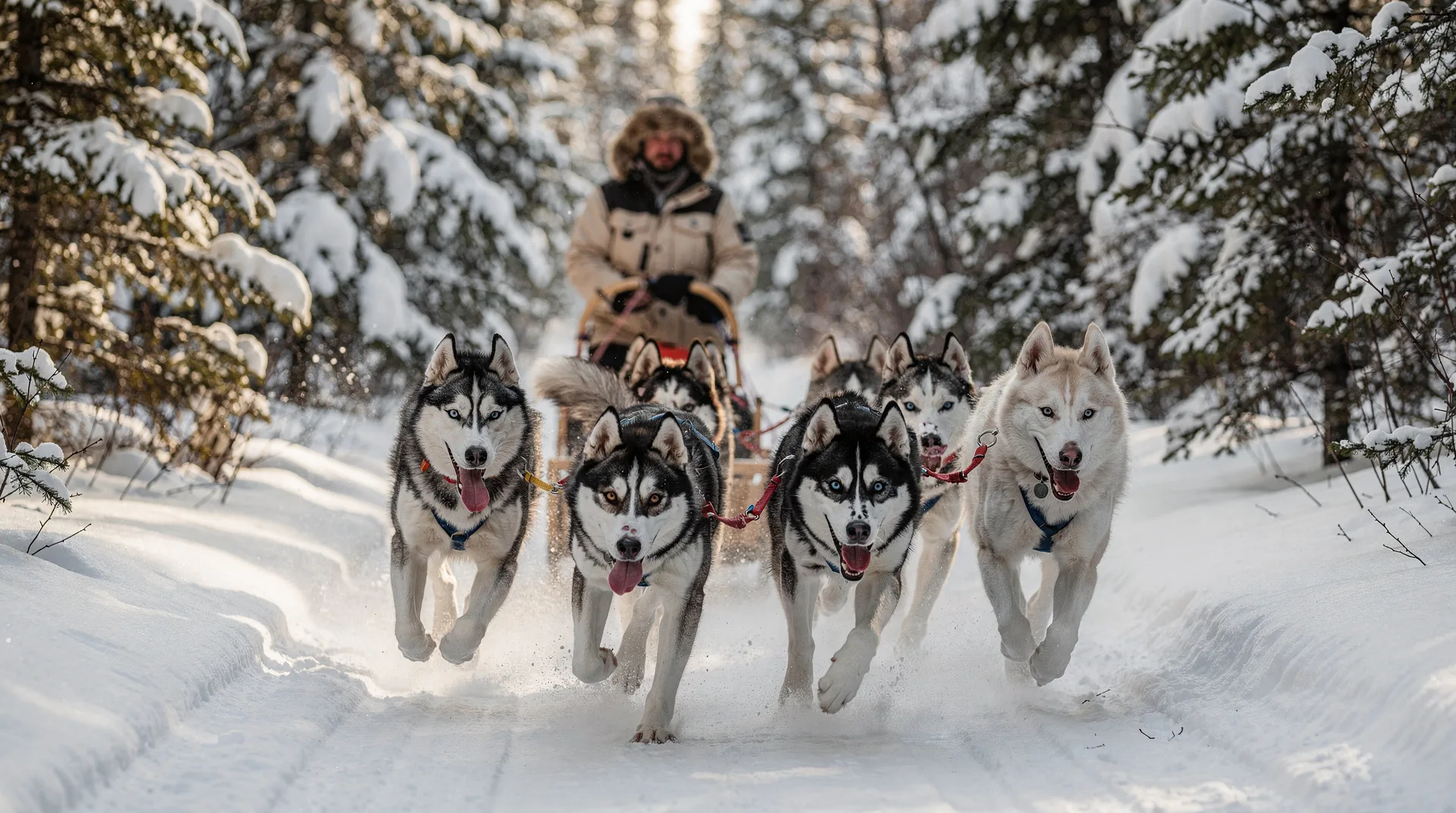
Dog Sledding in Yukon: Tours, Kennels & Multi-Day Trips
Where is the best place to go dog sledding in Yukon?
Whitehorse is the primary hub for dog sledding in the Yukon, with multiple kennels offering everything from 30-minute introductory runs to multi-day wilderness lodge stays. Haines Junction and Kluane country also has operators. The Yukon Quest race in February draws mushers from across North America, making February the peak month for the sport.
| At a glance | |
|---|---|
| Where | Whitehorse and surrounding wilderness; also Haines Junction/Kluane country |
| Cost | Around CAD 110–180 for a 30–60 min intro; CAD 2,500–6,000+ for multi-day expeditions |
| Time needed | 30 minutes to 10 days depending on format |
| Getting there | Fly into Whitehorse (via Vancouver or Calgary); Haines Junction is a 2-hour drive west |
| Best time | Mid-November through March; February coincides with the Yukon Quest |
Dog sledding in the Yukon is not a tourist attraction with a northern costume — it is a genuine working practice with deep roots in the territory’s transportation history and a thriving contemporary sport culture. The Yukon Quest International Sled Dog Race — run annually between Whitehorse and Fairbanks, Alaska — is widely considered the most demanding sled dog race in the world, covering 1,000 miles of trail through some of the most severe subarctic conditions on earth. The mushers who train in the Yukon year-round are genuine athletes working with carefully bred and conditioned dogs; the tourism experiences they offer visitors are a function of this authentic practice, not a performance staged for it.
This guide covers the full range of dog sledding experiences available in the Yukon: from introductory 30-minute runs to multi-day kennel lodge stays, from spectating the Yukon Quest to understanding what it means to run a working sled dog team in winter conditions.
The Yukon Quest: context and spectating
The Yukon Quest International Sled Dog Race runs every February between Whitehorse and Fairbanks, alternating start and finish cities annually. The route covers 1,000 miles (1,610 km) of Alaska and Yukon wilderness — the Alaska Range, the Yukon River, and the remote country between them — with checkpoints spaced up to 100 miles apart. Unlike the Iditarod’s more developed checkpoint infrastructure, the Quest has checkpoints at remote communities where mushers must manage their dogs with minimal outside assistance.
The race typically takes 9–14 days for the fastest finishers; recreational mushers and the sled dog tourism community watch the start (in Whitehorse in even years) as one of the great sporting spectacles in the Canadian North. Hundreds of dogs and their teams line the starting area on Second Avenue in downtown Whitehorse; the combination of excitement, the howling dogs, and the subarctic cold creates an atmosphere unlike anything in southern Canadian sport.
For spectators: The Whitehorse race start is free to watch; viewing areas line the start chute for several blocks. The Yukon Quest website publishes tracker data allowing followers to monitor musher progress throughout the race.
Dog sledding tours from Whitehorse
30–60 minute introductory tours
The most accessible entry point — a short run with a trained team over prepared trails near the kennel. You ride in the sled or potentially mush under close supervision. The experience covers the essentials: the dogs’ excitement at departure (the howling and straining at the lines is one of the most infectious moments in the activity), the feeling of speed through boreal forest, and the quality of silence that descends once the team settles into its rhythm.
What’s included: Safety briefing, equipment orientation, trail run, and usually an introduction to the dogs including meeting individual team members. Most kennels run morning departures.
Cost: CAD 110–180 per person for a 30–60 minute run.
Appropriate for: Families with children (check minimum age per operator, typically 4–6 years). No experience required. Wear warm clothing; operators typically provide additional outerwear if needed.
Half-day and full-day experiences
The step up from the introductory run provides enough time to learn basic mushing technique — weight shifting, brake management, verbal commands — and to actually mush the team yourself rather than just riding. Under guide supervision, you control the team through trail curves and speed changes, developing the balance and attention that mushing requires.
Longer experiences also provide more time with the dogs — understanding the social dynamics of a working team, learning individual dog names and personalities, and seeing how an experienced musher reads and responds to the team’s behaviour. The relationship between musher and dogs is the heart of the sport; an extended experience begins to reveal it.
Cost: CAD 250–450 per person for half-day; CAD 400–650 for full-day.
What’s typically included: All equipment, instruction, the run itself, and a warm meal or snacks. Transportation from Whitehorse hotels is standard with most operators.
Book Whitehorse dog sledding tours and kennel experiences with pickup from downtown hotelsKennel lodge stays
The immersive option — staying at a working sled dog kennel lodge for 2–4 nights, participating in daily kennel routines alongside the guided runs. Kennel lodge stays typically include:
- Morning and evening kennel chores — feeding, kennel cleaning, equipment maintenance
- Daily guided sled runs of increasing duration and independence
- Evening educational sessions on dog care, nutrition, training philosophy, and race history
- Simple but warming lodge accommodation and meals
The dogs live and breathe in this environment year-round; a kennel stay reveals the year-round relationship between mushers and their teams in ways a day tour cannot. You meet the dogs as individuals, understand the selection and breeding decisions that produce a competitive team, and see how 20 or 30 dogs are managed as a social unit.
Cost: CAD 800–1,800 per person per night, typically including accommodation, meals, all activities, and transportation from Whitehorse. Multi-night packages offer the best value.
Best timing: February and March for optimal snow conditions and the proximity to the Yukon Quest period. November and December for early-season runs.
Multi-day wilderness expeditions
At the upper end of Yukon dog sledding experiences, multi-day expeditions (3–7 days) travel into backcountry terrain with overnight camping or remote cabin stays. These trips require genuine physical fitness, tolerance for cold, and a willingness to participate fully in camp chores and sled management.
Destinations vary by operator: some travel the Yukon River corridor between communities; others run through the boreal forest and lake country north of Whitehorse; a few operators access the terrain toward the Ogilvie Mountains and the Dempster Highway corridor.
Cost: CAD 2,500–6,000+ per person for multi-day expeditions, depending on duration and logistics. These trips are typically organised in small groups (4–8 people) for logistical and experience quality reasons.
Choosing a Yukon dog sledding operator
The Yukon has a number of well-established sled dog operators with excellent reputations built over decades:
What to look for: Operators who run dogs year-round (not just for tourism), whose mushers have race experience or serious competitive backgrounds, and who provide genuine educational content rather than just a trail run. Transparency about dog welfare standards — breeding, care, retirement policy — is a meaningful signal.
Avoid: Operations where you cannot meet and interact with the individual dogs; where the dogs are kennelled in conditions that look inadequate; or where the tour is clearly a brief performance rather than a window into actual mushing practice.
Booking: January and February (Yukon Quest period) book out significantly in advance — sometimes months. If targeting the peak period, book 6–8 weeks ahead minimum.
Dog sledding in Haines Junction and Kluane country
Haines Junction, 160 kilometres west of Whitehorse on the Alaska Highway, has at least one established dog sled operator running in the Kluane National Park front-range terrain. The landscape for dog sledding in this area — open valleys with the St. Elias Mountains visible to the south and west — is exceptionally dramatic.
The Kluane country operations are smaller than the Whitehorse operators and offer a more intimate experience. The distance from Whitehorse means self-driving or arranging transport through the operator.
What to wear for dog sledding
The experience is physically active enough that you generate some body heat, but sled riding (as opposed to running alongside) is passive and gets cold quickly. Dress for the standing-still temperature, not the activity temperature.
Minimum standard: Insulated parka, insulated pants or bibs, wool or synthetic base layers, mitts (not gloves), insulated boots to -40°C rating, toque covering ears. Most kennel operators provide additional outerwear for riding in the sled basket if you’re underdressed, but starting with appropriate gear is the better approach.
Footwear specifically: Cold feet are the most common complaint from dog sled guests who bring inadequate boots. The sled rider’s feet are in a basket with limited movement, making cold a more acute issue than when hiking. Boots rated to -40°C are appropriate for any January or February Yukon activity.
Browse all Yukon winter activities including dog sledding, aurora tours, and wilderness experiencesThe dogs: a word on welfare
Yukon sled dogs are working athletes — bred for endurance, cold tolerance, and cooperative team behaviour. The breeds commonly used (Alaskan Huskies rather than Siberian Huskies, in most competitive operations) are leaner, faster, and less visually stereotypical than the popular conception of a sled dog. They are also extraordinarily healthy, well-fed, and housed by operators whose reputations depend on dog welfare.
The dogs you will meet at a reputable Yukon kennel are enthusiastic about running in a way that is unambiguous — the howling and charging at the lines at harness-up time is not trained behaviour for tourists, it is what sled dogs do when they know it’s time to run. The experience of seeing an animal that is genuinely, completely happy in its work is one of the most affecting elements of the dog sledding experience.
Ask operators about retirement policies — good kennels have structures for retiring dogs to families or maintained on-property as kennel dogs past their racing years. This is a meaningful indicator of organisational values.
Getting to Whitehorse and planning around it
Most visitors reach Whitehorse by air via Vancouver or Calgary; see our domestic flights guide for booking tips on that leg, and check whether you need an eTA to enter Canada before you fly. Whitehorse itself is small enough that most kennels offer hotel pickup, so a rental car isn’t essential unless you plan to explore beyond the city — for example a side trip to Dawson City further north, which adds a full day of driving each way in winter conditions and should only be attempted with confidence on snow-covered highways.
If you’re building a longer Yukon trip around dog sledding, decide early whether you want a day-tour base in Whitehorse or the more remote, quieter feel of Haines Junction and Kluane country — the latter trades convenience for scenery and a smaller-scale experience.
Combining dog sledding with the rest of a Yukon winter
A sled run is rarely the only reason to travel north in winter, and it fits easily alongside other cold-season plans. Evenings are the natural time to look for the northern lights, so our northern lights in Yukon guide is worth reading before you choose your dates. If the long daylight of summer interests you more than snow, the midnight sun in Yukon guide explains the other side of the territory’s calendar, although dog sledding itself belongs to the winter months.
Travellers who want a wider view of the territory can browse the Yukon destination page or the Whitehorse destination page to see what else sits within reach of a kennel base. Those drawn to mountain scenery can pair a run with a visit to Kluane National Park, and history-minded visitors may enjoy the story of the White Pass and Yukon Route, which shaped how people reached the territory long before airports existed.
If this is your first winter trip to the North, the Canada in winter guide covers the general realities of cold-weather travel, and our packing list helps you assemble the layers described above. For a broader look at the sport across the country, see the dog sledding in Canada guide, and for a Rockies alternative compare it with dog sledding around Banff and Canmore.
Related content and planning
Dog sledding in Yukon pairs naturally with aurora viewing — many visitors plan a winter Whitehorse trip that combines both. The Whitehorse things to do guide covers the full range of winter activities. The Whitehorse aurora viewing guide covers the northern lights experience in detail. The 7-day Yukon itinerary can be adapted for a winter circuit combining dog sledding, aurora, and Kluane country.
Frequently asked questions about Dog Sledding in Yukon: Tours, Kennels & Multi-Day Trips
Can I mush the dogs myself? On half-day and longer experiences, yes — you will take the handlebars and control the team under guide supervision. On 30-minute introductory runs, the format varies by operator; some allow it, some have guests ride as passengers while the guide mushes. Ask when booking if mushing yourself is important to you.
What is the minimum age for dog sledding? Varies by operator, typically 4–6 years for riding in the sled as a passenger; older minimums (10–14) for actively mushing. Children too young to mush can often ride in the sled with a parent. Check with your specific operator before booking a family trip.
Is dog sledding available in summer? No — dog sledding requires snow. The season runs from approximately mid-November through March in most Yukon years, depending on snowpack. Some kennels offer wheeled cart sessions with the dogs in summer for training purposes, but this is not a visitor activity.
Do I need any previous experience? None whatsoever. All operators provide complete instruction and run at a pace appropriate for absolute beginners. The technique for riding in the sled requires no instruction at all; the basics of mushing are taught on-site with experienced dogs that know their jobs thoroughly.
Do I need an eTA or visa to visit the Yukon for dog sledding? Most visa-exempt air travellers need an Electronic Travel Authorization (eTA) to fly into Canada, including Whitehorse. Apply online before your trip — see our Canada eTA and visa guide for details and current requirements.
Should I tip my musher or guide? Tipping is customary in Canada, typically 15–20% for guided experiences. A tip at the end of a dog sledding tour, kennel stay, or expedition is appreciated and standard practice, particularly for multi-day trips where guides work closely with guests throughout.