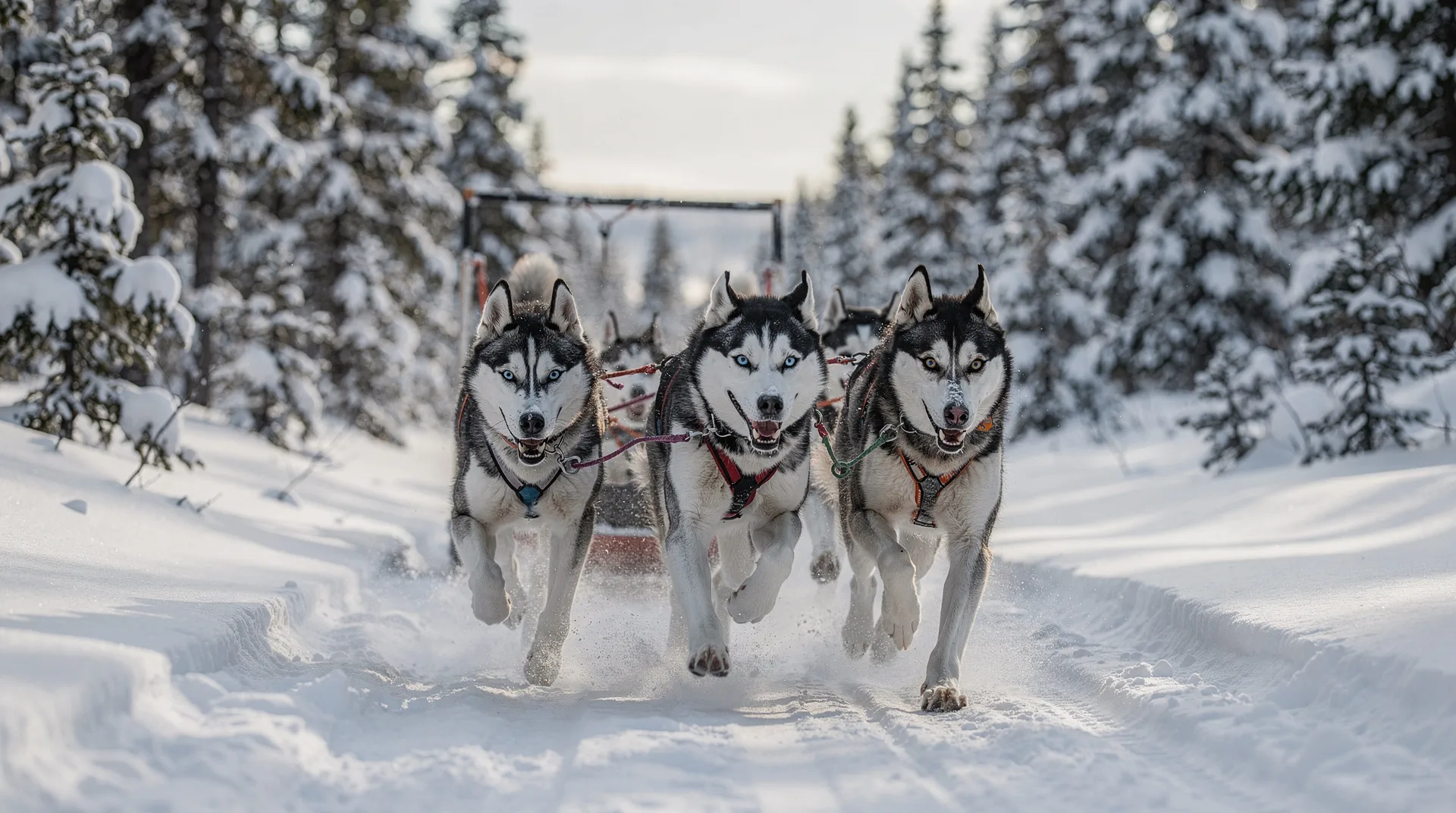
Dog sledding in Canada: Yukon, Quebec and Ontario tours guide
Where is the best place to go dog sledding in Canada?
The Yukon offers the most authentic multi-day wilderness dog sledding in Canada, with routes through boreal forest and mountain terrain. Quebec's Laurentians and Ontario provide accessible half- and full-day tours within reach of major cities. The season runs December through March across all regions.
| At a glance | |
|---|---|
| Where | Yukon (Whitehorse), Quebec (Laurentians), Ontario (Muskoka/Haliburton), Northwest Territories (Yellowknife) |
| Cost | Around CAD 120–450 per person for day tours; CAD 600–5,000+ for multi-day packages |
| Time needed | 2 hours for an introduction up to 10 days for a Yukon wilderness expedition |
| Getting there | Fly into Whitehorse, Montreal, Toronto or Yellowknife depending on region, then a regional transfer |
| Best time | Mid-December through mid-March; late January to February is the sweet spot across most regions |
Few winter experiences are as viscerally Canadian as dog sledding — standing on the runners of a wooden sled, a team of huskies running ahead with concentrated purpose, moving through silent boreal forest or across a frozen lake with only the sound of runners on snow and the rhythm of paws. The sport has deep roots in Indigenous and Northern communities across Canada, and today a range of operators offers experiences from accessible two-hour introductions near major cities to multi-day wilderness expeditions in the Yukon.
Dog sledding in Canada is not a tourist recreation built from scratch — it is a living tradition. The Yukon Quest, one of the world’s most demanding long-distance sled dog races (1,600 km from Fairbanks, Alaska to Whitehorse), runs every February, and the culture of dog mushing remains embedded in northern community life. Getting a sense of that heritage alongside the physical experience of running a team adds a dimension to dog sledding that distinguishes Canada from other destinations.
Where to go dog sledding in Canada
The Yukon — the gold standard
The Yukon offers Canada’s most compelling dog sledding experiences. The combination of vast wilderness, established mushing culture, experienced operators, and the possibility of aurora borealis overhead makes the Yukon the benchmark destination for serious winter travellers.
Whitehorse is the Yukon’s hub — a small city with international air connections (via Vancouver and Calgary) and multiple dog sledding operators ranging from afternoon introductions to 7–10 day self-guided expeditions on backcountry trails. The terrain around Whitehorse includes frozen lakes, river valleys, and forested ridgelines that provide varied and beautiful routing.
Multi-day Yukon expeditions typically involve camping in canvas wall tents heated by wood stoves, learning to care for and harness the dogs, cooking meals in the field, and navigating by map and compass through country that sees almost no other humans in winter. These trips require a level of physical and psychological preparation beyond a casual holiday activity — and they deliver experiences that are genuinely hard to find anywhere.
Browse all Whitehorse winter tours and dog sledding activitiesThe northern lights Yukon guide covers combining aurora viewing with a dog sledding Yukon trip — the two experiences complement each other perfectly.
Quebec — the most accessible option
Quebec’s Laurentian Mountains, an hour and a half north of Montreal, contain the highest concentration of dog sledding operators in Eastern Canada. The region combines excellent snowfall, extensive forest trail networks, and proximity to the major population centres of Montreal and Quebec City.
The Laurentians operators typically offer:
- Initiation or discovery tours (2–3 hours): For beginners; includes a briefing, learning to harness and care for the dogs, and a guided run through the forest. The guide drives a lead sled; you follow on your own sled. Most require no previous experience.
- Half-day tours (3–4 hours): More distance, more time with the dogs, usually including a warm meal break in a forest hut or cabin.
- Full-day tours (6–8 hours): Significant distance (20–40 km in some cases), full immersion in mushing, a hot lunch in the bush.
- Multi-day packages: Several Laurentian operators run 2–4 day packages that include cabin accommodation, meals, and extended sledding routes.
Base villages for Laurentians dog sledding include Saint-Donat, Labelle, Sainte-Agathe-des-Monts, and the area around Mont-Tremblant. A number of operators are located within 30 minutes of the Mont-Tremblant ski resort — the combination of skiing and dog sledding in the same region makes for an excellent full winter trip. See our from Montreal to Mont-Tremblant guide for the base route.
Quebec operators tend to be excellent value compared to the Yukon, with accessibility being the main advantage. The terrain, while beautiful, is less dramatic than the Yukon wilderness.
Ontario — near Toronto options
Ontario has dog sledding operators north of Toronto in the Muskoka, Haliburton, and Algonquin regions. The terrain around Huntsville, Haliburton Highlands, and the western approach to Algonquin Provincial Park provides excellent conditions for winter mushing, with frozen lakes and mature hardwood and boreal forest trails.
The proximity to Toronto (2–3 hours north) makes Ontario dog sledding the most accessible option for visitors staying in the city. A day trip combining the drive north through Muskoka cottage country, a half-day dog sledding experience, and a return via Barrie is achievable from Toronto.
Ontario operators are smaller than their Quebec counterparts, often family-run operations with teams of 8–20 dogs. The intimacy of a small operation — where you may meet the musher, learn each dog’s name and personality, and hear the story of how the team was built — can be more rewarding than a larger commercial operation.
For visitors based in Toronto, see our Ontario trails guide for context on the broader winter outdoor recreation scene in the region.
Yellowknife and the Northwest Territories
Yellowknife in the Northwest Territories offers dog sledding on Great Slave Lake, one of Canada’s largest lakes, providing a completely different experience to the forested trails of Quebec and Ontario. Running a dog team across the open expanse of a frozen lake — with aurora borealis potentially overhead and ice stretching to the horizon — has a scale and drama unlike anything available further south.
Yellowknife operators typically combine dog sledding with their aurora viewing packages, allowing visitors to use one base for both experiences. Half-day dog sled tours on Great Slave Lake run in January through March when the lake ice is fully established. See our aurora Yellowknife guide for combining the two activities.
What to expect on a dog sled tour
The dogs
Most Canadian operators use Siberian Huskies, Alaskan Huskies, or Greenland Dogs, or crosses between these breeds. These are working dogs, bred specifically for strength, endurance, and drive. You will be struck immediately by their energy — huskies before a run are pulling at their lines, barking and howling in anticipation, bursting with readiness. The transition from that chaos to focused, smooth running as the team launches down the trail is one of the most memorable moments in dog sledding.
Operators typically give guests a briefing on dog behaviour, safety around the team, and how to handle the dogs before the run. Most reputable operators allow — and encourage — guests to help harness the team, load dogs into their tuglines, and interact with the animals. Building a relationship with the dogs before you run is part of the experience.
Driving technique
On introductory tours, guests typically drive their own sled with a guide on a lead sled ahead. The technique involves standing on the runners (a footboard at the rear of the sled), using a foot brake (a metal claw dragged in the snow) to control speed, and leaning into corners to help the sled track. In practice, on flat terrain with an experienced team, the main job is staying balanced and keeping the brake ready for descents. On steeper terrain, brake technique becomes critical.
First-timers are sometimes surprised by how active the experience is — particularly on longer tours with varied terrain. Anticipating corners, managing speed on downhills, and helping the sled through tight turns in forest sections is genuinely physical work.
Caring for the dogs after the run
Good operators involve guests in the post-run care of the dogs: removing harnesses, returning dogs to their houses, giving water and food. This closing ritual — when the dogs are warm and contented from their run — is often the moment guests connect most deeply with the animals. Understanding the care that goes into maintaining a healthy sled dog team changes the way you think about the experience.
Browse dog sledding and winter wilderness tours across CanadaSeason and timing
The dog sledding season across Canada typically runs from mid-December through mid-March, with variations by region:
| Region | Typical season | Notes |
|---|---|---|
| Yukon | December – early April | Excellent snow and cold; late February and March popular for longer days |
| Quebec Laurentians | December – mid-March | Conditions depend on snowfall; January is most reliable |
| Ontario (Muskoka, Haliburton) | January – mid-March | Later season than Quebec; more variable snowfall |
| Yellowknife NWT | January – March | Great Slave Lake fully frozen; combine with aurora |
The sweet spot for most visitors is late January through February — temperatures are cold enough to guarantee good snow conditions, days are lengthening noticeably from the January solstice lows, and operators have their teams in peak condition after a month of regular running.
Multi-day Yukon expeditions
Multi-day dog sledding expeditions in the Yukon are a category apart from day-tour experiences. These trips — typically 4–10 days — involve:
- Learning to drive your own team from day one with increasing independence as the trip progresses
- Camping in canvas wall tents or backcountry cabins heated by wood stoves
- Covering 20–50 km per day across wilderness terrain
- Caring entirely for your own team throughout the trip
- Navigation using maps and trail signs through terrain with no other travellers
These expeditions require physical fitness, cold tolerance, and psychological readiness for genuinely remote conditions. Temperatures on Yukon expeditions can reach -30°C or below. The guides are deeply experienced — many are competitive mushers themselves — and the ratio of guests to guides is low (often 2–4 guests per guide on expedition trips).
The payoff is proportionate. A week in the Yukon backcountry by dog sled — learning to read snow conditions, bonding with the animals, moving through a white-on-blue landscape with no roads or buildings in any direction — is the kind of experience that reshapes a traveller’s understanding of what is possible in the natural world.
Costs
Dog sledding costs vary significantly by format and region:
| Experience | Typical cost (CAD) |
|---|---|
| 2-hour introduction, Quebec or Ontario | CAD 120–180 per person |
| Half-day tour (4 hours) | CAD 200–280 per person |
| Full-day tour | CAD 300–450 per person |
| Multi-day package, Laurentians (2–3 days, accommodation included) | CAD 600–1,200 per person |
| Yukon 5–7 day expedition | CAD 2,500–5,000 per person |
| Yellowknife half-day on Great Slave Lake | CAD 180–300 per person |
These are guide prices; specific operator rates vary. Yukon expeditions that include all equipment, food, and wilderness accommodation represent reasonable value for what they deliver.
What to wear
Dog sledding generates significant cold exposure — you are largely stationary on the sled (except for braking and steering), which means your body generates less heat than walking or skiing. Dress warmer than you think necessary:
- Base layer: Merino wool or synthetic thermal top and bottom
- Mid-layer: Fleece or down vest or jacket
- Outer layer: Windproof, insulated ski or snowmobile suit (many operators provide these)
- Boots: Insulated, waterproof winter boots rated to at least -30°C (Sorel or equivalent; many operators provide insulated overboots)
- Hat: Warm hat covering ears; balaclava for cold days
- Mittens: Insulated mittens preferred over gloves — you need finger warmth
- Hand warmers: Carry chemical hand warmers in outer pockets; useful on long runs
Most reputable operators provide insulated snowmobile suits and overboots — confirm at booking. If they provide outer gear, you still need proper mid-layers and footwear underneath.
Practical tips
Book well in advance for peak season: The most sought-after Yukon expedition operators (with limited capacity) book out months ahead. Quebec Laurentians operators have more capacity but popular weekends in February fill up. Book as early as possible.
Check operator credentials and dog welfare: A responsible musher maintains dogs in excellent physical and psychological condition. Ask operators about their dogs’ living conditions, care protocols, and training programme. IFSS (International Federation of Sled Dog Sports) and equivalent certifications indicate professional standards.
Combine with other winter experiences: Dog sledding pairs naturally with snowshoeing, cross-country skiing, aurora viewing (Yukon and Yellowknife), and winter camping. Many operators offer combined packages.
Photography on the sled: Shooting while driving is possible but requires a chest mount or wrist strap — your hands need to be free for the brake and sled handles. GoPro-style action cameras work well. For stationary shots, a camera or phone in an accessible outer pocket (never a bag — too slow to access) works fine when the team is paused.
Which region should you choose?
The right region depends on what kind of trip you’re building around it. If dog sledding is the centrepiece of your Canadian winter trip and you can commit several days and a bigger budget, the Yukon and Whitehorse deliver the most authentic wilderness experience, and pairing it with aurora viewing makes the flight north worthwhile.
If dog sledding is one activity within a broader trip built around a major city, Quebec’s Laurentians (easy from Montreal, with Mont-Tremblant as a base) or Ontario’s Muskoka/Algonquin region are far more time-efficient and considerably cheaper. Yellowknife and Churchill suit travellers already heading north for aurora or wildlife who want to add a half-day dog sled run on frozen lake ice rather than build a trip around mushing itself.
Frequently asked questions about Dog sledding in Canada: Yukon, Quebec and Ontario tours guide
Do I need experience to go dog sledding in Canada?
No experience is required for introductory and half-day tours. All reputable operators provide a comprehensive safety and technique briefing before you begin. Multi-day Yukon expeditions require good physical fitness and cold tolerance but not previous dog sledding experience — the early days of the trip are specifically designed to build your skills progressively.
How cold does it get during dog sledding?
Temperatures during dog sledding in Canada range from -10°C on a mild Laurentians day to -30°C or below on a cold Yukon expedition. Most operators provide insulated suits and overboots to supplement your own gear. The stationary nature of sled driving means you feel the cold more than if you were skiing or snowshoeing — dress accordingly.
Can children go dog sledding in Canada?
Yes — most operators welcome children, typically from age 5 or 6 upward for shared rides with a parent or guide. Children old enough to follow instructions and maintain balance can drive their own sled on introductory tours from around age 10–12, depending on the operator and the child. Confirm age requirements when booking.
Is dog sledding ethical and good for the dogs?
In reputable operations: yes. Sled dogs are bred for work and running; well-maintained working dogs are active, healthy, and visibly enjoy running. The key indicators of a responsible operator are: dogs live in appropriate outdoor housing with shelter; dogs are well-fed and healthy weight; harness-up is energetic and willing (not stressed or fearful); post-run care is attentive. Avoid operators where dogs appear thin, fearful, or housed in cramped conditions.
What is the Yukon Quest and can I watch it?
The Yukon Quest is a 1,600 km sled dog race between Fairbanks, Alaska and Whitehorse, Yukon (direction alternates annually), held every February. It is considered one of the world’s most challenging endurance events. Spectators can watch the start in Whitehorse (or Fairbanks) and checkpoint arrivals throughout the route. The Whitehorse start is a major event on the city calendar. See our northern lights Yukon guide — the race timing often coincides with excellent aurora conditions.
How far do you travel on a typical dog sled tour?
On a 2-hour introductory tour, expect 5–10 km over gentle terrain. A half-day tour covers 10–20 km. Full-day tours can reach 30–40 km with stops. Multi-day Yukon expeditions average 20–50 km per day depending on terrain and conditions. The pace is comfortable for the dogs (typically 12–18 km/h on flat terrain) — faster downhill, slower on climbs.
When does the Yukon dog sledding season end?
The Yukon dog sledding season typically runs from mid-December through early April. March and early April offer longer days — 12+ hours of daylight by late March — which makes wilderness camping significantly more pleasant. Snow conditions remain excellent through March in most years. Many mushers consider February and March the best combination of good snow, reasonable temperatures, and daylight.
Is dog sledding better in the Yukon or Quebec?
Neither is objectively “better” — they serve different trips. The Yukon offers wilder terrain, multi-day expedition options, and the possibility of combining with aurora viewing, at a higher cost and with more travel required. Quebec’s Laurentians are far more accessible from Montreal, cheaper, and suit a half-day or day trip rather than a dedicated expedition. Choose based on how much time and budget you’re allocating to the activity specifically.
Do I tip the mushers and guides on a dog sled tour?
Tipping is customary in Canada, generally in the 15–20% range for guided experiences, and dog sledding is no exception. A tip for the musher or guide at the end of a tour is appreciated, particularly on multi-day expeditions where guides work closely with you throughout.