Canadian currency and tipping: what you need to know
How much do you tip in Canada?
18–20% is the standard tip at restaurants and is effectively mandatory — it is part of how service industry workers are paid. Tip 15% for taxis, 10–15% for tour guides, and round up for hotel housekeeping. Tipping is not optional in Canada.
Money in Canada is straightforward for most visitors — the Canadian dollar is stable, payments are widely accepted by card, and ATMs are plentiful. The part that catches visitors by surprise is tipping. Canada has a strong tipping culture, similar to the United States, and understanding how it works — and why — will save you embarrassment and ensure you don’t inadvertently undercut service workers’ wages.
This guide covers everything: the currency itself, the best ways to pay, how to get good exchange rates, and a full breakdown of Canadian tipping norms by situation.
The Canadian dollar (CAD)
Canada’s currency is the Canadian dollar, abbreviated CAD or C$ and typically referred to simply as “dollars” in day-to-day conversation.
Exchange rates (approximate, 2026)
Exchange rates fluctuate constantly, but as a rough orientation:
- 1 CAD ≈ 0.72 USD
- 1 CAD ≈ 0.55 GBP
- 1 CAD ≈ 0.65 EUR
- 1 CAD ≈ 1.12 AUD
- 1 CAD ≈ 1.28 NZD
This means visitors from the UK, Europe, and Australia get more for their money in Canada than they do in the US. UK travellers in particular often find Canada modestly cheaper than expected in real terms, despite the high local price tags.
Important: always check current rates before travelling, as exchange rates shift. Canadian dollar is affected by oil prices (Canada is a major oil exporter) and can be volatile.
Coins and notes
Coins: 1¢ (penny — no longer produced, but prices round to the nearest 5¢ for cash), 5¢ (nickel), 10¢ (dime), 25¢ (quarter), $1 (loonie — the famous gold-coloured coin featuring a loon), $2 (toonie — two-toned bi-metallic coin).
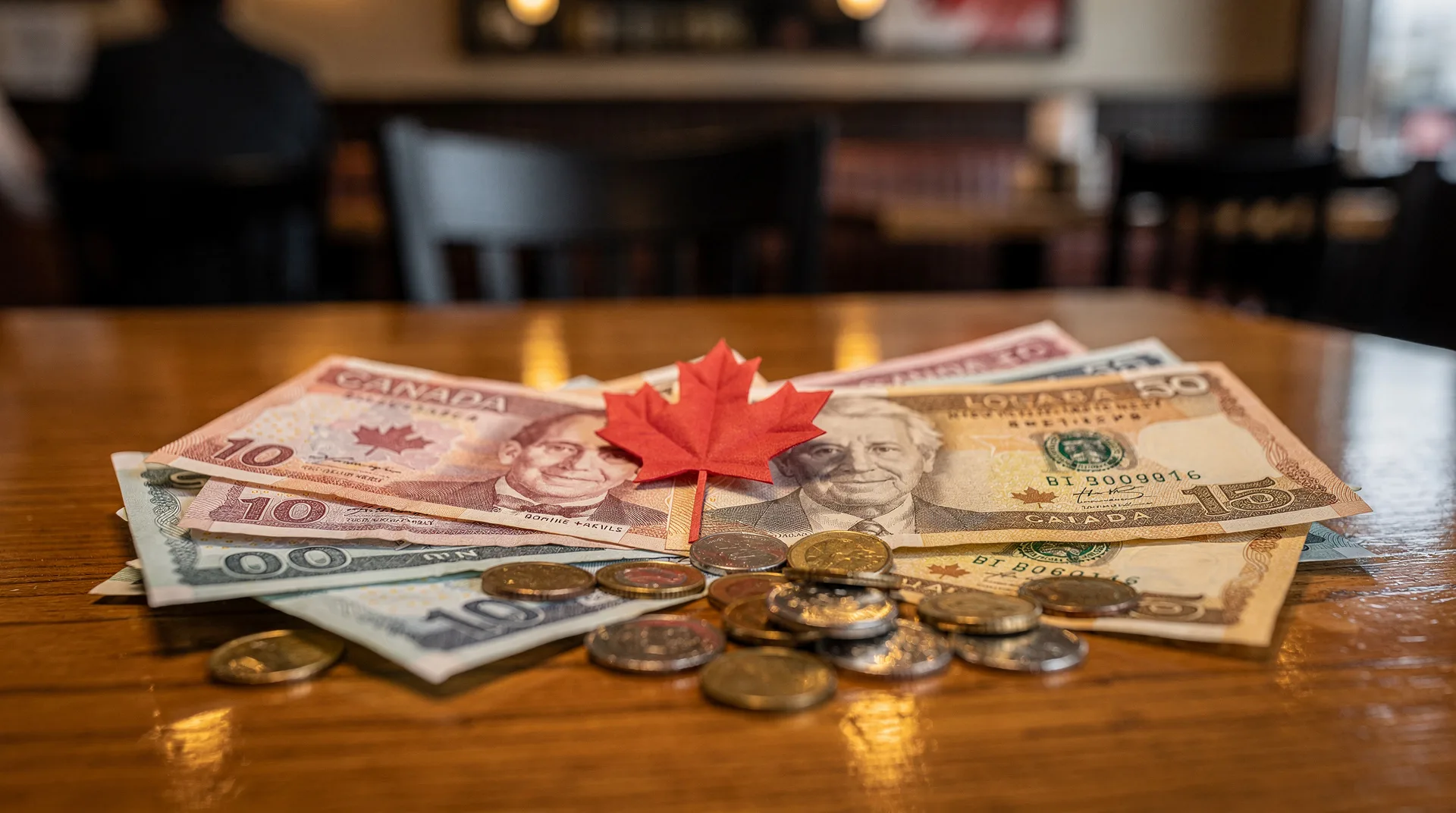
Notes: CAD $5 (blue), $10 (purple), $20 (green), $50 (red), $100 (brown). All Canadian notes are polymer — waterproof, durable, and resistant to counterfeiting.
The loonie ($1 coin) and toonie ($2 coin) are genuinely useful — parking meters, vending machines, laundromats, and tips for minor services often use coins. Carry a few.
How to pay in Canada
Cards: the primary payment method
Canada is highly card-friendly. Visa and Mastercard are accepted virtually everywhere. American Express is accepted at most restaurants and larger retailers, less reliably at smaller shops. Discover and Diners Club have limited acceptance.
Contactless payments (tap-to-pay) are standard — Canadian merchants adopted tap payment earlier and more thoroughly than most countries. Apple Pay, Google Pay, and Samsung Pay all work widely. Terminals typically accept tap up to CAD $250 without a PIN.
Interac Debit: Canada’s domestic debit network is called Interac. If you have a Canadian bank account, Interac e-Transfer is the standard way to send money. Foreign debit cards work on the Visa or Mastercard network, not Interac.
Cash
Cash is less necessary in Canada than it was five years ago, but still useful for:
- Smaller markets and artisan vendors
- Remote areas (fuel stations and small-town businesses occasionally cash-only)
- Tipping hotel housekeeping and bellhops
- Some food trucks and farmer’s markets
- Situations where you don’t want a paper trail (completely legitimate)
Carrying CAD $100–200 in cash is sensible for most trips. CAD $50s and $20s are the most practical denominations.
ATMs
ATMs (called ABMs — Automated Banking Machines — in parts of Canada) are ubiquitous in cities and even most smaller tourist towns. Major bank ATMs (RBC, TD, Scotiabank, CIBC, BMO) charge no fee to their own customers and typically a modest fee to others.
Best strategy for foreign visitors:
- Use your home bank’s ATM network wherever possible (check your bank for partner networks in Canada)
- Use major bank ABMs rather than independent machines in tourist areas (lower fees)
- Withdraw a moderate amount in one go rather than multiple small withdrawals (fee is usually per transaction, not per dollar)
- Avoid airport ATMs — their fees are disproportionate and conversion rates are poor
Credit cards: what to know
Many travel credit cards offer no foreign transaction fees — this is worth checking before you travel. A credit card with no foreign transaction fees, used for most purchases in Canada, gives you the interbank exchange rate (the best available rate) with no surcharge.
The typical foreign transaction fee for credit cards that charge one is 2.5–3%. On a CAD $3,000 trip, that’s CAD $75–90 in fees that can be eliminated by using the right card.
Currency exchange
Where to exchange money
Best options:
- Your home bank before departure: Reasonable rates, convenient, no surprises.
- ATM withdrawal in Canada: Using your bank card at a Canadian ATM gives you the interbank rate less a small ATM fee — often the best deal for cash.
- Currency exchange bureaus in major cities: Rates vary. Calforex and other dedicated exchange bureaus in Vancouver, Toronto, and Montreal typically offer better rates than airport exchanges.
Avoid:
- Airport exchange desks: Typically 5–8% worse than the interbank rate. The worst place to exchange money.
- Hotel front desks: Convenient but rate is usually poor.
- Dynamic currency conversion: When a Canadian card terminal offers to charge you in your home currency rather than CAD — always say no. The merchant’s exchange rate is typically 3–5% worse than your bank’s rate.
Understanding tipping in Canada
Tipping in Canada is not truly optional in most service contexts. Unlike in much of Europe, tipping is built into the wage structure — service staff in Canada often earn minimum wage (or just above) with the expectation that tips will bring their actual income to a liveable level. Not tipping in a restaurant where the service was satisfactory is considered rude and is noticed.
This is not a cultural quirk — it’s how the compensation system works. Understanding it means you won’t feel ambushed and won’t accidentally stiff someone who served you well.
Restaurants: 18–20% is standard
Sit-down restaurants (full service): 18–20% on the pre-tax total is the standard tip in Canada. 15% is considered on the low end and is appropriate only for mediocre service. 20–25% for genuinely excellent service.
How to tip: Most restaurant payment terminals prompt you to add a gratuity after the meal. Common options are 18%, 20%, 22%, and a custom amount. Select your choice or tap the custom option to enter a different amount. You can also tip in cash, which some servers prefer.
Pre-tax or post-tax?: The custom is to tip on the pre-tax amount, but most Canadians tip on the final bill total for simplicity. The difference is small (GST is 5% federal; tip on post-tax total vs. pre-tax is a fraction).
Ordering at a counter (fast casual, coffee shops): Tablet payment screens at coffee shops and fast casual restaurants will prompt for a tip. There is no obligation to tip at a counter-service establishment, and it is becoming more common for Canadians themselves to select “no tip” at these prompts without social judgement. That said, 10–15% tip is appreciated, particularly at independent coffee shops.
Bars: $1–2 per drink
At bars, tip CAD $1–2 per drink order, or 15–18% if you’re running a tab. In upscale cocktail bars, 18–20% on the tab is appropriate.
Hotels
Bellhop/porter: CAD $2–5 per bag.
Housekeeping: CAD $2–5 per night, left on the pillow or in an envelope marked “Housekeeping.” This tip is easy to forget and often skipped by visitors, but genuinely important for the workers.
Concierge: CAD $5–20 if they make special arrangements (booking a hard-to-get reservation, sourcing event tickets, etc.).
Valet parking: CAD $3–5 when your car is retrieved.
Room service: Check if gratuity is already included on the bill — it often is. If not, 18–20%.
Taxis and ride-sharing
Taxis: 15% of the fare is standard. Round up for convenience and friendliness.
Uber and Lyft: The app prompts for a tip after the ride. 15–20% is appropriate.
Tour guides and activity operators
Day tour guides: CAD $15–25 per person is standard for a full-day guided tour. If a guide has been genuinely excellent — particularly for private or specialist tours — CAD $30–50 per person is appropriate.
Activity instructors (ski instructor, kayak guide, etc.): 15–20% of the lesson/activity cost.
Spas and salons
15–20% on services. This is standard across North America.
Who you don’t tip
- Gas station attendants (rare in Canada — most are self-service)
- Grocery store cashiers
- Fast food counter staff (though tip prompts now appear at many)
- Government or public service workers
Taxes in Canada
Understanding Canadian taxes helps you budget accurately.
GST (Goods and Services Tax): 5% federal tax applied to most goods and services in Canada. This is the base rate nationally.
HST (Harmonized Sales Tax): In provinces that have combined federal and provincial tax into a single HST: Ontario (13%), Nova Scotia (15%), New Brunswick (15%), Newfoundland (15%), PEI (15%).
PST/QST: In provinces with separate provincial tax: BC (7% PST), Saskatchewan (6% PST), Manitoba (7% PST), Quebec (9.975% QST in addition to 5% GST — effective 14.975%).
Alberta, the Yukon, Northwest Territories, and Nunavut have no provincial sales tax — only the 5% GST. This makes Calgary noticeably cheaper for shopping than Toronto or Vancouver.
Menu prices are always pre-tax in Canada — unlike the UK where prices include VAT. The bill total will be higher than what you see on the menu. Budget accordingly: the final amount will be the menu price + 5–15% tax + 18–20% tip.
Quick mental math: If your meal shows CAD $80 on the menu, expect to pay approximately CAD $100–105 after tax, plus tip (CAD $14–20). Total out of pocket: approximately CAD $115–125.
Budget for money in Canada
Including tipping in your daily budget is important. Rule of thumb: add 25–30% to any food and drink budget line to account for tax and tip. A meal listed at $30 per person becomes approximately $38–40 after tax and tip.
Our full Canada travel budget guide has detailed daily cost breakdowns.
Recommendations by traveller type
International visitors not used to tipping: Treat tipping as a line item in your budget, not a surprise extra. Service staff are not overpaying you in service hoping for a large discretionary tip — they are earning wages that assume a tip will be added. Budget for it and leave it without resentment.
Budget travellers: The easiest ways to reduce daily tip expenditure are self-catering (no restaurant tips), cooking in an Airbnb or hostel kitchen, and using transit and walking (no taxi tips). See our money-saving guide.
Business travellers: Corporate credit cards typically handle foreign transaction fees automatically. Keep receipts for expense claims — Canadian restaurants provide detailed receipts showing pre-tax amount, tax amount, and tip separately.
Frequently asked questions about Canadian currency and tipping: what you need to know
Can I use US dollars in Canada?
Occasionally, in border areas and some tourist shops — but the exchange rate will be unfavourable and many businesses refuse them. Always use Canadian dollars or a card.
What happens if I don’t tip at a restaurant?
The server will notice and it will be remembered as rude. Unlike in many European countries, servers in Canada rely on tips as a core part of their income. If service was genuinely poor, 10–12% is acceptable with a polite word to the manager. Leaving nothing for satisfactory service is not appropriate in Canadian culture.
Are there any tip-free restaurants in Canada?
A small number of restaurants — typically higher-end establishments — have introduced “no-tipping” policies with higher menu prices to cover full staff wages. These are rare but growing in cities. The menu will make this clear.
Should I tip with cash or card?
Both are fine. Cash tips go directly to the server without any deduction. Card tips are distributed through the employer’s payroll, which can mean delays and occasionally employer deductions (though this varies). For servers, cash is generally preferred — but card tipping is standard and perfectly acceptable.
Is tipping expected at coffee shops like Tim Hortons?
No — quick service chains like Tim Hortons, McDonald’s, and Subway are counter service and tipping is not expected. Though tip prompts now appear on payment terminals at many of these locations, declining is entirely acceptable and normal.
Can I withdraw CAD from my foreign bank card?
Yes — Visa and Mastercard debit cards work at Canadian ATMs. Your home bank will charge a foreign ATM fee (typically CAD $3–7 per transaction) and potentially a foreign transaction fee (1–3%). Using a bank account that refunds international ATM fees eliminates this cost entirely.
Is it safe to carry cash in Canada?
Yes — Canada is a very safe country and pickpocketing is less common than in most European cities. Normal precautions apply: don’t flash large amounts in public, use a money belt in very crowded areas if preferred. Cash is not a concern in Canada in the way it might be in some other destinations.