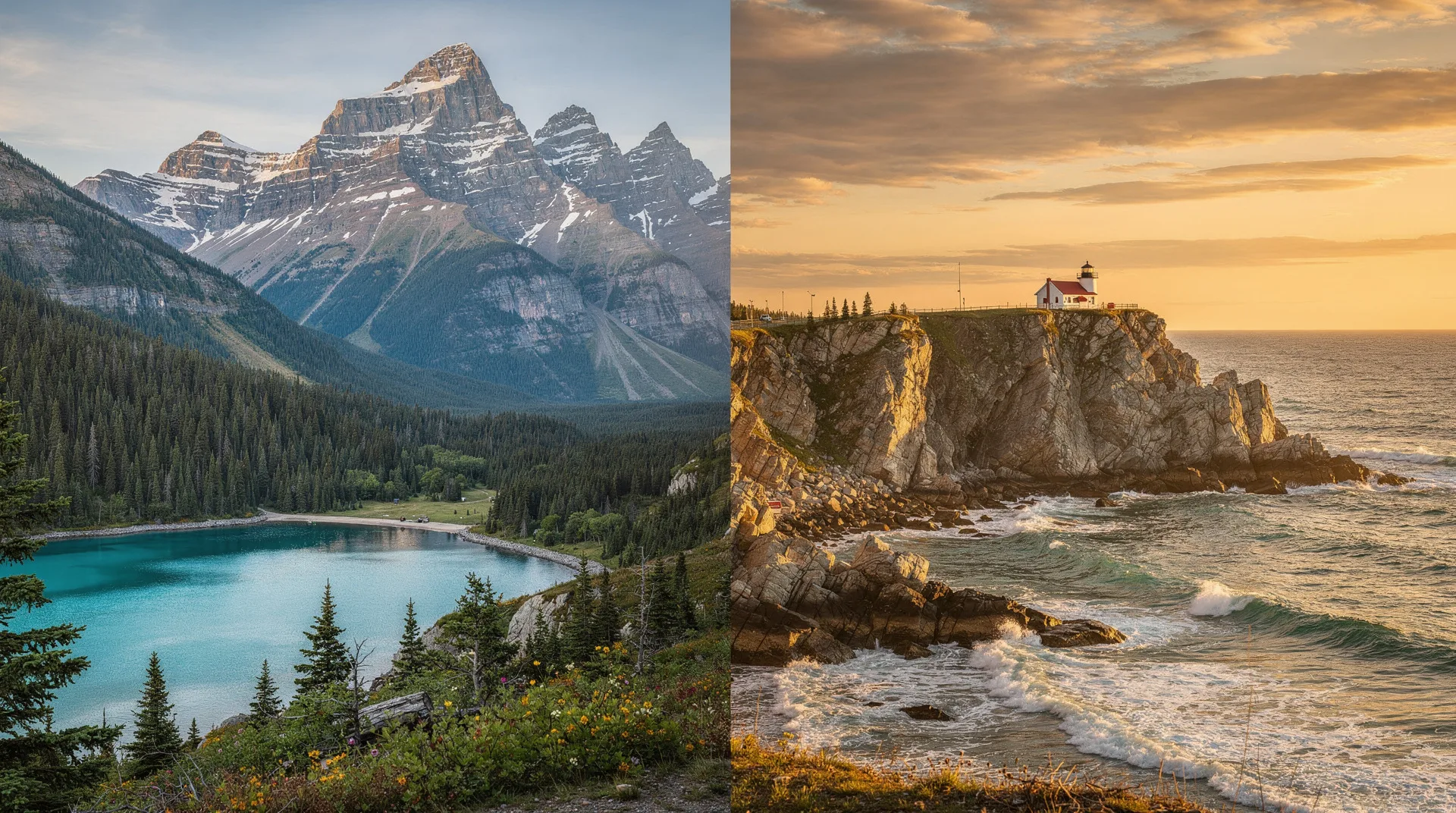
Canada coast to coast: train vs drive compared
Is it better to cross Canada by train or by car?
Take the train (VIA Rail Canadian Toronto-Vancouver) if you want a classic journey with zero logistics, big windows, and social dining cars. Drive if you want freedom to stop, more eastern Canada coverage, and lower costs on a long trip. The train is 4 days one-way; a proper drive coast-to-coast needs 3-4 weeks.
At a glance
| Where | Toronto-Vancouver by train, or St. John’s-Victoria by road |
| Cost | Around CAD $650-8,000+ one-way by train; roughly CAD $9,000-14,000 total for two people driving coast-to-coast |
| Time needed | Train: 4 days Toronto-Vancouver, 6-8 days true coast-to-coast with the Ocean. Drive: 3-4 weeks minimum |
| Getting there | VIA Rail Canadian (Toronto-Vancouver) plus the Ocean (Montreal-Halifax) for full coverage; rental car or RV for driving |
| Best time | June-September for peak train schedules and the most reliably open roads and ferries |
Crossing Canada is a big undertaking. The country is 7,821 km from St. John’s, Newfoundland to Tofino, British Columbia — wider than any country on Earth except Russia. Most visitors who attempt it pick one of two approaches: VIA Rail’s Canadian sleeper train from Toronto to Vancouver, or a cross-country road trip in a rental car or RV.
This guide compares them honestly across the decisions that actually matter.
The short answer
The train is a classic travel experience, not transportation. You’re paying for the journey itself — the domed observation cars, the full-service dining, the rhythm of the rails — not efficient movement. It covers Toronto to Vancouver in 4 days.
The drive is a deeper, more flexible way to see the country. You can start in the Maritimes, cover eight provinces if you want, and stop wherever you choose. But it requires 3-4 weeks to do justice and thousands of kilometres of driving.
What each route actually covers
Train (VIA Rail Canadian): Toronto to Vancouver, 4,466 km, approximately 97 hours. It passes Sudbury, Winnipeg, Saskatoon, Edmonton, Jasper, and through the Rockies to Vancouver. It does NOT cover Atlantic Canada. To reach the Atlantic by train, you’d combine it with the Ocean train (Montreal to Halifax).
A true coast-to-coast rail journey is Halifax → Montreal → Toronto → Vancouver, with transfers in Montreal and Toronto. Total travel time with layovers: 6-8 days.
Drive: Route depends on ambition. A minimal coast-to-coast via Trans-Canada Highway from St. John’s to Victoria is 7,821 km. With ferry crossings to Newfoundland (Marine Atlantic) and Vancouver Island (BC Ferries), budget 3-4 weeks minimum with reasonable stops.
Scenery
Both are scenic, but in different ways.
The train’s highlights are the Rockies segment (Edmonton to Vancouver), the prairies at sunset, and the Canadian Shield lakes between Sudbury and Winnipeg. Much of the prairie crossing is scheduled overnight — sleeping past some of the flattest terrain is a mercy. The Rockies section happens in daylight if you take the westbound departure.
The drive covers more varied landscape: Atlantic fishing villages, Quebec’s St. Lawrence River, the Great Lakes shoreline, prairie grain elevators, Rocky Mountain passes, Fraser Canyon, coastal rainforest. You see more, but you’re also driving through it rather than watching it unfold in a dining car.
Time and flexibility
Train: rigid. Departs Toronto twice weekly in summer (once weekly in winter) for Vancouver. You cannot step off for a side trip and rejoin, except at permitted stopover cities (Winnipeg, Edmonton, Jasper). No detours to national parks.
Drive: fully flexible. You set the schedule, change routes, add detours. Want to spend three days in Banff? Go. Want to skip Saskatchewan? Drive through in a day. This is the biggest reason most people who have the time choose driving.
Cost
Train (Toronto-Vancouver one way):
- Economy seating: CAD $650-850
- Sleeper Plus with bed and meals: CAD $1,900-3,400
- Prestige Class (best cabin, included drinks): CAD $4,500-8,000+
Prices vary heavily by season. Peak is June-September.
Drive (coast-to-coast, 3 weeks, 2 people):
- Rental car (small SUV, 21 days): CAD $1,500-2,500
- Fuel (roughly 10,000 km total): CAD $1,500-2,000
- Mid-range hotels and B&Bs: CAD $4,000-6,000
- Food: CAD $2,000-3,000
- Ferries (Newfoundland, Vancouver Island): CAD $400-700
- Total for two travellers: CAD $9,000-14,000
An RV changes the math substantially — rental is more expensive (CAD $250-400/night) but accommodation is built in.
Per person, the drive is often cheaper for two or more travellers. Solo, the train in economy or a basic sleeper can compete.
Comfort and social experience
The train is a social environment. Meals are assigned at shared tables. The observation dome and activity car naturally create conversation. You can read, sleep, or watch the country pass for 4 days without doing anything.
The drive is independent. You eat where you choose, sleep where you book, and converse with your travel partner mainly. Some people find this liberating, others find it exhausting over 20+ days.
Physical demands
The train is low-effort. You sit, walk between cars, and sleep. Anyone mobility-limited can do it comfortably.
The drive is tiring. Highway driving 500-700 km/day for weeks is harder than it sounds. Split driving between two people makes a big difference. Ontario alone is 2,000 km of highway driving.
A day on the train, a day on the road
It helps to picture an ordinary day on each option, because the two feel very different once the novelty fades. On the train, mornings begin with breakfast in the dining car, usually next to strangers who quickly become familiar faces. Between meals there is time to read, watch the landscape slide past the big windows, or move to the observation dome when something worth seeing appears. The pace is slow on purpose, and the best advice is to stop trying to be productive. Anyone who wants a deeper look at how the days unfold can read the VIA Rail Canadian guide, which walks through the onboard routine.
On the road, a day is built around decisions: where to fill the tank, where to eat lunch, which viewpoint deserves twenty minutes and which can be skipped. That freedom is the whole appeal, but it also means every day carries a small amount of planning. The getting around guide is a good overview of how the different transport modes compare once you are actually on the ground.
Choosing a direction and a season
Direction matters more than most people expect. Travelling west with the train puts the mountains near the end of the journey, which builds toward a dramatic finish, while travelling east saves the Atlantic coast for last. On the road, going east to west means you reach the Rockies fresh, whereas going west to east lets you finish with the fishing villages and lighthouses of the Maritimes. Neither is objectively better; pick the ending you want to remember. Whichever way you travel, it is easy to add guided tours across Canada along the route.
Season shapes everything else. Summer gives the most reliable roads, the longest daylight and the fullest ferry schedules, but it is also when prices and crowds peak. Shoulder months can be quieter and cheaper, with autumn colour as a bonus in the east. Winter makes a long drive much riskier, which is one reason the train keeps its appeal outside summer. The best time to visit Canada guide helps match your travel dates to the regions you care about most.
Planning the road version
A coast-to-coast drive rewards a rough outline rather than a rigid timetable. Fix the few things that cannot move, such as ferry crossings and rental pickup, and leave the rest loose. For the Atlantic end, the Marine Atlantic ferry guide explains how the Newfoundland crossing works, and the driving Atlantic Canada guide covers the Maritime stretch in more detail. If you want a scenic loop on the way, the Cabot Trail guide is a natural detour. At the Pacific end, the BC Ferries guide covers the crossing to Vancouver Island.
Through the mountains, the Icefields Parkway guide is worth reading before you commit to a schedule, since it is the kind of road where rushing defeats the purpose. Anyone considering a camper should look at the RV and camper van guide and the Canadian camping rules before booking, because where you can park overnight is not always obvious. The road trip permits guide is also a useful check for anything that needs paperwork along the way.
Planning the train version
The train asks for the opposite kind of preparation: fewer decisions on the road, more care before departure. Think about luggage, because storage on board is limited and you will want a small bag with everything you need for the day within reach. The packing list is a good starting point. If you plan to break the journey at stopover cities, the VIA Rail prairies guide describes that middle stretch, and cities such as Winnipeg and Jasper make natural places to step off. Travellers who like the idea of a rail pass should read about the Canada rail pass, and the scenic trains booking guide covers the practical side of reserving seats and cabins.
Where the journey starts and ends
Both options bring you into big cities at either end. Toronto is the usual starting point for the Canadian, and Vancouver is where it finishes, so it is worth planning a night or two at each end rather than arriving and leaving on the same day. For anyone adding the Atlantic leg, Halifax is the natural eastern base. If you are unsure how much time the whole country deserves, the how long to spend in Canada guide puts the question in context.
Best for specific trips
- Classic journey experience, zero logistics: Train
- Rockies and Canadian Shield focused: Train
- Atlantic Canada inclusion: Drive (train barely covers it)
- Solo traveller wanting company: Train
- Couple or family wanting flexibility: Drive
- Photography requiring stops: Drive
- Time-limited (1-2 weeks): Train
- Genuine cross-country adventure: Drive
The compromise: combine them
Many travellers drive the eastern half (Maritimes through Ontario) and take the train from Toronto to Vancouver, or vice versa. This gets you Atlantic Canada’s coastal drives plus the Canadian’s Rocky Mountain showcase without the endless Ontario-to-Manitoba driving.
Another option: fly one direction and travel the other by train. A 5-hour flight replaces 4 days of rail for when you want to return home quickly.
The domestic flights guide explains how internal flights work, and the east vs west Canada comparison is helpful if you can only do one half properly and are deciding which half to keep. Splitting the trip also lets you compare the two experiences directly, which is the best way to learn which one suits you for a future crossing. For stops where you would rather not drive or plan, you can book Canada tours and activities in advance.
Side-by-side comparison
| Factor | Train (VIA Rail Canadian) | Drive (coast-to-coast) |
|---|---|---|
| Time | 4 days Toronto-Vancouver, 6-8 with Ocean connection | 3-4 weeks minimum |
| Cost (per person, one-way/trip) | CAD $650-8,000+ | CAD $4,500-7,000 (half of a 2-person total) |
| Flexibility | Fixed schedule, limited stopovers | Fully flexible route and pace |
| Atlantic Canada coverage | Poor without the separate Ocean train | Full |
| Physical demand | Low | Moderate to high over 3+ weeks |
| Booking window | Peak season sells out months ahead | Rental car/RV should be booked well ahead in summer |
Practical planning notes
If you go the rail route, book directly with VIA Rail and check the VIA Rail booking guide for cabin classes and how far ahead to book the Canadian. Some travellers also compare it against the pricier, scenery-focused Rocky Mountaineer — see Rocky Mountaineer vs VIA Rail if you’re deciding between the two for the Rockies segment specifically. For a full day-by-day breakdown of the Canadian route, the VIA Rail Canadian itinerary is useful for setting expectations before you book.
If you drive, sort out your car rental early — summer demand is high and prices climb closer to departure. Consider slotting in a dedicated detour like the Vancouver to Banff drive rather than trying to rush the Rockies section in a single day, and budget for a Banff park pass if your route touches any national park, since none of them are free to enter. If train scenery is what you are really after but you want more route options than the Canadian alone, the best scenic train routes in Canada guide covers the alternatives.
Frequently asked questions about Canada coast to coast
Can I do a one-way trip and fly back instead of doing the return journey? Yes, and many travellers do exactly this — take the train or drive one direction, then fly home. A domestic flight replaces days of return travel and is a common way to combine a bucket-list rail or road trip with a realistic overall schedule.
Is the VIA Rail Canadian worth it if I’ve never done a long train journey before? Generally yes, if you book at least a Sleeper Plus cabin — the appeal is the journey itself (dining car, observation dome, the rhythm of days on the rails), not efficient transport. Economy seating for the full 4 days is a much harder sell for a first-timer.
The honest verdict
If you want an iconic Canadian experience that requires no logistics and delivers 4 days of luxury travel, take the VIA Rail Canadian. Book a Sleeper Plus cabin at minimum — economy seating for 4 nights is unpleasant.
If you want to actually see Canada coast to coast with the freedom to stop and explore, drive. Budget 3-4 weeks, split driving with a partner, and consider renting an RV for flexibility.
Neither is wrong. They’re different trips. Match the one to what you actually want from your Canadian journey.