Canoeing Algonquin Park: routes, outfitters and how to plan your trip
When is the best time to canoe in Algonquin Park?
Late May through September is prime canoe season in Algonquin. June offers high water, good portaging conditions, and loon calls; July and August are warmest for swimming; September delivers fall colours and significantly fewer paddlers. Avoid the May blackfly season unless you have excellent bug protection.
| At a glance | |
|---|---|
| Where | Algonquin Provincial Park, roughly 3 hours north of Toronto |
| Cost | Around CAD 1,200-1,800 all-in for a self-guided 5-day trip for two |
| Time needed | A day paddle to 8+ days for deep interior routes |
| Getting there | Own car recommended; some outfitters run shuttles from Toronto-area pickup points |
| Best time | Late May-September, with September widely rated the best |
Algonquin Provincial Park is the crown jewel of Ontario’s wilderness, and canoeing its interior is the defining Canadian outdoor experience that separates those who have done it from those who have only driven through. The park covers 7,653 square kilometres of the Canadian Shield — a vast landscape of rounded granite ridges, thousands of lakes connected by rivers and portages, and boreal and hardwood forest of extraordinary beauty. For the canoeist, this landscape is a network of routes that can keep you paddling for years without repeating a single journey.
The beauty of the Algonquin canoe system is its scalability. A beginner can complete a relaxed circuit on a single large lake, covering 15 km per day with short portages and camping on islands. An experienced wilderness paddler can route 200 km through the park’s interior, carry heavy loads over long portages, and navigate by map for weeks. Everything in between is available, and a well-briefed first-timer can plan and execute a multi-day canoe trip with appropriate outfitter support.
Why canoe Algonquin?
Algonquin is not just good — it is one of the world’s premier canoe destinations. The reasons are layered:
The wildlife: Algonquin’s lakes and forests hold healthy populations of moose, black bears, wolves, loons, osprey, beavers, and otters. Paddling silently at dawn across a still lake and surprising a moose feeding in the shallows 30 metres away is not a rare event — it is a normal occurrence on interior canoe routes. The common loon is the soundtrack of Algonquin nights; its call over dark water is one of the most haunting sounds in the Canadian wilderness.
The canoe route system: Over 2,000 km of mapped and maintained canoe routes, connected by portages ranging from a few metres to several kilometres, link the interior lake system. Route planning is straightforward with the park’s excellent canoe route map and the extensive trip reports available from the Algonquin Outfitters and Friends of Algonquin resources.
The portage culture: Algonquin’s portages — the carries between lakes where you lift the canoe on your shoulders and walk through the forest — are a fundamental part of the experience. The portage trail is where you earn the silence of the interior lake; where you find the solitude that the car-accessible park on Highway 60 cannot provide. The further you portage from access points, the quieter and wilder the country becomes.
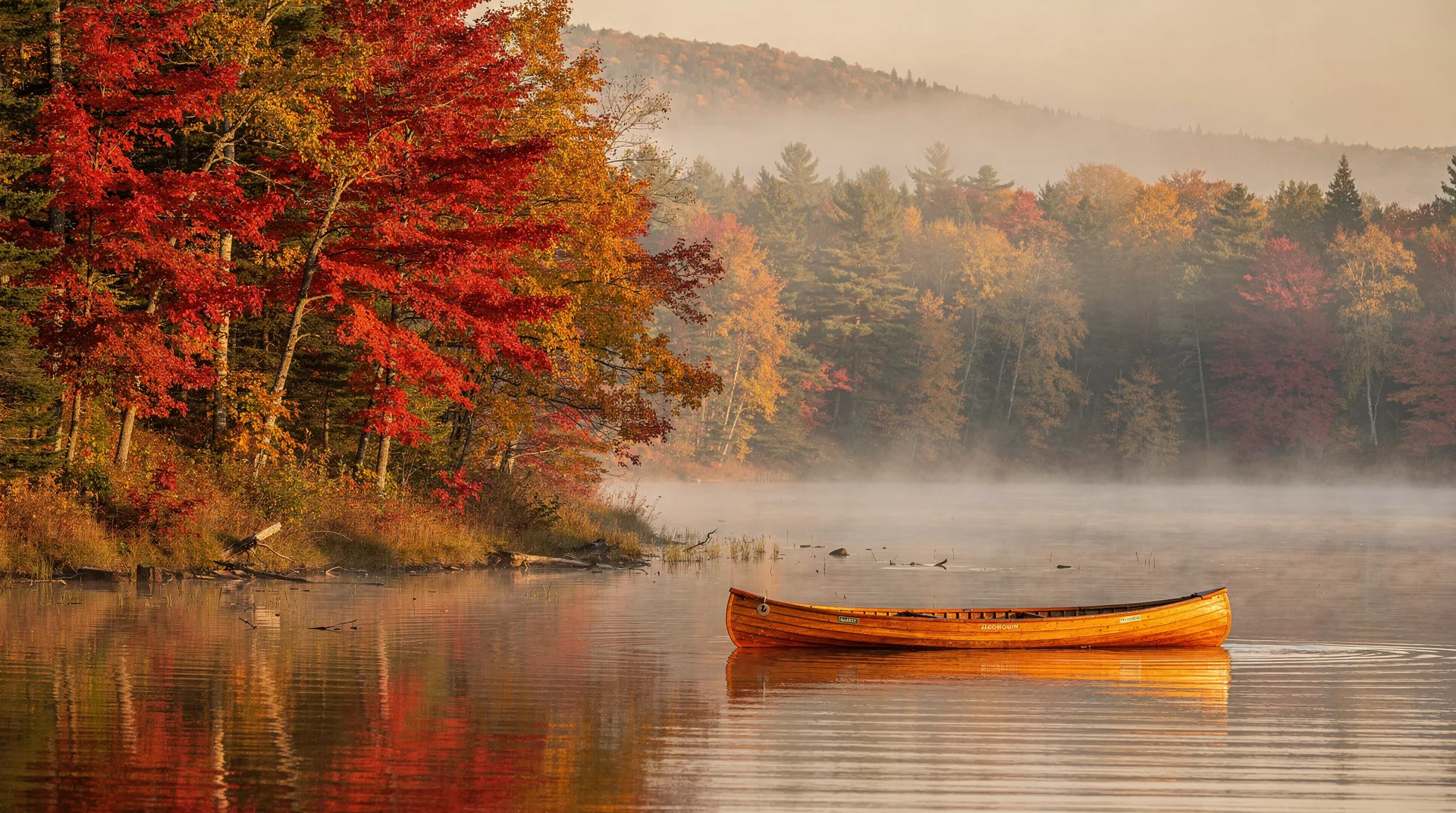
The fall colours: Algonquin in September and early October is arguably more beautiful than at any other time. The maples, birches, and aspens turn brilliant red, orange, and gold; the colours reflect in the still lakes; the air is crisp; and the interior is substantially emptier than in July. This is the time experienced paddlers consider the park’s best.
Best canoe routes in Algonquin
Tim River loop (beginner-friendly)
The Tim River loop is an excellent introduction to Algonquin interior paddling: relatively straightforward portages (none over 2 km), good moose habitat along the river sections, and a circuit structure that returns you to the launch point. The route accesses the Canoe Lake access point, the park’s most popular entry point, but quickly escapes the weekend crowds through its first portages.
Duration: 3–5 days
Distance: Approximately 50–60 km
Portages: Multiple, none extremely long
Difficulty: Beginner to intermediate
Canoe Lake to Burnt Island Lake circuit
One of the most popular multi-day circuits in the park, this route offers excellent variety: large open lakes (requiring navigation skills in wind), smaller more intimate lakes, good wildlife habitat, and reliable campsites. The circuit can be extended or shortened depending on time and energy.
Duration: 4–6 days
Distance: 70–100 km depending on extensions
Portages: Numerous; some up to 3 km
Difficulty: Intermediate
Opeongo Lake — Dickson Lake circuit (serious wilderness)
Opeongo Lake, the largest lake in the park, accesses deeper interior routes that are significantly less travelled than the Canoe Lake area. The Opeongo–Dickson circuit passes through remote lake systems where a paddler might go multiple days without seeing another party. Wildlife encounters are more frequent; the sense of wilderness is more pronounced.
Duration: 5–8 days
Distance: 80–130 km
Portages: Substantial; Dickson portage is notably long
Difficulty: Intermediate to advanced
Petawawa River (river paddling)
The Algonquin portion of the Petawawa River offers river paddling with sections of whitewater (up to Class III in high water), through one of the park’s wildest and least-visited areas. This route is for experienced paddlers comfortable with reading water and making decisions about running or lining difficult sections.
Duration: 4–6 days
Distance: Varies by entry and exit point
Portages: Multiple; some bypassing significant rapids
Difficulty: Advanced
Lake Opeongo day paddle
Not everyone has the time or equipment for multi-day interior travel. Lake Opeongo, accessible from the Opeongo access point on the Opeongo Road, is large enough to provide a genuine wilderness experience on a day paddle — particularly the less-visited north and east arms. Rent a canoe from Opeongo Outfitters at the lake access point.
Outfitters and rentals
Several outfitters operate within and immediately outside the park, providing canoe rentals, equipment, guided trips, route planning, and shuttles between access points:
Algonquin Outfitters is the largest and most comprehensive outfitter serving the park, with multiple locations including Canoe Lake, Opeongo, and Huntsville. They offer canoe rentals (ranging from basic aluminum to high-performance Kevlar), full gear packages, shuttle services between access points, and guided trips from day paddles to multi-week expeditions. Their staff are knowledgeable route planners who can tailor a trip to any experience level.
Opeongo Outfitters operates specifically at Lake Opeongo, the most remote major access point. They run a water taxi service across the large lake (enabling paddlers to skip the first section and penetrate further into the interior on day one), canoe rentals, and a well-stocked small store.
White Squall Paddling Centre (Parry Sound, near the southwest park boundary) offers guided paddling programs and canoe rentals for routes in and around the park.
Canadian Canoe Routes (canoeroutes.com) is an invaluable online resource for trip planning: detailed trip reports from hundreds of paddlers covering every corner of the park, GPS tracks, portage conditions, campsite reviews, and current water level information.
Browse Ontario outdoor activities and tours departing from TorontoBackcountry permits and booking
All interior canoe camping in Algonquin requires a backcountry camping permit. Permits are issued per person per night and are available through the Ontario Parks reservation system (ontarioparks.com/park/algonquin). The permit system for Algonquin operates on a first-come basis (not site-specific reservation) for interior camping — you book a permit for a general period and route, not a specific campsite.
Cost: Approximately CAD 12–16 per person per night for backcountry camping, plus a day use/parking fee for the access point vehicle lot
Day use fee: Required for vehicles parked at all Algonquin access points; available online or at the gatehouse on Highway 60
Park permit: The park’s day use fee (not the camping permit) covers access for the day
Book permits as early as the reservation window opens for peak summer weekends (reservations open in January for the upcoming season). For mid-week trips in June, September, and early October, less advance booking is generally needed.
Best time to canoe Algonquin
| Month | Conditions | Verdict |
|---|---|---|
| May (late) | High water, excellent portaging; blackfly peak | Good if prepared with head nets and bug repellent |
| June | Best water levels, warming temps, loons calling; weekends busy | Excellent |
| July | Peak season; warm swimming; busiest interior | Good but plan weekday departures |
| August | Similar to July; water levels dropping in dry years | Good |
| September | Fall colours developing; significantly fewer paddlers; crisp nights | Outstanding |
| Early October | Peak fall colour; cold nights; some access point hours reduced | Excellent for fall colour |
September is when experienced Algonquin paddlers tend to go. The combination of empty routes, fall colour, cool temperatures (warm enough to paddle, cold enough for the sleeping bag), and the heightened wildlife activity before winter gives September the edge over the crowded July peak. See our Canada in September guide for broader September travel context.
Wildlife you might see
Moose: The most iconic Algonquin wildlife encounter. Moose feed in the shallows of lakes and rivers, particularly at dawn and dusk, and are commonly seen from canoes. September is prime moose viewing with the rut adding drama. Give moose wide berth — they are large, can be aggressive, and are strong swimmers.
Common loon: The sound of Algonquin at night. Loons nest on interior lakes through the summer and their yodel calls carry enormous distances over still water. One of the defining sounds of the Canadian wilderness.
Wolves: Algonquin’s wolf population (the eastern wolf, a distinct species from the grey wolf) is healthy and sometimes heard howling across the lakes on calm evenings. The park runs its public wolf howl program on one evening in August each year, when park staff locate a wolf pack and invite visitors to join in the howling — a remarkable experience.
Black bears: Present throughout the park. Proper food storage (hung from a rope between trees, bear boxes at some access points) is essential and legally required. Bear encounters in Algonquin’s interior are typically non-confrontational — maintain good food storage practice and make noise when moving through dense bush.
Otters: Playful and curious; often seen sliding on riverbanks or floating on their backs in calm water.
Beaver: Visible at dusk on many lakes; their dams and lodges are prominent features of the Algonquin waterscape.
Osprey, bald eagle, great blue heron: Regularly encountered along waterways.
Portaging: what to expect
The portage — carrying the canoe and gear overland between lakes — is the defining physical challenge of Algonquin canoeing. Portage lengths range from 20 metres to several kilometres. The technique of carrying a canoe (the canoe is turned upside down, balanced on the paddler’s shoulders via the centre yoke) is learnable by most adults with practice.
The conventional approach to portaging is a double carry: carry the heavy gear across the portage first, return for the canoe (or carry the canoe first and return for the gear). Two paddlers can also tandem-carry a canoe (one at each end) on shorter portages, leaving one paddler free to carry gear. Experienced solo paddlers carry everything in a single trip.
Portage trails vary in quality — some are well-worn and obvious; others are faint and require reading the map. The Canadian Canoe Routes trip reports are invaluable for knowing current conditions on specific portages.
Costs
- Backcountry permit: CAD 12–16 per person per night
- Access point day use/parking fee: CAD 15–20 per vehicle per day
- Canoe rental (Algonquin Outfitters): CAD 45–65 per day for a standard canoe; Kevlar lightweight canoe CAD 70–90 per day
- Full equipment package (canoe, paddles, life jackets, sleeping bags, tent, cook kit): CAD 150–250 per day for two people; varies by outfitter and equipment specification
- Shuttle service (one way, Canoe Lake to another access point): CAD 60–120 depending on distance
- Guided multi-day trip: CAD 200–400 per person per day (all-inclusive with guides, equipment, food)
A self-guided 5-day trip for two people (renting a canoe and full equipment package from an outfitter, permits, access fees) budgets at approximately CAD 1,200–1,800 all-in, not including transport to/from the park.
Practical tips
Navigation: The official Algonquin canoe route map (available from Ontario Parks or outfitters at the access points) is the essential tool. It shows all routes, portage lengths, and campsite locations. Carry it in a waterproof map case. Do not rely solely on digital maps — phones lose battery and signal in the interior.
Weather: Algonquin experiences significant wind, particularly on large lakes. Wind can pin you on an exposed shore for hours or a full day on lakes like Opeongo or Canoe Lake. Build buffer days into your schedule, and read the wind on large lake crossings early in the morning when conditions are typically calmest.
Food storage: Ontario Parks regulations require all food to be stored at least 100 metres from your campsite, in a hung bear bag or bear box. Follow this — not just for legal compliance but because food-habituated bears create serious problems for the park.
Water: All water in the park should be treated (filtered or boiled). Giardia is present in beaver-populated waters. A reliable water filter is essential — not optional.
See our Canada safety guide for broader wilderness travel safety information.
Choosing a route by experience level
| Route | Best for | Difficulty | Days |
|---|---|---|---|
| Tim River loop | First-time interior paddlers | Beginner-intermediate | 3-5 |
| Canoe Lake to Burnt Island Lake | Confident paddlers wanting variety | Intermediate | 4-6 |
| Opeongo-Dickson circuit | Experienced wilderness paddlers | Intermediate-advanced | 5-8 |
| Petawawa River | Whitewater-experienced paddlers | Advanced | 4-6 |
| Lake Opeongo day paddle | No camping gear or time for multi-day | Beginner | 1 day |
If in doubt, book the Tim River loop or a Canoe Lake access point route through Algonquin Outfitters rather than overreaching on a first trip — a shorter, well-executed trip beats an ambitious one cut short by fatigue or weather.
What to pack beyond the basics
Beyond the canoe, paddles, and tent an outfitter package typically covers, a few items make a meaningful difference:
- A dry bag for electronics and documents — portages and windy crossings both create real risk of a soaked pack.
- A headlamp, not just a flashlight — needed for setting up camp after a long paddling day and for portaging in low light.
- Bug protection beyond spray — a head net for the May-June blackfly window is worth the small extra weight.
- A lightweight camp chair or sit pad — small comfort item that matters over a multi-day trip.
- Extra rope for a proper bear hang or use of bear boxes — food storage is a legal requirement, not optional.
For a broader look at wildlife you might encounter on the water, see the Canadian wildlife guide.
Compare this trip to a road-based alternative in the Ontario 7-day itinerary if you want lakes and forest without the backcountry commitment, or pair a shorter paddle with the wider Ontario canoeing routes guide if Algonquin’s permit system feels like too much for a first trip.
Planning around your paddle
A canoe trip rarely stands alone, and a little surrounding research makes the paddling days smoother. Start with the Algonquin Park destination page for the wider picture of the area, then use the Algonquin fall colours guide if September or early October is your target. For the regional context of autumn, the Ontario fall colours guide shows how the park fits into a wider season of colour.
If you are still deciding whether a backcountry trip suits you, the Ontario provincial parks guide compares other places to camp and paddle, and the Canadian camping rules explain the etiquette and regulations that apply once you pitch a tent. Paddlers who enjoy open water may also like the kayaking in Canada guide, and anyone curious how this style of trip translates to mountain scenery can read about canoeing the Rockies lakes.
Before you leave, run through the Canada packing list and the wildlife safety guide so that bear precautions and layering are settled before you reach the access point. If you are starting from the city, the guide to trips from Toronto helps with the first leg, and a few relaxed days afterwards in Muskoka make a gentle way to unwind once the portaging is behind you. If you have a spare day before or after the trip, you can book guided tours around Toronto to fill it.
Frequently asked questions about Canoeing Algonquin Park: routes, outfitters and how to plan your trip
Do I need experience to canoe Algonquin’s interior?
Basic paddling competence is needed — you should be able to paddle a straight course, perform a simple stroke correction, and be comfortable on the water. You do not need to be an expert. Most outfitters offer a short paddling lesson or assessment for beginners. For your first interior trip, choose a shorter route with easy portages (the Canoe Lake area has good beginner circuits) and allow more time than you think you need.
Can I canoe Algonquin solo?
Yes — solo canoe travel is popular in Algonquin. Use a solo canoe (narrower and shorter than a tandem canoe, or a tandem canoe kneeled in the centre) for better control. Solo travel requires greater self-sufficiency and is more physically demanding on long portages. It is not recommended for beginners without significant outdoors experience.
What is the longest portage in Algonquin?
The Dickson-Bonita portage on routes through the Opeongo area is among the longest in the park at approximately 5 km. Some routes in the park’s northeast contain portages over 3–4 km. These are serious carries that reward Kevlar lightweight canoes. Most routes accessible to beginners and intermediate paddlers have portages under 2 km.
Is the water in Algonquin lakes safe to swim in?
Yes — Algonquin’s interior lakes are cold and clear. The water is generally excellent for swimming in July and August. Water temperatures in interior lakes reach 18–22°C in mid-summer. September lake temperatures drop to 12–16°C — still swimmable for most but not warm.
Can I canoe Algonquin without camping?
Yes, with limitations. Day paddling on the park’s lakes accessible from Highway 60 is possible without camping. Several access points (Canoe Lake, Opeongo, Kearney Lake) allow rental canoes for day use. You will not penetrate deeply into the interior without camping, but lake day paddles offer genuine wildlife encounters and beautiful paddling.
What should I do if I encounter a bear while camping?
Store food properly and you significantly reduce the chance of a bear encounter at your campsite. If a bear approaches a campsite, make yourself look large, make noise, and do not run. Most Algonquin black bears will retreat when confronted with assertive noise. Do not leave food, scented items, or dirty dishes accessible. If a bear becomes aggressive or persistent, use bear spray (carry it and know how to use it) and report the encounter to park staff at the nearest ranger station.
Can I canoe Algonquin in October?
Yes, with modifications. Early October gives the best fall colour on the canoe routes — brilliant reds and oranges reflected in still water, dramatically fewer paddlers, and a quality of autumn light that summer cannot match. Nights become genuinely cold (temperatures drop to 0–5°C or below), so your sleeping bag and clothing need to be rated for these conditions. Some outfitters reduce their season in mid-October; confirm rentals and shuttle availability when booking. The park remains open and the routes are beautiful in early October.
How much does a full self-guided trip cost for two people?
Roughly CAD 1,200-1,800 all-in for a 5-day trip, covering canoe and equipment rental, backcountry permits, and access point fees, not including transport to and from the park. Guided trips with an outfitter run higher, typically CAD 200-400 per person per day, all-inclusive.
Do I need a park pass in addition to the camping permit?
Yes — a day use/parking fee applies at all Algonquin access points on top of the backcountry camping permit; the permit covers your nights in the interior, the day use fee covers the vehicle at the access point.