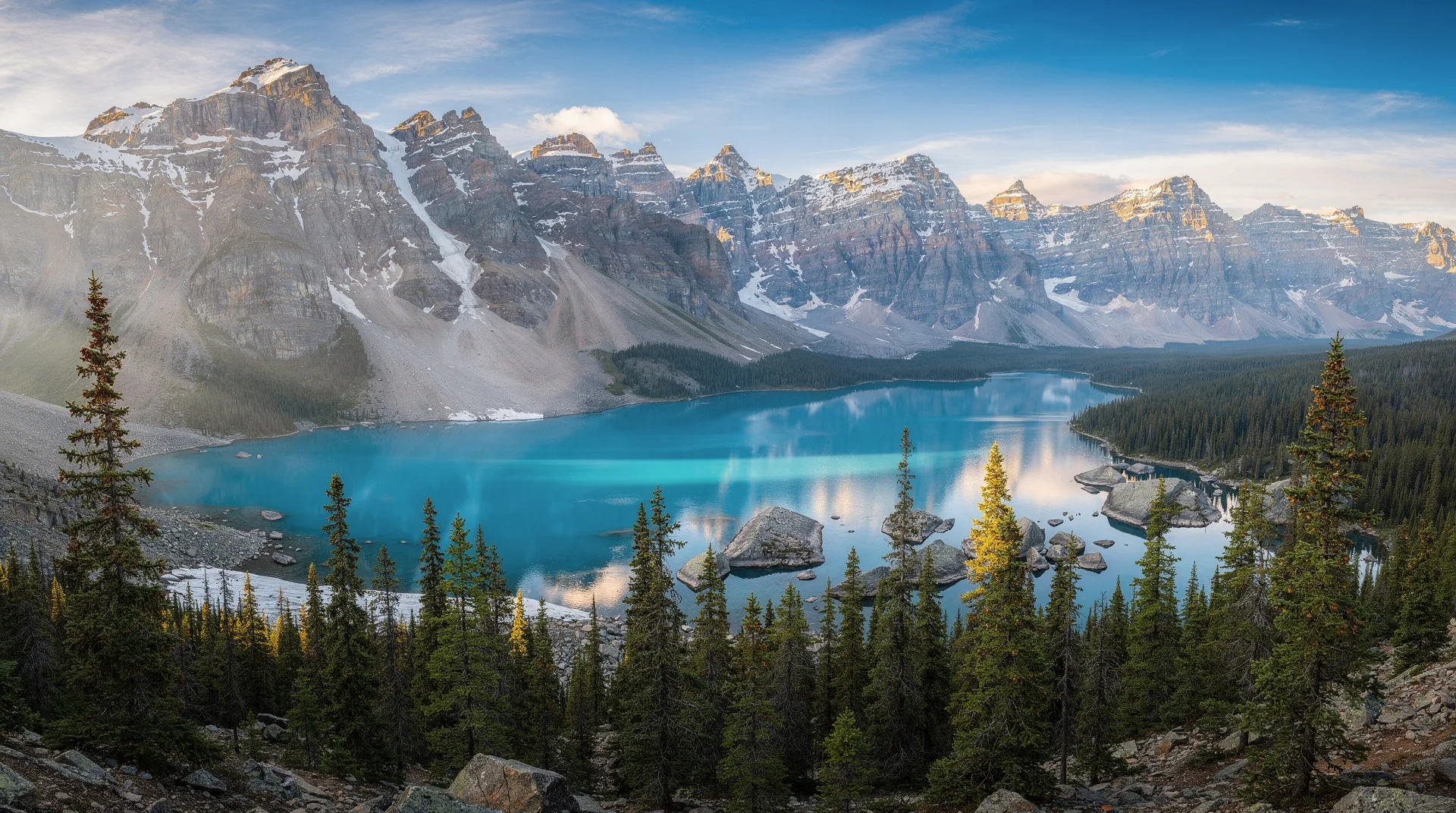
Canadian Rockies vs American Rockies: which to visit?
Are the Canadian Rockies better than the American Rockies?
The Canadian Rockies offer more dramatic turquoise lakes, bigger glaciers, easier wildlife viewing, and more compact touring. The American Rockies (Montana, Wyoming, Colorado) have geothermal wonders like Yellowstone, wider colour palette, and more variety across states. For first-time Rockies visitors, Canada wins for concentrated awe; the US wins for variety over longer trips.
The Rockies stretch nearly 4,800 km from northern British Columbia to New Mexico. They are often lumped together, but the Canadian and American sections feel like different worlds. The Canadian Rockies are younger geologically, more heavily glaciated, and protected by an almost unbroken string of national parks. The American Rockies are drier, broader, and scattered across seven states, each with its own character.
If you have one mountain holiday in you, this guide will help you decide where to spend it — and why some travellers eventually need to see both.
| Where | Canadian Rockies: Alberta/BC border, via Calgary; American Rockies: Montana to Colorado |
| Cost | Canada around CAD $2,500–4,500/week per person; US varies widely by state |
| Time needed | One week suits the Canadian side; two to four weeks suits an American Rockies road trip |
| Getting there | Canada: Calgary airport, road-based; US: multiple regional airports, longer drives between parks |
| Best time | June–September for both; September for fewer crowds and better light |
Which comparison table matters most
| Factor | Canadian Rockies | American Rockies |
|---|---|---|
| Signature scenery | Turquoise glacial lakes (Moraine Lake, Lake Louise) | Geothermal features (Yellowstone), red-rock canyons |
| Wildlife density | High, easily seen from roadside | Very high in Yellowstone specifically; thinner elsewhere |
| Trip length that fits best | One week | Two to four weeks |
| Access | Single airport (Calgary), road-connected parks | Multiple airports, long drives between parks |
| Peak season crowding | Severe at Moraine Lake and Lake Louise; shuttle reservations required | Severe at Yellowstone; timed-entry systems at several parks |
| Winter appeal | Compact ski trip (Banff, Lake Louise, Sunshine) | Scattered ski resorts across several states |
For trip planning once you’ve chosen a side, the Banff National Park guide, best time to visit Banff, and the Canadian Rockies overview cover the Canadian side in depth. A Banff vs Jasper comparison helps narrow the itinerary further once you’ve committed to Canada.
Combining both ranges in one trip
Some travellers with three or more weeks combine both ranges into a single north-south road trip, flying into Calgary, covering Banff and Jasper, then driving south through BC and crossing into Montana toward Glacier National Park before continuing to Yellowstone and Grand Teton. This works logistically but requires careful border-crossing planning and vehicle insurance that covers cross-border travel — check with your rental company well in advance, since not all Canadian rental agreements permit US drop-offs.
The short answer
For most first-time Rockies visitors, the Canadian side wins. Four adjoining national parks — Banff, Jasper, Yoho, and Kootenay — pack more turquoise lakes, icefields, and accessible viewpoints into a 300-km corridor than anywhere in the American Rockies. The drive between them, the Icefields Parkway, is routinely ranked among the world’s greatest roads.
The American Rockies reward longer, more exploratory trips. You can spend a month driving from Glacier National Park in Montana down to Rocky Mountain National Park in Colorado without repeating yourself. The scenery shifts from glaciated peaks to red-rock canyons to geothermal basins. But the experience is more spread out.
Scenery and landscape
The Canadian Rockies are defined by ice and water. Ongoing glaciation from the Columbia Icefield feeds meltwater into hundreds of lakes, and fine rock flour gives those lakes their famous milky turquoise colour. Lake Louise, Moraine Lake, Peyto Lake, and Maligne Lake are the photogenic stars. The peaks are sharp, steep, and often look more alpine than their elevation suggests because treelines are lower.
The American Rockies are drier and more varied. In Glacier National Park (Montana), you still get glaciated peaks and alpine lakes. In Yellowstone (Wyoming/Montana), geysers, hot springs, and bison-filled valleys dominate. Grand Teton has some of the most photographed mountain skylines in North America. Rocky Mountain NP (Colorado) is higher in elevation, with a lot of tundra above 3,500 metres. Further south, you slide into red-rock country around Utah and Colorado, which is a completely different landscape altogether.
Wildlife
Both ranges are wildlife-rich, but the viewing experience differs.
Canadian Rockies: grizzly and black bears, elk, moose, bighorn sheep, mountain goats, and wolves in remote valleys. Wildlife often appears within sight of the highway, especially at dawn and dusk along the Icefields Parkway and Bow Valley Parkway. Bears are common but well-managed.
American Rockies: Yellowstone alone hosts the largest concentration of free-roaming mammals in the lower 48 — bison, elk, grizzlies, wolves, moose, and pronghorn. Lamar Valley in Yellowstone is arguably the best wildlife viewing location in North America. Outside Yellowstone, wildlife is present but thinner.
Edge goes to Yellowstone for sheer volume and diversity, but the Canadian Rockies offer more reliable bear sightings for casual visitors.
Crowds and infrastructure
The Canadian Rockies funnel most visitors through two hubs: Banff and Jasper. In peak July and August, Moraine Lake requires shuttle reservations, and parking lots fill by 8 am. Banff town is crowded but well-serviced. Jasper, by contrast, feels refreshingly calm even in peak season.
The American Rockies absorb visitors across more parks. Yellowstone is chaotic at peak times, with traffic jams caused by bison. Glacier NP requires timed-entry reservations for the Going-to-the-Sun Road. Rocky Mountain NP also uses timed entry. Rural infrastructure around the parks varies wildly — some gateway towns are polished, others basic.
Costs
Canada is currently more affordable for international travellers thanks to a weak Canadian dollar. A typical week in Banff and Jasper runs CAD $2,500-4,500 per person excluding flights. Park fees are modest: CAD $12.25 per adult per day, or CAD $24.50 per family or group vehicle.
The American Rockies can be cheaper or more expensive depending on state. Wyoming and Montana are generally moderate. Colorado is pricier, especially around Aspen and Vail. US National Park annual passes cost USD $80 and cover all parks.
Access
The Canadian Rockies are best accessed via Calgary International Airport (YYC). Banff is 90 minutes from the airport. The main parks are connected by road; no domestic flights are needed.
The American Rockies are scattered. Glacier NP is nearest to Kalispell (FCA). Yellowstone and Grand Teton share access via Bozeman (BZN) or Jackson Hole (JAC). Rocky Mountain NP is easy from Denver (DEN). Linking them requires long drives or multiple flights.
What a day actually feels like
The difference between the two ranges shows up most clearly in how a typical day unfolds. In the Canadian Rockies, you can wake in Banff, reach a glacial lake before breakfast, drive a scenic road in the afternoon and be back in town for dinner without feeling rushed. The scenery is stacked so closely that the hardest decision is usually what to leave out, not how to fit it all in. If you want help sequencing those days, the 10-day Canadian Rockies itinerary shows how the parks link together in a single loop.
An American Rockies day is more often built around a long, rewarding drive. You might spend the morning watching wildlife in a wide valley, then the afternoon crossing a state line toward the next park. The reward is variety and a sense of open country, but the pace is slower and the daily distances are part of the experience. Neither rhythm is better; they suit different temperaments. Travellers who like to hike hard and photograph a lot in a short window tend to prefer the Canadian pattern, while those who enjoy long road days with frequent stops tend to prefer the American one.
The other Canadian parks worth knowing
Banff and Jasper get most of the attention, but the Canadian side is stronger than it first appears because the neighbouring parks add depth rather than repetition. Jasper National Park is quieter and wilder in feel. Yoho National Park packs waterfalls, rail history and rugged valleys into a small area, and Kootenay National Park adds a different, warmer side of the mountains with canyons and mineral springs. Together they give a first-time visitor several distinct moods without ever leaving the same mountain region, which is part of why the Canadian Rockies work so well on a shorter trip. If you prefer not to drive everything yourself, you can browse guided tours across Canada and compare the options.
Choosing your lake days
Lake-focused travellers often ask which lakes to prioritise. The Lake Louise vs Moraine Lake comparison helps if you only have time for one, and the Icefields Parkway stops guide shows which viewpoints along the road are worth a real pause and which can be a quick photo. On the American side, the equivalent decision is usually about which park to anchor your trip around, because each one offers a very different kind of scenery rather than variations on the same theme.
Wildlife etiquette on both sides
Whichever range you choose, the animals are wild and the rules are there for good reasons. Keep a respectful distance, never feed anything, and stay in your vehicle when a large animal is close to the road. The Canada wildlife safety guide explains bear awareness and what to do if you meet an animal on the trail, and wildlife watching in Alberta is a useful companion for planning the best times of day to look. The same common sense applies in Yellowstone, where crowds gathering around roadside animals can create real danger for both people and wildlife.
Practical planning notes
A few practical points are easy to overlook when comparing the two ranges. On the Canadian side, a vehicle gives you the most freedom, so read the Canada car rental guide before you book, especially if you plan any cross-border driving. Park access is handled through a pass system, and the Parks Canada Discovery Pass guide explains when an annual pass is better value than daily fees. If this is your first trip across the border region in general, the Canada vs USA first trip comparison offers a broader view of how the two countries differ for visitors.
Finally, think about the season you can actually travel in. If your dates fall in early autumn, the larch season in Alberta is a strong reason to lean toward Canada, since golden larches make the high valleys glow for a short window. If your dates are fixed in midsummer, plan around crowds on both sides and book early. Popular excursions sell out first, so it helps to reserve Canada day tours and activities well ahead.
Best for specific trips
- First-time mountain holiday, one week: Canadian Rockies.
- Wildlife-focused photography trip: Yellowstone and Grand Teton.
- Road trip, three weeks or more: American Rockies.
- Family-friendly with easy access: Canadian Rockies.
- Geothermal features and variety: American Rockies.
- Iconic turquoise lakes and icefields: Canadian Rockies.
When to go
Both ranges share a similar season. June through September is prime. July and August are hottest and most crowded. Late September brings fewer crowds and fall colour — larch season in the Canadian Rockies is a highlight. Winter transforms both ranges into ski destinations, though the Canadian side (Banff, Lake Louise, Sunshine Village) is more compact for ski trips.
The honest verdict
If you want one mountain trip that concentrates dramatic, photogenic landscapes into a drivable loop, choose the Canadian Rockies. Flight logistics are simpler, the Icefields Parkway is unmatched, and infrastructure is reliable.
If you have more time and appetite for variety — geysers, bison herds, cowboy towns, desert-edge canyons — the American Rockies reward a longer, more exploratory approach. Many serious mountain travellers eventually do both and find they complement rather than compete.
Frequently asked questions about Canadian Rockies vs American Rockies
Is it possible to visit both the Canadian and American Rockies in one trip?
Yes, with three weeks or more. Fly into Calgary, cover Banff and Jasper, then drive south across the border to Glacier National Park in Montana and continue toward Yellowstone. Confirm your rental car’s cross-border policy before booking.
Which is cheaper, the Canadian Rockies or the American Rockies?
It depends on the season and exchange rate, but Canada currently tends to be more affordable for international visitors thanks to a weaker Canadian dollar, while costs on the American side vary widely by state — Wyoming and Montana are moderate, Colorado is pricier.