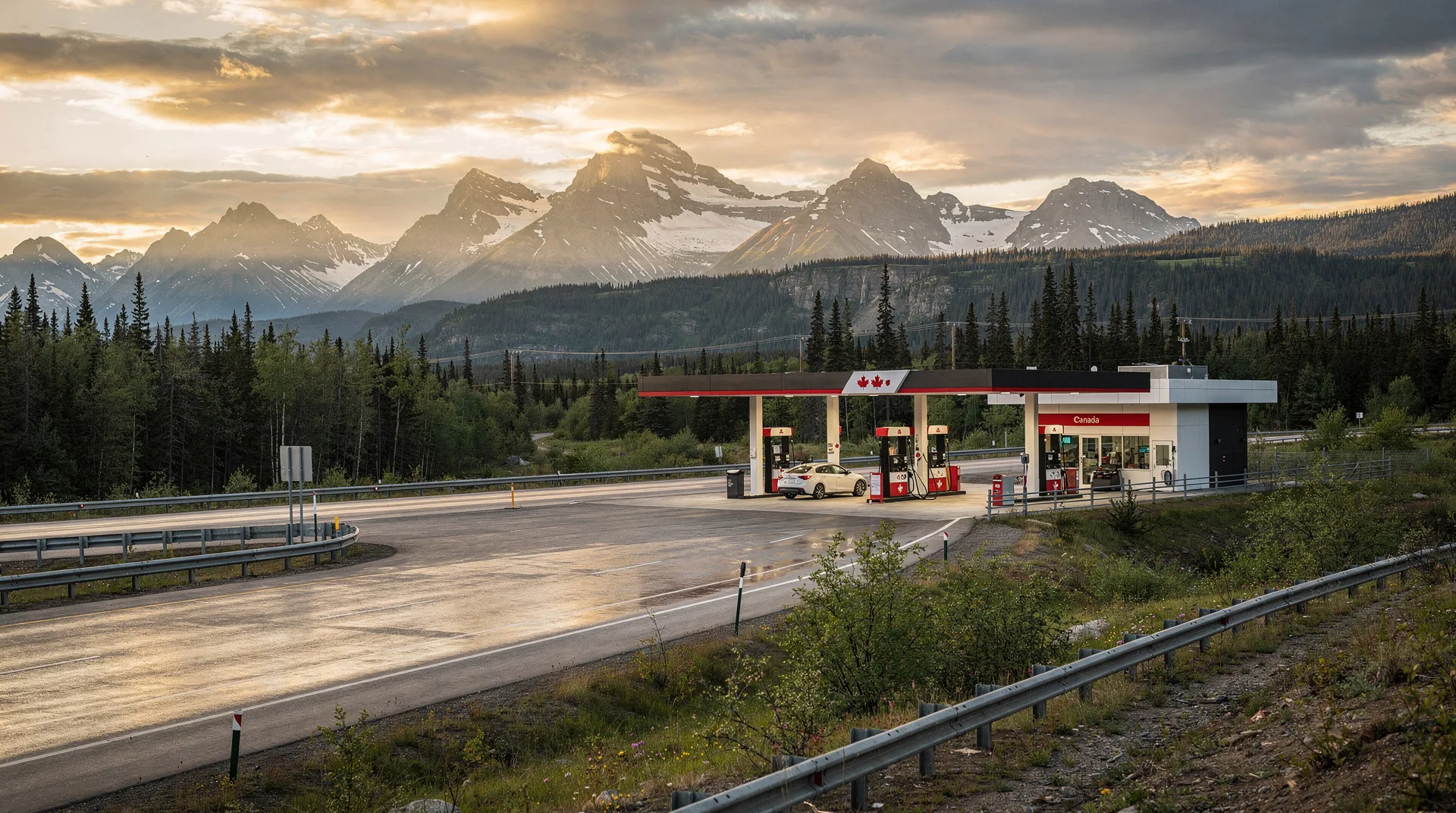
Canada fuel stations and highways guide
How do gas stations work in Canada?
Canadian gas is sold by the litre, typically CAD $1.40-1.90/L depending on province and season. Alberta and some others require prepay at the pump. Stations are plentiful in populated areas but scarce on northern highways — plan refuels 200+ km apart in Yukon, Labrador, northern Ontario. Most accept credit cards and Interac debit.
Fuelling a Canadian road trip isn’t complicated, but there are quirks that surprise visitors: prepay rules, enormous distances between stations on northern highways, cross-provincial price differences, and the occasional “diesel is cheaper than gas” region. This guide covers what you need to know.
| Where | Every province, but logistics change sharply between southern corridors and northern highways |
| Cost | Roughly CAD $1.35-2.10/L depending on province, higher again in remote north |
| Time needed | A few minutes per stop in populated areas; build in extra buffer time in the north |
| Getting there | Any rental car works; app-based route planning (GasBuddy, iOverlander) helps most in remote regions |
| Best time | Any season for southern routes; avoid deep winter for the most remote northern highways unless well prepared |
Fuel basics
- Units: sold by the litre (L). 1 US gallon ≈ 3.78 L; 1 UK gallon ≈ 4.55 L.
- Common grades: Regular (87 octane), Mid-grade (89), Premium (91-94).
- Diesel: available at most truck stops and large stations; less common at urban stations.
- Ethanol blends: most Regular gas in Canada contains 5-15% ethanol. Not all car rentals prefer higher blends; check manual.
- Fuel brands: Petro-Canada, Esso, Shell, Chevron, Husky (now Cenovus), Ultramar, Pioneer, Costco, Canadian Tire Gas+, Co-op.
Prices by region
Fuel prices vary significantly across Canada. Rough 2026 averages per litre:
- BC (Vancouver and Lower Mainland): CAD $1.80-2.10 (highest in Canada, multiple taxes)
- BC interior and north: CAD $1.60-1.90
- Alberta: CAD $1.35-1.60 (lowest in populated Canada)
- Saskatchewan, Manitoba: CAD $1.45-1.70
- Ontario: CAD $1.55-1.85
- Quebec: CAD $1.60-1.90
- Maritimes: CAD $1.60-1.85
- Newfoundland: CAD $1.75-2.00
- Yukon, NWT: CAD $1.70-2.00 (higher at remote stations, up to $2.50)
Prepay rules
After fuel-theft incidents, some provinces require prepay at the pump:
- Alberta: mandatory prepay provincewide since 2018.
- Saskatchewan, BC: many stations require prepay; varies by station.
- Ontario, Quebec, Maritimes: generally pay after pumping, though some urban stations require prepay at night.
Prepay options:
- Insert credit or debit card at the pump (most common)
- Pay cash inside before pumping (tell attendant “CAD $50 on pump 4” then return if the tank doesn’t take that much)
- Full-service attendants (rare; mainly in smaller rural towns)
Accepted payment
- Visa, Mastercard: universal
- American Express: accepted at most chains, rejected at some smaller independents
- Interac (Canadian debit): universal; foreign debit cards may or may not work
- Cash: always accepted but less convenient for prepay
- Contactless/tap: widely supported, CAD $250 transaction limit at the pump
Chip-and-PIN is standard. US magnetic stripe cards may be rejected at automated pumps — go inside to pay.
Station density by region
Dense (stations every 5-30 km)
- All major cities and suburbs
- Trans-Canada Highway through Ontario, Quebec, Maritimes
- Highway 1 through BC Lower Mainland
- Highway 2 between Calgary and Edmonton
- Quebec 20 and 40 corridors
Moderate (stations every 40-80 km)
- Rural Prairies secondary highways
- Rocky Mountain routes between major parks
- Northern Ontario (Highway 11 and 17)
- Cabot Trail and rural Maritimes
- Newfoundland (Trans-Canada)
Sparse — plan carefully
- Alaska Highway in Yukon/BC: stations every 100-300 km. Some open seasonal only.
- Dempster Highway (Yukon to Inuvik): only two fuel points over 740 km. Carry extra.
- Labrador Highway (510/500): remote stations, some 200+ km apart.
- Trans-Labrador Highway: fuel widely spaced; extra jerrycan recommended.
- Parts of northern Ontario and Manitoba: especially seasonal routes.
Fuel gaps: specific warnings
- Jasper to Whitehorse via Cassiar Highway: some segments 200+ km between stations, and some are closed off-season.
- Churchill, Manitoba: no road access; not relevant, but if driving to Thompson (railhead), plan for 700+ km from Winnipeg with moderate station spacing.
- Great Northern Peninsula (Newfoundland): final 400 km to L’Anse aux Meadows has limited stations, confirm they’re open.
- Dempster and Inuvik-Tuktoyaktuk Highway: extreme fuel discipline needed.
Services at Canadian stations
Full-service stations are rare outside specific corners of Quebec and small Ontario towns. Self-serve is the norm. Typical amenities:
- Pumps (most have 4-8)
- Convenience store (snacks, drinks, basic supplies)
- Washrooms (free with purchase; sometimes key required)
- Air for tires (sometimes free, often CAD $1-2)
- Windshield squeegee buckets
- Coffee (Tim Hortons partnerships common at Esso, Shell)
Truck stops
Full-service truck stops on main highways offer:
- 24-hour operation
- Showers for truckers (sometimes open to road-trippers, CAD $10-15)
- Restaurants (full meals, often 24 hours)
- Laundry
- Large parking areas
Notable Canadian truck stop chains: Husky, Flying J (Pilot), TA (TravelCenters of America in border regions), Irving Oil (Maritimes).
Winter fuel considerations
Canadian winters affect fueling:
- Winter gasoline blends: sold from late fall; slightly different from summer blend but no action needed.
- Fuel gelling (diesel): below -15°C, diesel can gel. Use “winter” or “Arctic” diesel in northern regions; most stations switch automatically.
- Fuel-line freeze: older cars may benefit from fuel-line antifreeze additive in extreme cold.
- Fill-up habit: keep tank above half full in winter to prevent condensation freezing in the line and for emergency warmth if stranded.
- Heated pumps: common in Prairie and northern stations; pumps may be slow in extreme cold.
Electric vehicles
EV charging in Canada has improved rapidly.
- Tesla Supercharger: extensive network on Trans-Canada Highway and in cities.
- Electrify Canada, ChargePoint, Petro-Canada EV network: cover major routes but not all regions.
- Remote/northern Canada: very limited EV infrastructure.
- Rental EVs: increasingly common in urban rentals; confirm charging logistics for your route.
If driving an EV outside major urban-to-urban routes, plan charging carefully using PlugShare or similar apps.
Fuel efficiency realities
Canadian highways are long, and speed limits are generous. Typical mid-size SUV on highway: 8-10 L/100 km. Small car: 6-8 L/100 km. Large SUV or minivan: 10-14 L/100 km. Budget fuel accordingly:
- Calgary-Banff return (250 km total): CAD $25-40
- Vancouver-Whistler return (250 km): CAD $30-50
- Toronto-Quebec City (800 km): CAD $100-140
- Halifax loop Cabot Trail (700 km): CAD $90-130
Renting a car and fuel policy
Most Canadian rental agencies use a full-to-full fuel policy: you receive the car with a full tank and must return it full, with a receipt as proof if asked. Returning it less than full triggers a refuelling charge that is almost always more expensive per litre than filling up yourself near the return location. See the Canada car rental guide for policy details, and the driving on the right-hand side guide if you’re used to left-hand traffic.
If your route runs through the Rockies or along the Icefields Parkway, fuel up in Banff, Canmore, Jasper or Lake Louise before setting out — services along the parkway itself are limited and seasonal. See Icefields Parkway stops for the full list of what’s actually open along the route.
Remote and northern route planning
For genuinely remote routes — the Dempster Highway, the Trans-Labrador Highway, the Alaska Highway through the Yukon — fuel planning is not optional. Carry a paper map or offline app data as a backup since cell coverage disappears for long stretches, and treat the “two fuel points over 740 km” figure on the Dempster as a hard planning constraint, not a rough guide. See the Dempster Highway guide and the BC driving distances guide for route-specific planning.
Useful apps
- GasBuddy: real-time prices and crowdsourced updates
- Pump Finder: Canadian station locator
- PlugShare: EV charging
- iOverlander: remote station locations and fuel availability in northern areas
Fraud and safety
- Skimmers are occasionally found at rural pumps. Inspect card readers for loose attachments.
- Fuel theft is rare for tourists.
- Some stations have inflated credit authorization (CAD $150 hold) when you insert card — this clears after the actual transaction amount posts.
Common mistakes
- Forgetting that Alberta requires prepay; holding up attendants by going “to tank up” first.
- Underestimating northern fuel gaps.
- Driving on fumes in remote regions because “there was a station 20 minutes back.”
- Filling with Premium when Regular is fine (wasted money; no performance benefit unless car specifies Premium).
- Running out of fuel in winter — can damage fuel pump and strand you in dangerous cold.
Rule-of-thumb refuel discipline
- Urban/southern Canada: refuel at quarter tank.
- Trans-Canada Highway: refuel at quarter tank; stations reliable.
- Northern highways (Yukon, Labrador, Alaska Highway): refuel at half tank or at every reliable station.
- Winter anywhere: keep tank above half.
Building fuel stops into your itinerary
The easiest way to stay relaxed about fuel is to treat refuelling as part of the schedule rather than an interruption. Pair each fill-up with something you were going to do anyway: a coffee, a washroom break, a picnic lunch, a stretch of the legs. On long days, decide in the morning where you will top up, and choose a town large enough to have more than one station in case one is closed or has a long queue.
Drivers heading west should note that the mountain towns are the natural refuelling points before the long scenic drives. If you are planning the classic route from Calgary, the driving Calgary to Banff guide and the driving Banff to Jasper guide show where the services cluster. The Icefields Parkway guide is worth reading before you commit to a departure time, since a full tank removes one source of stress on a day that is already full of stops.
On the east coast, the same logic applies to scenic loops. Before setting out on the Cabot Trail, fill up in a larger town, and use the driving Atlantic Canada guide to think through where the longer gaps fall between communities. In Quebec, the Gaspésie loop itinerary follows a coastline where villages are close together in places and far apart in others, so a habit of topping up at half a tank costs you nothing and buys peace of mind.
Fuel and the wider cost of a road trip
Fuel is only one line in a road-trip budget, but it is the one that surprises people most because prices change as you cross provincial borders. A sensible approach is to fill up in the cheaper province before crossing into a more expensive one, as long as it does not mean arriving at the border with a nearly empty tank. For the bigger picture, the Canada budget guide and the save money guide explain how fuel, accommodation and activities fit together, and the Canada road trip itinerary gives a sense of how many kilometres a typical trip involves. When you want a break from driving, you can browse guided tours across Canada and let someone else handle the fuel.
If you are weighing a rental against other options, the coast-to-coast train versus drive guide compares the trade-offs, and the getting around guide covers the alternatives when a car does not make sense for part of your trip. Campervan travellers should also read the RV and camper van guide, because larger vehicles drink more fuel and benefit most from careful planning.
Small habits that make a difference
A few simple routines remove most fuel-related stress. Check the fuel gauge whenever you stop for any reason, not only when the warning light comes on. Keep a receipt from your last fill-up if you are driving a rental. Take a photo of the pump number if you are paying inside, so there is no confusion with the attendant. And when a local tells you the next station is open, trust but verify: in small communities, hours can change with the season, and a quick look at a map app can save a long detour. For stretches where driving yourself is impractical, book Canada day tours and excursions instead.
The takeaway
Canadian fuel logistics are simple in populated areas and demanding in the far north. Use GasBuddy to save on prices, plan your refuels in remote areas, and respect the distances involved. Get those right, and fuel stops become a relaxed part of the road trip instead of a running anxiety.
Frequently asked questions about Canada fuel stations and highways guide
Do I need cash for gas stations in Canada?
No — the large majority of Canadian gas stations accept credit and debit cards at the pump, and cash is rarely required except at a handful of very small rural or Indigenous-community stations. Carrying some cash as backup is sensible on remote northern routes.
Is diesel widely available in Canada?
Yes at truck stops and most highway stations, though less common at small urban stations focused on passenger vehicles. If you’re renting a diesel vehicle, confirm your planned route has diesel-capable stations, particularly in the far north.