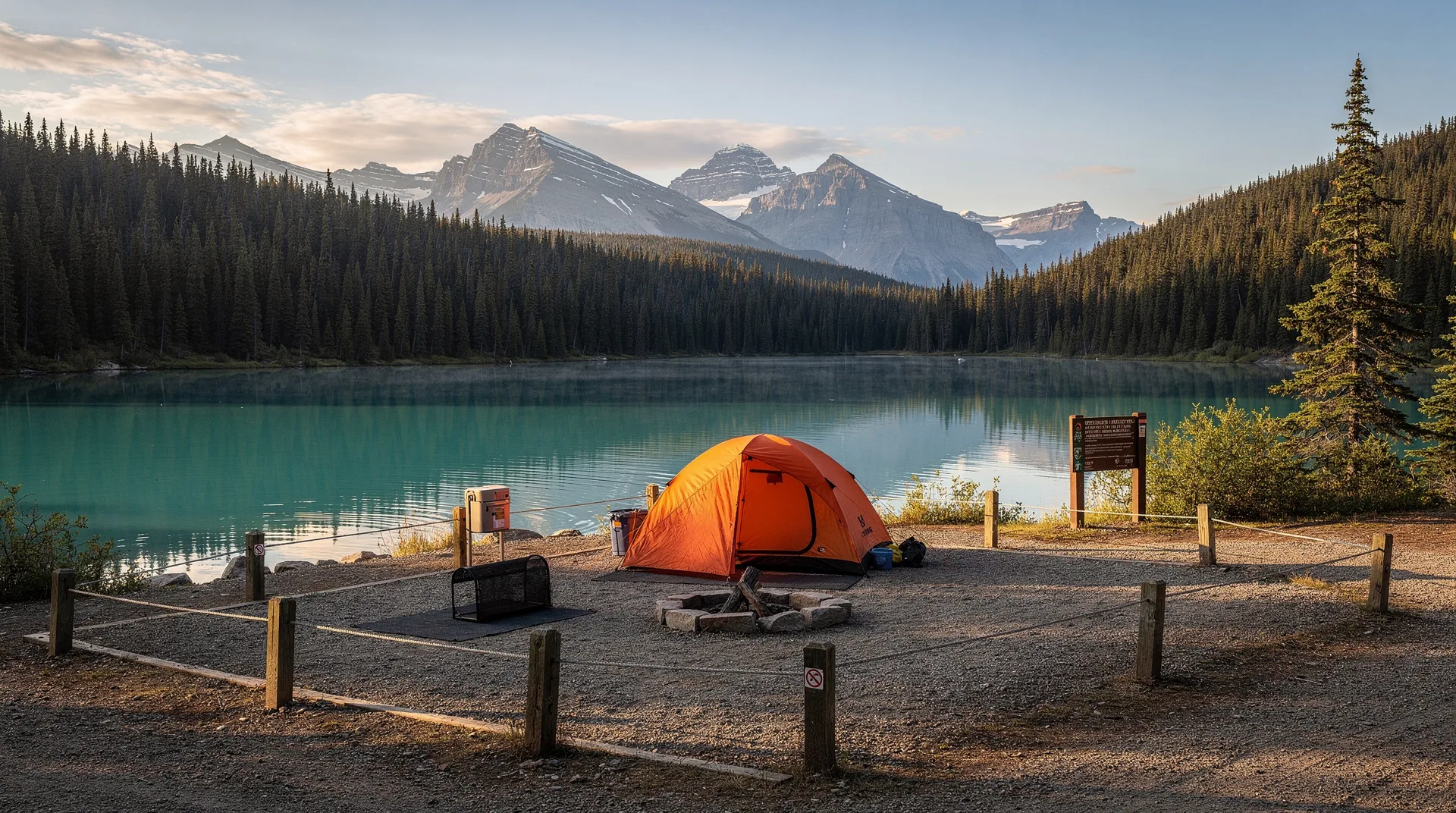
Canadian camping rules: permits, bookings, etiquette
What are the rules for camping in Canada?
Most national and provincial park camping requires advance reservations through Parks Canada's system (opens January) or provincial systems. Backcountry requires separate permits. Fire bans are strict in summer. You must store food in bear-proof lockers. Free dispersed camping (Crown land) is legal in most provinces for Canadian residents, limited for visitors.
Camping is one of the most Canadian experiences a traveller can have — and it comes with more rules than many visitors expect. Canada’s national and provincial parks run carefully managed reservation systems, fire regulations are strict, and wildlife safety is taken seriously for good reason.
This guide covers what you need to know: where you can camp, how to reserve, the rules, and the etiquette that keeps Canada’s parks enjoyable for everyone.
| Where | National parks (reservation.pc.gc.ca), provincial systems, or Crown land outside parks |
| Cost | Around CAD $18-45 per night frontcountry, plus an CAD $11.50 reservation fee |
| Booking window | National parks open reservations in January for the summer season |
| Getting there | A rental vehicle is usually essential — see the car rental guide |
| Best time | July-August is busiest and books out fastest; June and September are calmer and cheaper |
The three types of camping in Canada
- Frontcountry camping: drive-in campgrounds in national and provincial parks, with toilets, picnic tables, fire pits, and often showers.
- Backcountry camping: hike-in or paddle-in sites in wilderness areas, with basic facilities only (tent pads, sometimes bear-proof food storage).
- Dispersed / Crown land camping: free camping on public land outside parks, with no facilities.
Each has its own rules.
Reservations: national parks
Parks Canada operates a centralized reservation system at reservation.pc.gc.ca. Highlights for 2026:
- Launch dates: bookings open in January for the coming summer. Exact dates vary by park (Banff and Jasper launch earliest, typically late January).
- Cost: campsite fees range CAD $18-45 per night plus a CAD $11.50 reservation fee.
- Park entry: a separate day pass or annual Discovery Pass is required on top of campsite fees.
- Cancellation: fully refundable up to 3 days before arrival, minus a CAD $11.50 fee.
Popular campgrounds (Tunnel Mountain in Banff, Whistlers in Jasper, Green Point in Pacific Rim) book out within hours on launch day. Set reminders.
Reservations: provincial parks
Each province runs its own system. Key ones:
- Ontario Parks: reservations.ontarioparks.com. Five months in advance. Algonquin backcountry sites go fast.
- BC Parks: camping.bcparks.ca. Four months in advance. Day hikers at Garibaldi and Joffre Lakes need a free day-use pass in season; camping reservation holders do not need a separate one.
- SÉPAQ (Quebec): sepaq.com. Quebec’s provincial parks system, highly organized. Reservations open months ahead.
- Alberta Parks: reserve.albertaparks.ca. Kananaskis Conservation Pass required in addition (CAD $15/day or $90/year).
- Parks NS, NB, PEI, NL: individual systems, generally more relaxed.
Backcountry permits
Backcountry camping almost always requires a separate permit beyond the standard campsite booking. Examples:
- Banff/Jasper/Yoho backcountry: permits through Parks Canada, CAD $10 per person per night plus reservation fee.
- West Coast Trail: quota system, approximately CAD $200 per person for the trail pass plus ferry fees.
- Algonquin interior canoe trips: nightly fee per person, reserved through Ontario Parks.
- Nahanni National Park Reserve: expedition permits required, often booked through licensed outfitters.
Permits are checked. Rangers patrol popular areas. Camping without a permit carries fines of CAD $100-500 or more.
Crown land / dispersed camping
Canadians have extensive rights to free camping on Crown (public) land. Visitors have more restricted rights.
- Canadian residents: can camp up to 21 days in one spot on most provincial Crown land.
- Non-residents: typically require a permit (CAD $9-10 per person per night in Ontario and BC) to camp on Crown land.
- Where: outside national and provincial parks, on designated Crown land. Not all provinces permit visitor Crown land camping.
- Rules: leave no trace, no permanent structures, pack out all garbage, respect fire bans.
Apps like iOverlander and provincial Crown land viewers help locate legal spots.
Fire rules
Canadian wildfires have grown more severe. Fire bans are common from June through September, especially in BC, Alberta, Saskatchewan, and parts of Ontario and Quebec.
- Check current fire bans before your trip (BC Wildfire Service, AlbertaFireBans.ca).
- When fires are permitted, use designated fire pits only.
- Never leave a fire unattended. Fully extinguish with water, stir, and verify cool to touch.
- Propane stoves are usually still permitted during fire bans.
- Fines for violating fire bans start at CAD $1,150 in BC and can reach six figures if a fire results.
Bear and wildlife rules
Proper food storage is not optional.
- Store all food, toiletries, cookware, and garbage in bear-proof lockers (frontcountry) or bear hangs / canisters (backcountry).
- Never cook in your tent or leave food in your car overnight in Rockies campgrounds.
- Carry bear spray in areas with grizzlies (Rockies, BC, Yukon, northern provinces).
- Keep minimum 100 m distance from bears, 30 m from elk and moose.
- Feeding wildlife carries fines up to CAD $25,000.
RV and camper van rules
- Most national park campgrounds have RV sites; many have hookups (water, power, sewer).
- Maximum RV length varies by site — check listings.
- Overnight parking in non-campground lots is generally not allowed in national parks.
- Walmart overnight parking is permitted at many (not all) Canadian locations — call the specific store to confirm.
- RV waste dumps are available at most parks and many highway rest stops.
Campground etiquette
- Quiet hours are typically 11pm-7am and strictly enforced.
- Generators allowed only during limited daytime hours.
- Dogs must be leashed in national parks (6 ft/2 m maximum).
- Pack out everything you pack in.
- Use designated grey water disposal — don’t empty dishwater into streams or on ground.
Planning your first night under canvas
If this is your first time camping in Canada, start small. A single night or two at a drive-in campground in a national or provincial park is the gentlest introduction: you are close to your vehicle, there are toilets and water nearby, and rangers or camp hosts are on hand if something goes wrong. Many travellers build the rest of the trip around that first stay and add more adventurous nights later, once they have a feel for the routine.
Think about the practical rhythm of a camping day. Arrive with enough daylight to pitch your tent, sort out your food storage and read the campground notice board, which usually lists current fire restrictions, wildlife sightings and any trail closures. Evenings can cool quickly even after a warm day, so pack layers and a sleeping bag rated for colder nights than you expect. Mountain weather in particular changes fast, as the packing list explains in more detail.
Think, too, about the weather you are likely to meet. Seasonal patterns differ a lot between the Rockies, the Pacific coast and the Atlantic provinces, so it pays to read the best time to visit Canada guide before you commit to dates. Shoulder-season camping can be quiet and rewarding, but some campgrounds open late or close early, and services such as showers or water taps may be limited at the edges of the season.
What to check before you leave home
A short checklist saves a lot of stress at the campground gate:
- Confirm your reservation details and arrival window, and keep a copy on your phone that works without a signal.
- Check whether the park requires a separate entry pass, and buy it in advance if you can.
- Look up current fire bans and any area closures for the park and the region around it.
- Make sure you know where the nearest bear-proof lockers or food storage facilities are.
- Download offline maps, because mobile coverage is patchy or absent in many parks.
- Plan your route and fuel stops. Long stretches between towns are normal, and the getting around guide covers the basics of travelling between regions.
Visitors arriving from abroad should also confirm that their travel documents are in order well before departure; the Canada eTA and visa guide explains who needs what.
Gear and food: what actually matters
You do not need expensive equipment to camp well, but a few items are worth getting right. A tent that suits the conditions, a sleeping system that keeps you warm, a stove that is allowed during fire bans and a reliable headlamp cover most needs. If you do not want to carry a full kit across the Atlantic, renting or buying locally once you arrive is common, and a rental vehicle gives you somewhere to carry it all.
Food planning is where the rules and the practicalities meet. Everything with a scent counts as food in bear country: snacks, toothpaste, sunscreen, pet food and the cooler itself. Plan simple meals that you can cook and clean up quickly, and store everything in the provided lockers the moment you finish. Cooking away from your tent and washing dishes promptly keeps smells down and keeps wildlife from learning that campsites mean food. The wildlife safety guide goes deeper on how to behave around bears, moose and other animals.
Camping with children, dogs and groups
Families often find that campgrounds are among the most relaxed places to travel in Canada. Children enjoy the freedom of a car-free loop, a fire pit and a night sky with little light pollution. Choose a site near the toilets and water, set clear boundaries about where they can roam, and teach them early that food stays in the locker and wildlife stays at a distance. The Canada with kids guide has more ideas for trips that suit younger travellers.
Dogs are welcome in many campgrounds but not everywhere, and leash rules apply even where they are allowed. Dogs can attract or provoke wildlife, so keep yours close, never leave it tied up unattended and pick up after it. Large groups should check whether a campground limits the number of people or tents per site, and book adjacent sites well ahead if you want to stay together. If your group would rather leave some activities to a local expert, you can reserve Canada day tours and excursions in advance.
Leave no trace in practice
The phrase appears in every park brochure, and it is worth taking literally. Camp only on durable, established surfaces, keep to marked trails, and never cut or damage living trees for firewood or shelter. Pack out all rubbish, including food scraps and fruit peels, which do not break down quickly in cold, dry or high-altitude environments. Keep noise low, especially near water and at dusk and dawn when wildlife is most active. If you are heading into the backcountry, think about where you will relieve yourself well in advance and follow the park’s specific guidance.
Respect extends to the people who live and work around the parks. Many protected areas sit on the traditional territories of Indigenous peoples, and learning a little about that history adds meaning to the trip; the Indigenous tourism guide is a good place to begin.
Combining camping with a wider trip
Camping works best as one part of a varied journey rather than the whole of it. Many travellers alternate campground nights with a hotel stay in a town, which gives them a chance to dry gear, do laundry, eat a proper meal and recover. On those off-nights it is easy to fill a day with guided tours across Canada, from wildlife outings to city walks. If you are building a longer route through the mountains, the Banff and Jasper itinerary shows how the two parks fit together and where campgrounds can slot in. On the coast, the Vancouver Island itinerary pairs well with a few nights at provincial and national park campgrounds.
Choosing between national parks, provincial parks and Crown land
| Option | Best for | Facilities | Booking difficulty |
|---|---|---|---|
| National parks | Iconic scenery (Banff, Jasper, Pacific Rim) | Toilets, water, often showers | Hard — books out in hours in peak season |
| Provincial parks | Regional variety, often less crowded | Similar to national, varies by province | Moderate — months ahead recommended |
| Crown land | Budget travellers, RV/camper vans, flexibility | None | Easy but requires self-sufficiency and local knowledge |
For a road trip that mixes all three, pair this guide with the RV and camper van guide and the Canada road trip permits guide before you set out.
When to book
- Peak summer (July-August) in Banff, Jasper, Gros Morne, Pacific Rim: book the day reservations open in January-February.
- Shoulder season (June, September): usually bookable 2-3 months out.
- Off-peak provincial parks: often bookable weeks ahead.
- Backcountry and iconic trails (West Coast Trail, Skoki): book the hour the lottery or reservations open.
Cost summary
- Frontcountry site with services: CAD $30-45/night
- Frontcountry site no services: CAD $18-30/night
- Backcountry site: CAD $10-15 per person per night
- Parks Canada Discovery Pass (annual, unlimited): CAD $83.50 adult, CAD $167.50 family
- Reservation fees: CAD $11.50 per reservation
Common mistakes
- Assuming you can show up without a reservation. In peak summer, you can’t.
- Forgetting to add Park entry passes to the camping reservation.
- Bringing firewood from outside the province (prohibited to prevent pest spread).
- Underestimating how cold Rockies nights get in July (2-8°C is common).
- Leaving food in tents or unlocked coolers.
The short rule of thumb
Reserve early, respect fire bans, store food properly, and pay your permits. Follow those four, and Canadian camping is among the most rewarding experiences the country offers.
Frequently asked questions about Canadian camping rules
Can visitors camp for free on Crown land in Canada?
Non-residents typically need a permit (around CAD $9-10 per person per night in Ontario and BC) to camp on Crown land, unlike Canadian residents who have broader free access. Not all provinces allow visitor Crown land camping.
Do I need a park pass in addition to a campsite reservation?
Yes. A campsite booking only reserves the site itself — a separate day pass or annual Discovery Pass is required for park entry on top of the camping fee.