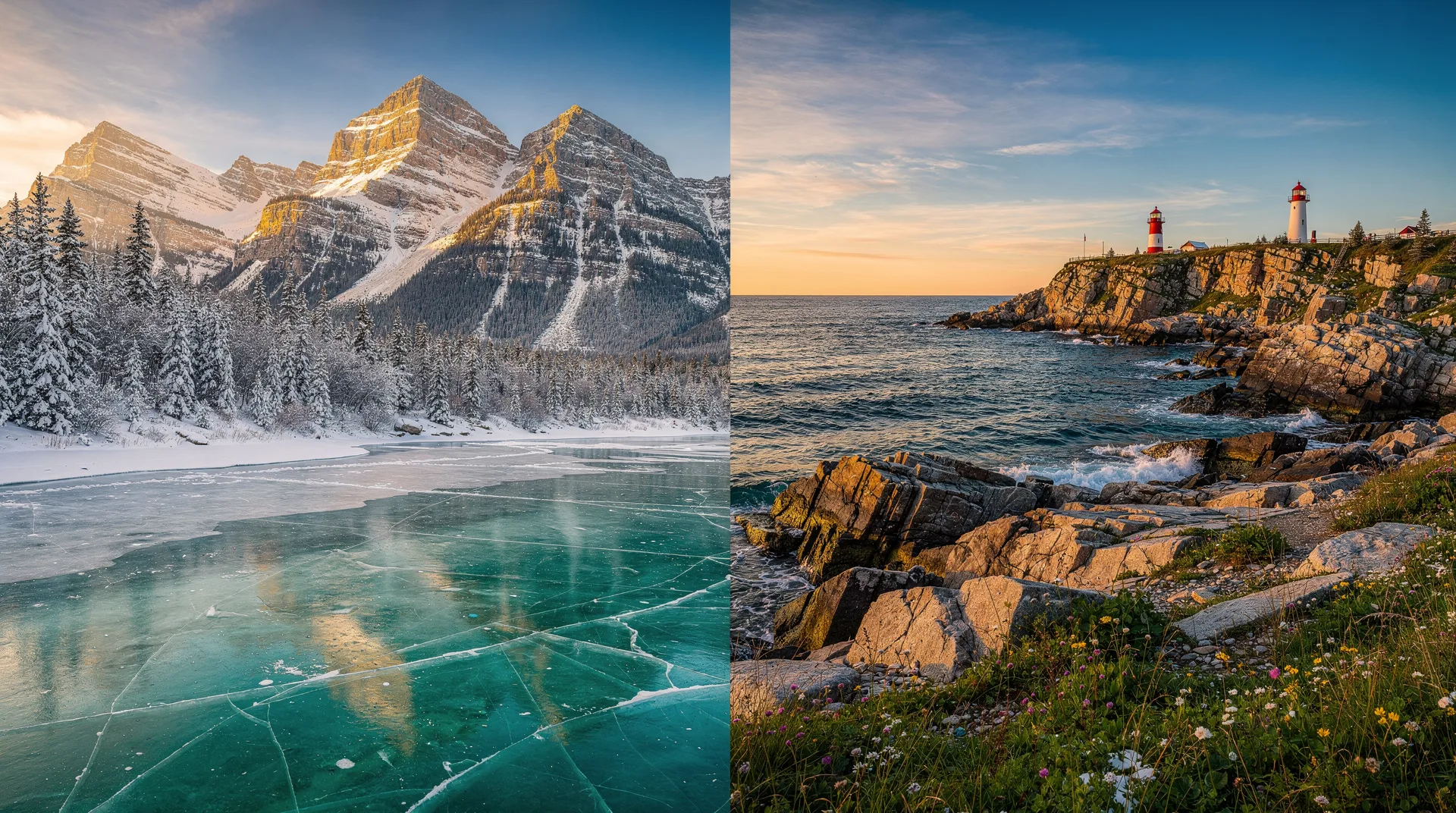
Canada vs Alaska: which wilderness trip wins?
Should I visit Canada or Alaska?
Alaska beats Canada for pure wilderness immersion, bear viewing, and classic glacier cruises. Canada beats Alaska for variety, infrastructure, affordability, and Rockies scenery. For a first wilderness trip, Canada is easier. For a once-in-a-lifetime wildlife expedition, Alaska wins. Inside Passage cruises touch both.
Canada and Alaska share a border longer than most countries have coastline. Both deliver mountains, glaciers, wildlife, and that cold-clear Northern light that photographers chase. But they offer meaningfully different experiences — and very different price tags.
This guide compares them across the decisions that matter most: landscapes, wildlife, access, cost, and the type of trip each one does best.
| At a glance | |
|---|---|
| Best for | Canada: variety and value / Alaska: pure wilderness immersion |
| Typical trip cost (per person, 1 week) | Canada: around CAD $2,500-4,500 / Alaska: around USD $4,000+ |
| Access | Canada: fly into Toronto, Vancouver, Calgary, drive freely / Alaska: mostly cruise or fly into Anchorage/Fairbanks |
| Best season | Both: roughly June-September for wildlife and hiking |
| Combine? | Yes — an Inside Passage cruise or the Alaska Highway road trip links both |
The short answer
Alaska is more remote, more wildly wild, and more expensive. Most visitors arrive by cruise ship; the road network is limited and driving distances are enormous. Alaska wins for bear viewing, glacier cruising, and salmon fishing.
Canada is more accessible, more varied, and more affordable. You can drive the Rockies, fly into dozens of mountain towns, or take the VIA Rail Canadian across four time zones. Canada wins for variety, infrastructure, cultural depth, and multi-city trips.
Landscape
Alaska: home to 17 of the 20 tallest peaks in the US, including Denali (6,190 m). Tidewater glaciers reach the ocean at Glacier Bay and Kenai Fjords. Vast tundra in the Arctic. Temperate rainforest in the southeast panhandle. Active volcanoes on the Aleutian chain.
Canada: the Canadian Rockies, the Coast Mountains, the Laurentians, the Torngat Range in Labrador. Canada has the second-largest glacier system outside the polar regions at the Columbia Icefield. The Yukon borders Alaska and offers similar subarctic landscapes with far fewer visitors.
Neither range is objectively better, but Alaska packs more extreme terrain into its state than anywhere in Canada. Canada offers more landscape variety from coast to coast.
Wildlife
Alaska is the heavyweight for wildlife. Brown bears at Brooks Falls catching salmon, beluga whales in Cook Inlet, orcas off Seward, moose in every region, Dall sheep in Denali, musk oxen on the North Slope. Bear viewing is arguably the best on Earth.
Canada holds its own with grizzlies in BC’s Great Bear Rainforest, polar bears in Churchill, spirit bears (white-morph black bears) on Princess Royal Island, beluga whales in Hudson Bay, narwhals in Nunavut, and an accessible chance of seeing elk, moose, and bighorn sheep without a guide.
Edge to Alaska for sheer volume. Canada is stronger for polar bears and more cost-accessible wildlife experiences.
Glaciers
Alaska has more tidewater glaciers accessible by boat. Glacier Bay, College Fjord, Hubbard Glacier, and Kenai Fjords are all cruise or day-boat destinations where you watch ice calve into the ocean.
Canada’s glaciers are mostly alpine. The Columbia Icefield in Jasper is accessible by specialized ice explorer vehicle. Athabasca Glacier you can walk on. The Juneau Icefield partly lies in BC. Salmon Glacier near Stewart, BC is arguably the most accessible massive glacier in North America.
If you want to see ice calve into salt water, Alaska is required. If you want to walk on a glacier affordably, Canada wins.
Northern lights
Both are excellent, but Canada is more diverse. Yellowknife (NWT), Whitehorse (Yukon), and Churchill (Manitoba) are all premier aurora destinations. Fairbanks, Alaska, is the US equivalent — and arguably the most reliable single city on Earth for aurora viewing September to April.
Costs are comparable. Yellowknife has slightly higher success rates at latitude 62°N.
Access and logistics
Alaska: most visitors arrive by cruise ship through the Inside Passage. Independent travel requires flying into Anchorage (ANC) or Fairbanks (FAI) and using a mix of small-plane charters, the Alaska Railroad, and rental cars. Road access is limited; only a fraction of the state is reachable by road.
Canada: accessible through dozens of international airports — Toronto, Vancouver, Calgary, Montreal. You can drive almost anywhere in the southern 60% of the country. The Trans-Canada Highway runs coast to coast. Domestic flights are frequent.
Canada wins decisively on logistical ease.
Costs
Alaska is expensive. A week-long cruise runs USD $1,500-4,500 per person before excursions. Independent travel including flights, lodges, and a rental car easily exceeds USD $4,000 per person for a week. Bear viewing lodges cost USD $1,200+ per night.
Canada is more affordable. A comparable week in the Rockies or Atlantic Canada runs CAD $2,500-4,500 per person. The weak Canadian dollar sweetens things for American and European visitors. Polar bear viewing in Churchill, while still expensive (CAD $6,000-9,000), is cheaper than comparable Alaskan bear lodges.
Best for specific trips
- First wilderness trip, moderate budget: Canada
- Bear viewing at its peak: Alaska (Katmai, Lake Clark)
- Cruises with glacier calving: Alaska
- Polar bears: Canada (Churchill)
- Coast-to-coast rail journey: Canada (VIA Rail Canadian)
- Driving road trip with variety: Canada
- Once-in-a-lifetime wildlife expedition: Alaska
- Cultural and city travel combined with nature: Canada
Head-to-head summary
| Category | Canada | Alaska |
|---|---|---|
| Landscape variety | Coast to coast: Rockies, prairies, Atlantic coast, Arctic | Concentrated extremes: Denali, tidewater glaciers, Aleutians |
| Wildlife volume | Strong (grizzlies, polar bears, orcas) | Best on the continent (brown bears, salmon runs) |
| Glacier access | Alpine, walkable (Athabasca, Columbia Icefield) | Tidewater, cruise/boat-accessed |
| Logistics | Easy — drive or fly almost anywhere | Harder — limited roads, cruise-dependent |
| Typical week-long budget | Around CAD $2,500-4,500 | Around USD $4,000+ |
| First-timer friendly | Yes | Less so — plan further ahead |
For readers weighing similar wilderness-versus-accessibility trade-offs elsewhere in Canada, the east vs west Canada guide and BC vs Alberta Rockies comparison use the same logic on a smaller scale.
Practical planning notes
If Canada wins your decision, the Canadian Rockies are the natural starting point — Banff and Jasper give you glaciers, wildlife, and alpine scenery within a single, drivable region, and the Columbia Icefield Skywalk is the closest Canadian equivalent to standing on Alaskan ice. Pair it with Churchill for polar bears if wildlife is the priority, or the Yukon aurora season if northern lights matter more than bears.
Budget travellers should note that a Canada-only itinerary using the VIA Rail Canadian or a self-drive road trip keeps costs well below an Alaska cruise, since accommodation and car rental in Canada’s mountain towns run cheaper than Alaskan lodges.
How to choose when you are undecided
Start with the question of what you want to remember afterwards. If the answer is a single overwhelming image, such as a brown bear standing in a river or a wall of ice falling into the sea, Alaska is built for that. If the answer is a string of different good days, with a lake at dawn, a train ride, a city dinner and a wildlife sighting from the roadside, Canada delivers more of them for the same effort.
Time matters as much as money. Canada rewards short trips because the infrastructure is dense: a long weekend in Banff or a Whistler weekend already feels like a complete trip. Alaska rewards patience, because transfers between lodges, boats and small planes eat into the days you have.
Think also about who is travelling. Families, older relatives and first-time visitors usually cope better with Canada’s road network and family activities. Travellers who are comfortable with remote logistics, and who enjoy planning around weather and tides, tend to love Alaska’s rawness.
Canada’s answers to the Alaska experiences
Many people ask whether Canada can stand in for Alaska. For several headline experiences, it can come close, and a few are done better here.
- Bears: the grizzly bear viewing options in British Columbia, including Great Bear Rainforest and Bella Coola, put you on the water or on a viewing platform with a guide. For a rarer sighting, look at the spirit bear tours.
- Whales: whale watching in Canada is strong on both coasts, from Victoria to the Bay of Fundy.
- Mountain scenery: the Icefields Parkway is one of the great drives of the continent, with glaciers, lakes and wildlife along the road itself.
- Far north: the Dempster Highway and the Yukon give you tundra and big sky without needing a chartered plane.
- Aurora: Yellowknife is a dependable base for northern lights, with a long season of clear, cold nights.
Where Canada does not match Alaska is the sheer scale of untouched country you can reach in a single trip, and the tidewater ice that you can only see from a boat. That is the honest trade-off, and it is worth accepting before you book.
Seasons and timing
Both destinations are at their best when the days are long and the wildlife is active. Summer is the safe choice for hiking, boat trips and driving. Shoulder months can be quieter and cheaper, but services close earlier, some roads and lodges wind down, and the weather turns less predictable.
In Canada, the best time to visit depends on the region, so check the timing before locking in flights. Winter opens a different trip altogether, with dog sledding, snowshoeing and aurora viewing replacing the summer hikes. For a month-by-month feel, the Canada in summer and Canada in winter pages show how much the country changes.
For Alaska, plan around the cruise and lodge calendar. Fixed sailing dates and limited lodge capacity mean you choose your season first and then fit everything else around it, instead of staying flexible as you can in much of Canada.
Border, paperwork and getting around
Crossing between the two means dealing with two sets of rules. Check the Canada ETA and visa guide and the general visa requirements page early, and carry your passport for any overland crossing. If you plan to rent a car on one side and drop it on the other, read the Canada car rental guide first and confirm the cross-border terms directly with the rental company.
Inside Canada, getting around is straightforward by car, train or plane. If you would rather not drive, Canada day tours and excursions can handle the logistics for you. The domestic flights page helps when distances are too long to drive, and the packing list covers the layers you will want in the mountains and the north. For a first visit, the first-time visitors guide and the plan your trip page tie these decisions together.
Wildlife manners in both places
Whichever side of the border you choose, you share the landscape with large animals that deserve space. Keep your distance, never feed wildlife, store food properly and follow the guidance of rangers and guides. The Canada wildlife safety guide explains what to do around bears and moose, and the same habits carry over to Alaska.
Choosing a guided tour is often the safest and most rewarding way to see animals, because guides know where to look and how to behave once you find them. You can compare guided tours across Canada before you decide. It also keeps your impact low, which protects the sightings for the next visitor.
Can you combine them?
Yes. The most common combination is an Inside Passage cruise that begins or ends in Vancouver and visits Ketchikan, Juneau, and Skagway in Alaska. You can also drive the Alaska Highway from Dawson Creek, BC through the Yukon into Alaska — a classic 2-3 week road trip.
The honest verdict
If you want a wilderness trip with reasonable logistics, varied scenery, and good value, choose Canada. You can see icefields, grizzlies, polar bears, aurora, and coastal rainforest — all within one country, at a cost accessible to most travellers.
If you want the most untouched, biggest-wild experience on the continent and budget is a lower priority, choose Alaska. Its bear viewing, glacier cruises, and sheer scale can’t be matched.
Many travellers eventually do both. Start with Canada for the ease, and return for Alaska when you want the deep wilderness.
Frequently asked questions about Canada vs Alaska
Is Alaska part of Canada or the USA?
Alaska is a US state, separated from the contiguous United States by Canadian territory (British Columbia and Yukon). It shares a long land border with Canada but has its own entry requirements, currency (USD), and infrastructure.
Can I drive from Canada to Alaska?
Yes, via the Alaska Highway starting near Dawson Creek, BC, through the Yukon and into Alaska. It’s a multi-day drive through remote country — plan for fuel stops, variable road conditions, and a valid passport for the border crossing.