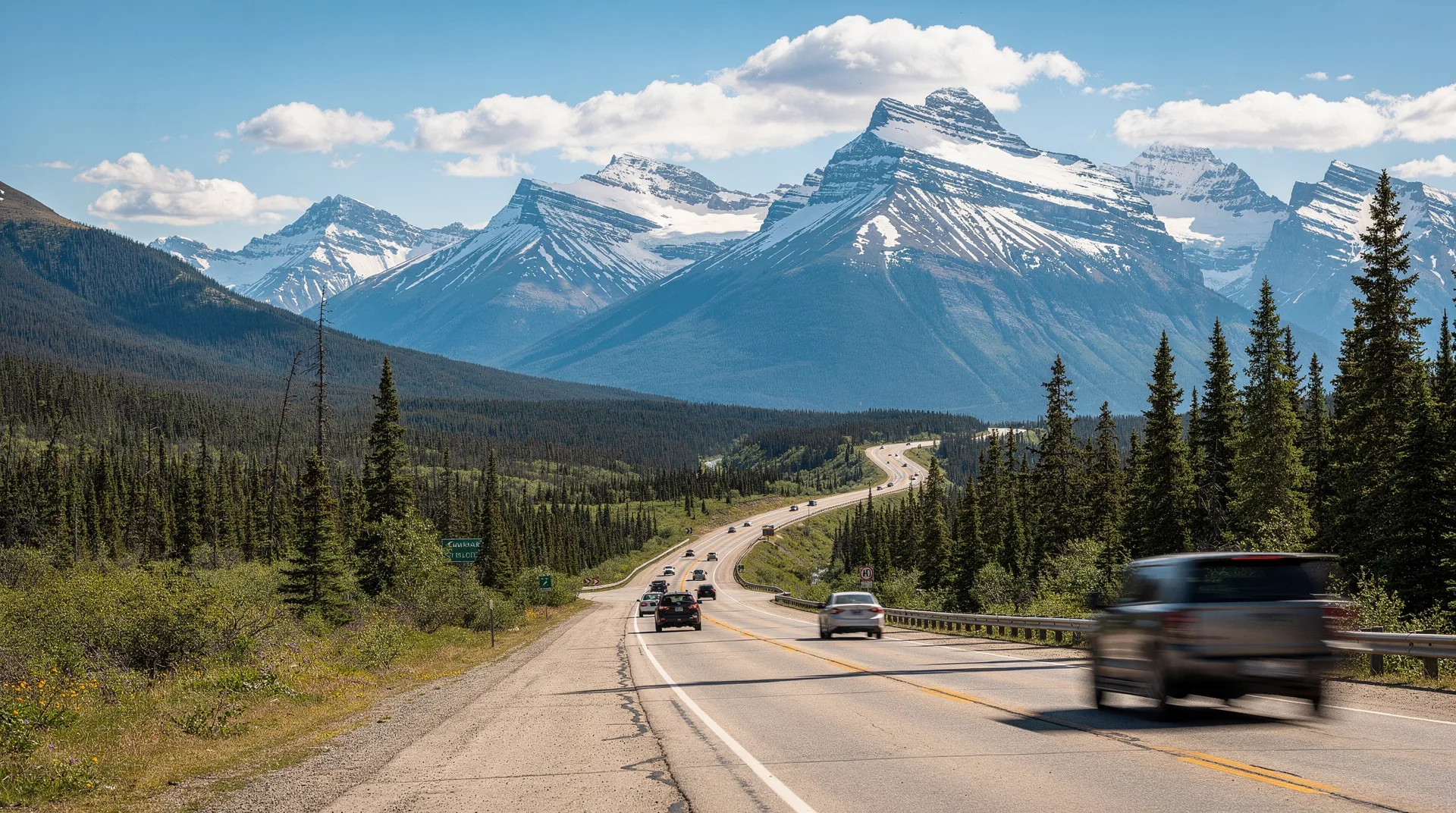
Driving in Canada: right-hand rules for visitors
Does Canada drive on the right or the left?
Canada drives on the right-hand side of the road, with left-hand-drive vehicles. Visitors from the UK, Australia, Japan, India and other left-hand countries need to adapt. Roads are generally wide, signs are clear, and adjusting typically takes 1-2 days. Turning right on red is legal everywhere except on the island of Montreal.
Canada drives on the right-hand side of the road, following the North American standard. For visitors coming from the UK, Australia, New Zealand, Japan, India, South Africa, Ireland, or the Caribbean (where many drive on the left), this takes adjustment. For visitors from continental Europe, the US, or most of Asia, it’s familiar territory.
This guide covers everything you need to adapt quickly: the rules, the habits, and the specific Canadian quirks that surprise first-time drivers.
| At a glance | |
|---|---|
| Adjustment time | Around 1-2 days of conscious effort for left-side drivers |
| Vehicles | Left-hand drive, nearly all automatic transmission |
| Speed and fuel | Posted in km/h, sold in litres |
| Where to start | A quiet rental lot or suburb, not downtown Toronto or Montreal |
| Documents needed | Home licence, IDP recommended for stays over 90 days |
If you haven’t booked the car yet, our Canada car rental guide covers costs, insurance and winter tire rules in detail before you get to this point.
The basics
- Canada drives on the right-hand side of the road.
- Vehicles are left-hand drive (steering wheel on the left).
- Signs are in English; also in French in Quebec; bilingual in New Brunswick and federal parks.
- Speed limits and distances are in kilometres (km and km/h).
- Fuel is sold in litres.
Who needs to adjust
Visitors from these countries drive on the left at home and will need to adapt:
- United Kingdom
- Ireland
- Australia
- New Zealand
- Japan
- India
- Pakistan
- South Africa
- Malaysia
- Singapore
- Hong Kong
- Most Caribbean nations
Visitors from continental Europe, the US, mainland Asia, and most of Africa already drive on the right.
| Home country | Adjustment needed | Typical hardest habit |
|---|---|---|
| UK, Ireland | Full switch | Turning into the wrong (left) lane |
| Australia, New Zealand | Full switch | Roundabout direction |
| Japan | Full switch | Indicators and wipers reversed |
| India, Pakistan, South Africa | Full switch | Judging lane position from the left seat |
| US, continental Europe | None | Metric speed and distance signage only |
Before you drive: checklist
- Valid driving licence: your home licence is valid in Canada for up to 90 days in most provinces. Longer stays require an International Driving Permit (IDP) alongside your home licence.
- Minimum age: rental car companies require drivers 21-25+ depending on company. Some have young driver surcharges under 25.
- Insurance: rental agencies offer CDW (collision damage waiver); many travel credit cards include coverage but check your policy specifics.
- Automatic vs manual: nearly all Canadian rentals are automatic. Manual transmission is rare.
Adjusting to right-hand driving
The hardest adjustments for UK/Australian/Japanese drivers are:
1. Roundabouts and intersections
- You enter roundabouts by going right (anti-clockwise), not left (clockwise).
- At 4-way stops, follow first-come order or yield to the vehicle on your right if arriving simultaneously.
2. Turning into the correct lane
Common error: turning into the left (oncoming) lane after a turn. This is the single most dangerous mistake for left-side drivers. Focus deliberately on “turn into the nearest lane on my side.”
3. Position on the road
The driver sits on the left, closer to oncoming traffic. The passenger sits closer to the kerb. Judging lane position takes time — stay deliberately right of centre for the first day or two.
4. Gear shift and indicators
On left-hand-drive cars, the gear shift is on the right of the driver (or on a column). Indicators are usually on the left side of the steering column; wipers on the right — reversed from UK/Japan/Australia. Expect to flick the wipers on when you meant to signal. It’s a universal rite of passage.
5. Mirror check habits
You still check over your right shoulder for blind spots (the passenger-side blind spot). Rear-view mirror is centered as usual.
Canadian rules you must know
Right on red
At most red lights, you can turn right after coming to a full stop and yielding to pedestrians and cross traffic — unless a sign prohibits it.
Exception: the entire island of Montreal (including downtown Montreal) prohibits right-on-red everywhere. Watch for this.
School buses
When a yellow school bus stops with flashing red lights and an extended stop sign, traffic in BOTH directions must stop until lights stop flashing. On divided highways with physical barriers, only traffic in the same direction must stop. Violations carry heavy fines (CAD $400+).
Pedestrians
Pedestrians always have right of way at crosswalks, even unmarked ones at intersections. In British Columbia, step into a crosswalk and cars must stop.
Winter tires
Required by law December 1 to April 30 on most highways in:
- British Columbia (mountain routes, Highway 1 through Rockies)
- Quebec (December 1 to March 15, provincewide)
Heavily recommended elsewhere in Canada but not legally mandated. Rental cars are generally equipped with all-seasons or winters depending on region and season.
Seatbelts
Mandatory for all occupants. Children under 9 or 145 cm require appropriate car seats.
Cell phones
Handheld use while driving is illegal in every province. Fines CAD $250-1,000 plus demerit points.
Alcohol
Canadian impaired driving laws are strict:
- Federal criminal limit: 80 mg/100 mL blood alcohol (0.08%)
- Most provinces have additional “warn” penalties starting at 50 mg/100 mL
- Immediate licence suspension and vehicle impound at the warn level
- Criminal record for DUI with lasting immigration consequences
The safe rule: don’t drive after any drinking.
Speeding
Speeds are posted in km/h. Common limits:
- Urban: 40-60 km/h
- Highway: 80-100 km/h
- Trans-Canada / BC coastal highway: 110-120 km/h in some sections
Photo radar and red-light cameras are common in major cities. Tickets go to the rental company, which then bills you with a service fee.
Mountain and park road driving
If your trip includes the Rockies, the driving style shifts again. Roads through Banff and Jasper are two-lane, wind through elevation changes, and share the shoulder with cyclists and wildlife. The Icefields Parkway between the two parks is stunning but has long stretches without fuel or cell coverage — plan accordingly.
Note that private vehicles are no longer permitted on the Moraine Lake road; access there is by shuttle or tour, not your rental car. A Parks Canada day pass or Discovery Pass is required to drive within any national park, separate from your rental agreement — see the road trip permits guide for which parks require what and how to buy one in advance.
Road quality and conditions
Main Canadian highways are well-maintained. Secondary and northern roads can be rough, gravel, or seasonally closed. Key considerations:
- Ice and snow: October-April in most of Canada. Black ice especially on shaded sections.
- Gravel sections: common in Yukon, parts of NWT, and Labrador.
- Wildlife: moose, elk, deer on highways; slow at dawn and dusk.
- Fuel spacing: plan refuels in remote regions (Yukon, northern Ontario, Labrador) — stations can be 200+ km apart.
Urban driving
Canadian cities vary in driving difficulty:
- Toronto: congested, aggressive, complex highway system. 407 toll road bypasses the worst.
- Montreal: confusing one-way streets, Quebec signage in French only, no right-on-red on the island.
- Vancouver: slower pace but rainy visibility and hills.
- Calgary, Edmonton, Winnipeg: straightforward grids.
- Halifax, Quebec City, St. John’s: narrow old-town streets, hills.
Rural and highway driving
Canadian highways are often two-lane rural roads with long straight stretches. Passing opportunities come via passing lanes every 20-30 km. Patience is required; tailgating is considered rude.
Planning routes around your comfort level
The easiest way to settle into right-hand driving is to choose a first route with few decisions: long, simple roads, little traffic and clear signage. The Icefields Parkway guide and the Banff to Jasper driving guide describe exactly that kind of drive, while the Calgary to Banff guide is a gentle way to start if you land in Calgary. On the west coast, the Vancouver to Whistler guide covers a scenic highway where lane discipline matters more than speed.
In the east, the Toronto to Ottawa route and the Montreal to Quebec City route are straightforward highway drives once you are out of the city centres. If you would rather skip the wheel for a stretch, the getting around guide compares trains, buses and flights so you can mix driving with other transport. For days when you prefer not to drive, you can also browse guided tours across Canada.
Habits that make the first days easier
Small routines help more than willpower. Walk around the car before you leave the lot and look at where the steering wheel, the mirrors and the controls sit. Adjust the seat and mirrors fully, then drive a slow loop in the lot until your hands find the indicator and the wipers without looking. Let the passenger act as a second pair of eyes: asking them to say “stay right” at junctions is not embarrassing, it is useful.
Fatigue makes old habits come back. After a long flight, the first hours behind the wheel are when most left-side drivers drift toward the wrong lane, so consider a night near the airport and an early, rested start the next morning. Take breaks often on long highway days, and pay extra attention when you pull out of a car park, a gas station or a quiet side road, because there is no traffic to guide you into the correct lane. Following another car for a few minutes is often the simplest reminder of where you belong on the road. If you are still tired after a long flight, a day of Canada day tours and activities lets someone else handle the driving.
Four unexpected things
- Some gas stations in Canada require prepay at pumps (especially in Alberta after mandatory prepay laws). Insert card before filling.
- Highway numbering varies by province — no consistent national numbering.
- Quebec road signs are French-only, even on major highways. Know basic terms (SORTIE = EXIT, ARRÊT = STOP).
- Ontario has a lot of 60-zone photo radar near schools; fines add up quickly.
First drive tips for left-side drivers
- Start from a quiet rental lot, not airport traffic.
- Do a parking lot loop before merging onto real roads.
- Say out loud “I’m turning into the RIGHT lane” before every turn.
- Place a post-it or ribbon on the dashboard reminding you.
- Avoid night driving for the first 24 hours.
- Don’t attempt Montreal or Toronto on your first day.
A quiet pick-up for left-side drivers
Where you collect the car shapes how that first drive feels. A rental lot away from the airport gives you room to do a slow loop of the parking area, adjust the mirrors and place your dashboard reminder before any real traffic arrives. If your flight lands late, a city-edge location also makes it easier to wait until morning rather than driving at night while your instincts are still set to the left.
Think about the route out of the lot too: a simple road onto a quiet street is far kinder than a tangle of merging lanes, especially if Montreal or Toronto is close. You can compare rental locations on DiscoverCars and choose a counter that leads onto calm roads.
Insurance and breakdowns
- Canadian Automobile Association (CAA) — reciprocal with AAA, RAC, AA (UK), NRMA (Australia). Roadside assistance included with many credit cards and auto memberships.
- Report accidents to police within 24 hours if damage exceeds CAD $2,000 or injuries occurred.
- Keep rental agreement, insurance documents, and emergency contact numbers in the glove box.
Fuel, tolls and small costs on the road
Fuel is priced per litre and varies from one province to the next, so do not expect the same price at every stop. Our gasoline stations and highways guide explains how pumps, prepay and remote stations work. If you are building a budget, the save money guide and the tipping guide cover the everyday costs that sit around a road trip.
The honest takeaway
Driving in Canada is straightforward — wide roads, clear signs, polite drivers. The adjustment from left-side driving takes 1-2 days of conscious effort. Avoid big cities on day one, allow time for habit to build, and within a few days it’ll feel natural. The real challenges aren’t the side of the road; they’re winter conditions, wildlife, and long distances between services.
Once the basics feel automatic, most visitors find road trips like the Calgary to Jasper road trip or a longer loop such as the Canada 2 weeks itinerary are entirely manageable — the driving itself stops being the hard part after the first day or two.
Frequently asked questions about Driving in Canada
How long does it take to get used to right-hand driving?
Most visitors from left-hand-drive countries adapt within 1-2 days of conscious effort. Starting in a quiet area rather than a busy downtown speeds this up considerably.
Is right-on-red legal everywhere in Canada?
Almost everywhere, after a full stop and yielding to pedestrians and cross traffic. The one major exception is the island of Montreal, where right-on-red is banned outright.