Calgary Stampede guide: tickets, dates, events and insider tips
When is the Calgary Stampede and how do I get tickets?
The Calgary Stampede runs for 10 days each July, starting the first Friday of the month (typically July 4–13 in 2025, July 3–12 in 2026). Tickets are sold through the official website at calgarystampede.com — buy early as Grandstand Show and rodeo events sell out months ahead.
The Calgary Stampede calls itself “The Greatest Outdoor Show on Earth,” and while that is a promotional claim, it is not an entirely hollow one. For ten days each July, a city of 1.4 million people essentially transforms its identity. Office towers empty early as workers change into Western boots and Stetsons at their desks. Free pancake breakfasts appear on street corners across the city, hosted by everyone from banks to car dealerships. The Stampede grounds buzz continuously from 8am to midnight with one of the most diverse programming mixes in any festival in the world.
The core of the Stampede is rodeo — specifically, one of the most competitive and prestigious rodeos in North America, hosting the world’s top cowboys and cowgirls competing for millions of dollars in prize money. But the Stampede long ago expanded beyond its rodeo origins to encompass a midway with major rides, a food festival of extraordinary ambition, a nightly Grandstand Show with major music acts, the legendary Calgary Stampede Chuckwagon Races, and a community of First Nations cultural programming that has been central to the event since its founding.
Understanding how it is structured — and what is worth your time and money — makes all the difference between an overwhelming sensory experience and one of the best festival days of your life.
If this is your first visit to the country, our first-time visitors guide and the general Canada trip planning guide are useful companions to this page.
At a glance
| Where | Stampede Park, Calgary, Alberta |
| When | 10 days each July, starting the first Friday of the month |
| Cost | Around $18-22 grounds admission; $60-120 for a Grandstand Show seat |
| Time needed | 1 full day covers the highlights; 2-3 days for rodeo finals plus midway plus a Grandstand Show |
| Getting there | Fly into Calgary International; the grounds are a short CTrain ride or 20-minute walk from downtown |
| Best time | Mid-week (Tuesday-Thursday) for smaller crowds; the final Sunday for the Rodeo and Chuckwagon Finals |
A brief history of the Stampede
The Calgary Stampede was founded in 1912 by Guy Weadick, an American trick-roper and showman who convinced four prominent Calgary ranchers (later known as the Big Four) to fund an outdoor wild west celebration. The first Stampede was a massive success, drawing 80,000 visitors to a city of 65,000 people and featuring rodeo events, horse racing, and wild west performances.
The event became annual in the 1920s and grew continuously throughout the twentieth century. First Nations peoples — particularly the Blackfoot Confederacy (Siksika, Kainai, Piikani, and Stoney Nakoda nations) — have been central participants since the beginning, setting up their teepee village on the grounds and participating in the parade.
Today the Stampede generates approximately CAD 540 million in economic impact for Calgary annually.
What is on: the main events
The Rodeo
The rodeo is the competitive heart of the Stampede and takes place in the Stampede Park Grandstand every afternoon during the 10 days. Events include:
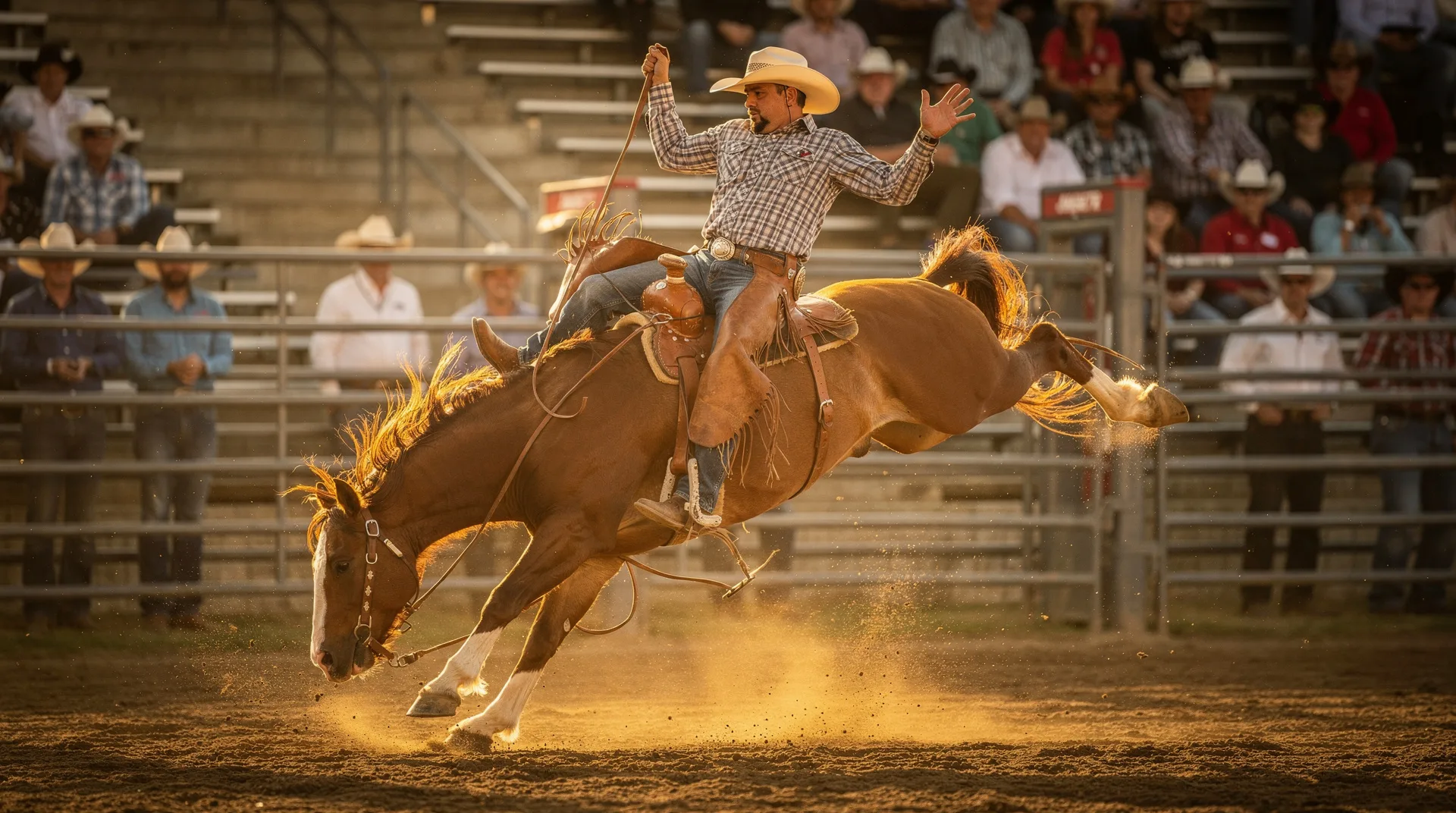
Bareback riding: Riders must stay on a bucking horse for 8 seconds using only one hand on a rigging handle. Scores are based on the difficulty of the horse and the quality of the ride.
Saddle bronc riding: The classic rodeo event — considered by cowboys to be the purest test of riding skill. Riders use a specialized saddle and must follow strict form requirements.
Bull riding: The most watched rodeo event. Riders attempt to stay on a 900 kg bull for 8 seconds. Bulls at the Stampede include some of the highest-ranked rodeo bulls in the world.
Steer wrestling: A timed event in which a cowboy leaps from a galloping horse onto a running steer and wrestles it to the ground.
Tie-down roping: Cowboy ropes a running calf, dismounts, runs to the calf, and ties three legs in the fastest time.
Team roping: Two riders — header and heeler — rope a steer together in a timed event. One of the few team events in rodeo.
Barrel racing: The signature women’s rodeo event — competitors race their horses around three barrels in a cloverleaf pattern for the fastest time. The Stampede attracts the top barrel racers in North America.
Rodeo competition runs throughout the 10 days; competitors accumulate points, with the top scorers advancing to the final weekend’s championship rounds. The prize money at the Calgary Stampede Rodeo is among the highest in the world, drawing the best competitors from Canada, the United States, and increasingly from Australia and Brazil.
Chuckwagon races (GMC Rangeland Derby)
The Chuckwagon races are uniquely Stampede. Four wagons race around a track — each team consisting of four outriders who must circle the wagon before galloping the track — in a spectacle that is genuinely chaotic, genuinely fast, and genuinely unlike anything else in Canadian sport.
Races are held in the early evening (before the Grandstand Show), and points accumulate over the 10 days. The finale on the last Sunday is one of the most exciting sporting events in Calgary’s annual calendar.
Chuckwagon race tickets are included with Grandstand admission.
The Grandstand Show
The Grandstand Show is the nightly entertainment event — typically starting around 8:30–9pm after the chuckwagon races. The show runs about 75–90 minutes and combines a large-scale theatrical spectacular (acrobatics, pyrotechnics, dance, live music) with a headlining musical act that changes nightly.
Past headliners have included Carrie Underwood, Blake Shelton, Florida Georgia Line, and Brooks and Dunn. The show ends with one of North America’s largest fireworks displays above the Grandstand.
Grandstand Show tickets are separate from general grounds admission and sell out early. Book as soon as they go on sale (typically April for the July event).
The Midway
The Stampede Midway is one of the largest travelling midways in North America — over 60 rides ranging from gentle children’s rides to major thrill rides (the midway has hosted some of the highest-capacity thrill rides in Canada). Games, shows, and food vendors are interspersed throughout.
First Nations village and programming
The Elbow River Camp, set on the Stampede grounds, hosts the participating First Nations communities and is one of the most important cultural programming areas of the event. Traditional teepees, cultural performances, artisan demonstrations, and storytelling provide context and depth that balances the Wild West spectacle of the rodeo.
Browse Calgary Stampede tours and experiences, including guided city and festival packagesWhat to eat at the Stampede
The Stampede has developed an ambitious food festival culture over the past decade. Beyond standard midway food, vendors compete to produce the most outrageous novelty foods each year — deep-fried Nutella, Stampede-specific BBQ ribs, mini donuts (a Stampede institution since 1964), and rotating novelties that make food news across Canada each July.
The BBQ and western cooking tradition is well-represented — several permanent vendors specialize in smoked brisket and ribs. The Crazy Creations competition each year produces genuinely creative (and frequently bizarre) offerings.
Mini donuts from the same operators that have been on the grounds for decades remain an emotional touchstone for Calgarians who grew up attending the Stampede.
Free events: pancake breakfasts
One of the most distinctive Stampede traditions requires no ticket at all. Across the city, for the entire 10 days, hundreds of organizations (corporations, community leagues, churches, car dealerships) host free pancake breakfasts. Staff serve pancakes, eggs, sausage, and coffee from makeshift kitchen setups on sidewalks, parking lots, and plazas from approximately 7–11am.
The breakfasts are listed at the City of Calgary’s community events database and on the Stampede’s website. Having a genuine pancake breakfast served by bankers in cowboy hats on a downtown Calgary sidewalk on a July morning is an experience that is hard to explain but impossible to forget.
Getting there and around
Location: Stampede Park is located 1.5 km southeast of Calgary’s downtown core — walkable from the city centre in 20 minutes or a short CTrain (light rail) ride to the Victoria Park/Stampede station, which deposits you at the grounds entrance.
CTrain: Calgary’s CTrain is free during Stampede (10 days) — a policy the city implemented to manage the traffic generated by 1 million+ visitors across the festival.
Driving: Parking exists near the grounds but fills early. Using the CTrain is strongly recommended.
Tickets and costs in CAD
| Ticket type | Approximate cost (CAD) |
|---|---|
| General grounds admission (adult) | 18–22 |
| General grounds admission (child 6–12) | 12–15 |
| Grandstand Show (rodeo + chuckwagons + show) | 60–120 depending on seat location |
| Rodeo only (afternoon) | 35–55 |
| Midway rides (individual) | 4–7/ride |
| Midway ride all-day pass | 50–65 |
Buying tickets: Purchase at calgarystampede.com — start as early as March for Grandstand Show dates. Print-at-home or mobile tickets. Will-call and box office available but expect queues.
What to wear
The unofficial dress code at the Stampede is full western — cowboy/cowgirl boots, Wrangler jeans, pearl-snap shirts, and a Stetson or similar cowboy hat. Calgarians genuinely dress this way for the 10 days, and visitors are warmly welcomed to participate. You will not look out of place in western gear; you may feel slightly conspicuous without it.
If purchasing a hat, Calgary’s western clothing stores (Smithbilt, Riley and McCormick) sell authentic hats — Smithbilt has manufactured Stetson-style hats in Calgary since 1919.
Comfortable walking shoes (under the boots if needed) matter — the grounds involve significant walking across uneven surfaces.
Suggested one-day Stampede plan
| Time | Activity |
|---|---|
| Morning | Free pancake breakfast downtown, then walk or CTrain to Stampede Park |
| Midday | Explore the First Nations village and midway, grab Stampede food |
| Afternoon | Rodeo (afternoon session in the Grandstand) |
| Early evening | Chuckwagon races |
| Evening | Grandstand Show and fireworks finale |
Combining the Stampede with the Rockies
Calgary sits about 90 minutes from Banff, so many visitors combine Stampede week with a mountain trip. See our Banff with kids guide for a family-friendly Rockies extension, or the broader Calgary destination guide for what else the city offers outside Stampede week. If you’re driving onward, the Calgary to Jasper Icefields itinerary is a popular add-on, and Banff National Park itself is an easy day trip or overnight from downtown Calgary. If you want to extend the trip, you can compare guided tours across Canada before you book.
Planning the rest of your trip around Stampede week
Stampede week is a busy moment in the Canadian summer, so it helps to read our Canada in July guide before locking in the rest of your route. July is peak season in the mountains too, and the best time to visit Banff explains how the crowds shift from one part of the summer to the next.
If you plan to leave the city, think about transport early. A car rental in Canada is easiest to arrange well ahead, since vehicles are in demand when a major festival fills the city. The driving guide from Calgary to Banff walks through the road itself, and our guide to day trips and routes from Calgary gives more ideas if you want to see the prairies and foothills as well as the mountains.
Travellers who want to pair the festival with a longer mountain stay can look at the 3-day Banff itinerary or stretch into the Banff and Jasper 7-day plan. The Icefields Parkway guide is the natural next step if you are continuing north toward Jasper, and the overview of the Canadian Rockies helps you choose between the parks.
Learning more about Indigenous culture
The Elbow River Camp is a good introduction, but it is only a small window into a much larger story. For context beyond the Stampede grounds, our overview of Indigenous culture in Canada and the guide to powwow experiences in Canada explain how to attend cultural events respectfully, what to ask before taking photographs, and how to support Indigenous-led businesses during your trip.
Where to stay in Calgary
Downtown Calgary is the most convenient base — CTrain access to the Stampede grounds, proximity to the downtown pancake breakfasts and Stampede-adjacent bar scene. Hotels in this area include the Marriott Downtown, Sheraton Suites Calgary Eau Claire, and The Westin Calgary. Expect peak-season pricing (often double normal rates) during Stampede week.
Beltline neighbourhood: Just south of downtown, walkable to both the grounds and downtown, with a mix of hotels and apartment-style rentals. The Beltline’s bar scene is the Stampede nightlife epicentre.
Book months ahead: Calgary hotel inventory during Stampede sells out — many properties are booked by regular visitors a year in advance. Consider apartment and short-term rental options (Airbnb, VRBO) if hotels are sold out or prohibitively expensive.
Frequently asked questions about Calgary Stampede guide: tickets, dates, events and insider tips
What are the exact 2026 Calgary Stampede dates?
The Stampede always begins on the first Friday of July and runs 10 days. For 2026, the dates are July 3–12, 2026. The Stampede Parade takes place on the opening Friday morning.
Is the Calgary Stampede appropriate for children?
Yes — the Stampede is genuinely family-oriented. The midway rides range from toddler-appropriate to adult thrill rides. The rodeo is engaging and exciting for children (the bull riding and barrel racing hold attention well). The grounds have multiple dedicated family areas, food options, and programming aimed at younger visitors.
Is the rodeo controversial?
Animal welfare concerns around rodeo are discussed in Canada, as they are internationally. The Calgary Stampede maintains that its animal welfare standards are among the strictest of any rodeo in the world, with veterinary staff on-site throughout and rules governing treatment. The debate is genuine and ongoing. Visitors should be aware of this context and make their own informed decision.
What is the best day to visit the Stampede?
Opening day (the Friday) is electric but crowded. Mid-week days (Tuesday–Thursday) have noticeably fewer crowds and shorter midway queues. The final Sunday is the Rodeo Finals and Chuckwagon Finals — the most competitive and exciting single day, but also the most crowded.
How much should I budget for a day at the Stampede?
A full day at the Stampede including grounds admission, midway rides (half-day pass), food and drinks, and a Grandstand Show seat: budget CAD 150–250 per adult. Families with children should budget CAD 350–500 for two adults and two children for a full day including evening show.
Can I visit Stampede Park outside of Stampede week?
Yes, though the atmosphere is entirely different — Stampede Park hosts other events year-round, but the midway, rodeo, chuckwagons and pancake breakfasts are specific to the 10-day festival in July. If you’re in Calgary at another time, the Calgary destination guide covers what the city offers the rest of the year.