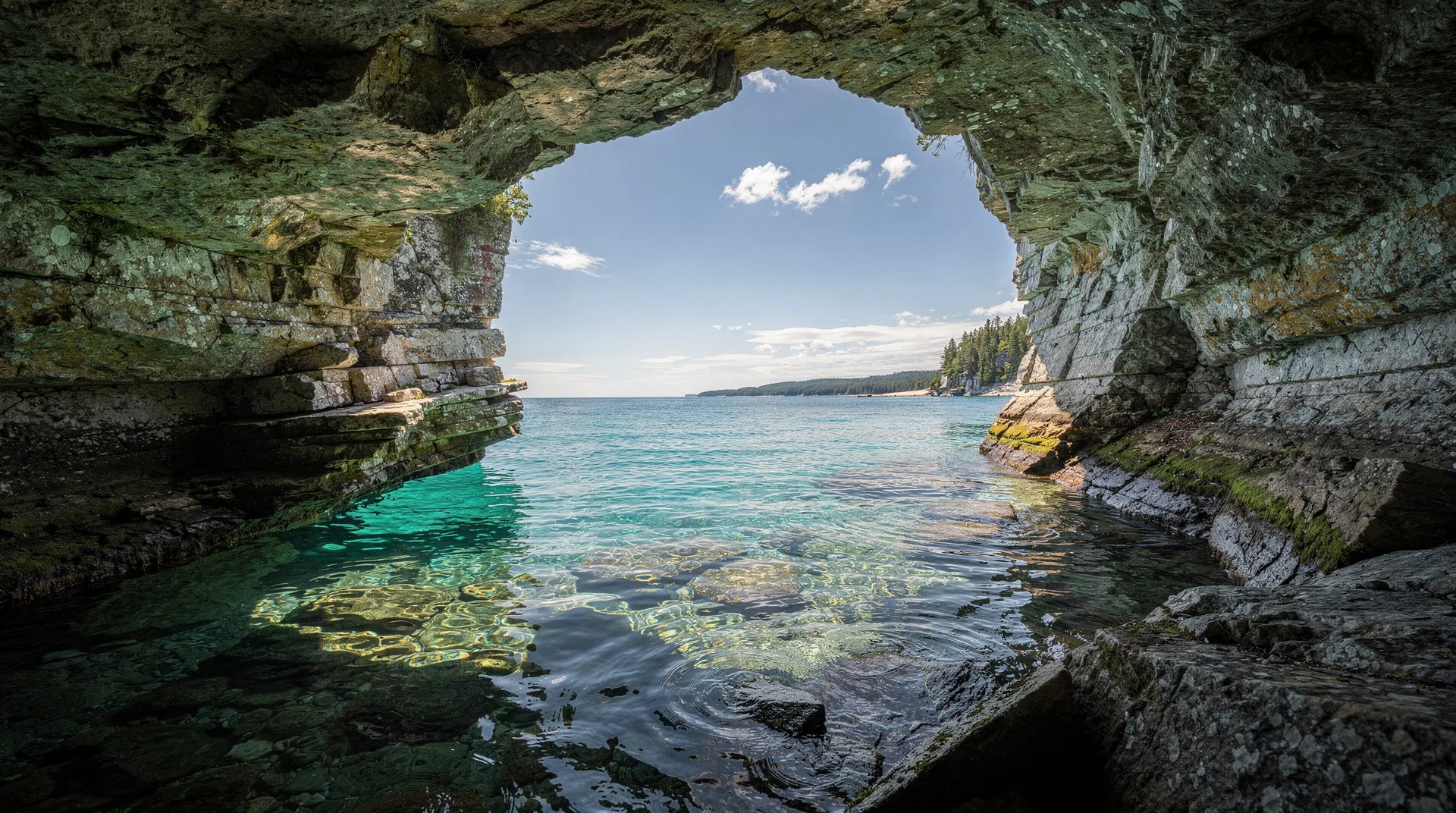
Bruce Peninsula National Park guide: the Grotto, Niagara Escarpment and Georgian Bay
What is Bruce Peninsula National Park known for?
Bruce Peninsula National Park protects the northern tip of the Niagara Escarpment in Ontario, best known for the Grotto — a stunning sea cave where crystal-clear turquoise Georgian Bay water meets ancient cliff. The park also features the Bruce Trail, rare orchids, cliff-top Georgian Bay views, and superb freshwater snorkelling.
At the northern tip of the Bruce Peninsula, where the Niagara Escarpment meets Georgian Bay, Canada’s national park system preserves one of Ontario’s most dramatic and beloved landscapes. Bruce Peninsula National Park occupies 154 square kilometres of ancient dolomite cliffs, cobble beaches, turquoise-clear bay water, and the dense mixed forest of the Escarpment. It is a park of intimate, tactile drama — not vast open wilderness but a concentrated experience of cliffs, caves, wildflowers, and impossibly clear water that rewards every hour spent exploring it.
The park’s defining landmark is the Grotto: a sea cave carved into the base of the cliffs by centuries of wave action, where the Georgian Bay light refracts through underwater openings to illuminate the water in shades of turquoise and cobalt found nowhere else in Ontario. Swimming in the Grotto pool and snorkelling the rocky bay bottom at the nearby Indian Head Cove is the experience that draws most visitors — and the crowds that gather on summer weekends reflect just how powerful that draw is. The Parks Canada reservation system for the Grotto access trail is essential to understand before any visit.
Beyond the Grotto, Bruce Peninsula offers the rugged northern section of the Bruce Trail, one of Canada’s oldest and most celebrated long-distance hiking routes, following the Escarpment cliff edge above the bay. The park’s bogs, alvars, and old-growth cedar forests shelter 44 species of wild orchids — more orchid species than anywhere else in Canada — making it a pilgrimage destination for botanists and naturalists. Fathom Five National Marine Park, directly adjacent by water, adds a world-class freshwater diving destination and access to Flowerpot Island’s famous rock pillars.
| At a glance | |
|---|---|
| Where | Tip of the Bruce Peninsula, Ontario, above Georgian Bay |
| Cost | Park pass around CAD 9.50/adult/day; the Discovery Pass (around CAD 145) pays off across multiple parks |
| Time needed | A full day for the Grotto and cliff hike; 2-3 days to add Flowerpot Island and orchid trails |
| Getting there | About 3-3.5 hours by car from Toronto via Owen Sound; no public transit to Tobermory |
| Best time | Late June to mid-July for orchids and swimmable water; September for quiet trails |
A landscape carved by ancient seas and glaciers
The Niagara Escarpment is a UNESCO World Biosphere Reserve, a 725-kilometre ridge of Silurian-age dolomite limestone running from Niagara Falls to the tip of the Bruce Peninsula and continuing in the Manitoulin and Tobermory islands. The escarpment formed roughly 450 million years ago as a tropical sea floor, subsequently buried, compressed, and uplifted. Glacial ice sheets, advancing and retreating multiple times in the last two million years, shaped the current topography — carving the Georgian Bay basin, depositing boulders and sediment, and creating the cobble beaches and underwater cliffs that make the Bruce Peninsula coast so distinctive.
The clarity of Georgian Bay water in the park area is exceptional. Because the bay’s bedrock is largely impermeable limestone with minimal surrounding agricultural land (unlike Lake Ontario and Lake Erie), the water clarity can exceed 10 metres. Snorkelling in Indian Head Cove on a sunny afternoon, watching the sunlight filter through turquoise water over ancient limestone boulders and fish weaving between cliff faces, is a genuinely memorable experience.
The orchid diversity reflects the park’s unusual combination of habitats: calcareous alvar pavement, boreal forest, rich hardwood forest, bogs, and fens each support different species. Yellow lady’s slipper, showy lady’s slipper, calypso orchid, and more than 40 additional species bloom at various times from May to August — the park produces an annual orchid blooming guide available at the visitor centre.
Top things to do in Bruce Peninsula National Park
Swim and snorkel at the Grotto and Indian Head Cove
The Grotto is Bruce Peninsula’s most famous feature and the primary reason most visitors come. The sea cave is carved into the base of the dolomite cliffs and opens both landward (via a tight, low passage requiring scrambling) and seaward (via an underwater opening that floods the cave with brilliant turquoise light). A rocky ledge above the cave pool is a popular jumping platform — but the water level varies with Georgian Bay levels and the safe jumping configuration changes; follow Parks Canada guidance on jumping and swimming.
Indian Head Cove, accessed from the same parking area via a short trail extension, is a small cobble cove between cliff faces where the clear Georgian Bay water is ideal for snorkelling. Bring your own mask and snorkel; water shoes or neoprene boots make navigating the cobbles comfortable. The snorkelling is among the best freshwater snorkelling in Ontario.
Reservation required: Timed parking reservations for the Horse Lake Head trailhead (access point for the Grotto and Indian Head Cove) are mandatory from late June to Labour Day. Book through Parks Canada online well in advance — slots sell out quickly. Out-of-season visits (May, June pre-reservation period, September after Labour Day) are walk-up.
Browse Ontario adventure tours and day trips from TorontoHike the Bruce Trail cliff edge
The Bruce Trail enters the national park from the south and follows the Georgian Bay cliff edge for approximately 20 kilometres through to the Tobermory trailhead, passing through some of the most spectacular Escarpment scenery available to hikers anywhere in Ontario. The cliff-edge sections pass above sheer 15-20 metre drops to cobble beaches and turquoise water, with views extending across the bay on clear days.
The section from the Cyprus Lake campground to the Grotto and beyond to Halfway Log Dump (about 8 km one way) is the finest park hike. The trail passes through old-growth white cedar forests, crosses exposed limestone pavement, and arrives at lookout points over the bay that stop conversations in their tracks. The full one-way walk to the Grotto from Cyprus Lake is 3.5 km and takes about 45 minutes at a leisurely pace.
Explore Flowerpot Island and Fathom Five Marine Park
Fathom Five National Marine Park, accessible by water taxi from the town of Tobermory, protects 22 islands and the waters of Georgian Bay around the tip of the peninsula. The most famous destination is Flowerpot Island, named for two remarkable rock pillars (sea stacks) that stand on its shore — remnants of the dolomite cliffs after the surrounding rock eroded away. The larger flowerpot stands about 8 metres tall and can be walked around at shore level.
The island also has maintained hiking trails, several caves, and camping facilities operated by Parks Canada. The Fathom Five waters contain 22 known shipwrecks dating from 1855 to 1936, making it one of the premier freshwater diving destinations in the world. Water temperatures are cold enough to require a drysuit for most of the season; several dive operators in Tobermory offer equipment rental and guided dive tours. If you would rather leave the planning to someone else, you can compare guided tours across Canada before you book.
Search for wild orchids
Bruce Peninsula National Park contains more orchid species than anywhere else in Canada — 44 species have been recorded within park boundaries. The showy lady’s slipper (Cypripedium reginae) blooms in late June and early July in the park’s calcareous fens; the yellow lady’s slipper in late May and June on limestone slopes; the calypso orchid (fairy slipper) in May in conifer forest. Parks Canada publishes a seasonal orchid blooming calendar; the visitor centre staff can direct visitors to current blooming locations. Walking the Singing Sands Beach and dunes area in late May through July almost always reveals multiple orchid species.
Sunset from the cliffs
The cliff-top viewpoints above Georgian Bay on the western park shore catch spectacular sunsets, particularly from the lookout points along the Bruce Trail north of the Grotto. The light on the limestone cliffs, turning from gold to orange to pink as the sun drops toward the lake horizon, is quintessential Bruce Peninsula atmosphere. The Cyprus Lake campground provides easy access to the cliff trails in the late afternoon.
Best hikes and trails
Cyprus Lake to Grotto to Indian Head Cove — 7 km loop, moderate. The park’s classic day hike. Cliff-edge Bruce Trail, the Grotto, Indian Head Cove swimming, and bog trail return. Allow 3-4 hours.
Burnt Point Loop — 5.3 km loop, easy-moderate. Cobble beach sections and cliff views along the Cyprus Lake shore, with bog and mixed forest interior sections. Good for orchids in June.
Singing Sands Trail — 3 km loop, easy. Interpretive trail through dunes and shoreline of Dorcas Bay, the park’s southeast corner. Exceptional for orchids (June-July) and shorebirds.
Georgian Bay Trail — 3.4 km return, easy. Flat trail along the Georgian Bay shoreline with multiple lookout points and cove access.
Bruce Trail (full park section) — approximately 20 km one way, moderate-strenuous. The full cliff-edge traverse from the south park boundary to Tobermory. Exceptional wildlife and scenery throughout.
Marr Lake Trail — 1.5 km loop, easy. Short family trail in the interior forest, good for birds and wildflowers.
Wildlife you might see
Bruce Peninsula’s diverse habitats support a wide variety of wildlife. Black bears are present in the park — carry bear spray on backcountry hikes and follow campground food storage rules. White-tailed deer are abundant and visible at dawn and dusk along park roads and trails. The Massasauga rattlesnake — Ontario’s only venomous snake — inhabits the rock pavement, cliffs, and cobble beaches. Encounters are rare and the snake is docile, but watch where you step and sit in rocky terrain. It is a species at risk; any sightings should be reported to park staff.
Eastern massasauga notwithstanding, herpetological diversity is a park highlight. The northern map turtle basks on logs in Cyprus Lake; the snapping turtle is present in the bogs. Five-lined skinks, the only native lizard in Ontario, dart across the sun-warmed dolomite slabs.
Birding is excellent year-round. The park’s alvar and forest habitats host nesting birds including the yellow-bellied flycatcher, common nighthawk, and a wide variety of warblers. The Georgian Bay coast is good for loons, mergansers, and migrating waterfowl in spring and fall. The rare trumpeter swan, reintroduced to Ontario from a captive population, is occasionally seen on Cyprus Lake.
Getting there
Bruce Peninsula National Park is located at the northern tip of the Bruce Peninsula, approximately 260 kilometres northwest of Toronto. The town of Tobermory, at the peninsula tip, is the main access point.
From Toronto, take Highway 400 north to Highway 10 or Highway 26 west to Owen Sound, then Highway 6 north approximately 80 km to Tobermory. Total driving time is approximately 3 to 3.5 hours. Highway 6 runs the full length of the peninsula and provides the main park access.
There is no public transit to Tobermory. The Ontario Northland bus service runs to Owen Sound; from there, onward travel requires a car. Car rental is not available in Tobermory, so arriving with your own vehicle or a rental from Toronto or Owen Sound is necessary.
Where to stay
Tobermory (at the park’s north gate) is the main base: a small tourist village with motels, cottage resorts, restaurants, and dive shops strung along the harbour. In July and August, accommodation fills weeks in advance — book early. The Tobermory waterfront is charming and the sunsets over Little Tub Harbour are excellent.
Cyprus Lake Campground (inside the park) is the park’s main campground, with over 200 sites including electrical hookup sites and tent-only sites. It is the base for the Grotto and cliff trail hikes. Reservations through Parks Canada are essential from late June to Labour Day; the campground fills within minutes of the reservation window opening. Backcountry camping permits allow camping at more remote sites within the park.
Owen Sound (80 km south of Tobermory) provides a wider range of hotels and services for those combining the park with the southern Bruce Peninsula.
Best time to visit
Late June to mid-July is the sweet spot: the weather is warm, the orchids are at peak bloom (showy lady’s slippers bloom in late June), and the Grotto water is swimmable. Reservations are required but the park is not yet at August maximum capacity.
May and early June offer a quieter park, wild orchid beginnings (calypso orchids in May, yellow lady’s slippers in June), and the possibility of morning fog over the bay that creates dramatic photography conditions. No reservations required; some services not yet open.
August is the absolute peak: warmest water, all services operating, maximum crowds. Grotto reservations are hardest to obtain. Worth it if you can be flexible on timing.
September is increasingly popular and excellent: the park quiets dramatically after Labour Day, the water is still swimmable, fall colours begin in the Escarpment forest by late September, and hikes are uncrowded. No reservation required after Labour Day.
Fall and winter: The park trails are open year-round. October brings exceptional cliff-top scenery with fall colours; Georgian Bay storms create dramatic wave photography. Cross-country skiing is possible in snowy winters.
Bruce Peninsula by season
| Season | Grotto access | Water temp | Crowds |
|---|---|---|---|
| May-early June | Walk-up, no reservation | Cold, not swimmable | Quiet |
| Late June-mid July | Reservation required | Swimmable, refreshing | Busy, but not peak |
| August | Reservation required, hardest to get | Warmest of the year | Maximum, book everything early |
| September (post Labour Day) | Walk-up, no reservation | Still swimmable, cooling | Quiet, increasingly popular |
Extending a Bruce Peninsula trip
Bruce Peninsula pairs naturally with the rest of the Niagara Escarpment corridor. Travellers coming from Toronto sometimes combine a Bruce Peninsula visit with a stop at Blue Mountain further south along the Escarpment, or extend a broader Ontario loop toward Niagara Falls using the Toronto to Niagara Falls guide for that leg. Across the water, Manitoulin Island is reachable by ferry from Tobermory in season (roughly May to October) and makes a good add-on for travellers with an extra day or two, extending the Georgian Bay theme with a very different, more low-key island landscape.
Practical info
Park entry fee (2026): Adult CA$10.00/day, family/group CA$19.50/day. The Parks Canada Discovery Pass (CA$83.50/adult, CA$167.50 family/group) is cost-effective for multiple-park visits.
Grotto reservation: Mandatory timed parking reservations from late June to Labour Day via the Parks Canada reservation system. Book at least 2-3 weeks in advance; popular dates sell out immediately. Passes are for the Horse Lake Head trailhead only — the Grotto trail begins here.
Water temperature: Georgian Bay at the park averages 15-19°C in summer at the surface. The water is refreshing rather than warm; the Grotto pool is cold even in August due to the cave’s shading. A brief swim is comfortable; extended snorkelling in a wetsuit is more pleasant.
Bear safety: Follow posted food storage requirements at Cyprus Lake Campground and on backcountry hikes. The park has an active black bear population.
Frequently asked questions about Bruce Peninsula National Park guide: the Grotto, Niagara Escarpment and Georgian Bay
How do I book access to the Grotto?
Timed parking reservations for the Horse Lake Head trailhead (required from late June to Labour Day) are made through the Parks Canada reservation system at reservation.pc.gc.ca. Reservations open in mid-April for the peak season. Slots for July and August sell out within hours to days of opening; set a calendar reminder for the opening date and book immediately. Out of peak season (before late June, after Labour Day), access is walk-up with no reservation required.
Is it safe to jump into the Grotto?
Jumping from the Grotto ledge is tempting and many visitors do it, but safety conditions vary. Georgian Bay water levels affect the depth below jumping platforms; Parks Canada posts current guidance on jumping safety at the trailhead. Follow posted advice and observe whether rangers have restricted jumping. The rocks around the pool are slippery; approach carefully. The underwater opening to the bay creates currents in certain conditions.
Can I camp in the park without a car?
Technically yes — Parks Canada accepts walk-in registrations for any unreserved sites — but reaching the park without a car is extremely difficult. If arriving by bus to Owen Sound, you would need to arrange a taxi (approximately 1.5 hours, expensive) or hitchhike the 80 km to Tobermory. The park itself requires a car to move between sections. There is no bike-share or park shuttle service.
Are the Massasauga rattlesnakes dangerous?
The Eastern Massasauga rattlesnake is venomous but not aggressive. Bites are extremely rare and occur almost exclusively when a snake is accidentally stepped on or handled. The practical precaution is simple: watch where you step in rocky terrain, check before you sit on a ledge or log, and never handle or approach a rattlesnake. If bitten, seek medical attention promptly. The hospital in Owen Sound (80 km south) is the nearest facility.
What is the best day trip itinerary for one day in the park?
One full day at Bruce Peninsula: arrive at the Horse Lake Head trailhead by 9 am (reservation or early walk-up), hike the Bruce Trail north along the cliff edge to the Grotto (about 45 minutes), swim and snorkel at Indian Head Cove, return via the bog trail, then drive to Singing Sands Beach for orchid spotting and a late afternoon walk. End the day at Tobermory harbour for dinner and a sunset over the water taxis.
Can I visit Flowerpot Island as a day trip?
Yes. Water taxis run from Little Tub Harbour in Tobermory to Flowerpot Island from mid-May to mid-October. The crossing takes about 30 minutes. Day visitors can hike the island trails, walk around the flowerpot sea stacks, and explore the caves before returning on the last water taxi of the afternoon. Overnight camping on the island requires a Parks Canada backcountry permit and advance reservation.
Can I visit Bruce Peninsula as a day trip from Toronto?
It is possible but demanding — the drive is 3 to 3.5 hours each way, so a Toronto day trip means roughly 7 hours of driving for a few hours in the park. It is more comfortable as an overnight or multi-day trip, or combined with other stops such as Blue Mountain on the way up or back.
Is Bruce Peninsula better than Niagara Falls for a nature-focused visit?
They are very different experiences. Niagara Falls is about the spectacle of the falls themselves and is easy to reach with extensive tourist infrastructure; Bruce Peninsula is about quieter, more active outdoor exploration (hiking, swimming, snorkelling). Travellers wanting both can combine them using the Toronto to Niagara Falls guide for one leg of a broader Ontario trip.