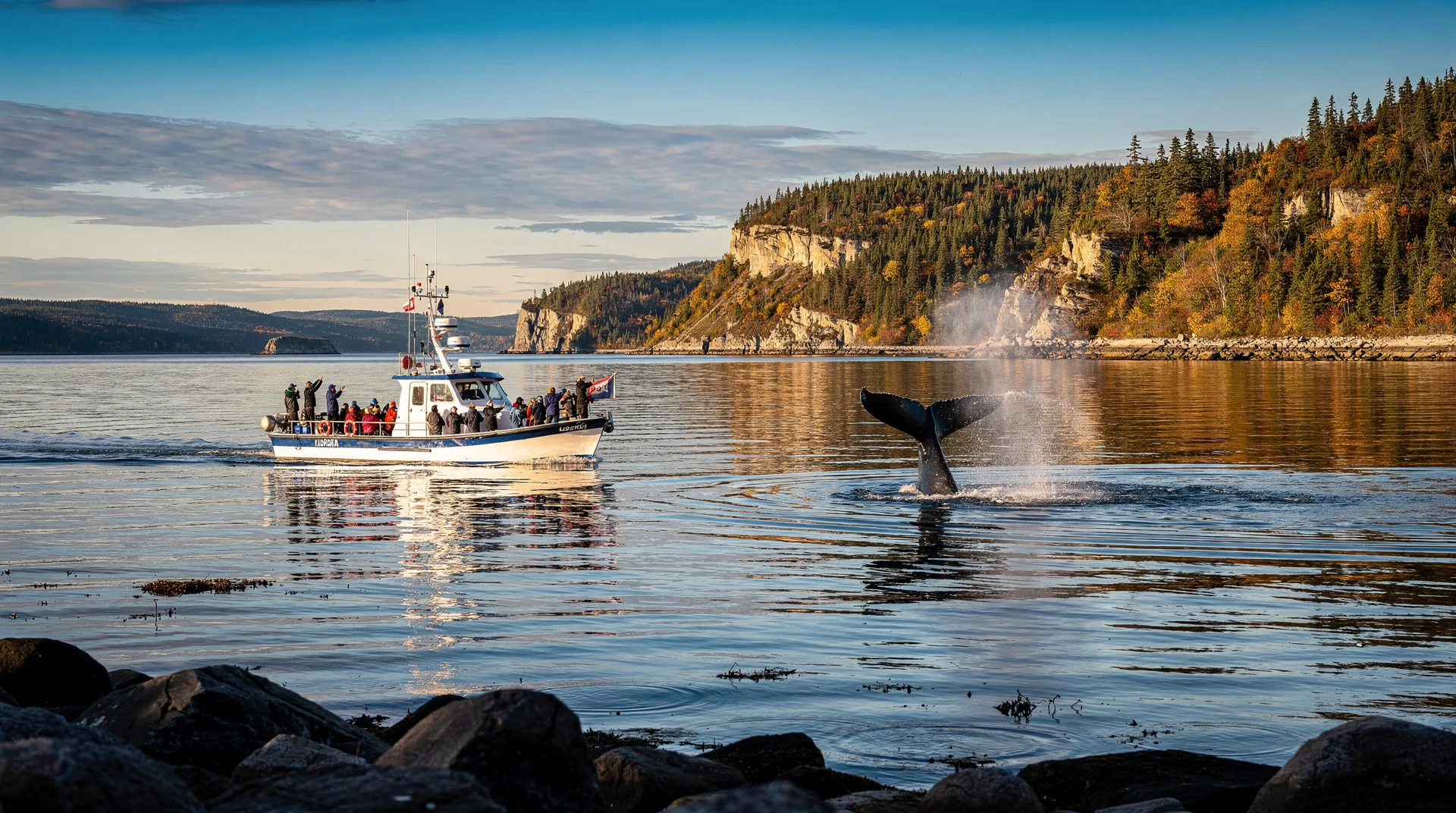
Blue Whale Viewing in Quebec: Tadoussac, Les Escoumins and the Science
Where can I see blue whales in Quebec?
The primary zone is the Saguenay–St. Lawrence confluence near Tadoussac and Les Escoumins, with the best probability in August–September. The Mingan Archipelago area also has significant blue whale activity.
A blue whale surfaces differently from any other animal. The blow — the vapour cloud that rises when the lungs exhale — reaches 9 metres high when the conditions are right, visible from kilometres away. Then the back appears: vast, blue-grey, surprisingly flat, with the small dorsal fin set far back on the body appearing seconds after the head has submerged again.
The whole sequence takes 8–12 seconds, after which the whale is gone — back to depths of 100–200 metres, feeding on krill. Then it happens again, sometimes after 5 minutes, sometimes after 30, at a location you cannot predict. Waiting for the second surfacing is the essential experience of blue whale watching, and the unpredictability is part of what makes it feel like a genuine encounter with a wild animal rather than a performance.
Blue whales are the largest animals that have ever existed on Earth. An adult female in the North Atlantic averages 24–26 metres. The largest reliably measured individual on record was 33 metres. They weigh between 100 and 150 tonnes. A blue whale’s heart, extracted after death, is roughly the size of a small car. They feed almost exclusively on krill — tiny crustaceans typically 1–5 cm long — consuming up to 4 tonnes per day during their summer feeding season. The biomass they require to sustain themselves is staggering, and only environments with exceptional krill productivity can support blue whale feeding concentrations. Quebec’s St. Lawrence estuary is one of those environments.
| At a glance | |
|---|---|
| Where | Tadoussac and Les Escoumins, at the Saguenay-St. Lawrence confluence |
| Cost | Whale watching boat tours are typically CAD 80-110 per adult for a 3-4 hour trip |
| Time needed | A single tour (3-4 hours), or 2-3 nights to allow for weather flexibility |
| Getting there | Around 3-3.5 hours by car from Quebec City along Route 138 |
| Best time | August and early September for the highest blue whale probability |
Why blue whales come to the St. Lawrence
The St. Lawrence estuary’s blue whale productivity has a specific oceanographic cause. Where the Saguenay River enters the St. Lawrence, the cold, dense bottom water of the Saguenay (chilled by contact with the ancient Precambrian rock of the fjord) flows into the St. Lawrence at depth and then upwells due to the bathymetric structure of the seabed. This upwelling brings deep, nutrient-rich water to the surface layer — nutrients that fuel exceptional plankton growth, which in turn supports the krill concentrations that blue whales need.
The krill species most important to St. Lawrence blue whales is Thysanoessa raschii, a species adapted to cold water and abundant in the estuary. The whales track the krill aggregations, which are themselves driven by oceanographic conditions (temperature, salinity, current) that shift through the season. This is why blue whale locations are somewhat unpredictable from day to day — the whales are following food, not a fixed schedule, and the food’s location responds to conditions that change.
The GREMM (Group for Research and Education on Marine Mammals), based at Tadoussac, has been studying the St. Lawrence blue whale population since the late 1970s. Their photo-identification catalogue currently contains approximately 450 individual blue whales identified by natural markings — primarily the mottled blue-grey pigmentation pattern on the back and flanks, which is individually distinctive the way a human fingerprint is. The catalogue allows researchers to track individual whales across seasons and years, and the data accumulated over 40+ years of continuous study make the St. Lawrence blue whale population one of the most intensively studied in the world.
The Tadoussac zone: where the action concentrates
The primary blue whale feeding area identified by GREMM research spans roughly the section of the St. Lawrence between Tadoussac in the west and Les Escoumins in the east, with extension further east in years of high krill abundance. This zone, approximately 60 km long, is where the upwelling conditions are most consistently productive.
Blue whales in this zone typically dive to 100–200 metres (occasionally deeper) and surface after 8–20 minutes of diving. A feeding sequence of 4–8 blows at the surface, separated by short dives, is typically followed by a longer dive during which the whale moves some distance. Predicting where a blue whale will surface after a long dive is essentially impossible, which is why tour operators position their boats near feeding areas (identifiable by the prey aggregations detected by echo-sounding equipment) rather than following individual whales.
Depth and krill: The GREMM research has established that blue whales in the St. Lawrence feed at depth on krill aggregations detected by sonar. The whales’ dive profiles (recorded by suction-attached data loggers in research operations) show them accelerating into krill patches at depth and decelerating as they filter the krill through their baleen plates. The largest krill aggregations in the estuary are typically associated with the zones of maximum upwelling — which is why the Tadoussac–Les Escoumins zone is so consistently productive.
Les Escoumins: the quieter blue whale option
Les Escoumins, 50 km east of Tadoussac on the north shore, provides access to the same whale habitat with significantly less boat traffic. Several operators based at Les Escoumins run daily whale watching tours that venture into the same zone as the Tadoussac fleet. For those who prefer less crowded water — fewer tour boats competing for proximity to the same whale — Les Escoumins is the better choice.
The Parks Canada marine mammal interpretation centre at Les Escoumins, operated in conjunction with the Saguenay–St. Lawrence Marine Park, provides scientific context through the summer. The underwater observatory at the site (a structure allowing observation of the water column below the surface) is primarily useful for viewing the inshore species (fish, invertebrates, curious belugas) rather than the large rorquals, which stay well offshore.
Book a blue whale watching tour in Quebec on GetYourGuideThe science of the St. Lawrence blue whales
The GREMM research program has produced a remarkably detailed picture of the St. Lawrence blue whale population over four decades.
Population size: The current estimate is approximately 400–450 individual blue whales visiting the St. Lawrence estuary during the feeding season. These animals are part of the larger North Atlantic blue whale population, which includes whales that winter in the Caribbean and along the mid-Atlantic ridge. The St. Lawrence is not the only feeding ground — blue whales also feed in the Gulf of St. Lawrence, on the Nova Scotia shelf, and in various other North Atlantic locations.
Individual histories: The photo-identification catalogue tracks individuals across decades. Some whales have been photographed every summer for 35+ years. Researchers have documented mother-calf pairs, social associations between adults, and individual variations in feeding site preferences. The catalogue is the primary tool for population assessment.
Recovery from whaling: Blue whales in the North Atlantic were systematically hunted to near-extinction by commercial whaling, which continued in the St. Lawrence itself until 1971. The current population represents recovery from an estimated 250 survivors in the 1970s. The population has grown slowly — blue whale reproductive rate is low (females give birth to one calf every 2–3 years) — and the species remains listed as endangered in Canada.
Ongoing threats: Ship strikes are the primary documented cause of blue whale mortality in the North Atlantic. Large commercial vessels travelling at high speed can strike a whale feeding near the surface without the vessel crew being aware. GREMM data indicate that ship strikes account for a significant proportion of recorded blue whale deaths in the St. Lawrence. Mitigation measures — voluntary speed reductions for commercial vessels in the highest-risk zones — have been implemented and are subject to ongoing evaluation.
Entanglement: Fishing gear entanglement is the second documented mortality cause, though less frequent for blue whales (which feed offshore) than for right whales that feed closer to fishing grounds.
What a blue whale encounter looks like from a boat
The standard encounter sequence on a tour that finds blue whales:
-
The blow is spotted at the surface — the guide or naturalist calls it out. At 2–5 km distance, the blow is a white column against the sky or the horizon. The boat moves toward it.
-
The boat approaches to the regulation exclusion zone (current regulations require a minimum distance of 200 metres from blue whales in the marine park). The boat positions and waits.
-
The whale surfaces in a feeding sequence — 4–8 blows separated by 1–3 minute intervals between shallow dives. The blow is clearly visible and audible from 200 metres on a calm day. The vast blue-grey back appears as the whale arches for the next dive.
-
The whale dives deeper — the dive signalled by the arching of the back and, in some dives, the raising of the tail fluke above the surface (fluking). The fluke pattern is photographed for identification.
-
The long dive follows — 10–20 minutes during which the boat may drift or reposition. The waiting is part of the experience.
-
The whale surfaces again — possibly close to the boat’s position, possibly 500 metres away. Tracking and waiting repeats.
The entire sequence from spotting a blow to losing a whale after a long dive can last 30 minutes to 2 hours, depending on the whale’s behaviour. Tours of 3–4 hours typically allow for 1–3 blue whale encounters in a session of high activity.
Photography of blue whales
Blue whale photography is technically demanding for several reasons:
Scale confusion: Because blue whales are so large, they frequently look smaller in photographs than they are. Without a reference object (a boat, a person, a known landmark), the scale is lost. The best images include scale context — a companion boat in the frame, or a whale surfacing close enough to a tour boat that the relative sizes are clear.
Timing: The surfacing sequence is brief. The blow appears first (a good photographic subject), then the back rolls through the surface for 3–6 seconds before the dorsal fin appears, and then the whale descends again. Getting the complete back-and-fin sequence in a single frame requires fast continuous shooting and anticipation.
Fluking: A fluking dive (where the tail comes out of the water) provides the most dramatic frame. Blue whales fluke less frequently than humpbacks — perhaps 30% of deep dives produce a visible fluke in this population. When it happens, the shutter speed needs to be fast (1/1000 second minimum) to freeze the motion.
Focal length: 400–600mm equivalent on a crop sensor camera is the useful range. A 70–200mm zoom does not reach far enough for isolated surface shots; a longer lens is needed for behaviour documentation.
Planning for a blue whale trip
When to go: August and early September offer the best blue whale probability. GREMM’s publicly updated sightings record (available on their website, whales-online.ca) shows distribution and frequency through the season and gives a real-time picture of what is being seen in which area.
Where to book: The established operators in Tadoussac (Croisières AML, Groupe Dufour) and Les Escoumins have the experience and equipment to find whales consistently. Smaller operators with fewer boats and more individual attention are also available.
Weather: Blue whale tours require reasonable sea state — not necessarily calm, but not wave heights above 1.5–2 metres. Tours are cancelled in unsafe conditions. Operators typically offer rebooking for weather cancellations.
Species context: On any given tour, blue whales may or may not be the primary species encountered. Fin whales, humpbacks, and minkes share the habitat, and a tour that produces no blue whale but has a humpback breaching sequence or multiple fin whales at close range is still an excellent experience. Managing expectations about species encounter is part of the planning.
Book Quebec whale watching and marine wildlife tours on GetYourGuideSeasonality: when the blue whale probability is best
| Period | Blue whale probability | Conditions | Crowds |
|---|---|---|---|
| May-June | Low-moderate, whales still arriving | Cool, variable weather | Light |
| July | Moderate | Warmer, more stable seas | Busy, peak tourist season begins |
| August-early September | Highest of the season | Warm, generally good sea state | Very busy, book ahead |
| Mid-September-October | Declining as whales depart | Cooling, rougher seas more common | Quieter |
Extending the trip beyond blue whales
Most visitors base themselves in Tadoussac or nearby Charlevoix, which offers its own scenic driving routes and villages within an hour or two of the whale watching zone. The wider Côte-Nord region extends the trip further along the north shore for travellers with more time.
For those drawn to belugas specifically rather than the large rorquals, note that Tadoussac’s inshore waters are the beluga zone — the closest comparable paddling experience elsewhere in Canada is beluga kayaking near Churchill, a very different trip in Manitoba’s subarctic. Travellers combining whale watching with other Quebec wildlife should also consider the snow geese migration Quebec guide, a spring and fall spectacle on the St. Lawrence itself.
Related pages
- Quebec whale watching complete guide — all species, all ports
- Tadoussac — the whale watching capital
- Côte-Nord region — the north shore blue whale corridor
- Mingan Archipelago — blue whales in the Gulf zone
- Snow geese migration Quebec — Quebec’s other great wildlife spectacle
- Charlevoix — the scenic base region near Tadoussac
- Beluga kayaking near Churchill — a different beluga encounter, in Manitoba
Frequently asked questions about Blue Whale Viewing in Quebec: Tadoussac, Les Escoumins and the Science
What is the probability of seeing a blue whale on a Quebec tour? In the peak period (August and early September) from Tadoussac or Les Escoumins on a standard 3–4 hour tour: roughly 60–80% probability on any given day with an experienced operator in good conditions. Some operators will offer rebooking for tours where the target species are not sighted.
How close do the boats get to blue whales? Regulations in the Saguenay–St. Lawrence Marine Park currently set minimum distances of 200 metres from blue and fin whales and specific approach angle protocols. These regulations are enforced by park wardens on patrol boats. The 200-metre distance is close enough for good binocular viewing and telephoto photography.
Can I volunteer with the blue whale research? GREMM offers occasional citizen science opportunities — whale watch programs where participants record sighting data using standardised forms. Contact GREMM through their website (whales-online.ca) for current volunteer opportunities.
Are blue whales dangerous to approach by kayak? Blue whales are not aggressive and are not documented to have harmed humans intentionally. However, a whale surfacing beneath or adjacent to a kayak creates an obvious danger from its mass and motion. Kayaking in areas of known blue whale feeding activity is not recommended for this reason; guided kayak tours in the Tadoussac area operate in areas where beluga rather than blue whale encounters are the target, and in inshore areas where the large rorquals are not typically feeding.
Is Tadoussac or Les Escoumins better for a first-time blue whale trip? Tadoussac has more operators, more departure times, and easier access from Quebec City, making it the practical default for most visitors. Les Escoumins offers the same feeding zone with less boat traffic and is a good choice for those who have already visited Tadoussac or who specifically want a quieter experience.
Do I need to book a whale watching tour in advance? In August and early September, yes — book at least a few days ahead, ideally a week or more, since peak-season departures fill up. In shoulder months (June, late September), walk-up booking the day before is often possible.