Quick facts
- Best time
- Aug to March (aurora) or June to July (midnight sun)
- Days needed
- 2-4 days
- Languages
- English, French, Dene languages
- Getting there
- Direct flights from Calgary, Edmonton, Vancouver
Yellowknife is the capital of Canada’s Northwest Territories — a city of about 20,000 people on the north shore of Great Slave Lake, north of the 62nd parallel, where the boreal forest gives way to the subarctic. It is the aurora capital of the world, or at least the most accessible one: sitting directly under the auroral oval (the ring around the magnetic pole where geomagnetic activity most often produces the Northern Lights), with over 200 clear nights per year that put most other northern destinations to shame.
Flying into Yellowknife from Edmonton or Calgary, the landscape shift is immediate and complete. The boreal forest below the aircraft is unbroken — no roads, no settlements, nothing but trees and lakes for hundreds of kilometres in every direction. Great Slave Lake appears: the second largest lake in Canada, so large that the far shore is below the horizon. The city itself sits on the Canadian Shield bedrock, and the exposed granite and the weight of the sky above it feel different from anywhere in southern Canada.
| At a glance | |
|---|---|
| Where | Northwest Territories, on the north shore of Great Slave Lake, north of the 62nd parallel |
| Cost | Aurora tours typically run around CAD 130-180 per person for a night; flights from Calgary/Edmonton/Vancouver vary widely by season |
| Time needed | Around 2-4 days for a solid aurora chance (3 nights improves the odds noticeably) |
| Getting there | Direct flights from Calgary, Edmonton and Vancouver; Highway 3 for the adventurous (around 1,500 km from Edmonton) |
| Best time | Roughly January to March for the clearest, longest aurora nights; June-July for midnight sun instead |
Aurora capital of the world
The aurora borealis is the primary reason most visitors come to Yellowknife. The science is straightforward: the auroral oval passes directly over the NWT, Yellowknife gets over 200 cloud-free nights annually (extremely high for a northern location), and the city is accessible by regular scheduled flights. This combination is unusual. Churchill in Manitoba is under the auroral zone but cloudier. Tromsø in Norway is often expensive and crowded. Yellowknife is accessible, clear, and authentically northern.
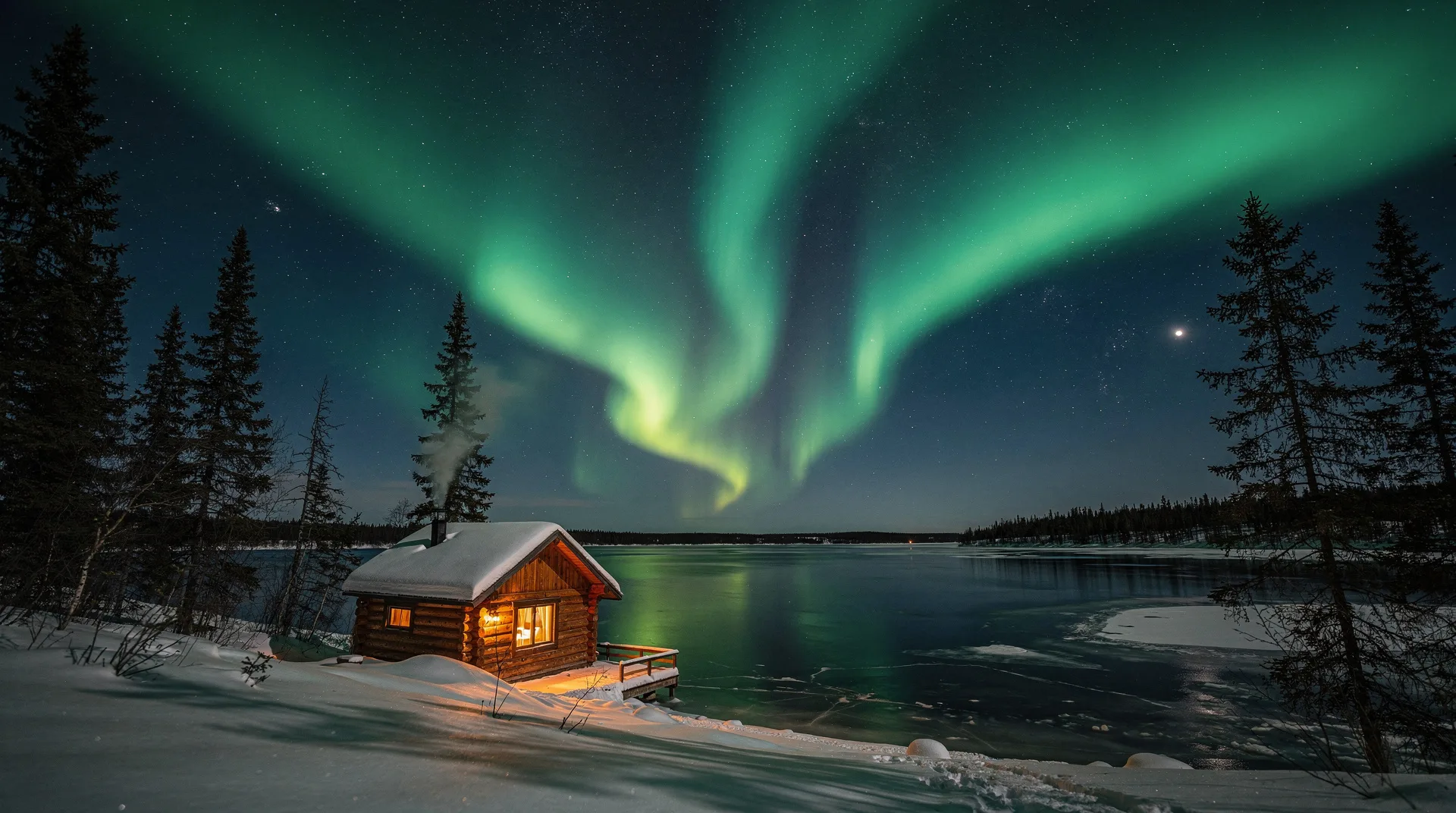
Aurora season runs from late August through April, with the darkest skies (and therefore best viewing) from December through February. On strong geomagnetic activity nights, the display can last for hours — green curtains rippling across the sky, shifting through yellow, red, and occasionally blue, with the stars of the subarctic night behind them. The silence under an active aurora — the only city lights far behind you, the temperature at -30°C — is one of the most overwhelming sensory experiences available in natural Canada.
Multiple tour operators in Yellowknife run aurora viewing excursions to warm-up cabins outside the city, equipped with heated viewing areas, hot drinks, traditional Indigenous teepees with fires, and guides who can explain the geophysics and photograph the display for you.
Top things to do in Yellowknife
Aurora viewing tours
The standard aurora tour format in Yellowknife departs from hotels after 10 PM and travels 30–40 minutes outside the city to a viewing site away from light pollution. Heated cabin or teepee structures allow warming up while keeping a watch on the sky. Guides monitor aurora forecast apps and wake sleeping clients for good displays. The quality of the experience varies with geomagnetic activity (unpredictable) and cloud cover (reasonably forecastable 24 hours in advance).
Aurora forecast sites — Space Weather Center data and dedicated apps — give a Kp index prediction that helps set expectations. Kp 3 produces visible bands from Yellowknife; Kp 5+ produces full-sky displays that fill every direction. A stay of three nights significantly increases the probability of seeing a strong display.
Browse northern lights tours and aurora viewing experiences across CanadaGreat Slave Lake and the ice road
Great Slave Lake covers 28,930 square kilometres — the deepest lake in North America at 614 metres. In summer, boat tours depart from the Yellowknife waterfront. In winter, the lake freezes to sufficient depth to carry loaded trucks, and a network of ice roads connects communities that have no summer road access. Driving the ice road across Great Slave Lake is an experience unique to the Canadian North: a truck road marked with spruce boughs, the ice groaning beneath, and the flat white expanse of the frozen lake in every direction.
The ice road typically opens in January and closes in March when warming temperatures make the ice unsafe. Guided ice road driving experiences are available for visitors who want the experience without the responsibility of navigating it independently.
Old Town and the rock
Yellowknife’s Old Town, on a peninsula of exposed granite west of downtown, is the most characterful urban neighbourhood in the Northwest Territories. Wooden houses built on the bare rock in the 1930s and 40s gold rush era, connected by elevated boardwalks over the irregular granite, surround a float plane base where de Havilland Beaver and Otter aircraft land continuously throughout the day. The Wild Cat Café (1937) is the oldest surviving building in Yellowknife and operates as a summer café — lunch on its porch, watching floatplanes, with the Slave River below.
Ndilo and Dettah are Yellowknives Dene Nation communities on the lake shores immediately adjacent to Yellowknife — the oldest continuously inhabited sites in the area, with cultural programs and crafts available through community partnerships.
Northern Land Adventures and dog sledding
Dog sledding with a genuine working sled team — not a tourist demonstration but a full expedition-style outing — is available through multiple Yellowknife operators. Day trips and multi-day wilderness excursions run from November through March. The experience of running behind a team of huskies through the boreal forest on a clear winter day is elemental.
Snowmobile tours, cross-country skiing on the trails around the city, and ice fishing on Great Slave Lake are all winter activity options. Summer brings hiking, kayaking on the Mackenzie River system, and fly-out fishing trips to remote lakes.
Explore aurora tours across Canada’s north including late-night viewing experiencesIndigenous culture and the Dene Nation
Yellowknife sits on the traditional territory of the Yellowknives Dene, and the broader Northwest Territories is home to Dene, Métis, and Inuvialuit peoples whose cultural traditions are increasingly shared with visitors through guided programs. The Prince of Wales Northern Heritage Centre (Yellowknife’s main museum) has excellent exhibits on Dene culture, the history of the northern fur trade, and the natural history of the NWT.
Cultural tourism programs include traditional drum dancing demonstrations, beadwork and hide-tanning workshops, Indigenous-guided land tours, and community visits to Dettah. The Dene Cultural Institute supports these programs and can facilitate connections.
The midnight sun
From roughly May 21 to July 21, the sun does not fully set in Yellowknife — a “polar day” of continuous light that is as disorienting and beautiful in its way as the aurora. The light at midnight, with the sun low on the horizon, turns the boreal forest and the lake into a dreamlike golden landscape. Activities that would be impossible in normal nighttime conditions — photography, hiking, kayaking — continue through what should be the middle of the night. The adjustment requires blackout curtains.
Diamond mining history
Yellowknife’s 20th-century history was defined by two gold rushes (1930s and 1940s) and the discovery in 1991 of diamonds in the Northwest Territories — one of the largest diamond deposits in the world. The Prince of Wales Northern Heritage Centre tells the story of both industries. The Royal Oak Mine and the Giant Mine (currently undergoing a massive remediation for arsenic contamination) are sites of this history. The Diavik and Ekati diamond mines, 300 kilometres north of Yellowknife, can be visited on fly-in tours arranged through local operators.
Best areas in Yellowknife
Old Town on the peninsula is the most atmospheric part of the city — float plane base, wooden houses on rock, the Wild Cat Café, and walking distance to the Weaver and Devore Trading Co. for traditional northern crafts.
Downtown (50th Avenue area) has the hotels, restaurants, and services.
Latham Island connecting Old Town to the mainland across the bay has several excellent restaurants and the most scenic approach to Old Town.
The Ski Club hills north of downtown provide winter recreation close to the city.
When to visit
January to March are the peak aurora months — the coldest but also the clearest, with the longest dark periods and the highest probability of strong geomagnetic activity. March has slightly warmer temperatures while maintaining good aurora conditions.
August and September offer the beginning of aurora season combined with manageable temperatures (5–15°C) and summer activities still operating. The aurora begins in late August as the nights return after the midnight sun period.
June and July are midnight sun months — endless daylight, hiking, paddling, and the uncanny northern summer. No aurora, but a different kind of northern experience.
October and November are transitional — aurora conditions improving, temperatures dropping, some services reducing hours. Ice road enthusiasts should target January.
Where to stay
The Explorer Hotel downtown is Yellowknife’s most established full-service hotel — comfortable, central, and with the aurora viewing deck that’s become a city landmark.
Chateau Nova Yellowknife on 50th Avenue is a reliable mid-range option with well-equipped rooms for winter visitors (good heating, blackout curtains, parking for -40°C nights).
Wildcat Retreat Cabins near Old Town provide self-contained cabin accommodation with views over Back Bay — the most atmospheric option for those wanting character over amenities.
Several aurora tour operators include accommodation packages in remote heated cabins outside the city — these combine accommodation and viewing in a single arrangement.
Food and drink
Yellowknife’s small size belies a surprisingly active restaurant scene, shaped by the high incomes of mining workers and a well-travelled professional class. Bullock’s Bistro in Old Town is the Yellowknife institution — a rough-wood dining room serving remarkably good fish: Arctic char, whitefish, pickerel from Great Slave Lake, prepared in butter with sides of bread and coleslaw. The rule is simple: arrive when they open (dinner service fills immediately), take what they serve, eat everything. It has been operating this way since 1985.
Zehabesha Ethiopian restaurant on 50th Avenue reflects Yellowknife’s international workforce. The Woodyard Brewhouse provides local craft beer in a post-industrial space. Javaroma Gourmet Coffee is the local coffee institution.
Traditional Dene foods — dried fish, moose meat, bannock (fry bread), and ptarmigan — appear at cultural events and through some guided programs rather than in conventional restaurants.
Getting around
Yellowknife Airport (YZF) has direct connections from Calgary, Edmonton, Vancouver, and Ottawa. The airport is 5 kilometres from downtown — a short taxi or rideshare away. Within Yellowknife, a car is useful but not essential for the downtown core, Old Town, and the main hotels. Aurora tour operators provide hotel pickup. Car rental is available at the airport.
Highway 3 connects Yellowknife to the rest of Canada — a 1,500-kilometre drive from Edmonton. The road is paved but long and passes through genuine northern wilderness. Most visitors fly.
Day trips from Yellowknife
Detah (accessible by ice road in winter or water taxi in summer) for Yellowknives Dene Nation cultural visits and the only road connection to the ice road network.
Tibbet Lake / Prosperous Lake area (30 km from Yellowknife) for wilderness hiking, wildlife viewing, and aurora viewing from a dark-sky location.
Fly-out fishing to remote lakes in the NWT interior — outfitters can organize day trips by floatplane to lakes with exceptional Arctic char, lake trout, and northern pike fishing.
Wood Buffalo National Park (accessible by road, approximately 8 hours south in Alberta/NWT) is the world’s largest national park and a UNESCO World Heritage Site — home to the world’s last free-roaming wild bison herd and the only natural nesting habitat of the whooping crane.
Yellowknife by season
| Period | Conditions | Aurora odds | Crowds |
|---|---|---|---|
| Jan-Mar | Deep cold, -25 to -40°C, longest dark nights | Best of the year | Peak aurora tourism, book ahead |
| Apr-May | Milder, breakup on the lake, shoulder season | Fading as nights shorten | Quiet |
| Jun-Jul | Midnight sun, mild, 15-20°C | None (too much daylight) | Moderate, summer activities |
| Aug-Sep | Nights returning, cooling | Season restarts late Aug | Growing again |
| Oct-Nov | Ice forming, transitional | Improving | Quiet, some services scaled back |
Comparing Yellowknife to Canada’s other northern lights bases
Yellowknife is not the only Canadian aurora destination, and it is worth knowing how it stacks up. Churchill, Manitoba sits under the auroral oval too and pairs aurora season with polar bears in autumn, but it is cloudier on average and considerably more expensive to reach.
The Yukon, especially around Whitehorse and further north on the Dempster Highway, offers similarly strong odds with a more road-trip-friendly structure if you already plan to explore Northwest Territories more broadly. For a dedicated guide to timing an aurora trip anywhere in the Canadian north, see when to see the northern lights and the Churchill aurora guide for comparison.
A three-night stay is the practical minimum for a realistic chance of a strong display, since even a clear-sky forecast can produce a quiet geomagnetic night. Building in a buffer night before a flight home avoids the disappointment of an active KP forecast landing on your departure day.
Planning your northern trip around Yellowknife
If aurora is the whole point of your trip, start with the dedicated Yellowknife aurora guide, which goes deeper on timing and what a viewing night looks like. The five-day Yellowknife aurora itinerary turns that advice into a day-by-day plan, with daytime activities that leave you rested for the late nights.
Photographers should read the aurora photography guide before packing, because cold weather changes how cameras and batteries behave. Pair it with the packing list and the broader notes on Canada in winter so that your clothing matches the conditions you will actually stand in.
Yellowknife also works as a base for a longer northern journey. The Mackenzie River and the remote Nahanni National Park show what the Northwest Territories looks like beyond the city, while Inuvik takes you further toward the Arctic coast. For another approach to the dark season, dog sledding in Canada covers what to expect on the trail, and the midnight sun guide explains the opposite end of the northern year.
Visitors who want to understand the people whose land this is can read about Indigenous tourism in Canada, which helps in choosing respectful, community-led experiences. If your plans include a road leg, the Wood Buffalo National Park page covers the park mentioned above in more detail.
Frequently asked questions about Yellowknife
What is the best month for aurora viewing in Yellowknife?
Most aurora photographers target January for the combination of clear skies, long nights, and statistically high geomagnetic activity. February and March have warmer temperatures while maintaining similar aurora conditions. August is the earliest month aurora viewing becomes feasible as nights return.
How cold does it actually get in Yellowknife in winter?
January averages around -26°C, with frequent nights of -35°C to -40°C. Wind chill can make it feel colder. This is not uncomfortable if you have appropriate clothing — insulated parka, insulated boots to -40°C, mitts, hat, and neck protection. All aurora tour operators provide rental gear for clients who don’t bring adequate clothing. Exposed skin freezes in minutes at these temperatures.
Can I see the aurora from downtown?
On very strong nights (Kp 5+), the aurora is visible from downtown despite light pollution. For reliable viewing of even moderate displays, you need to get 20–30 kilometres outside the city to reduce the ambient light. Tour operators take you to dedicated sites with this purpose.
Is Yellowknife safe?
Yellowknife has a higher proportion of Indigenous residents experiencing social challenges than most Canadian cities, and some areas have higher rates of social disorder. The downtown, Old Town, and tourist areas are generally safe and welcoming. Standard city awareness applies.
Can I drive to Yellowknife?
Yes — the Mackenzie Highway from Edmonton (Highway 1/3) connects to Yellowknife via Highway 3 at Enterprise, NWT. The full drive from Edmonton is approximately 1,500 kilometres (about 15 hours of driving). The road is paved throughout but remote — fuel up at every opportunity and carry emergency supplies. It is a genuine adventure drive through the boreal North.
Is Yellowknife better than Churchill for the northern lights?
Both sit under the auroral oval, but Yellowknife generally has more reliably clear skies, cheaper and more frequent flights, and a wider choice of tour operators. Churchill has the added draw of polar bears in October-November, which Yellowknife doesn’t offer, so the choice often comes down to whether you want aurora alone or aurora plus wildlife.
Do I need a car in Yellowknife for aurora viewing?
Not necessarily — most aurora tour operators include hotel pickup and drop-off as part of the package, since the viewing sites are typically 20-40 minutes outside the city. A car is more useful if you plan day trips to Detah or the Tibbet Lake area independently.