Quick facts
- Population
- ~30 (permanent)
- Best time
- May–October; sunrise and sunset for photography
- Languages
- English
- Distance from Halifax
- 45 minutes (43 km)
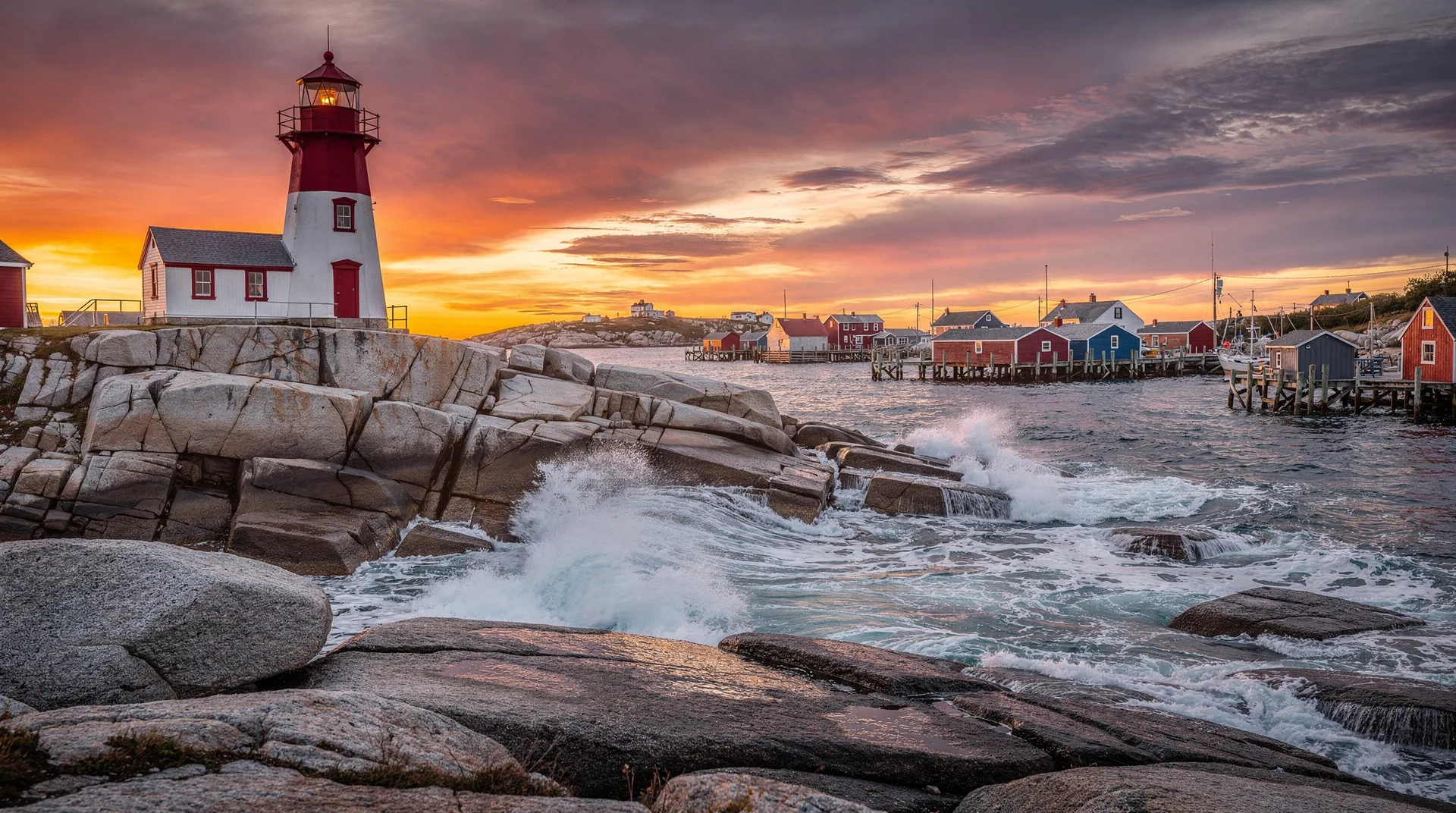
Peggy’s Cove has been photographed more often than almost any other scene in Canada — the red-and-white lighthouse standing on a dome of wave-worn granite at the ocean’s edge, the fishing village behind it, the wooden houses reflected in the mirror of the protected cove — and that familiarity has done nothing to diminish the impact of arriving here and finding the real thing exactly where it should be. The image is accurate. The lighthouse does stand exactly that way on those rocks with exactly that quality of Atlantic light, and the fishing village behind it is still a working place, albeit one that serves coffee and lobster rolls alongside its remaining commercial fishing operation.
The village sits at the tip of a granite peninsula 43 kilometres southwest of Halifax, technically in the Municipality of the District of St. Margaret’s Bay, and holds a permanent population of around 30 people. What makes the site extraordinary is not the lighthouse itself — it is a standard Canadian Coast Guard octagonal concrete tower, operational since 1868 and rebuilt in 1914 — but the landscape it inhabits: a field of glacier-polished granite boulders, bare of soil and vegetation, that extends from the village down to the sea, carved into smooth whale-back forms by 10,000 years of wave action and interrupted by pools of trapped seawater that flash green in the sun.
| At a glance | |
|---|---|
| Where | St. Margaret’s Bay, Nova Scotia — 43 km / around 45 minutes southwest of Halifax |
| Cost | Free to visit; parking is free but limited; budget around CAD 20-30 for a lobster roll lunch |
| Time needed | 1-2 hours for the village and rocks; a half-day with a South Shore stop |
| Getting there | Self-drive on Highway 333, or a half-day tour from Halifax |
| Best time | Sunrise, May-October; avoid July-August late mornings |
Top things to do at Peggy’s Cove
The lighthouse and the granite barrens
The lighthouse itself takes about three minutes to walk to from the parking area — it is not far, but the terrain underfoot requires attention. The granite is polished smooth by wave action and can be slippery even when dry; warning signs at the site are explicit about the danger of the black rocks at the ocean edge, which are wetted by spray from waves that arrive without warning. People have died here when rogue waves swept them from rocks they thought safe. The caution is not theatrical.
What draws people closer than the warnings suggest is wisdom is the quality of the rock landscape itself. The boulders have been shaped into forms that invite exploration — smooth bowls, intersecting planes, balanced rocks, the tidal pools in the depressions between them. The lighthouse occupies the highest point, and from its base on a clear day you see the Atlantic horizon without interruption from one edge of vision to the other, which is a feeling difficult to find on the Nova Scotia mainland.
The lighthouse still functions as an active navigational aid; it also houses a post office in summer, allowing visitors to send postcards with the Peggy’s Cove postmark — a tradition that has operated for decades.
Book Halifax and Peggy’s Cove day tours on GetYourGuidePhotography at golden hour
Peggy’s Cove rewards patience and timing more than any other Nova Scotia destination. The site at midday in summer, when tour buses are stacked in the parking area and several hundred people are simultaneously photographing each other photographing the lighthouse, is not the experience the image promises. The site at dawn on a clear morning in September, with low-angle light hitting the granite and the village reflected in the cove, with nobody on the rocks yet — that is the Peggy’s Cove that has fuelled a century of paintings and photographs.
Practical considerations for photography: arrive before 8am in summer, or aim for the last two hours of daylight. The eastern-facing cove catches morning light on the fishing boats and sheds; the lighthouse and open granite face south and southwest and are best lit in late afternoon. Fog is frequent at the tip of the peninsula — while it reduces the long-range views, it transforms the lighthouse into something more dramatic and can produce exceptional images.
The village and fishing culture
Behind the granite barrens, the village of Peggy’s Cove is small enough to walk completely in 15 minutes. The harbour is a protected cove where lobster boats and small fishing vessels bob on the tide, the wharves stacked with traps. Several fishing families have operated here for generations — the commercial fishing is real, though increasingly supplemented by tourism income.
The village’s half-dozen restaurants and takeaway counters serve lobster rolls, fish and chips, and chowder made from local catch. Sou’Wester Restaurant, operating in a building directly beside the lighthouse parking area, has served tourists longer than most other operations here and is reliably good. The lobster rolls — cold or warm, on a toasted brioche bun — are worth the line.
A small collection of studios and galleries in the village sell maritime paintings, carved fish and lighthouse models, and Nova Scotia crafts of variable quality. The work of William deGarthe (1907–1983), a Finnish-Canadian artist who made Peggy’s Cove his home and subject for 30 years, is referenced in a small museum and in the remarkable bas-relief he carved into a granite outcrop behind his studio — a 30-metre carved frieze depicting the fishermen and families of the Nova Scotia coast.
Swissair Flight 111 Memorial
On the coastal road 6 kilometres north of Peggy’s Cove, at Bayswater Beach Road, two memorials mark the crash site of Swissair Flight 111, which went down in St. Margaret’s Bay on September 2, 1998, killing all 229 people aboard. The aircraft, en route from New York to Geneva, suffered an in-flight fire caused by arc-fault wiring and crashed 8 minutes after the crew declared an emergency.
The Swiss memorial at Whalesback is a simple stone monument at the cliff edge above the ocean where the aircraft came down — a granite form with a small aperture aligned to frame the crash site offshore. The separate Nova Scotian memorial, also at the site, recognizes the local fishermen and search and rescue personnel who responded immediately and recovered 229 victims from the water over the days that followed. The dual memorials, approached by a short walk from the road, are quiet and moving — appropriate given the scale of what happened here.
Hiking the trail to Peggy’s Cove
The Peggy’s Cove trail system extends along the coast both northeast and southwest of the village, following the granite barrens above the sea. The Lighthouse Trail (3.5 km return) runs northeast from the lighthouse along the cliff edge, offering elevated views of the coast and the open Atlantic, with the lighthouse receding behind and smaller rock formations appearing ahead. The terrain is consistent Peggy’s Cove geology — smooth granite with tidal pools — and the exposure to the sea makes this a good option when the village is crowded.
The trail can be extended to Indian Harbour for a longer coastal walk. Parts of the trail are unmarked across open granite, and navigation requires attention to the painted trail markers on the rock. The coastline here is completely unsheltered, and wind and spray can be intense even in calm weather.
When to visit Peggy’s Cove
May and June: Fewer visitors, spring light, and a better chance of having the rocks to yourself in the early morning. The sea can be rough and conditions change quickly — interesting for photography, less so for casual visiting. Lobster season opens in late May, which means fresh lobster at the restaurants.
July and August: Peak season, with tour buses arriving from 10am onward. The site is genuinely crowded from late morning through early afternoon. Sunrise visits in July reward early rising with empty rocks and extraordinary light. August fog is common and photogenic.
September and October: The best combination of quality and manageability. Crowds thin from mid-September; the light in early October is exceptional; the sea is often rough enough to be dramatic without the dangerous winter conditions. Fall colour on the drive from Halifax adds to the experience.
November to April: The village services are largely closed, and the coastal conditions can be genuinely dangerous. Winter storms produce dramatic wave action on the granite — experienced photographers come in winter specifically for this — but casual visitors should be aware that the site is significantly more hazardous in wet and icy conditions.
Where to stay near Peggy’s Cove
Peggy’s Cove has no hotel — the village population is too small to support one. The nearest accommodation is in:
Tantallon (15 km east on Highway 333): a small community with several B&Bs and rental cottages that allow day-trip access to both Peggy’s Cove and the Bedford/Halifax corridor.
Chester and Mahone Bay (40–50 km southwest): charming coastal towns on Mahone Bay that pair well with a Peggy’s Cove visit on a longer South Shore itinerary.
Halifax (43 km east): the practical base for most Peggy’s Cove day trips. Halifax has a full range of accommodation from budget hostels to waterfront hotels, and the 45-minute drive to Peggy’s Cove allows an early morning departure to beat the crowds. See the Halifax city guide for accommodation recommendations.
Getting there and around
From Halifax by car: Highway 333 west from the Armdale Rotary on the western edge of Halifax runs directly to Peggy’s Cove. The coastal route via Portuguese Cove and Terence Bay adds 15 minutes but is considerably more scenic — the coastal road passes several smaller fishing villages and viewpoints before arriving at Peggy’s Cove from the south.
By tour: Multiple Halifax tour operators run half-day Peggy’s Cove excursions, typically departing mid-morning and returning to Halifax by early afternoon. These tours are convenient and are led by guides who provide historical context and local knowledge. The downside is arrival at the site during peak crowd hours; photographers are generally better served by a private early-morning drive.
Parking: Peggy’s Cove’s parking area is a single lot with limited capacity. On peak summer days (July weekends, holidays), it fills by 10am and vehicles queue on the highway. Arriving before 9am solves this problem; alternatively, arriving after 4pm on summer afternoons catches the site as tour buses depart and evening light arrives.
Explore Nova Scotia coastal tours and lighthouse excursions on GetYourGuideThe South Shore extension
Peggy’s Cove works best as the western anchor of a South Shore driving itinerary rather than a sole destination. From Peggy’s Cove, Highway 3 and Route 333 lead southwest through a sequence of towns that are among the most attractive in Nova Scotia:
Mahone Bay (50 km): a former shipbuilding town on the inner arm of Mahone Bay, famous for the view of three church steeples reflected in the harbour and for its independent boutiques and craft galleries.
Lunenburg (90 km): a UNESCO World Heritage Site and the best-preserved British colonial town in North America, with colourful wood-frame buildings on a steep harbour hillside, a working fishery, and the home port of the Bluenose II schooner. An essential stop on any Nova Scotia itinerary.
Chester: a sailing community on Mahone Bay with a pleasant waterfront and good restaurants; more affluent and quieter than Lunenburg.
Practical tips
Do not climb beyond the warning signs: The signs marking the “black rocks” around the lighthouse base and facing the open ocean are not decorative. Waves at Peggy’s Cove arrive without warning, and the rocks they wet are frictionless. Every year there are close calls and occasionally fatalities at this site. Photograph from the approved areas; the image is just as good, and the composition usually benefits from the distance.
Timing relative to tides: Check the tide tables for your visit. At low tide, the granite extends further from the water and the tidal pools are fuller and more interesting. At high tide, parts of the granite path are under water and the waves reach closer to the lighthouse base — dramatic, but requiring greater caution.
Accessibility: The granite barrens are not wheelchair accessible. The lighthouse can be seen from the parking area and from the village without navigating the rocks, but the classic close-up viewpoints require walking on uneven granite.
Beyond Peggy’s Cove: the wider South Shore and Atlantic Canada
Travellers building a longer Nova Scotia loop typically pair Peggy’s Cove with a night in Halifax, a walk through Mahone Bay, and a stop in Lunenburg before continuing further down the coast. Those with more time push on toward Digby or Yarmouth on the province’s southwestern tip, or compare notes on Nova Scotia versus New Brunswick for a longer Maritimes itinerary. Annapolis Royal, one of Canada’s oldest European settlements, is another worthwhile detour for travellers with a car and a few extra days.
Is Peggy’s Cove worth visiting?
With appropriate expectations, yes. Peggy’s Cove is the most iconic image in Nova Scotia tourism for reasons that become evident on arrival — the site really is as striking as advertised, and the lighthouse-on-granite composition is not a telephoto trick or a narrow angle of view but the actual relationship between the structures and the landscape. The trick is timing: visited at sunrise in September, with the village quiet and the light oblique on the granite, Peggy’s Cove is one of the most beautiful coastal sites in Canada. Visited at 11am on a July Saturday, it is a crowded parking lot with a lighthouse in the background. Plan accordingly.
Frequently asked questions about Peggy’s Cove
Is Peggy’s Cove free to visit?
Yes — there is no admission fee to walk the village or the granite barrens around the lighthouse, and parking at the main lot is also free, though it fills quickly in peak summer hours.
How much time do you need at Peggy’s Cove?
Most visitors spend 1-2 hours: enough for the lighthouse, the granite rocks, and a coffee or lobster roll in the village. Photographers chasing golden-hour light, or travellers adding the Swissair memorial and a short hike, should budget closer to half a day.