Quick facts
- Area
- 22,013 km² (park and reserve)
- Best time
- June–September (hiking); May for wildlife
- Languages
- English
- Days needed
- 3-5 days
There are wild places, and then there is Kluane. Covering 22,013 square kilometres in the southwestern corner of the Yukon, Kluane National Park and Reserve contains the largest non-polar icefield system on earth — a vast frozen plateau at altitude that feeds glaciers flowing in every direction, including the Kaskawulsh Glacier, one of the few remaining glaciers on the continent that you can actually reach on foot from a trailhead.
Above it all, Mount Logan rises to 5,959 metres, the highest peak in Canada and the second-highest in North America after Denali. Most visitors never climb it — a full Logan expedition takes two to three weeks and requires serious mountaineering credentials — but its presence defines the park’s scale and ambition.
Kluane is a UNESCO World Heritage Site jointly with Wrangell-St. Elias National Park in Alaska, Glacier Bay National Park, and Tatshenshini-Alsek Provincial Park — a transboundary designation covering 98,000 square kilometres of protected wilderness, the largest international protected area in the world. The park’s gateway town is Haines Junction, 158 kilometres west of Whitehorse on the Alaska Highway. It has a Parks Canada visitor centre, a handful of accommodation options, fuel, and enough provisions for a multi-day wilderness stay — but don’t expect more than that.
| At a glance | |
|---|---|
| Where | Southwest Yukon, gateway town Haines Junction on the Alaska Highway |
| Cost | Parks Canada entry fee, plus around CAD $350-$800 per person for flightseeing and a paid permit for backcountry camping |
| Time needed | Around 3-5 days for a proper visit |
| Getting there | Around 2 hours (158 km) from Whitehorse via the Alaska Highway; a rental vehicle is essential, there is no public transport |
| Best time | June to September for hiking and glacier flights; May and September for wildlife with fewer visitors |
Kluane and the wider Yukon and Rockies picture
Kluane is frequently mentioned alongside Jasper National Park and the Canadian Rockies as one of Canada’s premier mountain destinations, but the comparison only goes so far. Jasper and Banff have road corridors running through the heart of their mountain scenery; in Kluane, the road only skirts the edge, and the true scale of the park — the icefield, Mount Logan, the interior glaciers — is reserved for flightseeing passengers and serious mountaineers.
Paired with a wider Yukon itinerary, Kluane works best as the physically demanding, high-reward centrepiece of a trip that also includes Whitehorse and Dawson City for easier, more service-rich stops.
Why Kluane is unlike any other park in Canada
Most of Kluane is permanently inaccessible except by aircraft. The icefields that dominate the park’s interior sit at elevations between 2,000 and 3,000 metres and are reached only by ski-equipped bush planes from spring expeditions. What this means in practice is that the accessible portions of the park — the front ranges along the Alaska Highway, the valleys that descend from the mountains, the moraine fields at glacier termini — feel profoundly untouched, because the interior is so remote that even the accessible edges retain genuine wilderness character.
The park’s ecology reflects this scale. It supports one of the densest grizzly bear populations in Canada. Dall sheep pick their way across impossibly steep limestone slopes in the front ranges, white against the grey rock. Moose browse the willow flats along the Dezadeash and Aishihik rivers. Golden eagles and peregrine falcons nest on cliff faces. In the alpine tundra above treeline, the landscape shifts to tundra polygons, frost-heaved ground, and wildflower meadows that bloom brilliantly in late June and July.
For the wider regional picture, the Yukon destination page shows how Kluane fits alongside the territory’s other stops, and the Kluane National Park guide goes deeper on planning. Haines Junction is the town where most visits start, so it is worth reading before you commit to dates.
Top things to do in Kluane
Kaskawulsh Glacier access trail
The Slims River West trail to Kaskawulsh Glacier is Kluane’s signature hiking experience — and one of the most rewarding day hikes in Canada. The trail begins at the Sheep Creek trailhead on the Alaska Highway and runs approximately 15 kilometres each way through sub-alpine terrain to the glacier’s terminal moraine. The views of the glacier, a river of ice several kilometres wide descending from the St. Elias Mountains, are staggering at any time of day but particularly extraordinary in the angled light of a long Yukon evening.
Be aware that the route crosses active moraine terrain and several braided glacial streams. Water levels fluctuate with daily temperature and can be knee-deep or higher in the afternoon. Start early, carry poles for stream crossings, and allow a full day — 8 to 10 hours is realistic for the return trip. The Parks Canada visitor centre in Haines Junction has current trail and water level information; check in before departing.
Flightseeing over the icefields
The most dramatic way to understand Kluane’s scale is from the air. Fixed-wing flightseeing tours operated from Haines Junction take visitors over the St. Elias icefields at low altitude, banking over crevasse fields, nunataks (mountain peaks projecting above the ice), and the upper reaches of Mount Logan. On clear days, the panorama extends to peaks in Alaska and the open Pacific coast.
Browse Yukon wilderness and glacier experiencesThese flights run from May through September, weather permitting. Book through operators based in Haines Junction. Flights typically last 60 to 90 minutes and cover terrain that would take weeks to reach on foot. For anyone with a serious interest in mountain photography, this is one of the extraordinary opportunities in the country.
Wildlife watching in the front ranges
The front ranges along the Alaska Highway between Haines Junction and the park’s eastern boundary are prime habitat for Dall sheep and grizzly bears. Sheep are often visible from the highway, particularly on the slopes of Sheep Mountain above Kluane Lake — the prominent limestone massif that rises directly from the lake’s edge. Bring binoculars and scan the upper cliff faces methodically; sheep are white and stand out clearly against the grey rock, but they blend into snow patches in early season.
Grizzly bears are present throughout the park but are most visible in spring (May–June) when they emerge from dens and forage in valley bottoms, and in late summer when they concentrate on berry patches at treeline. Wolves, caribou, and Yukon moose round out the large mammal list. Black bears are also present but far less commonly seen than grizzlies.
If bears are a main reason for your trip, the grizzly bear viewing guide explains how to watch them responsibly, and the Canada wildlife safety guide covers distances, bear spray and what to do if an animal approaches. Good habits matter more here than anywhere on the Rockies circuit, because help is far away.
King’s Throne hike
One of the most spectacular day hikes in the park, King’s Throne begins at Kathleen Lake (23 kilometres south of Haines Junction) and climbs steeply to a cirque — a natural amphitheatre — with views over the lake and the mountains of the park’s interior. The ascent is approximately 1,000 metres over 6 kilometres, making it genuinely demanding. The top of the cirque offers panoramic views into the heart of Kluane that are rarely matched on a trail accessible without a permit or a full expedition.
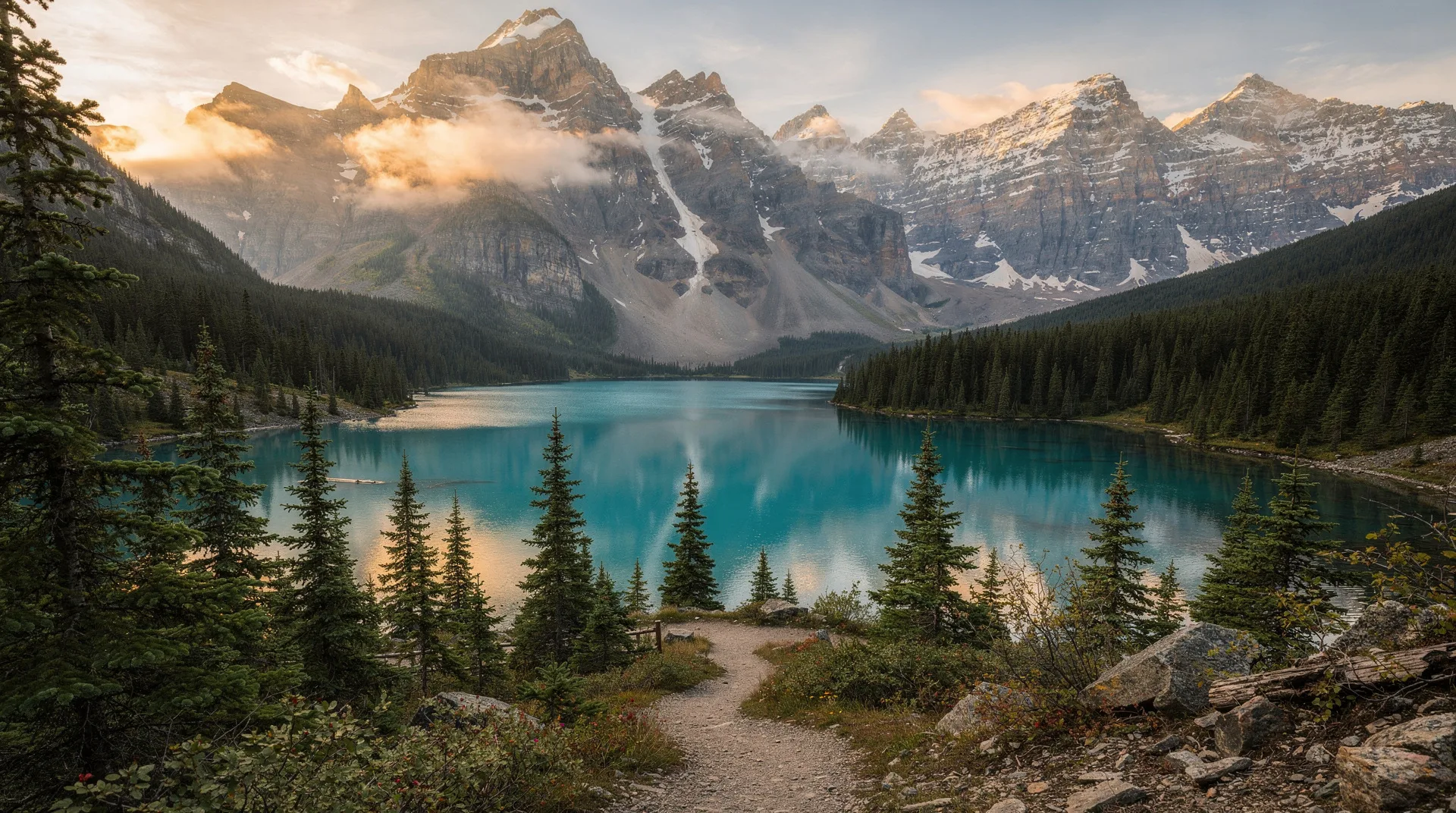
Kathleen Lake campground serves as an excellent base for this and several other trails in the southern portion of the park. The lake itself, fed by glacial meltwater, has a distinctive turquoise colour in midsummer.
Dezadeash Lake and the front country
For visitors who prefer less demanding terrain, the Dezadeash River and Dezadeash Lake area near Haines Junction provides gentle hiking through boreal forest and open valley terrain with reliable wildlife viewing. The Dezadeash River Loop is a half-day circuit through willow and spruce forest with excellent birding in spring and early summer. In winter, this area is used for cross-country skiing and snowshoeing.
Kluane Lake itself — the largest lake entirely within the Yukon — sits along the Alaska Highway and provides a dramatic foreground for the mountains behind. A small boat launch at Destruction Bay allows canoe and kayak access, though the lake is subject to sudden, powerful winds that can create dangerous conditions quickly.
The geology of the St. Elias Mountains
Understanding Kluane requires a brief detour into plate tectonics. The St. Elias Mountains are among the youngest major mountain ranges in the world, actively rising as the Pacific Plate subducts beneath North America. The geological violence that creates such extreme topography — mountains rising from near sea level to over 5,000 metres within 100 kilometres — is ongoing. Earthquakes are common in the region; a significant seismic event in 2002 triggered landslides visible from the highway for years afterward.
The icefields that cap the range are a direct consequence of the mountains’ height and position: moist Pacific air masses rise and cool against the St. Elias wall, dumping enormous snowfall at altitude. The accumulation over millennia has created an icefield system comparable in extent to many found in polar regions. The ice is receding — the Kaskawulsh Glacier’s terminus has retreated several kilometres over the past century — but remains one of the most extraordinary glacial environments accessible to visitors.
Practical realities of visiting Kluane
Kluane is remote, and its remoteness is the point — but it demands genuine preparation. Mobile phone coverage is essentially absent in the park. There are no services within park boundaries; everything comes from Haines Junction or Whitehorse. Fuel, food, and any specialised gear must be acquired before entering the park. Parks Canada requires registration for all overnight backcountry travel, and bear canister use is strongly recommended or required on many routes.
Weather changes rapidly and can be severe even in summer. Snowfall is possible at any elevation above treeline throughout the hiking season. Temperatures that start at 20°C in the valley can drop to near freezing at alpine elevations in the same afternoon as a storm system moves through. Clothing layers, waterproof gear, and emergency bivouac capability are not optional items for anyone venturing beyond the front country.
Bear safety is non-negotiable. Grizzly bear density in Kluane means encounters are a realistic possibility on any backcountry route. Carry bear spray, know how to use it, make noise on trails, and store food and scented items correctly. Parks Canada’s visitor centre staff provide current wildlife activity information and will flag high-risk areas before any backcountry departure.
Haines Junction: the gateway town
Haines Junction sits at the confluence of the Alaska Highway and the Haines Road — the route south to Haines, Alaska and the ferry network of the Inside Passage. With a population of under 600, it is a genuine northern settlement rather than a tourist town, but it has the essentials: the Parks Canada Kluane National Park and Reserve visitor centre (open May through September, essential stop for maps, trail conditions, and registration), the Raven Hotel, Da Ku Cultural Centre (run by the Champagne and Aishihik First Nations with excellent programming on the Indigenous history of the region), and a small number of restaurants and outfitters.
The Champagne and Aishihik First Nations and the Kluane First Nation are the Indigenous peoples whose traditional territory encompasses the park. The park is formally a National Park Reserve in recognition of ongoing land claim negotiations with these nations, and their cultural relationship to the land — the traditional harvesting of fish, game, and plants within the area — is integral to understanding the place. The Da Ku Cultural Centre in Haines Junction provides essential context.
When to visit Kluane
May: Wildlife is highly active. Grizzly bears are emerging from dens, Dall sheep lambs are appearing on the slopes, and migratory birds are arriving. Snow is still present above treeline and many hiking routes are not yet passable, but the valley floor trails are open and wildlife density is exceptional.
June to July: Full hiking season opens. Long days (up to 20 hours of usable light near solstice) allow extended outings. Wildflowers peak in late June. Glacial streams are at their highest from snowmelt — factor this into any route planning.
August to September: Increasingly reliable weather, lower water levels, fall colours beginning in September. Bears are feeding heavily on berries in preparation for winter and are very active. Fewer visitors than midsummer. September can see early snowfall at elevation.
October to April: The park is effectively a wilderness winter environment. The Alaska Highway remains open but the visitor centre closes, trailheads may be inaccessible, and backcountry travel requires full winter expedition preparation. Cross-country skiers and experienced winter campers visit; it is not suitable for general tourism.
Seasonal extras are worth building into your timing. Summer visitors can read about the midnight sun in the Yukon to plan very long days outdoors, while winter travellers often pair the region with the northern lights in the Yukon or try dog sledding in the Yukon instead of hiking.
Getting to Kluane
The Alaska Highway connects Whitehorse to Haines Junction in approximately two hours (158 kilometres). Driving is the standard approach; there is no public transport to or within the park. Most visitors base themselves in Whitehorse and make Kluane a day trip or overnight excursion, though spending multiple nights in Haines Junction or at Kathleen Lake campground allows a more thorough exploration.
Book guided Yukon wilderness tours departing from WhitehorseFrom the south, the Haines Road connects Haines Junction to Haines, Alaska (a 231-kilometre drive through spectacular mountain scenery), where ferry connections to Juneau and other Inside Passage ports are available. This makes a loop possible: fly into Whitehorse, drive to Haines Junction and Kluane, continue to Haines, ferry to Juneau or Skagway, and return via the Klondike Highway — a classic Yukon circuit.
Because a vehicle is essential, read the Canada car rental guide before booking, and the Inside Passage ferry guide if the Haines loop appeals. Travellers who want more northern road-trip ideas can look at the Dempster Highway or the White Pass and Yukon Route for a gentler, scenic contrast to Kluane’s rugged terrain.
Where to stay near Kluane
Kathleen Lake Campground (Parks Canada, within the park): The best base for serious hiking. 41 sites, flush toilets, no hookups. First-come, first-served. The lake setting is exceptional and several major trails start nearby.
Haines Junction has a handful of accommodation options including the Raven Hotel and several bed-and-breakfast operations. Book well in advance for July and August, when rooms are regularly unavailable at short notice.
Wilderness lodges: Several operator-run lodges in the Haines Junction area offer guided experiences including flightseeing, hiking, and wildlife watching as part of all-inclusive packages. These fill early in the season.
Frequently asked questions about Kluane National Park and Reserve
Can I visit Kluane as a day trip from Whitehorse? Yes — the Sheep Creek/Kaskawulsh trail and the front range areas near Kluane Lake are accessible as long day trips. Two hours each way from Whitehorse is manageable. However, you will want at least two nights based in the area to properly explore the park’s hiking without rushing.
Is the Kaskawulsh Glacier hike suitable for beginners? The route is long (30 km return) and involves stream crossings that can be challenging, but there is no technical climbing involved. Fit hikers with appropriate footwear and full-day preparation can complete it. It is not suitable for casual day walkers unprepared for sustained mountain terrain.
Do I need permits for backcountry camping? Yes. All overnight backcountry travel requires registration with Parks Canada and payment of a backcountry permit fee. This is done at the visitor centre in Haines Junction.
How does Kluane compare to Kluane Lake and the front-country viewpoints along the highway? The Alaska Highway pull-offs around Kluane Lake and Sheep Mountain give a strong sense of the park’s scale for free, without a permit or a flight — good for travellers with only a few hours. Reaching the glaciers and the true interior, whether by the Kaskawulsh trail or flightseeing, is a different level of commitment in time and preparation.
Is Kluane a good stop if I am also visiting Jasper or Banff on the same trip? It can be, but treat them as two separate, non-overlapping experiences rather than a single itinerary. See the Canadian Rockies guide for planning a Rockies leg; Kluane requires its own dedicated days in the Yukon and should not be squeezed into a single big loop unless you have a generous timeline.